Showing posts with label greece. Show all posts

Saturday, January 10, 2015

April 25, 404 BC – Athens Defeats Sparta


After more than a quarter century of warfare with their ancient rival Sparta, the whole of Greece became unified under Athenian leadership. The two city-states had often been at odds while carrying a begrudging respect for one another, particularly in their battles against Persian invasion. At Marathon in 490 BC, Athens defeated a Persian landing force in a downhill charge that annihilated the Persians before the Spartans could arrive. Ten years later, at Thermopylae, the Spartan Leonidas led an epic defense that stalled the Persian army while the Athenian general Themistocles destroyed the Persian fleet at Salamis. Further allied victories against Persia drove the empire back to Asia Minor.
The city-states grew in power, and their rivalry turned to all-out warfare. They traded victories and defeats until both sides were exhausted in 421 BC. Sparta and its allies had powerful land-based armies, conquering Attica, the region around Athens, time and again. Each siege lasted only a few weeks, however, as the Spartan army had to return to keep the helot slave population in check. Athens, meanwhile, maintained a vast empire of islands through its democratically supported navy.  A peace treaty was proposed and signed by Spartan general-kings and Athenian politicians, led by the strategos (elected general) Nicias. Both sides vowed to uphold it for fifty years. It took less than seven years for the war to resume when Athens’s ally in faraway Sicily, Segesta, called for military aid against Syracusan attack.

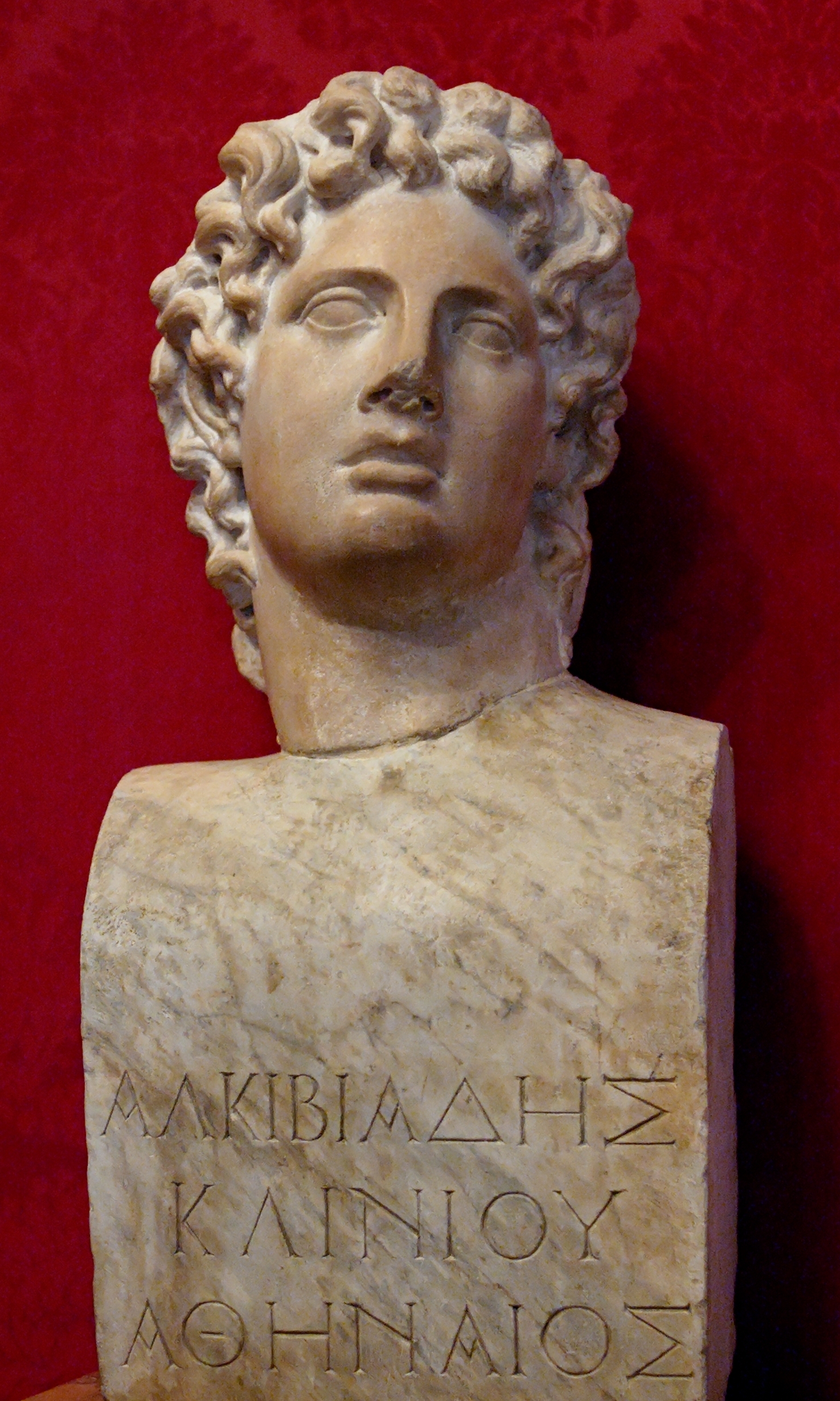
The young Athenian leader Alcibiades championed the campaign to support them. Syracuse was the most powerful of the Greek colonies on Sicily, a land rich with grain and trade. If they conquered it, the Athenians could bring many other cities into their Delian League, perhaps enough to overwhelm Sparta. He had supporters such as enthusiastic Lamachus, but others opposed starting a new war, especially Nicias, who had prompted peace years before. In an energetic speech, Nicias outlined the vast resources Athens would have to expend to even attempt a conquest of wealthy, powerful Sicily. The speech backfired, invigorating the assembly into voting to send those soldiers and ships with hopes of seizing rich new colonies. Nicias himself was voted to be among the commanders, along with Alcibiades and Lamachus.

Just before the fleet sailed, hermai all over the city were desecrated. Marker stones dedicated to Hermes, god of luck and travel, were venerated in Athens as they not only had religious significance but also established boundaries, gave directions, and served as meeting places. Alcibiades and his cronies were blamed, primarily by Nicias and others who opposed the brash young Athenian. Alcibiades requested a trial to prove his innocence, but the request was denied.

Rather than wait and be recalled once his opponents who stayed behind to have the ear of the assembly, Alcibiades threw himself into his own trial. For hours, he debated with himself, waiting for his accusers to appear. His theatrics did gather a crowd, and eventually a quorum determined that he was innocent. His embarrassed political foes dropped the issue.

Upon arriving in Sicily, Alcibiades led the army, balancing Nicias’s conservatism with Lamachus’s eagerness to attack Syracuse head-on. The first battle in 415 BC proved a new stalemate as the Athenian infantry put the Syracusans to retreat, but the massive Syracusan cavalry kept the Athenians from pursuit. That winter, the Athenians completed a wall to siege the city, making cavalry ineffective, and Syracuse surrendered. Using the victory to his advantage, Alcibiades rapidly moved from city to city gaining allegiance from their Greek leaders, first in Sicily and then in southern Italy.

Within a few years of campaigning and diplomacy, the Athenian Empire had nearly doubled in size. Sparta’s position as leader of the oligarchies of Greece waned, and more city-states followed the Athenian model of populace-rule. Alcibiades masterminded a new war with Sparta, baiting them into an attack that was painted as imperialistic to the other Greeks. After the defeat and forced installation of democracy into Sparta, the first great threat to Athens came from the north as expansionistic Macedonians marched. Using the full weight of its empire, such as effective Sicilian cavalry, Athens countered the Macedonian assault and turned it into a client state.

In the coming century, Athens would face other incursions from growing powers. Romans from central Italy threatened allies in the south, requiring counterattacks again and again. Athens also faced rivalry in Sicily from growing Carthaginian influence, which prompted the outright conquest of the once-Phoenician colony. Persia continued its rule in the east, regularly fighting over cities in western Asia Minor with large Greek populations and losing Egypt after a rebellion with Athenian support. For centuries, Athens served as a political and intellectual capital of the world, attracting geniuses such as Archimedes and Hiro. Ultimately decadence caused the democratic Athenians to collapse, leaving a power vacuum in the Mediterranean that would last until Hunnish invasion.


--

In reality, Sparta won the Peloponnesian War. Alcibiades left without having a trial and was recalled immediately upon arrival. He fled out from under arrest and made his way to Sparta, where he served as a military adviser recommending reinforcement of Syracuse. The Athenian expedition to Sicily proved to be ruinous, devastating Athenian manpower and money just as Nicias had feared and ultimately leading to Spartan superiority in Greece. Alcibiades later returned to Athens, then to Persia, then back to Athens, and finally was slain in Thrace surrounded by mistresses. Spartan domination of Greece rapidly declined over the next decades, ended in conquest by Macedonian king Philip II, father of Alexander the Great.

Thursday, June 28, 2012

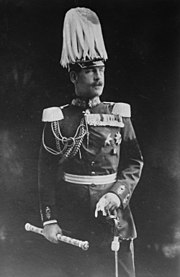
June 12, 1917 – King Constantine of Greece Approves Declaration of War Against the United States


As the Great War erupted in Europe in 1914, the nation of Greece became caught in the middle.  Greece had won its independence in 1830 after nine years of war with the Ottoman Empire, which had ruled the southern Balkans for centuries.  The new kingdom grew as Britain returned the Ionian Islands in 1864 and the Ottomans ceded Thessaly in 1881.  Further gains were made in the Balkan Wars in the early twentieth century, winning Greek occupation for Macedonia.  These wars made great gains for the Balkan League but ended up destroying trust as Serbia and Greece made a secret division of spoils, spurring Bulgaria to declare war against its former allies.  Serbians continued to struggle with the Austro-Hungarians, leading to the assassination of Archduke Ferdinand in Sarajevo and the beginning of war over almost all of Europe.

Greece itself became divided.  King Constantine, backed by his German wife Queen Sofia, argued for neutrality, which would benefit the Central Powers with free ports to take in supplies for the war effort.  Prime Minister Eleftherios Venizelos suggested joining the Entente, noting the necessity of Allied operations in the region against Bulgaria and the Ottoman Empire.  If the Greeks did not work with the Allies, he believed they would force cooperation with a blockade by the powerful navies of the British and French, devastating the peninsular kingdom (he noted, “One cannot kick against geography!”).  In 1915, the Entente began plans to take the Dardanelles, and Venizelos noted the opportunity to support what he saw as the eventual victors of the war.  Constantine refused, causing Venizelos to resign February 21.  Elections in August quickly put Venizelos back into office upon the promise of keeping neutrality, but, by October, Venizelos stated that Bulgaria’s invasion of Serbia would prompt him to join with the Allies due to their Serbian treaty.  An Allied expedition to liberate Serbia arrived at Thessaloniki, causing a final division between the King and Prime Minister.

Constantine determined to use his constitutional power as monarch to dismiss the government and call for new elections.  However, reflecting on the division of his peoples and Venizelos’ clear popularity, he decided a different action:  declaring war on the invading Allies.  He arrested Venizelos and many of his supporters, placing them under guard as political prisoners until the nation was secure.  The Allied army, which had been divided as the French attempted to march forward alone and were rebuffed by the Bulgarians, was caught and proceeded to retreat.  The action doubled the embarrassment of the Allies as it coincided with the failure and evacuation of the Gallipoli Campaign, effectively ending Allied activity in the region.  Diplomats in 1916 hurried to prompt Romania into the Entente with promises of immense territorial gains, but heavy losses to Central victories in 1917 forced them out of the war with the Treaty of Bucharest.  Russia, too, had fallen due to internal revolution, and the Eastern Front became quiet.  Bulgaria worked to relieve its own internal struggles from dissatisfaction among the soldiers fighting a war alongside Muslim Ottomans against fellow Orthodox Christians.

Greece, meanwhile, struggled against the Allied blockade.  Cities were bombarded, but shoreline defenses and sabotage proved effective counterattacks.  Well-armed resistance fighters made attempts at occupation impossible, turning to bloodbaths akin to Gallipoli.  The British Navy was stretched thinly, allowing a good deal of food and materiel to be smuggled between Central nations, relieving much of the tension of the Turnip Winter of 1916-17 from Germany.  America came into the war April 6, 1917, and Greece eventually declared war, following the actions of the other Central Powers.  By this time, most populations had become disgusted with the war.  France had faced mutinies among its soldiers with more than 20,000 soldiers court-martialed.  Emperor Charles I of Austria had attempted to sue for peace through secret negotiations shortly before the fall of Russia, causing a diplomatic catastrophe among the Central Powers.

In 1918, the Allies launched aggressive advances along their remaining fronts in France and the Jordan Valley.  The Ottoman Empire was clearly crumbling, though the Balkans held in the midst of blockade.  In the West, however, German offenses had run out of steam, and Allied counteroffensives pushed back with such force that the end seemed near.  Still, they held Eastern Europe, and the decision was made to push through another winter after the Americans had rejected suggestions of an armistice.  The Germans were pushed back through Belgium in as organized of a retreat as the German High Command could muster.  At sea, convoys and submarine-hunters gradually extinguished the threat of u-boat attack.  As another campaign season approached with the spring, German Chancellor Prince Maximilian of Baden finally accepted American President Wilson’s Fourteen Points, and the Americans led peace-talks beginning in 1920.

While French diplomats argued vindictively, Germany’s delegation stood much of their ground despite losing their overseas colonies.  Wilhelm abdicated in favor of his son, Wilhelm III, who had been noted as opposing the war.  Austria-Hungary was broken apart along with the Ottoman Empire.  The Germans led international intervention into the former Empire of Russia, breaking it asunder as well by granting independence to previous client states such as the Ukraine and stymieing attempts at domination by soviets.

For its part in the war, Greece was mildly punished with reparations that weakened its economy in the long term.  Alongside the struggling Greek economy, nationalism expanded as Greeks and Turks fled one another’s countries in a population exchange of more than two million.  Hardening conservatism battled with socialist ideals, but the King of the Hellenes has maintained a sense of stability in the nation.


--

In reality, King Constantine only dismissed Venizelos.  The National Schism erupted as Entente-supporters set up a new government in the north alongside the Allied expedition on the Macedonian front.  Constantine abdicated in 1917 after threats of bombardment, and Kaiser Wilhelm announced to his soldiers, “The collapse of the Macedonian front has occurred in the midst of the hardest struggle.  In accord with our Allies I have resolved once more to offer peace to the enemy.”  The resulting Treaty of Versailles awarded Greece Smyrna in Turkey as reward for participation in the war, which ignited the Greco-Turkish War in 1919.  Humiliated by the new republic of Turkey, Greece dethroned its king and collapsed into near-anarchy with 23 changes of government from 1924 to ’35.  After royal restoration and being an integral Ally in World War II, Greece again fell into chaos during the Cold War as nationalists and communists fought in the Greek Civil War.  A new republic in 1975 turned to quasi-socialism, joining the EU in 1981 and receiving massive investment, though inability to repay loans sparked a debt crisis in 2009.

Site Meter