Showing posts with label slavery. Show all posts

Thursday, December 30, 2021

June 2, 1816 - Bolívar Plans Universal Emancipation

Simón Bolívar, who would become known as El Libertador, returned to South America after yet another reversal of fortunes. Bolívar had been born to a wealthy family that lived in luxury thanks to slave labor in mines and plantations outside of Caracas. Bolívar’s parents had both died when he was young, and he as a boy was placed in the care of Hipólita, a nurse-slave, whom the later wrote served as his mother and father. Bolívar was handed to different tutors and uncles through his later youth, traveling Europe while learning the high ideals of the French Revolution as well as the ascendancy of Napoleon. When his wife died after only one year of marriage, he vowed never to marry again and instead turned his attention to independence for Venezuela.
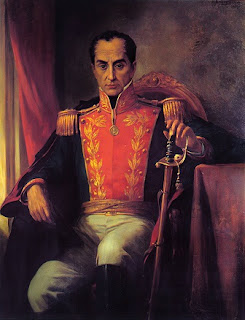
Bolívar lived his philosophical life as a paradox. He quoted Enlightenment writing about the equality of all men, yet he kept slaves and adhered to the strict social structure of birth that ranked him beneath Spanish-born nobles yet above freemen of color. Bolívar considered these social matters and focused his attention on politics, looking to overthrow the crown-appointed officials in favor of elected representatives alongside special hereditary positions.

Upon Napoleon’s invasion of Spain, the colonies were ripe for independence. Juntas and coups broke out in New Granada, but Spanish loyalists were quick to fight back. After serving as a colonel in the First Republic of Venezuela and ending up in retreat to his plantations, Bolívar himself led a campaign in 1813, earning his title of “El Libertador” while marching to establish the Second Republic. He fought on the basis of his “Decree of War to the Death,” vowing to kill anyone who wasn’t an adamant supporter of independence, thus stripping the land of any potential neutrality. By 1814, however, he was fighting fellow republicans, losing momentum against the royalists, and then fleeing to the Caribbean in exile.

After failing to find European support in Jamaica, Bolívar traveled to Haiti and met with President Alexandre Pétion. Bolívar found Haiti a strange and admirable land, the only truly free republic in the world, yet it was thick with racial tension even after the supposed end of social hierarchy with the Rights of Man declared from Paris. Pétion, himself mixed-raced, happily offered aid with 1,000 soldiers and sailors along with weapons and transport on the condition that Bolívar free the slaves of the lands he liberated from Spain. Bolívar readily agreed, though he spent many nights awake pondering how best to do so.

Indebted to Haiti, Bolívar was nevertheless nervous about its sudden upheaval of the social norms. Haiti had won its independence only to turn to civil war between the absolutists maintaining the large plantations in the north under Henri Christophe, who named himself a king, and the troubled democracy in the south where the struggling economy of subsistence farming continued dissidence, prompting Pétion to revise the constitution to make himself an unquestionable President for Life. Bolívar knew he needed to offer liberation to slaves, both African and Native, for honor’s sake. He also needed to support rights of people of color, lest the new republic collapse again as the others had fallen largely due to pardo (mixed-race people) under the command of royalist caudillos like José Tomás Boves. Yet if the social order turned to chaos, he also might lose everything.

Turning to theory for his solution, Bolívar reread his constant companions: Adam Smith’s The Wealth of Nations, the Letters of Voltaire, and Montesquieu’s The Spirit of the Laws. Bolívar needed to preserve the economy from the Wealth of Nations while creating a new government, which could be, according to Montesquieu, a monarchy built on the principle of honor, a republic built on the principle of virtue, or a despotism on the principle of fear. He at last determined to plan a society where honor could be established by means of virtue through service to the state.

Bolívar announced liberation for all slaves who came to serve his campaigns. Men were drafted into the military while women and children worked in support at camps and plantations that had been seized from royalists. As the military victories liberated New Granada, Bolívar pivoted his plans toward keeping up the economy by maintaining the government-owned plantations and mines as major exporting centers where workers elected their foremen and received salaries based on their output. Soon the economy recovered from its struggles, and wealthy landowners found ready competition for labor forces who had ready wages, which attracted men and women of every race.

When Bolívar marched south to liberate Peru and Rio de la Plata, cavalry-commander José Antonio Páez Herrera became the political voice in the new nation of Gran Colombia. Páez held a great deal of popular support but found the new independent government’s position under constant influence of the wealthy and the Catholic Church. Páez, who had grown up the son of a lowly ranked government clerk and literally fought his way to the top, decided to battle them both with expanding the economic opportunities Bolívar’s “virtue” plan had begun through the plantations and mines. Government investment into public works, education, and transportation such as roads, canals, and, later, railroads boosted the middle class while Páez encouraged legal action against the elite whenever they misstepped, such as illegally maintaining slaves or confiscating native land. Mixed-race general José Padilla became an ardent supporter of Páez and rallied the African- and native-descended population to maintain a united Gran Colombia.

Bolívar balked at Padilla, suggesting he threatened to exterminate the upper class, but again Páez was able to maintain peace by balancing one against the other. After Bolívar’s death from tuberculosis in 1830, Páez’s party became the dominant voice in not only Gran Colombia but also through sister-parties in Peru, Bolivia, and Argentina. Gran Colombia would serve as the economic and diplomatic leader of South and Central America as well as much of the Caribbean, proving to be a counterweight against the United States assisting in Spanish colonies gaining independence and joining the Latin Alliance, which itself served as the framework for the United Nations.

--

In reality, Bolívar sought to abolish slavery gradually. Initially, freedom was only granted to male slaves who volunteered to join his army. He then worked in 1819 to end the slave trade and in 1821 to emancipate children born to slaves on their eighteenth birthday. Bolívar did free his own slaves soon after the war, making good on his word. True abolition did not come to most South American countries until the 1850s.

Monday, December 13, 2021

March 11, 1641 - Battle of Mborore Leaves no Bandeiras Alive

https://external-preview.redd.it/16-J0OhPcO9B74GF5ejk7rMxjvceGak7i_dzqzsWues.jpg?width=640&crop=smart&auto=webp&s=0c657f74ab87f2e14e4ceb85288c5274a8ee55a6 

South America was a hotbed of colonial activity in the seventeenth century. Officially the continent was split between Spanish and Portuguese control by edict from the Roman Catholic Church, but the Protestant Dutch made inroads with their own settlements. Striking out from their haven ports, the Dutch acted as pirates, capturing ships and disrupting Portuguese sea traffic. Often cut off from the mother-country, Portuguese Brazil went on its own path of operating plantations worked by thousands of native slaves. With an ever-present need for more slaves, as well as promises of silver and precious stones hidden inland on the continent, adventurers called “bandeiras” made treasure-seeking expeditions. The well-armed bandeiras easily captured natives, the vast majority of whom died on the long journey back to Sao Paulo.

Farther south, a very different path had been ordered by the governor of Spanish Paraguay. Funds and support were dispatched to Jesuit missionaries to establish settlements and evangelize among the native Guarani. Towns were built, and locals readily adopted the European trades, rapidly expanding the economic potential of the region. The missions also offered protection against the slavers since converted natives were technically not to be taken as slaves.

It was not long before the reaches of the Guarani caught the attention of the bandeiras. The Guarani massed near the missions, making for an opportunity to capture masses of slaves in one action. Moreover, the slaves would be valuable in the markets of Sao Paolo and Rio de Janeiro for their skills. Though the bandeiras ignored the laws preventing enslaving Christians, most of the natives followed the law of not carrying weapons. Raids began in 1620, and they increased with such severity that even the natives who weren’t captured fled south, depopulating the region.

The Jesuits and native leaders were determined to fight back. Father Francisco Diaz Tano and other priests traveled to Europe, pressing King Felipe IV to allow natives firearms to defend themselves and Pope Urban VIII to condemn the bandeiras capturing converts. Even before those orders were passed, the governor of Paraguay dispatched reinforcements to the mission defenders and encouraged Guarani to be armed and trained.

Bandeiras parties soon came upon ambushes with well-armed opponents. The hills and forests where natives had been terrified to live now became places of terror for the bandeiras, who were attacked and pursued whenever they were discovered. A group of them took refuge in the remains of a mission near Mborore Mountain that bandeiras had destroyed some time before, and others joined them in an organized defense. More than 4,000 missionaries and Guarani converts marched on the makeshift fort. After a devastating battle, the bandeiras surrendered, pleading with the victors to grant them Christian forgiveness and allow them to flee. Instead, the victors decided swift punishment was due to the slavers and executed them for their crimes.

Months passed in Sao Paulo without word from their bandeiras expeditions to the upper reaches of the Parana River. Rumors trickled back that the natives had begun fighting back, which unnerved the plantations and government, even more so since there were no hard facts to back it up one way or another. The adventurers simply seemed to disappear.

Hard truth did arrive when Father Tano and his fellows returned from Europe with new laws and papal bulls that brought an end to Portuguese incursions into the area. By that point, the Paulistas were happy enough to leave it be.

The Guarani success was a splash that caused ripples all through the continent. Indigenous slavery practically ended within the Spanish realm with numerous uprisings to break the hold of plantation owners. Uprisings took place throughout Brazil, too, sponsored by Jesuits seeking better care and even freedom for those enslaved as well as Dutch adventurers looking to break Portugal’s hold on the region. The economy shifted away from huge plantations seeking cash crops at the expense of workers’ lives to family-run farms and businesses, creating a strong middle class by the eighteenth century. With the arrival of the Industrial Revolution, South Americans were eager to implement modern technology for manufacturing and transport, making the continent one of the major centers of production in the modern world.


--

In reality, the defeated bandeiras escaped to Sao Paulo, where they spread the word of the armed uprising. The plantations and government dismissed Father Tano despite his documents from Europe, going as far as banishing all the Jesuits from the capital. Manuel Pires formed up an army of hundreds of bandeiras and thousands of Tupi warriors who marched to destroy the defenders utterly. Waves of bandeiras from Sao Paulo ravaged the region for years before trained armies of Guarani affirmed their defense of the region. The 1750 Treaty of Madrid moved the border westward, resulting in seven years of guerilla warfare until the last of the Guarani were defeated.

Friday, December 12, 2014

December 2, 1859 – John Brown's War Ends


The largest outbreak of violence over the issue of slavery in the United States erupted in 1859 as abolition-extremist John Brown seized the Federal arsenal at Harpers Ferry, Virginia. Inside the arsenal were 100,000 government firearms, enough for the largest army the continent had ever seen. Brown's agents rushed as much of the weapons as possible to nearby farms, creating enough chaos that wagonloads of munitions went in disparate directions and turned the region into a war zone.

The raid was not the first of John Brown's ends-justify-the-means actions, though it would be his crowning achievement. Born to a Connecticut Puritan family, Brown became an industrious entrepreneur in Ohio before the economic crash following the Panic of 1837 wiped out his businesses. He moved his family, scourged by illness, to Springfield, Massachusetts, where he was touched by the abolition movement and eagerly became a part of the Underground Railroad. When his last bid toward business in the wool industry collapsed, he became enraptured in the cause of abolition, founding the League of the Gileadites to defend, by any means necessary, fleeing slaves from legal capture under laws such as the Fugitive Slave Act. As the Kansas territory opened and Border Ruffians (pro-slavery forces) gathered there to ensure it would not be voted free, Brown rushed to fight, murdering five ruffians at Pottawatomie in 1856, the bloodiest massacre of Bleeding Kansas, and losing a son to the feud.

When calm settled in Kansas, Brown left for the North on a crusade to raise funds for all-out war. He gave lectures to crowds that included writers Henry David Thoreau, Ralph Waldo Emerson, and Bronson Alcott. As word grew, Brown met with wealthy abolitionists, some of whom dispatched weapons to his cause such as 200 breech-loading carbines and 950 pikes. Mercenary Hugh Forbes signed on as well as two dozen volunteers. Harriet Tubman offered to serve but was unable due to illness, while Frederick Douglass refused to join what he correctly thought to be a suicide mission. In fact, this outright violence "would array the whole country against us."

Brown ventured forth nonetheless. His first action was to kidnap George Washington's great-grandnephew Lewis Washington and, more importantly to the cause, seize relics of liberation that were in his possession: a sword given to Washington by Frederick the Great and pistols gifted by Lafayette. They proceeded to cut telegraph wires and capture a passing train, where they killed the black baggage-clerk who tried to stop them. Brown was about to let the train go to spread the word of the uprising when one of his men asked, "Shouldn't we spread our own word?" Brown agreed, the train was disabled, and the men marched on the unsuspecting armory.

Northern Virginia and western Maryland were turned into a warzone. Runners dispatched arms to slave populations scouted out the summer before. Some of the slaves seized the opportunity to fight back, others refused to fight, and many fled and hid to escape the coming violence. Local militia immediately began to counterattack, but Brown proved far more organized and successfully held the arsenal, even sending out more weapons. State and federal officials did not hear about the raid until everyone else did, through panicked or excited telegrams.

As the United States government hurried to assemble a force to march on Brown's holdout, Brown himself received reinforcements as word spread among slaves and abolitionists from the North raced to join. Finally, after days of turmoil, President Buchanan called together Marines and put them under command of cavalry Colonel Robert E. Lee, who had time to dress in his uniform before marching. As they approached the arsenal, Brown's forces retreated, setting fire to everything that hadn't already been emptied.

The small military force was joined by more and more soldiers, and an overall quelling of the uprising was organized by General Winfield Scott. His work was slowed by constant guerilla warfare Brown had learned in Kansas, although he was ultimately betrayed by the surrender by Henry Forbes, who exonerated himself by pointing to a letter he had sent to Secretary of War John Buchanan Floyd. Theories rose up that Floyd, a Virginian, could have prevented the whole thing, making public opinion on the matter one of government failure with Floyd becoming the fall guy, creating the colloquial term "his name is Floyd" for anyone who fails miserably.

Brown was shot during a standoff in the Appalachian Mountains on December 2, and, though there were some actions after, that was considered the end of the rebellion. It became the top matter in the election of 1860, when Senator Stephen Douglas was able to blame the sitting administration, including Vice-President John C. Breckinridge, and rally Deep Southern votes to win the Democratic nomination and then the presidency with Virginian Robert M. T. Hunter, whose home had been in the area of the turmoil, as his vice-president.

While the nation was united against violent uprising in any form, the Abolition Movement virtually collapsed. People did not want to associate with Brown and many abandoned the cause. A dedicated few carried on, finally winning an end to slavery through economic incentive by federal and private grants liberating slaves, which planters used to invest in new farming methods and later factories. Through the Southern Industrial Revolution, the South's tradition as nation's strongest economic region surged.


--

In reality, John Brown let the train go on, expecting word of mouth to be all that was required to start his slave rebellion. Instead, word went straight to the authorities, and little, if anything, was mentioned to the slaves. Militia (many of them railroad workers who had been warned by the train) besieged the arsenal. Lee led the Marines in an assault that killed many of Brown's men and captured him. Upon his execution as a traitor to the United States, he became a martyr to the cause of abolition, written about with glorifying words by men like Thoreau and Alexandre Dumas.

Site Meter