Showing posts with label alternate history. Show all posts

Monday, January 24, 2022

March 3, 1921 - Congress Orders Osage Council for Competency and Guardianship

Word trickled back to tribal headquarters in Pawhuska, Oklahoma, that Congress was again working to rewrite the statutes that defined the rights of Osage tribe members. Once one of the main powers in the Great Plains, the Osage people had been reduced by smallpox epidemics and encroaching settlement on their hunting grounds. While other tribes had been relocated to lands chosen by the federal government, in 1881, the Osage purchased ~1.5 million acres of Indian Territory for a reservation that would maintain special privileges, including the tribe retaining surplus land after allotment and mineral rights being held communally by the tribe.

The issue of mineral rights came to the forefront in 1894 when oil was discovered in their hilly land. Kansas oilman Edwin Foster began speculating after agreeing to pay the Osage 10% of all sales of oil produced on the reservation, which entailed the whole of Osage County. While initially the oil was not much of an impact on the region, the expiration of Foster’s lease in 1916 along with surging demand due to World War I caused a rush. Under the “Million Dollar Elm,” a sprawling elm tree outside of the county courthouse, public auctions were held where oil companies paid enormous sums for leases, setting the world record of $1.99 million for one 160-acre lease.

The leases proved good investments, and exploding oil production prompted boomtowns full of roughnecks to spring up across the county. Crime was rampant, and officials were frequently corrupt. The corruption flowed upward to the federal government, where lobbyists worked to alter definitions of “competency” and require guardianship by court-appointees for Osage tribal members. This often led to white men collecting oil royalties for legally disempowered Osage and pocketing whatever they could.

With another round of laws looking to be passed in 1921 by the new Republican-dominated government, tribal leaders decided to lobby themselves by playing the “white man’s game.” In postwar Washington, that game was bribery. Secretary of the Interior Albert B. Fall, whose department contained the Bureau of Indian Affairs, was notorious for his legal shenanigans long before becoming a senator from New Mexico. Fall defended cattle rustlers and killers in the latter days of the Wild West, including Jesse Wayne Brazel, who gunned down Pat Garrett when the former sheriff had pursued suspects in the murder of Fall’s neighbor.

When palms were successfully greased, new laws pertaining to the Osage tribe granted recognition of the tribal council, which had been dissolved in 1889, reinstated in 1906, and dissolved again. The council received rights to maintain tribal rolls and issue their own certificates of competency with Secretary Fall endorsing the agreement as a saver of department resources better allocated to managing federal lands, such as the Naval Reserve at Teapot Dome, Wyoming. When Fall’s efforts to maneuver leasing the reserves to oil companies were discovered, along with numerous other scandals in the Harding administration, blame shifted around Washington in every direction. The Osage, meanwhile, stepped back into their degree of self-government out of Pawhuska.

Through the 1920s, even more money surged into the region. In 1926 alone, a single tribal citizen could expect more than $16,000 in royalty money ($240,000 in 2020 dollars). By 1939, more than $100 million had been dispersed to the Osage. There were numerous attempts to steal headrights by marriage and inheritance after murder, but the local courts had been cleansed of corruption by tribal votes and were swift to deal with such matters. Instead, the Osage spent their income on travel, education, and luxuries with Pawhuska hosting the first Rolls Royce dealership west of the Mississippi.

After seeing the decadence and collapse of the 1920s into the Great Depression, tribal members decided to put their wealth to more long-lasting investments. Much of the country dragged on economically, but Osage County became a center of construction and local industry. The five-mile Osage Canal project expanded the Arkansas River to make it navigable to shipping up to Hominy in the southern part of the county, which became the focus of agricultural and petroleum exchange for the entire region, ultimately outpacing Tulsa to the southeast.

Riding the wave of the Golden Age of Hollywood, Osage investment in film caused it to become a center for television and indie film production that grew substantially with the end of the Studio System in the 1960s. The need for knowhow in electronics prompted the founding of Osage Institute of Technology (Osage Tech), the MIT of the Midwest, which later became one of the centers of the Internet with Osage Hills rivaling many of Silicon Valley’s startups.


--

In reality, Congress passed an act enforcing guardianship and maintaining direct authority through the Secretary of the Interior’s office. In addition to guardianship schemes, dozens if not hundreds of murders were carried out in the Reign of Terror in 1921-1926. Laws were then changed to prevent headrights from going to anyone without more than half native ancestry.
Thursday, December 30, 2021

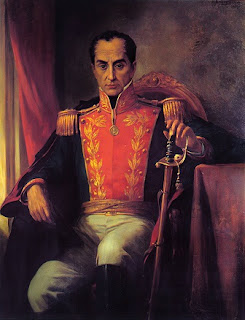
June 2, 1816 - BolĂ­var Plans Universal Emancipation

SimĂłn BolĂ­var, who would become known as El Libertador, returned to South America after yet another reversal of fortunes. BolĂ­var had been born to a wealthy family that lived in luxury thanks to slave labor in mines and plantations outside of Caracas. BolĂ­var’s parents had both died when he was young, and he as a boy was placed in the care of HipĂłlita, a nurse-slave, whom the later wrote served as his mother and father. BolĂ­var was handed to different tutors and uncles through his later youth, traveling Europe while learning the high ideals of the French Revolution as well as the ascendancy of Napoleon. When his wife died after only one year of marriage, he vowed never to marry again and instead turned his attention to independence for Venezuela.

BolĂ­var lived his philosophical life as a paradox. He quoted Enlightenment writing about the equality of all men, yet he kept slaves and adhered to the strict social structure of birth that ranked him beneath Spanish-born nobles yet above freemen of color. BolĂ­var considered these social matters and focused his attention on politics, looking to overthrow the crown-appointed officials in favor of elected representatives alongside special hereditary positions.

Upon Napoleon’s invasion of Spain, the colonies were ripe for independence. Juntas and coups broke out in New Granada, but Spanish loyalists were quick to fight back. After serving as a colonel in the First Republic of Venezuela and ending up in retreat to his plantations, BolĂ­var himself led a campaign in 1813, earning his title of “El Libertador” while marching to establish the Second Republic. He fought on the basis of his “Decree of War to the Death,” vowing to kill anyone who wasn’t an adamant supporter of independence, thus stripping the land of any potential neutrality. By 1814, however, he was fighting fellow republicans, losing momentum against the royalists, and then fleeing to the Caribbean in exile.

After failing to find European support in Jamaica, Bolívar traveled to Haiti and met with President Alexandre Pétion. Bolívar found Haiti a strange and admirable land, the only truly free republic in the world, yet it was thick with racial tension even after the supposed end of social hierarchy with the Rights of Man declared from Paris. Pétion, himself mixed-raced, happily offered aid with 1,000 soldiers and sailors along with weapons and transport on the condition that Bolívar free the slaves of the lands he liberated from Spain. Bolívar readily agreed, though he spent many nights awake pondering how best to do so.

Indebted to Haiti, BolĂ­var was nevertheless nervous about its sudden upheaval of the social norms. Haiti had won its independence only to turn to civil war between the absolutists maintaining the large plantations in the north under Henri Christophe, who named himself a king, and the troubled democracy in the south where the struggling economy of subsistence farming continued dissidence, prompting PĂ©tion to revise the constitution to make himself an unquestionable President for Life. BolĂ­var knew he needed to offer liberation to slaves, both African and Native, for honor’s sake. He also needed to support rights of people of color, lest the new republic collapse again as the others had fallen largely due to pardo (mixed-race people) under the command of royalist caudillos like JosĂ© Tomás Boves. Yet if the social order turned to chaos, he also might lose everything.

Turning to theory for his solution, BolĂ­var reread his constant companions: Adam Smith’s The Wealth of Nations, the Letters of Voltaire, and Montesquieu’s The Spirit of the Laws. BolĂ­var needed to preserve the economy from the Wealth of Nations while creating a new government, which could be, according to Montesquieu, a monarchy built on the principle of honor, a republic built on the principle of virtue, or a despotism on the principle of fear. He at last determined to plan a society where honor could be established by means of virtue through service to the state.

BolĂ­var announced liberation for all slaves who came to serve his campaigns. Men were drafted into the military while women and children worked in support at camps and plantations that had been seized from royalists. As the military victories liberated New Granada, BolĂ­var pivoted his plans toward keeping up the economy by maintaining the government-owned plantations and mines as major exporting centers where workers elected their foremen and received salaries based on their output. Soon the economy recovered from its struggles, and wealthy landowners found ready competition for labor forces who had ready wages, which attracted men and women of every race.

When BolĂ­var marched south to liberate Peru and Rio de la Plata, cavalry-commander JosĂ© Antonio Páez Herrera became the political voice in the new nation of Gran Colombia. Páez held a great deal of popular support but found the new independent government’s position under constant influence of the wealthy and the Catholic Church. Páez, who had grown up the son of a lowly ranked government clerk and literally fought his way to the top, decided to battle them both with expanding the economic opportunities BolĂ­var’s “virtue” plan had begun through the plantations and mines. Government investment into public works, education, and transportation such as roads, canals, and, later, railroads boosted the middle class while Páez encouraged legal action against the elite whenever they misstepped, such as illegally maintaining slaves or confiscating native land. Mixed-race general JosĂ© Padilla became an ardent supporter of Páez and rallied the African- and native-descended population to maintain a united Gran Colombia.

BolĂ­var balked at Padilla, suggesting he threatened to exterminate the upper class, but again Páez was able to maintain peace by balancing one against the other. After BolĂ­var’s death from tuberculosis in 1830, Páez’s party became the dominant voice in not only Gran Colombia but also through sister-parties in Peru, Bolivia, and Argentina. Gran Colombia would serve as the economic and diplomatic leader of South and Central America as well as much of the Caribbean, proving to be a counterweight against the United States assisting in Spanish colonies gaining independence and joining the Latin Alliance, which itself served as the framework for the United Nations.

--

In reality, BolĂ­var sought to abolish slavery gradually. Initially, freedom was only granted to male slaves who volunteered to join his army. He then worked in 1819 to end the slave trade and in 1821 to emancipate children born to slaves on their eighteenth birthday. BolĂ­var did free his own slaves soon after the war, making good on his word. True abolition did not come to most South American countries until the 1850s.

Sunday, December 19, 2021

December 19, 1675 - Narragansett Victory in Great Swamp Fight

With the arrival of the first English settlers in 1620, a new player with steadily growing power came into the complex politics of the “New England” region. It was already home to several tribes, including the Wampanoags, who had served as allies with the English. Their sachem (“high chief”) Massasoit worked tirelessly to maintain peace in a land ravaged by disease and strained resources, balancing his own power with that of the English and the Narragansetts to the south. Following Massasoit’s death, his voice of peace faded, and his youngest son Metacom arrived as sachem with a plan to reestablish Wamanoag authority in the face of the English and end an era of broken treaties, theft, oppressive laws ordering native disarmament, and executing natives under colonial jurisdiction rather than native law.


Raiding began in the summer of 1675 in what the English called “King Philip’s War” after Metacom’s Christian name. Metacom organized attacks on Swansea, Dartmouth, and Springfield. Colonists fled to the fortified ports, and farmers worked to harvest and transport their wagons under the watch of militia. The United Colonies of New England pooled their defenses while other players, such as the Colony of New York and the Narragansetts, struggled to maintain neutrality.

When winter approached, the Wampanoags retreated toward the frontier between New York and New England as well as seeking shelter among the Narragansetts. Colonists remained nervous, and despite the Treaty of Neutrality between the Massachusetts Bay Colony and Narragansetts signed that October, the colonists decided to make a preemptive attack on the Narragansetts in Rhode Island before the war would likely expand next spring. Governor Josiah Winslow assembled over 1,000 troops, including allies from the Pequot and Mohegan tribes.

The military action proved the warning cries of Metacom, which he had spread among the neighboring tribes. Using the example of the Mystic River Massacre, Metacom’s diplomats had argued that there was no long-term solution that would allow for survival for tribes while the colonies continued to grow. In 1637 during the Pequot War, colonists and Pequots battled one another with raids on trading. A militia led by Captain John Mason sieged a Pequot fortification with wooden palisades and set the village inside on fire. Those trying to escape the flames over the palisades were shot as they appeared. Of the hundreds of men, women, and children in the village, only five escaped.

Metacom’s storytellers had visited the Pequot, Mohegan, Narragansetts, and Mohawk of New York, stirring those who distrusted the colonists. While there were many natives who had converted to Christianity (known as “praying Indians”), the stories swayed many of those who had been undecided in allegiance. Word from spies among the Pequot gave the Narragansetts advance warning about the colonial attack, which planned to cross the frozen defensive moat for a direct assault. Narragansett warriors spent the night before the attack drilling small holes in the ice of the moat, making it so that only a few men could walk on it at a time. When the militia marched over the ice, they were caught by surprise when it suddenly gave way beneath them after enough troops marched onto it. The Narragansetts then charged out from the village, wiping out many of the militia and sending the rest to retreat in disarray.

In the spring of 1676, attacks by the natives resumed with new allies that included more than 2,000 Narragansett warriors under Canonchet. These marched on Providence, Rhode Island Colony’s capital, and burned it. Metacom swept through southern Massachusetts while guerilla warfare scattered settlers in the northern reaches of Massachusetts called Maine. Colonists went into disarray, many boarding overcrowded ships to sail south and others working to fortify their towns. A delegation traveled to London to appeal for military aid, but the court of Charles II was battle-weary from the Third Anglo-Dutch War and far too concerned with internal religious strife.

The colonists at last sued for peace. A permanent border was set at the Blackstone River for the rump Massachusetts Colony, which absorbed the remains of Rhode Island and New Hampshire. An allied Algonquian Nation formed among the Abenaki and others, ranging from southern ports on Narragansen Bay and stretching north to New France on the St. Lawrence River, bordering Connecticut and New York. Through Metacom’s contacts with the Mohawk and western Algonquins, he served as a mediator to secure a growing alliance that came to rival French and English in the region. English colonists preferred to settle southward, challenging Spanish control, while French interest in the western hemisphere faded when the fur trade died out.

The spirit of Metacom’s native alliance continued beyond the French interest, which had long supplied weapons and manufactured goods to the growing nation. Periodic wars with the English continued, but natives were always able to find new allies among the Dutch or Spanish to until they became self-sufficient with their own foundries and ports. Today North America is a patchwork of native countries with economic focus along the St. Lawrence/Great Lakes region, where a free-trade agreement keeps the waterways busy with craft from the Algonquin, Odawa, Mississaugs, Chippewa, and Iroquois.

--

In reality, the battle was a New England victory, described by James Drake as “one of the most brutal and lopsided military encounters in all of New England's history.” Once the militia crossed the frozen-over moat without issue, they stormed the fortifications and utterly destroyed the village. Following Wampanoag defeat by Mohawk in New York, battles through the latter part of the war went largely to the New Englanders, who killed Metacom at Mount Hope in 1676 and hung his head at Plymouth until 1701. By the end of the war, much of the native population had died, fled, or were sold as slaves to Bermuda.

Site Meter