Monday, January 31, 2011

January 31, 1876 – Grant Extends Indian Reservation Deadline

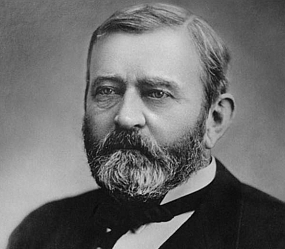
In a move that prevented open war across the Northern Plains, President Ulysses S. Grant issued an executive order extending the deadline set previously for all Native Americans to return to their reservations. The initial date for the deadline had been carefully calculated two months before by Grant and his generals Philip Sheridan, commander of the Division of the Missouri, and George Crook, commander of the Department of the Platte, to be unreachable by the Indians, who had settled into their winter quarters. When the Indians did not move (General Sheridan noted that the Indians would not move no matter the date, though Lakota leaders had already decided they would travel to the agencies that spring), they would march troopers into the Indian camps and force them into submissive positions on the reservations.

The matter at the core was gold. White encroachment on Indian lands had gone on for decades, and the Indians had gradually migrated and dealt with the growing White settlement. Several wars had raged, but none were as large as the surprise attack Sheridan and Crook were planning to clear the Indians quickly and effectively out of the Black Hills, where gold had been discovered by the Custer Expedition in 1874. A gold rush was in full sway and expected to boom. The Federal government had ended stopping trespassers onto the Sioux hunting grounds as an initial part of the plan and offered to pay the tribes $25,000 and reservations south in Indian Territory. Spotted Tail summarized the feelings of the Sioux leaders who had traveled to Washington with, “You speak of another country, but it is not my country; it does not concern me, and I want nothing to do with it. I was not born there.”

Yet, the land was needed both to open for the glut of would-be miners following the Panic of 1873 as well as for railroad projects. Grant had previously reversed the objectives of the Federal government, which had been anti-Indian since its founding. Johnson’s order to General Sheridan years before about the Cheyenne and Arapaho had been, “I want you to go ahead, kill and punish the hostiles, capture and destroy the ponies.” Grant later confronted Congress on the policies, saying, “Wars of extermination are demoralizing and wicked” and “A system which looks to the extinction of a race is too horrible for a nation to adopt without entailing upon itself the wrath of all Christendom.” Despite his advances in upholding treaties, in his second term the question of the Black Hills had turned him to the same policies he had derided.

In late January, a telegram from the US Indian Agent at Standing Rock reached the president, saying that his requests to extend the deadline had been repeatedly denied despite that travel in the midst of winter was impossible. He noted that any God-fearing, decent man would be reasonable rather than start a war, and Grant felt his spark of conscious. The Whiskey Ring scandal that had implicated his secretary Orville E. Babcock had destroyed Grant’s popularity among Republicans, and he decided that acting in favor of the Indians could not do any more damage, saying famously, “If I’m going to be unpopular, I might as well do the right thing.”

In spring of 1876, the majority of the Indians came to their reservations as had been agreed. Sheridan and Crook were allowed to mop up the stragglers and then ordered to maintain some kind of peace amid the Indians and the swarms of prospectors centering on Deadwood. Methods of herding the remaining buffalo were organized by the Sioux and government agents, who finally were able to work a deal for the Northern Pacific Railroad giving the Indians a toll based on transport. When the gold began to give out, the prospectors deserted, and the Sioux gradually came back into control over much of the area. Conservationist Theodore Roosevelt hunted the buffalo in 1893, and his political actions back East helped give funding to rebuilding the Northern Buffalo Herd, which had been barely saved from the extinction that had struck the Southern.

Despite decades more of politics and needless violence, the White and Native Americans gradually learned to live alongside one another, perhaps best exemplified by the peaceful demonstrations at Wounded Knee in 1890 where invited government officials understood the severity of breaking up the Great Sioux Reservation and determined to honor the previous treaty.


In reality, the request for extension was firmly denied. The Great Sioux War began, leading to nearly double the casualties of American soldiers as Sioux (such as in the disastrous Battle of Little Bighorn), but firmly establishing the US Army’s control over the Indians. The buffalo were systematically eradicated, leaving the Native Americans no choice but to depend upon the Federal Agencies for supplies. Policies of assimilation continued for decades on the reservations, especially after the cultural misunderstanding of the Ghost Dance that led to the Massacre at Wounded Knee.

Sunday, January 30, 2011

January 30, 1835 – President Jackson Assassinated

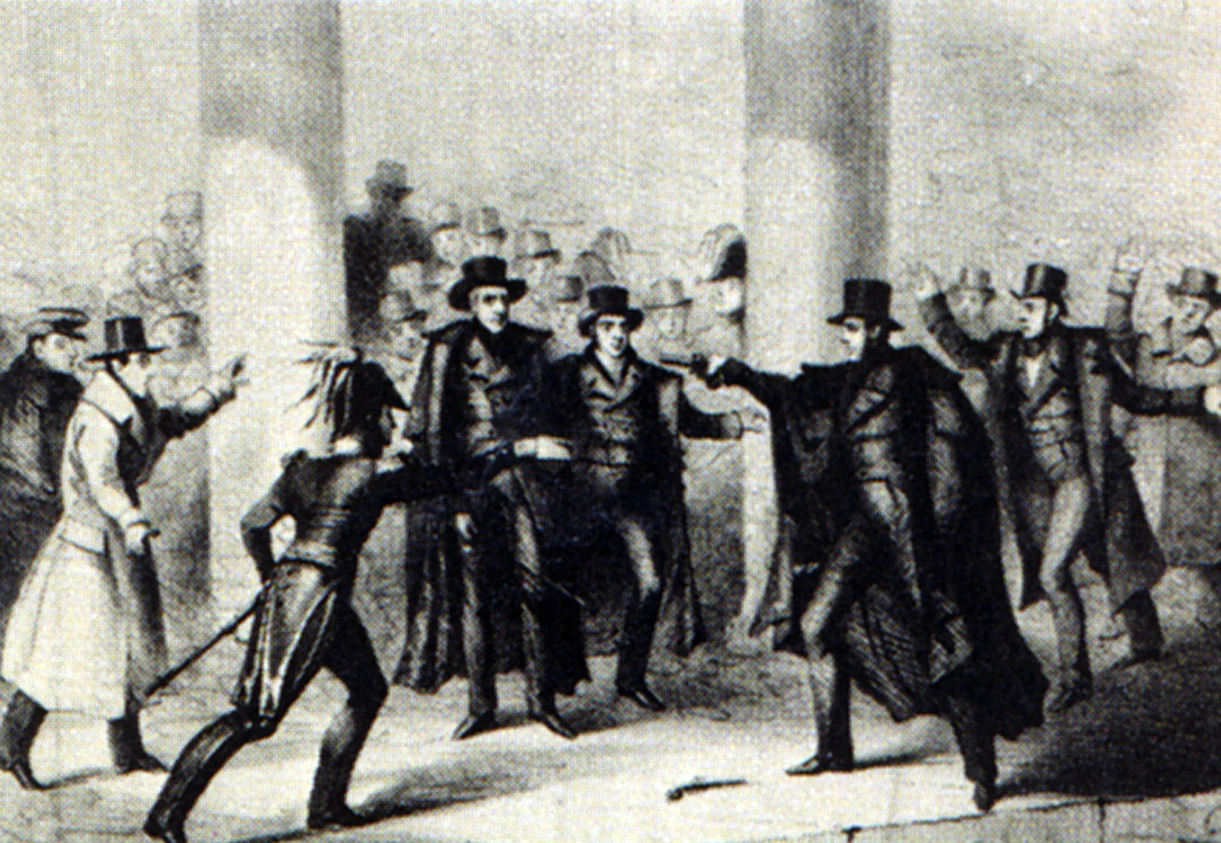
Just after leaving the East Portico of the United States Capitol, President Andrew Jackson, twice-elected to the nation’s highest office, was gunned down by the deranged English housepainter Richard Lawrence. Jackson had fought in the War of 1812 and in numerous altercations with Indians as well as participating in thirteen duels, but now his luck seemed to have run out. Lawrence stepped from behind a column with two pistols and fired them into Jackson’s back on the unseasonably dry winter’s day. Reportedly, Jackson, when shot, turned, shouted, and charged at Lawrence before he fell dead.

Lawrence was apprehended by the crowd, including Congressman Davy Crockett. He was taken into custody and questioned first by police, then by doctors, whom he told that he had a great deal of money coming from the Federal Government, but was held up by Jackson. Lawrence went on to explain that he would use the money to retake his place as king of England as he was, in fact, Richard III, who had died three-and-a-half centuries earlier. When taken to trial that April, Lawrence was quickly deemed not guilty by reason of insanity, but prosecutor Francis Scott Key and the many mourners of Jackson would not let the matter rest. The trial went to the Supreme Court, where a precedent of execution for the homicidally insane would be set. Lawrence was hanged that winter, and mental asylums around the nation were purged of those deemed “dangerous to mankind.” The deplorable conditions of the insane would continue for decades, prompting reformer Dorothea Dix to champion for the rights of “harmlessly mad.” In her early work, she had made attempts to help all those mentally troubled, but the stigma in America ran too deeply to overcome. The policy would continue through the early twentieth century where gas chambers became popular among asylums before giving way to the experimental lobotomies and drugs in the 1940s and ‘50s.

Just as national mourning turned to rage at the insane, it also poured out against Jackon’s enemies in politics. It was discovered that Senator George Poindexter of Mississippi had hired Lawrence some months before, and he was brought under charges of conspiracy. Poindexter was eventually declared innocent, but his political career would never recover. More notably, Senator John C. Calhoun of South Carolina, former vice-president under Jackson, was also suspected. Though he testified to his innocence on the Senate floor, he was not reelected in 1838 and eventually moved to Texas. The new Whig Party, who had formed in 1833 opposing Jackson’s assurance of Federal power over nullification, became crippled by the desertion of Henry Clay and soon ceased to be a credible political unit.

Vice-President Martin Van Buren assumed the presidency and won his own election in 1836 and again in 1840 amid chaos of the border war with Britain dubbed the Canadian War brought about by the Caroline affair and the Pork and Beans War, which would ultimately lead to a divided Canadian republic, British colony, and substantial gains in the Pacific Northwest for the Americans. He pushed for Jacksonian ideals, many of which he helped create, suppressing bids for a national bank and instead offering Free Soil and limiting slavery in the territories in aid of the poor White. Polk continued the Jacksonian dynasty with war against Mexico, expanding Manifest Destiny in the Southwest.

After fifteen troubled years, the United States seemed to settle in the 1850s. The economy rebounded with its war-speckled depression over, and immigration filled up the new territories gained. Questions over slavery still boiled, but the matter had been largely settled by legally maintaining the status quo and refusing expansion. Slavery would gradually die out as it became economically infeasible in the face of the growing Industrial Revolution and Abolitionist movement. The question of secession, of course, had been dealt with by Jackson during the Nullification Crisis in his famed “Proclamation to the People of South Carolina” stating, “Secession, like any other revolutionary act, may be morally justified by the extremity of oppression; but to call it a constitutional right, is confounding the meaning of terms, and can only be done through gross error.”

While the United States enjoyed great prosperity over the latter half of the nineteenth century thanks to the strong base of Common Man economics built by Jacksonians, its laissez-faire policies would become a bed of corruption leading to fresh outbreaks of revolution as the twentieth century dawned.


In reality, the weather had been wet, and Lawrence’s pistols had misfired due to moisture in the powder. Reportedly, Jackson beat Lawrence with his cane until both were restrained. Lawrence would be deemed insane and committed to institutions until his death in 1861. Jackson would die in 1845 with his Democratic ideals challenged on numerous fronts.

Saturday, January 29, 2011

January 29, 1523 – Faber Out-Debates Zwingli

Central Europe looked to be a smoldering mass of corrupt indulgences and humanism, needing only a spark to explode into revolution. In the Germanies, former monk Martin Luther had nailed his 95 Theses to the door of All Saints’ Church, been excommunicated without much of a flinch, and stood before the Diet of Worms refusing to recant. Farther south in Switzerland, a similar surge of reform was welling in Zurich, where layman pastor Huldrych Zwingli preached to his congregation against the corruption of the Church.

Unlike Luther, who had served as an Augustinian monk against his father’s wishes, Zwingli had avoided monasticism despite the invitation of the Dominicans because of his father and uncle’s disapproval. Instead, he attended university at Vienna and Basel, finishing his master’s, and being ordained in Konstanz in 1506. He moved fairly often, continuing his learning and becoming disgusted with the politics of church and mercenaries that seemed to pervade Switzerland. Finally he settled in Zurich in 1519, where he began to diverge from proper Church teachings. He condemned veneration of the saints, described monks as decadent, affirmed that unbaptised children were not damned, and questioned tithing, hellfire, and excommunication. Zwingli and others petitioned for an end to clergy celibacy, and Zwingli himself married Anna Reinhard three months before their first child was born.

The petition caught the attention of the bishop of Zurich, who called upon the civil authorities to uphold order. Zwingli declared the Church corrupt, and the city council became caught in the middle. Hoping to clear the air before the Swiss Diet marched on Zurich to force restoration of order, the council invited the bishop and the unorthodox to a Disputation. The bishop sent Johann Faber and a delegation while Zwingli came himself, armed with his Schlussreden summarizing his theological views. Faber was forbidden to discuss theology with laymen, and so he had been unprepared for such deep discussion. Initially he decided to appeal only to the authority of the Church, but Zwingli’s words pressed him to reply. In an hours-long impromptu speech, he addressed each one of Zwingli’s sixty-seven articles and explained or discredited all of them.

Zwingli and his followers were shocked. The large crowd that had gathered spread the word of the failures of the “reformers,” and support for Zwingli fell throughout the city. He attempted to reclaim his place by holding communion simply on grounds that the Eucharist was commemorative rather than substantial. The political gamble would prove a loss, and the tide of reformation would turn against him as the northern Swiss came to agree with reformed teachings by the Church. As the Peasants’ War guided by the Anabaptists toward a Christian commonwealth went sour in Germany, another huge loss for Protestants sank its holdings in central Europe. Luther had separated himself from the Peasants’ War, but his followers lost numbers as the writings of Johann Faber became more convincing.

Faber would go on to revitalize the Church in his new method of openly discussing theology. Ideals from Lutheranism such as the free reading of the Bible were taken and adapted toward a more unified Church standing. While indulgences would fall out of fashion, the Church would continue its nearly unquestioned position as guide of Christendom accepting petitions and minor reforms. Considered by many the instigator of what perilous times may have come, humanist Desiderius Erasmus was gradually eroded from the collective mind and replaced with Faber’s sense of condemnation for heretics as outlined in his Malleus Haereticorum.

Faber was also instrumental in organizing the New Crusade against the Turks in the late 1520s, where his delegation to England convinced Henry VIII that time and prayer was needed for a male heir, proving correct in the birth of Henry IX in 1533, though at the cost of his beloved wife Catherine’s life.


In reality, Johann Faber did not argue theologically, and Zwingli won his right to preach freely. The Second Disputation followed nine months later where Zwingli again rose in power. As Zurich and other Swiss cities diverged from the rest of the confederation, war became inevitable. Zwingli gathered allies and forged a defensive army to protect the right to preach, which led to the Wars of Kappel, where Zurich would be among those killed in the disastrous battle against Bern and its Five States. The Protestant right to preach would be fought over again in 1656 and finally won in 1712 in the Wars of Vilmergen. Faber, meanwhile, would go on to be chaplain to Ferdinand I of Austria, for whom he would unsuccessfully campaign for a crusade, and Bishop of Vienna, where he would write many works opposing the growing Reformation.

Friday, January 28, 2011

January 28, 1902 – Carnegie Institution for Science (in Man) Founded

Famed industrialist Andrew Carnegie founded many institutions to promote education, art, free libraries, and technological development. Most famed would be his Institute for Science in Washington, D.C., to which he would give, along with $10,000,000 in registered bonds yielding five percent interest per year, the instruction, “that the objects in the corporation shall be to encourage in the broadest and most liberal manner investigation, research, and discovery, and the application of knowledge to the improvement of man.”

The twenty-four trustees on the board would determine toward what the investigation and research would be, and, soon after the endowment, an argument broke out over the Scotsman's choice of the word “man.” First President Daniel Coit Gilman (later to be founder of the Johns Hopkins University School of Medicine) held that the word should be taken literally to mean the betterment of the human body. Others thought more figuratively, expecting the institutional grants to go toward more widespread sciences such as astronomy and materials science. It was rumored that Gilman demanded those who disagree ask Carnegie for a clarification, which no one did for fear it would insult his accent or make them look foolish. Whatever the reality, Gilman eventually won the argument, and the dedicated sciences toward the improvement of humans began.

In their first years, the Institute worked with research in determining the proper activity and diet of individuals. Healthy consumption of eggs and milk in prisons outlined the need for what would become known as Vitamin D as well as the general knowledge of vegetables and fruits opposing rich foods, leading to problems such as diabetes and gout. They duplicated much of the research of Dutch scientist Christiaan Eijkman performed in the 1880s on animals and began a mutually beneficial discourse with British doctor Frederick Hopkins. Building from the research, the Institute helped to design numerous meal programs for schools and workers across the nation, along with publishing articles to help families live their healthiest. Production of pills and oils containing the necessary vitamins and minerals

National health improved overall with statistical visits to doctors much decreased. In 1907, Carnegie gave the Institute an additional $2,000,000 to keep up the good work, and they launched into further programs. Over the course of the next decades, the Institute would merge with the Eugenics Record Office of New York and employ numerous anthropologists in determining how to cure hereditary disease. The growth of science in the Netherlands and Nazi Germany found another great connection for human improvement, and the Institute worked diligently to assist in the development of testosterone for medical use. In 1944, with the discovery of the source of much of the experimental date in concentration camps, the Institute fell into a public relations nightmare. President Margaret Sanger (who also served as chairperson of the Birth Control Council of America) handled the situation carefully, denouncing Nazi extremes while upholding what might be done for future generations regardless of race.

Since World War II, the Institute has been instrumental in generating the modern cocktail of vitamins, steroids, physical education, and dietary control that has benefitted man. While the average male height in 1900 was approximately 5’8”, it is today 6’3”, with the typical time of running a mile at around five and a half minutes. The Institute continues many projects in research for the future, working to increase longevity toward a lifespan of 200 years and to cure cancers and genetic weaknesses through viral therapies. Of course, with such a surge of improved humans, population control has become an integral matter, and sterilization toxins are known to be placed in water-systems worldwide with reversal treatments available primarily to those in the First World.


In reality, Carnegie's instruction concluded, "to the improvement of mankind." While dabbling in eugenics during its popular period between the wars, CIW ended its Department of Genetics in 1944. The CIW researches numerous fields such as plant molecular biology, developmental biology, global ecology, astronomy, astrobiology, and many others.

Thursday, January 27, 2011

January 27, 1593 – Bruno Escapes the Inquisition

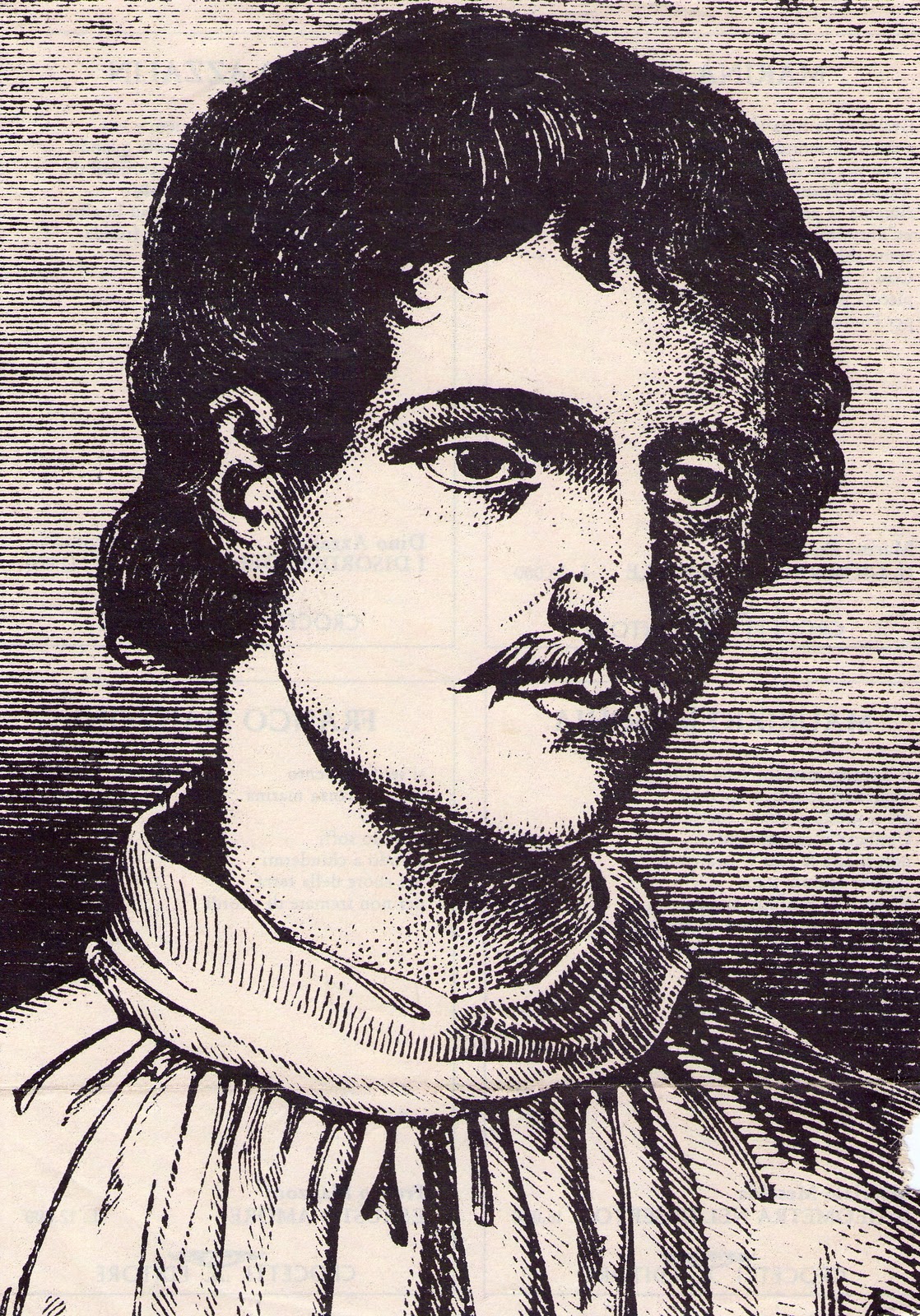
Giordano Bruno was once a highly admired Dominican monk with numerous publications on the topic of memory, so approved that Pope Pius V had accepted the dedication of one of his earliest works. As he continued in his studies and philosophy, however, Bruno became increasingly heretical toward the accepted dogma of the time. Initially, he simply read banned works in curiosity, understanding their principles while upholding the hegemony of the Church. He then delved deeper, creating defenses of disagreements such as those of Arian about the lower position of Christ under God and an increasingly pantheistic view of the Universe. These outrages and the discovery of his hidden copy of a banned work by Erasmus would eventually cause such uproar that he would flee his monastery and cast off his habit.

Bruno's life became one of wandering, trying to find a place where a free thinker may exist. He journeyed to the modern city of Venice, then to Padua, where he took up his monasticism again, though not joining a monastery, and came to Geneva, where rumor holds he cavorted with Calvinism. Later, he traveled to France, where he studied and taught at Toulouse before coming to Paris under the patronage and protection of the nobles. All during this time, he wrote and thought and learned, writing essays and comedies about the way ideas and memories work. Attached to the French ambassador to England, he came to London and joined new circles of intelligentsia and began his most controversial works on cosmology, describing a universe that not only included the Earth revolving around the Sun, but the Sun being only one of the infinite stars beyond. During anti-French riots, Bruno left London with the ambassador and began wandering again, teaching in German universities and being excommunicated by the Lutherans. Finally he returned to Italy, hoping to teach in Padua (but losing his chair of mathematics to Galileo) and tutoring privately in Venice to Giovanni Mocenigo. When Bruno announced he would be moving on, Mocenigo denounced him to the Venetian Inquisition. He defended his trial well in Venice, noting that many of the accusations were against points he had made only in philosophical pondering and did not believe. His few undeniable heresies against the dogma of the Church, however, prompted Rome to ask for his transfer, where he may well have been executed as an example of the increasing questioning of Church cosmology.

While being transferred, Bruno was asked to escape by a mutual friend sent by John Dee. The famous English philosopher and Hermetic had never met Bruno, but the two had shared much fascination with the supernatural, and Dee had taken up several of Bruno's works on the mind in his library. Dee had done his own travels to Poland and the Continent, where he had lectured for several courts before finally returning to England to find his library looted. Looking to rebuild, he sought out Bruno's works and found that the monk/philosopher/scientist had gone to Venice after attending the Frankfurt Book Fair. Dee sent a letter and money to invite him back to England. When found in distress in Italy, the message was expanded as an invitation to flee. Bruno initially felt that fleeing would be a false turn for views he felt so true that he would be willing to burn at the stake for them, but he was persuaded on descriptions of Dee's desire to work together (though Dee himself was only looking for new copies of Bruno's books).

Nonetheless, slipping out under the unwatchful eyes of bribed guards, Bruno took a ship from Venice to London, where he traveled by land to Manchester. Dee and Bruno struck up a strong friendship as Dee had with seer Edward Kelley (before the latter had told Dee that the angel Uriel had commanded they share wives), discussing cosmology and building upon each other's works in the occult and signs. While generally disliked by the faculty and administration, Dee acted as Warden of Christ's College and gave Bruno a chair in mathematics as well as a later position in what would become psychology. Building a unique curriculum and acting as a magnet for controversial thinkers all over Europe, Dee would transform Manchester into one of the most advanced centers of thinking in Europe. Over the next century, men such as Bacon and Newton would instill great new philosophy, methods, and technology into reality, such as frozen foods for storage, substantial memory techniques, focused light for heating and war, and the capture of steam for work, ushering in the Industrial Revolution circa 1690.


In reality, Bruno was handed over to Rome and underwent a seven-year trial. He refused to recant in whole, holding many of his ideals (some of which would be scientifically proven over the next centuries) as fact. Bruno offered a partial recantation and appealed to Pope Clement VII, but he was turned over to the Roman authorities and burned at the stake on February 17, 1600. His trial would be seen again a generation later in Galileo’s trial where science was again halted by dogma. It would be another 289 years before Bruno would be recognized with a monument upon the spot he was executed.

Wednesday, January 26, 2011

January 26, 1788 – Prisoners Overthrow Guards in New South Wales

With the loss of Georgia in the Rebellion of the American Colonies, Britain’s so-far-successful experiment in penal colonies as buffers to foreign expansion had been cut short. With prisons overcrowded by debtors and petty criminals, a new plan was launched for a penal colony in the far-off New South Wales, which was also meagerly claimed by the Dutch as New Holland. On May 13, 1787, the First Fleet set sail from England with 772 convicts and a few marines commanded by Captain Arthur Phillip, who was to be the first governor of the colony. They would arrive at Botany Bay in late January of 1788, which would prove a grim reality to the glorious description Captain James Cook had given of it. This would prove the first sign that the attempt at colonization would be doomed.


While the rest of the fleet was stuck in the bay due to bad winds, Phillip and others explored for a better site, coming upon Sydney Cove. On January 26, disembarking from the HMS Supply, Phillip and some of his officers and marines came ashore to claim the land officially. While they were gone, however, the convicts who were allowed on deck to watch suddenly broke free and overwhelmed the guards. Phillip and the others tried to storm the ship and return order, but the convicts armed themselves from the armory and subdued the soldiers, putting them in the same chains that had once held the thieves.

Back in Botany Bay, the remaining British ships met with a small French fleet under the comte de Lapérouse that had been sent as a scientific expedition by Louis XVI. While the French explored the bay for specimens, the British gradually made their way past the rocks and to Sydney, where they would be liberated by the escaped convicts one by one over the course of the 26th. The Battle of Sydney would be the first altercation of the bloody Colony Days in what would become known as Australia. The thieves formed into something of a mass-gang and built a rugged colony using the goods and supplies from the ships. Phillip and his officers, meanwhile, were handed over to the French, who were to return them to Britain with the message that the colony was independent soil. Lapérouse complied begrudgingly, carrying the extra men with him as he continued his expedition, which was also ill fated. The French ships would ultimately wreck near Vanikoro Island, where their fate would be unknown until Irishman Peter Dillon’s expedition in 1826.

The early days of Australia would be plagued with murder, debauchery, and lawlessness. As illness, specifically scurvy, settled in, the colonists began to organize more peacefully under James Ruse, who traded extensively with the locals and established farming. Rumor spread about the fate of the colony, but it was unconfirmed as none of the ships returned to port. It was word enough, however, to attract the notice of Fletcher Christian and his mutineers who joined their ranks after wandering aimlessly from their deposing of Captain William Bligh. Shortly thereafter, the Second Fleet from Britain arrived, whose luck had been even worse since their transport by ex-slavers had given the voyage a 26% death rate. Christian, who had seen the despicable treatment of his own men and now stood even more horrified by the slavers, rallied the New South Wales Corps to desert, and Major Grose returned to England with the empty transport ships.

Parliament and the Navy began to prepare an expedition to re-conquer the colony, but war with Republican France suddenly interrupted the planning in 1791. Led by Christian and regulated by the wayward marines, Sydney became a vibrant pirate town, working as a magnet for deserters from first the Republican and Napoleonic Wars and thriving on an illegal rum trade. They made political contact with the United States of America as well as Napoleon, asking for protective treaties, but neither would officially recognize the colony. An expedition by the aged Vice-Admiral Bligh launched in 1814 to take Sydney, but Christian and his men would fight off the Royal Navy. Bligh would die shortly after the battered ships returned to India to be refit.

The victory would be short-lived, however, as a larger British fleet would overwhelm the colony in 1817. Many of the convicts and pirates would escape into the Outback or open sea while many others were caught or executed. Christian and other ringleaders were hanged for treason, and the settlements were burned. Australia would be gradually colonized again but in limited numbers until the discovery of gold in the 1850s. Gold rushes followed, filling the land with a new breed of settler that would make Australia into the highly profitable though notoriously most devastated ecologies in the world.


In reality, the convicts under Governor Arthur Phillip were treated practically as equals, gradually building up a viable colony as he pressed for an agricultural base. William Bligh would serve as Fourth Governor of New South Wales while his mutinous crew under Fletcher Christian would disappear to the mismapped Pitcairn Island, out of touch with the outside world until 1808. After the Rum Rebellion against Bligh in 1808, Australia would be under military rule, establishing a rigid foundation upon which the explosive growth of its gold rushes in the 1850s would be built.

Tuesday, January 25, 2011

January 25, 1787 – Daniel Shays Waits to take Springfield Armory

In the economic turmoil after the American Revolution, many of the most valiant fighters for freedom suffered long after the war ended. Daniel Shays was a laborer who had joined the Continental Army, fighting at battles such as Bunker Hill and victory at Saratoga. After being wounded, he resigned and left still unpaid. Upon arriving home, he found himself in court for unpaid debts. He was hardly alone; debtor's prison and courts had pursued hundreds of poor former soldiers in Massachusetts alone. Meanwhile, judges, lawyers, and wealthy merchants in Boston were making fortunes as the young nation grew, controlling specie in gold and silver as inflation made the poor poorer yet.

Shays met with other farmers and laborers, and they began to organize into a new revolutionary army. Numbers grew and altercations began as the masses fought against the bourgeois, who had confirmed power through the Revolution by pushing out the British. Governor John Hancock, famous signer of the Declaration of Independence, had suppressed riots, but local militias were losing support. The new governor James Bowdoin decided to take serious action. Leading wealthy Boston merchants funded a new 3,000-man militia to be commanded by General Benjamin Lincoln.

The militia marched toward Springfield in January, where Shays and Luke Day commanded armies of revolutionaries who had shut down the local courts from prosecuting debtors. The local 900-man armory headed by General William Shepard was under siege, and Secretary of War Henry Knox had ordered him not to use the weapons inside as it required Congressional approval. Shays sent a message to Day suggesting that they attack before Lincoln's army arrived and seize the weaponry, but Day replied that he needed another day to organize. Shays begrudgingly agreed, spending the rest of January 25 writing letters to Shepard explaining his case and asking for a surrender.

The infuriated Shepard felt that his duty to the new United States was to defend federal property, even though the federal government refused him to use it. Judging the times, he decided to let the people choose for themselves. On the 26th, Shays and Day marched on the armory, and Shepard ordered his men to fire their muskets in a warning shot. The revolutionaries refused to be deterred, overwhelming the troops and securing the armory.

At noon on the 27th, Lincoln and his mercenaries arrived. They attacked Shays and Day's joined forces in the defended position of the armory. The battle would last through the afternoon until Lincoln's exhausted troops began to break. Days led a counterattack across the frozen Connecticut River, routing Lincoln. The resounding victory would unite the farmers of western Massachusetts and lead to a march on Boston. Governor Bowdoin and the state legislature called for aid from the government, but Congress was out of session, so there was no way to legally declare war, even on Americans themselves. New York considered putting together a force to make peace, but the matter was deemed internal to a state, and a state invading another state to put down popular movement seemed contrary to the spirit of the Articles of Confederation.

With minimal resistance, Shays and his revolutionaries overthrew the Boston elite. New elections were held, despite stiff resistance from the shouts and writings of Samuel Adams, who now seemed unable to stop the voice of liberty that he had called for a little over a decade before. Heavy taxes were placed on the wealthy, solving the economic crisis while emptying the debtor's prisons. Calls for protection of property rang out but were drowned by councils judging those deemed “opposing the state.”

Backlash flowed across the rest of the United States. George Washington and others called for a constitutional convention to create a stronger federal government. It may have worked, but the summer of 1787 came too late, and ultimately the delegates would disband, creating only a new list of individual rights proposed by the representatives from Massachusetts. Planters in Virginia and Georgia suddenly faced uprising from small farmers who were kept out of competition. Insurrections from the slave class erupted in South Carolina, spreading to the hundreds before being violently put down. In New York, debates over river rights and shipping prices caused violent altercations and blockading of the Hudson. Political and military leaders took charge, promising security in exchange for rights.

Revolution in the states would continue at various levels, weakening the United States into a broken confederation as many in the British Government had anticipated. A similar revolution ran through France, sparking wars throughout Europe. As the states argued about supporting events in Europe, many supported the fellow revolutionaries while others began considering a return to Britain. Seeing possibility that all the work of the Revolution might go undone, George Washington endorsed the increasingly popular Aaron Burr of New York as a central leader. Burr would settle the country by war, eventually setting himself up as Emperor of the Americas, a position that would eventually be broken by fresh revolution a generation later under General Andrew Jackson.


--

In reality, Shays' men attacked before Day was ready and were defeated as Shepard used the federal cannon to fire into the crowd of rebels. Lincoln's army mopped up the stragglers over the course of February, but the uprising was an awakening to the American people for the need of a strong, central government. The resulting constitutional convention produced the U.S. Constitution, a model for republican governments for centuries to come.

Site Meter