Thursday, November 5, 2015

Guest Post: Pearl Harbor What-Ifs

What if the US's aircraft carriers had been wiped out at Pearl Harbor in 1941? What if the Nevada had been sunk to block Pearl's entry? What if a third wave had been launched? This post from Francisco Meza at Hoku Tours explores what could have been.

Did the Japanese Navy Cripple US Navy Fleet During Pearl Harbor Bombing?


No! An emphatic No!

Fortunately for the Americans, the US Navy’s aircraft carriers weren’t touched in the Japanese surprise attack. Otherwise, the Pacific Fleet’s capability to conduct offensive missions would’ve been crippled for over a year (assuming no diversions were made from the Atlantic Fleet). The complete destruction of some battleships at Pearl Harbor and the partial damage of some more was a blessing for the Americans. Just six months after Pearl Harbor, the Pacific Fleet had to rely solely on its submarines and aircraft carriers in the most decisive naval battle of WWII, the Battle of Midway Islands. The Americans sunk 4 Japanese aircraft carriers. The US Navy not only halted the Japanese advance but also dealt the Imperial Japanese Navy a stunning defeat  from which the Japanese never recovered.

Even before Pearl Harbor, it was evident that the real queens of naval warfare were the aircraft carriers. A single aircraft carrier was capable of sinking half a dozen battleships and winning a naval battle without firing its guns.

The Pearl Harbor Attack

On December 7, 1941, around 8 am, over 350 Japanese fighter planes mounted a surprise attack on Pearl Harbor, a US Naval base. Although the barrage lasted under two hours, it was devastating. The Japanese carrier-based planes destroyed almost 20 vessels, including 8 prized battleships and around 200 aircraft. Over 2,400 US sailors and soldiers died in the attack. One thousand more personnel were injured.

Japan Forces US to Enter WWII Arena

The next day, the US President declared war on Japan. The US had deliberately stayed out of this messy war for over two years. But Imperial Japan’s ambitious ventures in the Pacific region resulted in this foolhardy attack on the world’s number one naval power. Three days later, Germany and Italy, the allies of Japan in WWII declared war on the US. So, the US finally joined WWII in the Atlantic as well as Pacific coasts.

Imperial Japan Inflicts Massive Damage

The Japanese had damaged and or destroyed 18 US warships and almost 200 aircraft. For the US Navy, the most important loss was, of course, over 2,400 personnel who lost their lives and another 1,000 personnel who were wounded.

What if the Japanese planes had been successful in sinking the USS Nevada at Pearl Harbor's entry point?

Fires were raging when the USS Nevada received orders at 0810 to get underway. The USS Arizona had just exploded near her and the spilled oil was burning in the adjacent waters. So this provided the urgency for Nevada to get moving. She got underway at 0840. And Nevada was the sole battleship to get underway!

The Japanese aviators were alerted about any warship attempting to escape from the harbor. They had been specifically instructed to sink any ship attempting to escape in the harbor entrance so that other warships would be effectively bottled. So, when they saw the USS Nevada’s swift sortie, they followed orders. Nevada was targeted.

However, the Japanese target selection was questionable. Even if they had managed to sink the USS Nevada bang in the center of the harbor entrance, there would be sufficient room for another warship to exit the harbor. Eventually, the sinking USS Nevada ran aground deliberately to avoid blocking the channel.

Tactically, the target selection was wrong because even 14–18 dive bombers targeting her would be futile. It’d be almost impossible to sink a massive battleship with just 250 kg bombs. More importantly, the channel’s width of 1,200 feet would make it impossible to bottle up the harbor.

US Warships Bear the Brunt of the Japanese Surprise Attack

Bombs rained onto the warships moored in the harbor. A large bomb that landed on the deck of USS Arizona caused the most devastating damage. The forward ammunition magazine located below the deck caught fire, and the ship exploded. Over 1,100 personnel were trapped inside when the ship sank. This number was almost half the casualty at Pearl Harbor that day.

USS Oklahoma suffered the second-most devastating damage that day. Torpedoes penetrated the shell of this battleship, and she sank with over 400 personnel aboard. Sixty-four personnel were killed when USS Utah was hit by a torpedo and sank. Four personnel aboard USS Maryland died, and the warship was damaged extensively. But the anti-aircraft guns on this ship brought down several Japanese aircraft. USS Maryland returned to WWII action within 6 months.

USS Nevada Draws Many Japanese Planes Away from Pearl Harbor

USS Nevada suffered extensive damage and 60 casualties but downed at least a dozen Japanese aircraft. As USS Nevada attempted to exit Pearl Harbor, the Japanese aircraft tried to sink her at the entry point. They were not successful. The Japanese target selection was faulty as they could not sink USS Nevada despite making a desperate attempt. 

USS California was damaged extensively and lost over a hundred men. USS West Virginia suffered extensive damage and lost 66 sailors. USS Pennsylvania was damaged severely and lost 14 personnel. Although USS Tennessee escaped with minor damage, she lost her Commanding Officer and three other personnel. (All the battleships except USS Arizona and USS Utah were subsequently salvaged, repaired and refitted.)

The Japanese Think-Tank

Japanese Admiral Isoroku Yamamoto conceived this surprise attack. A strike force of 353 aircraft under Commander Mitsuo Fuchida was used. The attacking planes were launched from 6 heavy aircraft carriers that were accompanied by 24 supporting vessels. Another group of submarines was standing by to sink US warships that escaped the Japanese carrier force. This mission aimed at crippling the US Navy’s might in the Pacific so that the Japanese could seize control of the region. 

Imperial Japan’s Intelligence Failure

Imperial Japan’s Navy failed to cripple US Navy’s Pacific Fleet. The number one reason for this is that by the 1940s, battleships played a secondary role at best. They weren’t any longer the most crucial naval vessels. Aircraft carriers were the most important naval vessels. And in Pearl Harbor, none of the aircraft carriers belonging to the Pacific Fleet of the US Navy was damaged because none of them were in the vicinity. On December 7, all the carriers were away from their base. The Japanese should have known this and waited for the return of the carriers before launching their surprise attack. This error was a major Japanese intelligence failure.

The Consequences of Japanese Misadventure

Although initial appearances suggested otherwise, the Pearl Harbor attack was a total strategic failure. The Japanese Navy attacked a fleet in port. It’s extremely difficult to cause the permanent loss of a capital warship because repair facilities are available nearby. The Japanese attacked slower, almost obsolete warships. In doing so, the US Navy was alerted beforehand to rely on aircraft carriers in WWII rather than on battleships. The Japanese Navy launched the Pearl Harbor attack without any assurance that the most prized US warships—the aircraft carriers—would be present. All the three US carriers were safe elsewhere. Six months later, at Midway, these same US carriers sank 4 Japanese carriers. The Japanese Navy hurtled downward rapidly after this devastating loss.

Japanese Aircraft Leave Out Vital Targets

Although Admiral Isoroku Yamamoto had over 350 warplanes at his disposal, critical base installations including the power station, torpedo storage facilities, shipyard, maintenance facilities, fuel storage facilities and submarine piers were not attacked. The Pacific Fleet’s headquarters building that housed the intelligence section was left untouched as well. These huge blunders permitted the US Navy to rebound quickly from the Pearl Harbor attack.

The Japanese launched only two waves of attack. If they had launched a third wave of attack, they could have inflicted serious damage. The Japanese didn’t launch a third wave fearing a strong backlash from a determined enemy. Consequently, the Japanese Navy was not able to cripple the US Navy Fleet during the Pearl Harbor bombing.

The Pearl Harbor attack only resulted in the US Navy embarking on an Emergency War Building Program. Immediately on entering WWII, the US Navy ordered 16 large aircraft carriers. Also, 15 new battleships and 9 small aircraft carriers were ordered. The US Navy built anti-submarine vessels, escort carriers, and destroyers to counter Japanese submarines in the Pacific. In the next 4 years, around 50,000 combat aircraft were pressed into service. Naval aviation personnel strength increased from 10,923 to 437,524. Barely 6 months after the Pearl Harbor attack, the US Navy managed to sink 4 of the 6 aircraft carriers that participated in the attack at Midway Island.

Monday, October 26, 2015

October 16, 1909 - Double Tragedy in El Paso

A piece co-written with Today in Alternate History, combining stories here.

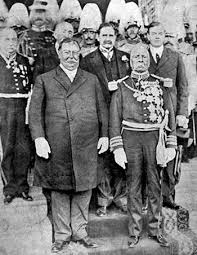
What was meant to be a historic first meeting between a U.S. president and a Mexican president (and also the first time an American president had crossed the border into Mexico) ended in a horrible double tragedy with the assassination of both William Howard Taft and Porfirio Díaz at a disputed neutral border territory.

The ill-fated summit was held without flags and considerable security forces including Texas Rangers, four thousand U.S. and Mexican troops, U.S. Secret Service agents, FBI agents and U.S. marshals. Both presidents were bilingual, and, with no need for translators, held a closed meeting to discuss matters of state. During their negotiations they readily agreed a number of bold initiatives that included the Elephant Butte dam project and also a treaty of arbitration for Chamizal a strip of land connecting El Paso to Ciudad Juárez (both of which Theodore Roosevelt would try to take credit for during his historic third-term).

With the formal business of diplomacy undertaken, the presidents set out to conduct a walking tour and greet the crowd. However, along the procession route at the El Paso Chamber stood an assassin with a concealed palm pistol. As had been seen only years before in the assassination of U.S. President William McKinley at the World’s Fair in New York, the assassin sprang from the crowd and delivered two murderous blows. Secret Service agents, who had misguidedly elbowed out other security forces, were immediately upon the killer. It was already too late.

James S. Sherman stepped up to his unexpected presidency, but calamitous reactions in Washington along with panic at the border consumed his first days as a drama of long cabinet deliberations. Sherman was already not in good health, and the strain aggravated his worsening kidney condition. Before the end of Taft's unexpired term, Sherman himself would be succeeded in the Oval Office by his Secretary of State Philander C. Knox. By 1912, the Republican Party National Convention was running out of candidates, which convinced party bosses to seek a return to better times by supporting Theodore Roosevelt in his run for a historic third term.

Roosevelt returned to the White House amid turmoil in the south. The grisly murder only foreshadowed the violence of the Mexican Revolution, which was accompanied by widespread anti-American rioting. The Tampico Affair of 1914 led to the American seizure of Veracruz as diplomatic relations collapsed. Ultimately the United States erected a series of forts, known colloquially as “the Border Fence,” for protection from the chaos, even though American forces routinely moved into Mexican territory on various military actions seeking justice for raids.

The tragedy in El Paso would also have profound unforeseen consequences for America's relations far beyond Mexico. The strong-armed American presence would also cast a long shadow to the tragedy in Sarajevo five years later. Internationally, Roosevelt argued that it set an unfortunate precedent for the Habsburg justification for sending detectives across the border into Serbia to investigate the murder of Archduke Franz Ferdinand. By the beginning of the Great War, Roosevelt was clamoring to support the Central Powers. Their pursuit of justice was seen as fit as American incursions in pursuit of Pancho Villa, and America should defend Austrian right as their own.

The rest of America was not so certain. TR quarreled with Speaker Champ Clark as he pressed Congress for a declaration of war, which they refused to grant. In his campaign, Roosevelt alienated enough Americans already sick of violence at the border, which cost him the 1916 election to his nemesis, Clark. Adding insult to injury, a new amendment (among others for Prohibition and Women’s Suffrage) set a term limit so that Roosevelt would never return to office. The true cost of this decision would become apparent only later when Roosevelt’s Democratic cousin Franklin was precluded from running in 1940.

The Great War dragged on without American involvement as Clark focused his administration on North America: settling the turmoil in Mexico and reviving hopes of annexing Canada. The international economic boom as Europe rebuilt lured Americans out of isolationism along the Monroe Doctrine, but the global financial collapse of the Great Depression drove them back to local interest. The United States was dragged back into the world theater after the attack on Pearl Harbor, just a few months after turmoil in the Democratic Party between former vice-presidents “Cactus Jack” Garner and Henry Wallace handed the 1940 election to Republican Wendell Willkie. Conspiracy theorists hold to this day that internationalist Willkie was given advanced knowledge of the Japanese attack in the Pacific but didn’t act so that the United States would be provoked into joining the war.


--

Author’s Note: In reality two men, the celebrated scout Frederick Russell Burnham and Private C.R. Moore, a Texas Ranger, discovered, captured and disarmed the would be assassin within only a few feet of Taft and Díaz.

Wednesday, October 7, 2015

Guest Post: September 27, 1987 - Monument-builder Found Dead

Elberton, GA - the dead body of a man in his mid-sixties was discovered in Elberton, northeast Georgia, the city of that claims the title "granite capital of the world" and was founded by Samuel Elbert, a very famous historical Freemason.

Police investigations soon determined that he was R.C. (or Robert) Christian, the shadowy figure that had hired the Elberton Granite Finishing Company to build the structure of the "American Stonehenge," a monument with the "ten commandments of the new age" (or alternatively believed to be the "ten commandments of the Antichrist") that now stood at the highest point in Elbert County. The owner of the company was a thirty-second degree masoner and shriner called Joe Fendley, Sr.

This transaction was discreetly handled by Wyatt C. Martin the President of the Granite City Bank, Elberton, back in 1979. Throughout this period Martin had served as sole contact on the honest-to-goodness understanding that Christian was the pseudonym for a WW2 veteran who represented a small group of peaceful, faith-based Americans that wanted to enshrine a set of ten guidelines or principles, an "an edifice to transmit a message to mankind." It was conjectured that future generations of Americans could apply these lessons to establish an age of reason, presumably a new world order in the aftermath of a nuclear holocaust ("Let all nations rule internally resolving external disputes in a world court").  

Cynics suggested that the group was conspiratorial rather than benevolent in nature seeking to overthrow the Federal Government in the present day and replace it with a ruling super-elite with a global de-population agenda known as the "Great Culling." Towns folk concluded that the whole matter was a hoax concocted by Martin and Fendley and R.C. Christian wasn't a real person at all (despite Martin insistence that he knew his true identity) a get-rich quick scam to make money from visitors.

However the monument stirred controversy because of the sinister Malthusian de-population logic of its messaging ("Maintain humanity under 500,000,000 in perpetual balance with nature"). Of course if the Guidestone messages were crafted for a post-apocalyptic society then it was perfectly possible that the global population would be below that threshold at that future time. Nevertheless at the unveiling of the monument in March 1980, a local minister proclaimed that he believed the monument was "for sun worshipers, for cult worship and for devil worship". Others had suggested that the stones were commissioned by secret societies such as the Rosicrucians (the founder had a similar name of Christian Rosenkreuz) or even Luciferians and that maybe R.C. Christian was even an ascendant master. This particular theory gained further credence when R.C. Christian published a follow-up book called "Common Sense Renewed" some six years later making a strong case for eugenics.

Somewhat more mysteriously the engravings on the Explanatory tablet had been left incomplete ("Time Capsule Placed six feet below this spot On To Be Opened on"). Because it was conjectured that the purpose of R.C. Christian's final visit to Elberton was to engrave these dates the time capsule was disinterred. It was found to contain a series of detailed predictions for near-future events in the major cities of the continental United States including both terrorist attacks and also natural disasters. Because of this evil association the Guidestones were broken up and the material used for local construction projects by the Elberton Granite Finishing Company.

Author's Note: in reality there is no evidence of a time capsule and contact with Martin ceased around the time of 9/11, when Christian, already in his eighties, may well have passed away. Chris Pinto, founder of Adullam Films claims to have identified the real R.C. Christian in his documentary "Dark Clouds over Elberton." Whereas computer analyst William C. Van Smith had said the monument's dimensions predicted the height of the Burj Khalifa, the tallest building in the world which opened in Dubai over thirty years after the Georgia Guidestones were designed. Smith said the builders of the Guidestones were likely aware of the Burj Khalifa project which he compared to the biblical Tower of Babel.

Wednesday, September 30, 2015

February 15, 1988 - Richard Feynman Announces Bid for Governor


After becoming increasingly political following the Challenger space shuttle disaster, Richard Feynman declared his bid for the governorship of California to resolve what he saw as a horrific failure for potential in applied sciences. His conclusions arose during the preparations of the Rogers Report, during which chair and former Secretary of State William Rogers said, “Feynman is becoming a real pain.”

The source of the pain was said to be Feynman’s hands-on approach during investigations of the booster rocket O-ring seals, which were dubbed by NASA managers to have a “safety factor of 3” since they only burned one-third of the way through during stress tests. Feynman told Congress that such damage was actually a safety factor of 0 since they incurred damage at all. He railed NASA officials for further bad mathematics stemming from a break in communication between engineers and administrators.

Feynman’s announcement was seen as politically absurd since it was so early, something fittingly uncouth for Feynman’s curious career. Born in 1918 to Jewish parents and maintaining his deep Bronx accent throughout his life, Feynman began tinkering with science early on, disassembling and reassembling his first radio. He soon began repairing radios professionally since he learned how the pieces worked and used the money to fund a laboratory for himself. After graduating MIT and Princeton, Dr. Feynman began his career exploring theoretical quantum physics. Fellow physicists got Feynman working with the Manhattan Project, which brought him to Los Alamos. He complained, “There wasn’t anything to do there.”

To keep himself entertained, Feynman learned how to pick locks after faking being a renowned lock-pick by fishing papers out of a desk’s locked drawer by pulling out the unlocked drawer beneath it and reaching up the back to fish pages out one at a time. Feynman and his wife pranked the censors at Los Alamos by writing letters in code and on the back of a puzzle the censors had to complete before they could review it. This lasted until they wrote him politely to stop.

Suffering depression after the death of his wife and seeing the destructive use of the atomic bomb both in 1945, Feynman dedicated himself to science at Caltech. His work in physics furthered quantum theory, and toward the end of his career Feynman began focusing on computing. At Los Alamos, Feynman had headed the computation department, creating a complicated and exceedingly efficient method of assembly line calculations for the “human computer” pool. He later contributed to punch-card programming and by the ‘80s was working on parallel computers to do multifaceted calculations. His fame (such as being one of the few foreign members of the Royal Society of science and his 1965 Nobel Prize) brought him into a position to be requested onto the Rogers Report.

As Feynman continued to rattle political cages and gain press coverage, sitting governor Republican George Deukmejian decided to bid for a third term, campaigning on stability while the Democratic race was divided with Feynman, San Francisco Mayor Dianne Feinstein, and actor James Garner. Ultimately Feynman won, said to be victorious thanks to contributions from businessmen hoping to expand academic NSFNET systems into a civilian computer communication network as well as his wild charisma in an age ready for something new.

During his term of governorship, Feynman worked to invest in science. He mandated that administrators have a solid understanding of physical principles, creating an unpopular turnover in much of the executive branch, yet he stood by his saying, “For a successful technology, reality must take precedence over public relations, for nature cannot be fooled.” After the transition, his actions proved popular as the press ate up Feynman’s education programs and his bold claims about computing networks were proven correct by the World Wide Web, which caused business to surge in Silicon Valley.

Feynman’s campaign to pick up a Superconducting Super Collider that had been given up in Texas fell on deaf ears, but his continuing feud with NASA did lead to a great deal of interest in private space travel. In the years after Feynman’s death in 2000, the desert in Southeastern California began to buzz with experimental craft. Although perhaps not as glamorous, Feynman’s policies were also credited with the whistle-blowing on Enron’s power manipulation shortly after deregulation as officials quickly recognized the flaw in their consumption arguments.


--

In reality, although he mentioned an interest in politics in 1966, Richard Feynman did not pursue it and died from cancer in 1988. Dianne Feinstein went on the Democratic ticket to nearly overcome Republican Pete Wilson for the 1990 California governorship. Feinstein instead went on to the Senate in 1992, where she has remained since as a voice for assault weapon regulation and chairs the Select Committee on Intelligence.

Friday, September 18, 2015

Guest Post from Chris Oakley: D.B. Cooper Arrested

November 24th, 1971--

FBI agents acting on an anonymous tip arrested would-be hijacker D.B. Cooper just minutes before Cooper was scheduled to board a Northwest Airlines flight to Seattle. According to the tipster. Cooper had been talking to someone named 'Raoul' from an airport payphone while waiting for his flight to begin boarding; Cooper's plan had been to take the plane over in midflight, then parachute to safety once he had extorted $200,000 from local authorities. Subsequent investigation revealed that 'Raoul' was a pseudonym for a high-level station chief with Cuba's DGI counterintelligence service and Cooper was actually one Dmitri Kaprinsky, a KGB agent who had operating in the United States since the late 1950s and only a week before his arrest had made up his mind to leave the country after becoming convinced his cover was about to be blown. The apparent hijacking plot, it turned out, was actually just a highly elaborate cover for Kaprinsky's escape back to the Soviet Union-- once he parachuted from the Northwest jet, he planned to make his way to the Oregon coast and rendezvous with a Soviet submarine to complete his journey home. ('Raoul' would commit suicide shortly after his role in Kaprinsky's escape plan was exposed.)

Kaprinsky was subsequently indicted in a San Francisco federal court on espionage charges; desperate to keep him from divulging sensitive information about Soviet espionage activity in the U.S. the KGB sent a “black ops” hit squad to assassinate him only to have the hit squad's mission go badly awry when they were intercepted in Los Angeles by U.S. federal agents and L.A.P.D. SWAT personnel. In the ensuing gun battle, most of the hit squad personnel including the team leader were killed. In early 1972 Kaprinsky was convicted of espionage, conspiracy to commit hijacking, and attempted assault with a lethal weapon(he'd tried to stab one of the FBI agents who arrested him) and given a prison sentence of 30 years to life; he would serve thirteen years of that sentence before dying from cardiac arrest on April 9th, 1985. Shortly after his death, his body was flown back to the Soviet Union and laid to rest in his old hometown in the Ukraine. At the time of the Soviet Union's collapse in 1991 most of the FBI personnel who had been involved in probing the D.B. Cooper/Dmitri Kaprinsky case were either retired or on the verge of retiring, although some of them would return to the bureau after 9/11 to serve as consultants on anti-terrorist operations.

The Cooper/Kaprinsky saga had one rather fascinating pop culture postscript: in April of 1990, five years after Kaprinsky's death, ABC-TV premiered the drama Twin Peaks, a crime series whose protagonist was suspected to have been inspired by the late KGB agent-- a suspicion the series' creator, David Lynch, would confirm two decades later in an audio commentary for the Twin Peaks DVD set. Lynch explained that his choice of a name for the main character, Dale Prince, had been a play on both Kaprinsky's true identity and the alias Kaprinsky used in his thwarted hijacking plot.

                                                               ******

In reality D.B. Cooper's real name and ultimate fate are still a mystery, although the FBI has at one time or another investigated at least nine possible suspects in the 1972 hijacking. In 1981 the movie The Pursuit Of D.B. Cooper was released to less-than-enthusiastic reviews by film critics and a largely indifferent reception from audiences, but in spite of the movie's box office failure Cooper remains an object of pop culture fascination to this day. No evidence has been uncovered as yet to suggest the KGB was even aware of D.B. Cooper's existence, much less had him on their payroll as an agent.

Wednesday, August 12, 2015

August 12, 1944 – Ghost Army Charges into Falaise Pocket


While the Manhattan Project worked to split the atom into a terrible new weapon, another project was crafting a way to improve biological defenses. The scientific work into bio-manipulation of the human body was decades ahead of its time, working blindly into fields of genetics that would not be better understood until X-ray crystallography determined the structure of DNA. Yet, just as fictional scientists did in comic books like Timely’s Captain America, the real ones created a method to make super-resilient men.

Although the primary goal was to make soldiers able to withstand severe trauma and even heal rapidly, the project proved to have two bonuses in the experiments’ subjects: inhuman speed and strength. The process was readied for human trials, and a group of 1,100 men were collected into the 23rd Headquarters Special Troops at Camp Forrest, Tennessee to be transformed into super-men. They underwent special training at Pine Camp, NY, and sailed for England to join in the D-Day assault.

The super-men were visually indistinguishable from normal (albeit extremely large and muscular) soldiers, but their ferocious advances wowed anyone who witnessed their activities on the battlefield. With some thirty-times the usual strength of an adult male, the men could sprint in excess of sixty miles per hour in huge bounds. As the Allies gained ground, a pair of French cyclists who happened upon the 23rd’s camp were astonished to see four soldiers picking up a 40-ton Sherman tank, repositioning it without expending extra fuel. One soldier, Arthur Shilstone, recalled, “They looked at me, and they were looking for answers, and I finally said: ‘The Americans are very strong.’”

Due to their speed and seeming invincibility to bullets, the soldiers were nicknamed the “Ghost Army” as they tore through German lines. They were instrumental in the war effort, running ahead of Canadian advances to cut off and capture thousands of retreating Germans as the Allies encircled Falaise. Gradually the Ghost Army was moved east, liberating Luxembourg as a base from which they raided across the Ruhr River, Maginot Line, and Hurtgen Forest. Their feinted crossing of the Rhine in March of 1945 distracted so many German soldiers that the actual Allied force met with almost no resistance on the banks.

The Ghost Army became a celebrated part of Allied propaganda, even though there were drawbacks that had to be overcome. The first side-effect of the process was clear in the early days with the soldiers’ monstrous appetites, eating as much as 60,000 calories and 1,800 grams of protein each day. Although their wounds healed practically within hours, scar-tissue was a major problem not only cosmetically but also in restricting movement at joints. The most unnerving consequence was the body’s breakdown due to the increased metabolism. The men visibly aged years within only a few months.

The war ended, and America began to disarm. Ghost Army veterans were quietly tucked away into a special hospital where they could live out their remaining few days with treatment for their increasing ailments. Their fates were largely covered up, and families were warned against un-American activities like leaking word to the press. Although there would be additional Ghost Army soldiers in Korea and Vietnam, the Army largely disbanded their use except for highly classified Special Forces agents.


--
In reality, the 23rd Headquarters Special Troops were artists. Their “Ghost Army” consisted of dummy inflatable tanks and planes, piped-in sound effects, and entire sets of fake camps and airfields, including fake laundry on clotheslines. The soldiers pretended to be armies thirty times their size through the use of impersonating military police, uniformed officers, and even other soldiers by getting “blasted” and repeating their favorite drinking songs for Germans to overhear. Their diversionary tactics (believed to have saved thousands of lives) were highly classified, and, although a documentary has been released about them, much of their efforts remain under wraps.

Tuesday, August 11, 2015

Guest Post: Icebreaker


Two posts on Today in Alternate History explored a potential “shadow history” where Stalin had pitted Western Europe against one another as the opening part of a plan to swoop in and seize the whole continent once it was weakened, based on Viktor Surovov’s book Icebreaker. One man, Rudolph Hess, who did attempt to broker peace in our own history, rushes to Britain to stop the war before it is too late.

10 May, 1941 - Mysterious Flight to Scotland

A twin-engine heavy fighter was shot down for ignoring an Identification Friend or Foe transmission sent by two Spitfires of 72 Squadron dispatched by the British Chain Home station at Ottercops Moss near Newcastle upon Tyne.

MI5 investigators at the crash site began to piece together an extraordinary chain of events. There was no body in the plane, prompting a search for a survivor. Local farmer David McLean had discovered a man wrestling with a parachute in a field south of Glasgow. The German was desperate to reach the Duke of Hamilton with a message, so McLean helped him to get in touch with the Home Guard and police. MI5 realized they already knew who the inexperienced pilot of the Bf 110E-1/N Messerschmit was: Rudolf Hess, Deputy Fuhrer of Germany.

Hess had traveled to Scotland in a last-ditch effort to save Europe from Stalinism. MI5 had intercepted a letter from Hess to the Duke of Hamilton, whose home Dungavel House Hess had been trying to locate before becoming lost over Scotland. Hess warned of “Icebreaker,” the planned Soviet invasion for taking control of all of Europe.

Hess had actually been seeking to negotiate peace since September 1940, but he failed to understand the power struggle at the apex of the British Government. Various factions within it were concerned with the conflicting objectives of saving the British Empire and the Class System, avoiding future domination by either America or the Soviets, and of course the overt idée fixe: defeating the Nazis. Needless to say the only point of agreement was that ending the war either through victory or peace settlement was highly unlikely to achieve all of these goals.

Yet Prime Minister Winston Churchill was far from a friend to Josef Stalin. Churchill had played an active role in the War of Intervention in 1918, the failed attempt to overthrow the Bolshevik State soon after the Russian Revolution. Most likely because of these anti-communist credentials, he was probably not the right man to engage with Stalin. Prior to the signing of the Molotov-Ribbentrop agreement, Britain had failed to ally itself with the Soviet Union. Suddenly ending the fight with Hitler to turn on Stalin might seem a possibility to Hess, but he had vastly misread British sentiments after Poland.

Worst still, Hess misaligned himself with the Establishment trying to engage the Duke of Hamilton in the mistaken belief that he was an opposition leader. Although he had correctly presumed Churchill would not break off the war with Germany, Hamilton was not the man to overthrow Churchill. Despite receiving no response (due to MI5’s interception), Hess decided to fly to Scotland but was delayed by the weather and his own meager flight training. Time was of the essence: the pre-emptive Soviet attack was less than a month into the future.


11th May, 1941 - Dungavel House Talks Collapse

There was never any realistic prospect of an agreement being reached at Dungavel House, and yet details of the secret negotiations were concealed by the forty-five year incarceration of Hess which finally ended in his murder by British agents in Spandau Prison. Hess’s initial flight was covered up as “Raid 42,” declared by MI5 in the books as a mission to test British northern defenses.

While MI5 followed Hess’s trail, the Duke of Hamilton met with him after serving duty at RAF Turnhouse. After discussion and meeting with the MI5 agents, Hamilton took Hess to Dungavel House for talks. The centerpiece to the proposed Anglo-German Peace Treaty was that British Prime Minister Winston Churchill would recognize the Deputy Fuhrer as the Head of Government. Hess in turn had made arrangements for a coup d'état led by senior German officers in Berlin. Only a peace settlement with Great Britain would deter Stalin from launching Icebreaker, the Soviet invasion of Europe. Hess even argued that Hitler was in favour of the deal brokered by Hess, his overthrow being necessary to end the war with the Western Allies.

Hamilton sent word to Churchill, but of course offer was rejected out of hand. The Nazis could not withdraw from all of their occupied territories (Hess himself had been a proponent of Lebensraum since his days at the University of Munich), and Churchill would not accept anything less. Agreeing to German demands would have portrayed Churchill as surrendering in the ongoing Blitz. Hess’s signal for the coup in Berlin never came as he was placed under arrest, first in the Tower of London and then in the luxurious “Camp Z” at Mytchett Place in Surrey.

Stalin’s invasion of Europe began soon after. Although Britain suddenly found herself allied with Soviet Russia against Germany, it made for uncomfortable bedfellows. Through the course of the war, Churchill would constantly argue for strategies that seemed to put Russia at a disadvantage, such as fighting Germany in North Africa rather than opening up a European front immediately and campaigning against Operation Dragoon in southern France, instead prompting an invasion of the Balkans to secure oil fields there (a suggestion American President FDR and his “Uncle Joe” in Moscow refused). The Soviets would not dominate all of Europe by the end of the war, but more than half with a great deal of influence into Italy and France.

Given the subsequent events that occurred in the summer of 1941 and through the coming years into the Cold War, many would take the view that the British Government had made a terrible mistake, and it was for this reason that the negotiations were shrouded in secrecy, particularly the plots to overthrow Hitler and Churchill.
Hess’s stubborn intransigence at doom for Europe raised the remote prospect of the Duke of Hamilton attempting to force Churchill from power, but there was even less likelihood of this gambit succeeding. Had Hess gone to a different source, the war might have gone very differently.

Site Meter