Showing posts with label civil war. Show all posts

Friday, May 15, 2015

May 15, 1932 – Japanese Civil War Begins


Eleven young officers in the Japanese Navy approached the home of Prime Minister Inukai Tsuyoshi to replicate the assassinations by the League of Blood from two months before. Japan was at a turning point with the populace frustrated by a struggling economy, and extreme-nationalists determined that it was time to purify the nation of the weak liberal-leaning civil leaders that had been in power since the beginning of the Taisho Democracy, when the emperor was ailing and political parties moved the Diet into authority.

Since being opened to the West by American Commodore Matthew Perry in 1853, Japan had undergone radical change. The Meiji Period saw the restoration of the emperor as the central source of power, ending the local control of the shogun. Industrialization brought new technology, and the Japanese market was flooded with commercially produced goods. The flow of foreign ideals upset many, especially as communism trickled over the border from the Russian Revolution.

Even more resentful than the radical changes in the country and the inflow of alien culture was Japan’s treatment by other world powers. Despite its participation in World War I where the Japanese Navy seized German colonies in China and the Pacific, Japan was treated as an outsider in the agreements. The Five Power Naval Limitation Agreement in Washington, D.C., in 1922 promoted disarmament in Pacific, creating a ratio of 5 to 5 to 3 for the United States, United Kingdom, and Japan for major ships. In 1924, the United States closed off immigration with the Japanese Exclusion Act, even though it enforced open markets. The final straw for Japan came when its own colonial ambitions in China were frowned upon after the invasion of Manchuria after a Chinese attack on a Japanese railway in 1931, even though that proved to be a hoax.

Conservatives grew in power throughout the 1920s. The first base came as a reaction against the communists, leading to the Peace Preservation Law in 1925 that ensured private ownership and sentenced anyone trying to undermine Japanese cultural spirit with ten years’ imprisonment. The populace grew restless as the war-time boom in the 1910s turned into a general recession, only made worse by the collapse of exports in the Great Depression. Nationalism, which had been strong in the country for centuries, was especially strong in the military, which enjoyed successes against Russia and China. Some believed that the disciplined military, not elected officials, should be in command of the country under the authority of the emperor.

Secret societies grew up among the ambitious young officers of the military, which had become stunted by spending cuts. The Army had its Sakurakai (Cherry Blossom Society), which attempted coup d’etats in March and October of 1931, which ultimately led to the society disintegrating in exchange for light punishments. Instead of cooling the flames, the light punishments proved to encourage others to act. In February of 1932, the “League of Blood,” formed by mystic Buddhist Nissho Inoue, who had previously served as a Japanese informant in Manchuria and was given a vision that he was to be the reformer of the country. He instructed a team of twenty followers with the motto “one person, one kill,” planning a wave of assassinations of politicians and businessmen that would rock the Japanese status quo. Only two of the assassins actually acted, and Nissho turned himself in, becoming exalted as a patriot. Another group from the Navy readied to carry through their own coup d’etat in May, planning to strike right after actor Charlie Chaplin arrived from America.

The assassins were slow in assembling on a strangely rainy evening, which proved fortunate to their cause as Chaplin and Prime Minister Inukai Tsuyoshi’s son attended a sumo wrestling match before the reception at Inukai’s home. They arrived shortly after Chaplin, charged inside, and gunned down Chaplin and Inukai Takeru, who threw himself in front of his father. The Prime Minister was wounded but survived, while the eleven went on a string of assaults later that night. In the end, they turned themselves in to the Kempeitai military police, expecting similar awe as Nissho had seen.

Instead, the Prime Minister ordered their trial for executions the next morning. The military balked, saying that the officers were under their authority and should be court-martialed. Inukai, who had been customarily diplomatic over his life, was hardened, saying that if the officers were acting under military authority, then the military was treasonous. He ordered civilian police to re-arrest the officers out of Kempeitai custody. The resulting firefight was considered the second battle of the civil war.

Desperate for support, the Diet appealed to the League of Nations. This turned the majority of Japanese against them, but the nations of Europe (particularly Germany) were eager to act. What might have been a short war in the military’s favor turned into a long and violent international occupation. Britain and France eventually dropped out of the effort, although Germany carried on to create a fascist client state by holding the emperor. Hitler’s attention was focused on the Pacific, which he seemed determined to reach through the USSR, strong-arming Japan’s Admiral Isoroku Yamamoto into striking Vladivostok with a sneak attack.


--

In reality, the civil government of Japan did little to stem the rising tide of militarism. The officers assassinated Inukai Tsuyoshi, who yet tried to reach out to them with his last words, “If I could speak, you would understand.” They replied, “Dialogue is useless.” The sensational trial furthered national zeal, which prompted Japan to walk out of the League of Nations after censure over Manchuria. Charlie Chaplin and Inukai Takeru avoided assassination by attending the sumo match.

Thursday, February 26, 2015

May 2, 1863 – Stonewall Jackson Survives Friendly Fire

While returning from a chaotic pursuit in the midst of the Battle of Chancellorsville, Lieutenant General Thomas Jonathan “Stonewall” Jackson was shot by Confederate troops. Earlier, he had led his men in a surprise attack on a camp of Union soldiers, many of them playing cards. The attack was so successful that Jackson chased and captured Yankees until after dark, when he gave the order to return to camp. There, infantry on guard mistook the commander's horses for Union cavalry and opened fire even before Jackson had a chance to reply to “who goes there?” It was the latest stroke of bad luck in a trouble life.

Jackson was born in Clarksburg in 1824 in what would later be called West Virginia. Typhoid fever took his older sister and father in 1826, one day before his mother had her fourth child, Jackson’s sister Laura Ann. The young widow struggled in poverty, remarrying and dying during the birth of Jackson’s half-brother. Now orphans, Jackson and his siblings were divided among relatives. After a year at his Aunt Polly’s, eight-year-old Jackson decided he preferred his Uncle Cummins and ran away, walking eighteen miles to his new home and showing willpower that would be the foundation of his personality.

In 1846, Jackson was accepted to West Point. His formal education had been lackluster, and entrance exams placed him at the bottom of his class. Through diligent hard work, he graduated four years later in the top third. His fellow students said that if it had been a five-year program, he would have been first in the class.

Directly out of West Point, Jackson served in the Mexican-American War as an artillery commander. He disobeyed an order to retreat, earning a promotion to major by the end of the war. After various assignments from Florida to New York, he found a teaching career at the Virginia Military Institute, where he expected his students to have the same level of discipline he did. Stories were told that Jackson memorized his lectures the night before class. If he were interrupted by a student, he would give a glare and then start over from the beginning. Students routinely fought with him, and sentiments were so sour that even after graduating, alumni requested that he be forced to resign.

Although they were overall happy years, Jackson’s time in Lexington, VA, continued his life’s plague of ill luck. His first wife died during the stillbirth of their first child. He remarried and had two daughters, but Jackson himself suffered a variety of ailments. Today doctors hypothesize he had a herniated diaphragm, but at the time Jackson was seen as an eccentric who slept only in catnaps, took mineral water baths, ate little other than crackers, milk, and lemons, and constantly stood rather than sitting, which he said caused indigestion.

At the outbreak of the Civil War, Jackson transitioned from a peacetime teacher to a drillmaster. He seized the depot at Harper’s Ferry and began winning fame with daring raids. During the Battle of Bull Run in 1861, his stalwart brigade refused to give a foot of battlefield, spurring General Bernard Bee to say (shortly before being mortally wounded), “There is Jackson standing like a stone wall.” The Valley Campaign of 1862 thrust Jackson further into the spotlight as his infantry raced from battle to battle up the Shenandoah, covering an average of more than thirteen miles of marching each day and earning themselves the nickname “foot cavalry.” Through worn-torn north Virginia, only General Robert E. Lee, whom Jackson had met in the Mexican War, was more famous.

Stonewall Jackson was shot three times in Chancellorsville, prompting the amputation of his left arm and part of his right hand. A particularly astute doctor noted Jackson’s complaints of pain in his chest as the onset of pneumonia. His lifelong bad luck had proven good since that pneumonia could have taken his life. As May turned to June, Jackson was back on his feet and requested duties from Lee.

Lee was dubious. Jackson, who was notoriously already terrible horse-riding, could barely hold a pencil, let alone a rein. Lee tried to convince Jackson to return home, but Jackson’s dedication required that he serve his country. At last Lee found a place for him replacing Major General Pendleton to oversee the artillery and brought him along on the new campaign to invade the North. Union General Hooker, still seething from defeat at Chancellorsville, took up pursuit but was replaced by the more cautious Meade. On July 1, the two enormous armies became intertwined at the Battle of Gettysburg.

The Confederates gained an early upper hand, but the Union defenses in the hills south of Gettysburg proved too solid to crack. Lee planned a daring artillery barrage followed by a sudden uphill charge to be led by Longstreet (a tactic perfected during Cavour and Garibaldi’s Unification Wars in Italy). His empty sleeve belted to his shirt, Jackson reviewed the artillery under Colonel Alexander and charged him with near-treason. Jackson, who had long practiced his hearing after his earlier work with artillery left him partially deaf, noted shells were going off too late, meaning they were overshooting. Longstreet, who was opposed to the risky assault, gave Jackson the duty of choosing the time for the assault. After reorganizing the artillery, Jackson volunteered to lead the charge.

Jackson’s Charge proved effectual in breaking the Union lines. Meade, who had already moved his command due to the early overshooting Confederate artillery, retreated southward. Over 15,000 Union troops to the north were encircled and captured, but the bulk of the army successfully escaped after a daring cavalry flanking attack by Union General Kilpatrick.

The South had won the day, but the victory proved a white elephant. Torrential rain on July 4 prevented Lee from pursuing Meade’s army. Meade reformed to the south and sent armies to cut off Lee’s supply lines through Chambersburg and Carlisle, just as the Confederates now had thousands prisoners to feed. Lee was forced to keep up his momentum, leaving behind thousands of unburied soldiers. He marched on Harrisburg, where he met with more Union armies that poured into the region from the north. At the disastrous Battle of Harrisburg, Lee surrendered along with tens of thousands of soldiers, including Jackson. Stuart led a force of less than 7,000 that escaped back to Virginia.

With the end of the war in 1864, Jackson returned to Virginia, where he became a teacher with the Freedman’s Bureau. Jackson already had a long history as a Black educator, even illegally teaching one of his uncle’s slaves to read in exchange for pine knots that he used as lighting for reading as a teenager. While at the VMI, Jackson had founded Sunday school classes for local Blacks while a deacon in the Presbyterian Church. Jackson continued his work through Reconstruction, helping to found the university that would later be named for him.


--

In reality, Jackson’s pneumonia went untreated, and he died on May 10. Jackson would be long remembered for his daring in battle and his superhuman resolve.

Monday, February 16, 2015

April 30, 1860 – Democrats Approve a Unified Platform


The vehemently pro-slavery masters of propaganda known as the Fire-Eaters came early in April to Charleston, South Carolina. The Democratic National Convention there would choose not only the party’s candidates, but also what planks would be included in the platform beneath those candidates. Fire-Eaters such as Alabaman William Yancey, however, had a different plan: create a pro-slavery platform through their committee that would hamstring their own party, sweep Republican candidate William Seward into office, and create a public outcry and backlash they could ride to secede from the Union into a new confederation where state’s rights (especially those concerning slavery) would be clearly defended.

The idea of secession was nothing new. New Englanders had tinkered with it in 1815, and South Carolina had threatened to leave the Union because of tariffs in the 1830s. In 1850, just after the United States had won a great deal more territory through the Mexican War, the question of whether those new lands would be open to slavery caused a new wave of secessionist thought. At the Nashville Convention in 1850, early Fire-Eaters argued that the South should leave the increasingly federalized country to defend its interests, but moderates eased their worries with suggestions that would later become the Compromise of 1850. The issue of slavery ground on, and a new generation of Fire-Eaters saw this as an opportunity to “stop Douglas,” as Yancey proposed.

Stephen Douglas was a senator from Illinois who had become a national leader through years of service as a representative as well as making a name through a series of published debates with his Republican counterpart, Abraham Lincoln. Douglas’s populist ideals, supporting Popular Sovereignty for issues like slavery, with his democratic catchphrase, “Let the people choose!” In matters beyond the local, he held the Constitution as utmost law. He was a strong believer in tying the Pacific states to the East through a transcontinental railroad and encouraged railroad construction to boost economic ties between the North and South as well. Unity was America’s strength, and even the thought of secession seemed criminal.

In Charleston, the Fire-Eaters presented a pro-slavery platform that representatives from the North found as useful as a coffin. A modified platform was offered with milder planks discouraging “subversive” state actions against the Fugitive Slave Law that made the Fire-Eaters begin to pack up their things. Douglas stood up to speak of the importance of unity, saying that the matters at hand were an unresolved fight, and only “a coward walks away from a fight once it’s begun.”

The Fire-Eaters were livid at the suggestion of cowardice against their honors and angrily remained at the convention. Douglas’s speech won approval of anti-secessionist Kentuckian James Guthrie, who had been Secretary of the Treasury and now gave his support to Douglas for the sake of the Union. Douglas won the nomination despite grumblings from the South.

The election of 1860 was a brutal one. It was traditional for candidates to stay home rather than parade themselves out seeking votes, but Douglas actively traveled from town to town speaking. When it was obvious that Ohio and Pennsylvania were going to his old adversary Lincoln (surprisingly not Seward), he focused all of his resources on New York, which narrowly went his way that fall. With it, New Jersey, and a sweep of the South, Douglas came into office in 1861.

Within a year, crisis began with a French-led invasion of Mexico, which had sworn off its pre-revolutionary debts from France, Britain, and Spain. While the United States had long been divided by slavery and expansionism, the issue of Mexico proved unifying. Neither side wanted European intervention in the Western Hemisphere. Southern secession-mindedness disappeared overnight at the opportunity to secure Cuba from Spain.

While Mexican bonds were sold throughout the United States to raise funds for a coming war, keen diplomatic actions secured a peaceful agreement. The United States paid off much of the debt, and the newly emboldened Mexican government worked alongside Douglas’s administration to develop its mineral-rich northwest with new rail lines. The dream of a transcontinental railroad was made a reality in 1862 through Chicago and again through New Orleans and Texas in 1864.

As part of the agreement, Spain sold Cuba, which had its own long history with slavery and even continued the transatlantic slave trade. Douglas’s ideal of Popular Sovereignty in the new territory was put to the test, continued slavery there, and caused a new wave of outcry in the North as word of conditions in the sugar plantations spread. Treatment of slaves there was so deplorable that even those in the South changed their minds. Marches to end slavery took place as far south as Richmond and Nashville, prompting yet another generation of Fire-Eaters to rebel against federal actions to regulate slavery, leading to the Civil War of 1869-71 in which the Deep South attempted to secede with Cuba.


--

In reality, Stephen Douglas made no such speech and instead relied on compromise and reason to maintain unity. The Fire-Eaters walked out of the convention and held their own later in Baltimore, nominating Vice-President John C. Breckenridge of Kentucky. The split ballots enabled Lincoln to win the electoral college even though he did not win a majority of the popular vote. At the inauguration, the story goes that Lincoln prepared to give his address but had nowhere to set his trademark stovepipe hat. Douglas took it for him, saying, “If I can’t be president, at least I can hold his hat.” Lincoln requested that Douglas campaign through the Border States and Midwest for unity during the secession crisis, which he did, exhausting himself and succumbing to typhoid fever in Chicago on June 3, 1861.

Tuesday, May 27, 2014

April 19, 1861 – Baltimore Riots Lead to Maryland’s Secession


With four men taken seriously on the ballots of the 1860 election, Abraham Lincoln’s victory sent all those who had voted solidly for Southern Democrat John C. Breckenridge calling for secession. The matter escalated, and Washington sat unsure of what to do in a legally ambiguous situation. When the new Confederate state of South Carolina opened fire on the Union Fort Sumter sitting in their capital’s harbor, civil war officially began. Lincoln now had legal standing to fight on grounds of returning captured Federal property, and he called for 75,000 volunteers to serve. The call was answered widely in the North; Ohio itself produced enough to fill the national quota.

Getting these troops to the front was a serious logistical issue. Foremost in the military’s mind was protecting Washington, D.C., just across the river from Virginia, seceded as of April 17. All around the federal city, Marylanders wondered what would become of their state. The electors had voted for Breckenridge, and folks shared the spirit of the South. They were also seafarers and traders linked to the North, creating a delicate balance that troubled many in what would become known as the Border States. Most of the Western Marylanders had voted for John Bell of the Constitutional Union party, who wanted to keep the nation together under clear terms, but his carried state of Virginia had already given up such a dream. With no way to be certain on how the vote would go, Maryland officials such as Governor Thomas Hicks were hesitant to call for a formal vote.

The military, meanwhile, acted. Union troops were brought down from the North to the rail hub in Baltimore. There, they had to march across town, through streets lined with Confederate sympathizers, to board southwest-bound trains for Washington. On April 19, the 6th Massachusetts began the transition to find the path blocked by protestors. The protestors became violent, throwing stones and shouting at the Northerners to get out of their city. Troops opened fire out of panic, and the protesters charged them. Police began to swarm the area, but even they could not stop the fighting. Somewhere in the crowd, a series of protestors produced guns and returned fire.

The regiment’s commander Colonel Edward F. Jones determined that retreat was no longer an option. He had warned his troops the night before to “pay no attention to the mob.” The civilians had created themselves combatants, so he rallied his troops into formation to return fire. Baltimoreans were leveled, and the mob scrambled to escape. Jones directed the men in fixing bayonets and marching out firmly to their waiting transport to Washington.

With dead scattered in the streets, Marylanders rose up. After the raid on Harper’s Ferry by John Brown, many in the state had formed militias as a precaution against a violent slave revolt. The call went out, and that night the militia seized the railroad bridges leading into the city. Whether they had official authority from Hicks and Balitmore’s Mayor George Brown was kept vague, but they were effective in turning around a trainload of troops. Major General Robert Patterson, commander of the Department of Washington, ordered Brigadier General Benjamin Franklin Butler to secure the state. Militia countered with guerilla warfare, but the Union’s superior arms enabled them to seize the major cities and declare martial law.

During their retreat to Virginia, the politicians who escaped arrest in Maryland voted for secession. Brown was captured and held in Baltimore while Hicks hurried to Washington to plead for peace that proved impossible, as Lincoln would explain that “Union soldiers were neither birds to fly over Maryland, nor moles to burrow under it.” Secession was politically significant, but largely moot as the military filled the void of elected government. Chaos with torn up railroads and cut telegraphs ruled in the countryside while strict regulations kept the cities from turning back into riots.

The Southern cry was to liberate the Marylanders. Virginian Generals Beauregard and Johnston were able to fend off a Union invasion at Bull Run, while Union troops held off two Confederate assaults late that summer. Eventually the stalemate around the Potomac swayed toward the Confederate side as they managed to float an army into southern Maryland. Many in Congress called for the evacuation of Washington, but Lincoln refused to budge, knowing what a political calamity it would be. The city was turned into a fortress and besieged time and again, but its defenses were unable to be cracked. Union General McClellan gained great aplomb for his efforts in drawing Confederate attention away in his Peninsular Campaign.

After years of brutal warfare that depopulated much of Maryland, victories in the West enabled the North to actualize the Anaconda Plan formulated by retiring General Winfield Scott that would choke out Confederate resources. Measures to placate Maryland tested the most effective strategies for occupying the South for Reconstruction as the war came to a close. The use of militias prompted a clear legal definition of “peaceable assembly,” which caused Federal crackdown on fraternities such as the Klan as they grew up. National loyalty was rewarded, and subversion resulted in public humiliation rather than execution to prompt vengeance. Troublemakers found themselves as forced exiles on the Canadian borders. A strong military system invaded the American populace with a continuance of the draft that used young men in civil service. Blurry “American” ideals spawned wide-spread government corruption, but it would be generations before Americans would be willing to speak out against it.


--

In reality, the rioters limited themselves to cobblestones and bricks for ammunition. The brawl claimed sixteen lives: four soldiers and sixteen Baltimoreans. Maryland did, in fact, vote on secession April 29, and the legislature opposed it 53 to 13. Nonetheless, for the security of the nation, General Butler declared martial law, suspending habeas corpus and ensuring no further votes could be held. In commemoration of the riot, James Ryder Randall, Marylander living in Louisiana, wrote “Maryland, My Maryland,” which would later become the state song despite somewhat shocking lyrics. Union troops also secured the border states of Delaware and Missouri, the latter with more violence.

Saturday, May 26, 2012

May 26, 1868 – President Andrew Johnson Removed from Office


The American Civil War was coming to a close with Lee's surrender at Appomattox Court House, but a new crisis gripped the government as Tennessee Democrat Andrew Johnson came into the highest office in the US following the assassination of Abraham Lincoln. While the Radical Republicans dominated Congress, Lincoln had filled his cabinet with men he hoped would heal the nation: his own rivals among the Republicans, Democrat-turned-Republican Edwin Stanton, and, as his new vice-president in 1864, National Unionist Andrew Johnson. Johnson had been the only Southern senator to refuse to leave his position, being a strong believer in the Union despite his political stances favoring slavery and limited government.

After Lincoln's death, Johnson became Commander-in-Chief and effective ruler of the conquered South. The Radical Congress called for stiff punishments for the former rebels and support for the Freedman's Bureau, enabling the African Americans who had gained their liberty to live better independent lives. Johnson was an adamant War Democrat and had served as Military Governor of Tennessee from 1862, instituting some of the first Reconstruction policies and setting groundwork for a post-emancipation government, although he himself was a believer in white supremacy. As president, however, he saw the war as over and determined to continue Lincoln's lenient Reconstruction in which Southern states would be quickly reintegrated. The Radical Republicans balked and passed bills toward protecting freedmen's rights. State governments under Johnson's Reconstruction, however, had instituted Black Codes to keep white legal supremacy, which Johnson protected with presidential veto.

The Executive and Legislative branches in Washington thus began a struggle for power. Congress passed the original Civil Rights Act and the Freedmen's Bureau Act, both of which Johnson vetoed, citing them too vengeful toward Southern whites. The Republicans maneuvered around him by making much of the Civil Rights Act into the Fourteenth Amendment, which would be ratified by the states and thus never cross the president's desk. Johnson fought against the Republicans, launching a speaking tour of the North before the 1866 elections that turned disastrous as he painted himself as the savior of the white race and became a figure Democrat Representative Samuel S. Cox described “...as ugly as the devil. He was regularly mad and couldn't talk like a reasonable being.” The Republicans made great gains with 37 new seats in the House and 18 in the Senate.

Johnson worked against the Republicans, who could easily override his veto with a two-thirds vote, by any means necessary, such as using bureaucratic legal issues to stop implementation of voting regulations put forth in Congress's Reconstruction Acts. Tensions grew until Johnson was at last impeached for removing Secretary of War Stanton, a violation of the Tenure of Office Act passed shortly before. The impeachment trial before the Senate lasted for months with Chief Justice Salmon P. Chase presiding and nearly all of Washington involved. It became something of a circus with bets being placed in gambling houses, Representative Thaddeus Stevens demanding to be carried to the trial in a chair despite being deathly ill, a para-political acquittal committee established with $150,000 of “influence” money, and Johnson meeting with several decisive senators with offers of political favors. After the political dust settled, Johnson was removed from office with just one vote over the two-thirds required.

Under the Presidential Succession Act of 1792, President pro tempore of the Senate Benjamin Wade came into the White House. Wade was radical even by measure of the Republicans, calling not only for racial equality but also women's suffrage and political support for trade unions against rampant capitalism. Rallying his allies in Congress, Wade put forth aggressive policies with Reconstruction, seizing and parceling up plantations, reinforcing the Freedmen's Bureau at the expense of former slave-owners, and maintaining military governments to ensure control while the Southern economy readjusted. States would only be allowed back into the Union after a majority of its citizens had taken loyalty oaths, which had been a bill created by Wade in 1864 that Lincoln nullified by pocket veto. His actions were widely unpopular in the South and enough to cause a “white flight” as crowds headed north or west and settled under the Homestead Act (interestingly, one of Andrew Johnson's main works as a senator). Other Southerners stayed and resumed fighting incognito through organizations such as the Ku Klux Klan, which was deemed illegal and seditious by Wade, who hired the Pinkerton Detective Agency to aid Union soldiers in rooting out the movement.

Many Republicans found Wade too extreme for the presidency, such as James Garfield, who referred to him as “a man of violent passions, extreme opinions and narrow views who was surrounded by the worst and most violent elements in the Republican Party.” He was replaced by General Ulysses S. Grant with the 1868 election under the promise of women's suffrage (1870, with the Fifteenth Amendment), but many of Wade's policies continued, if in a lighter fashion. Reconstruction would forever change the shape of the South, destroying the aristocracy and contributing to the establishment of African American rights there. Few African Americans moved to settle in the North and Midwest, which maintained racial notions for generations to come. One hundred years after the Civil War, a new movement began in the South calling for nationalized civil rights, and many in South Carolina with its Black majority suggesting secession if segregation was not ended.


--

In reality, Johnson's presidency was saved, the vote falling one short of the requirement for the removal from office. He continued to fight the Republicans, but their majority in the Senate made his vetoes impotent. As a last act on Christmas Day, 1868, he proclaimed unconditional, universal amnesty for the South, eliminating loyalty oath requirements and hastening Reconstruction. Without widespread support, freedmen became victims of Jim Crow laws, beginning the Great Migration of African Americans to cities in the North and Midwest. Unfortunately, segregation followed them there, too.

Thursday, January 19, 2012

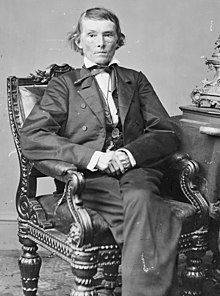
February 9, 1861 – Alexander Stephens Elected CSA President

In a surprising turn, longtime Congressional Representative Alexander Stephens was chosen as President for the provisional government of the Confederate States of America to hold office until formal elections could be held. The constitutional convention meeting in Montgomery, Alabama, had been expected to choose Jefferson Davis, who had twice served as senator from Mississippi as well as being the Secretary of War under Franklin Pierce. However, it became clear that Davis would rather serve his country as a general, and so Stephens was chosen, as he was also a moderate, instead of fiery secessionists Howell Cobb and Robert Toombs. While Toombs had called for war almost immediately (his farewell speech to the US Senate had included, "as one man would meet you upon the border with the sword in one hand and the torch in the other"), Stephens was slow to raise arms. Earlier in the convention that elected him, he campaigned against secession and detailed the American political system with the Republicans holding a minority in Congress and, even if any laws were to be passed around them, the Supreme Court would continue the status quo, as it had in its 7-2 decision in the Dred Scott case four years before.

Georgia native Stephens had always seemed to best understand the mechanics behind the obvious. Despite growing up poor, benefactors had paid for his education, and he passed the Georgia bar at age 24 after graduating at the top of his class. He was routinely ill, even from childhood, but he was a masterful lawyer who, in his 34 years of practice, never had a client charged with a capital crime meet the death penalty. As he became wealthy and established himself with land and slaves, he returned the generosity he had been given by opening his own home to the homeless and paying for more than one hundred students' educations. Even though he was constantly thin from illness, he earned the nickname "The Strongest Man in the South" from his intelligence and craftiness. Stephens went on to Washington as a Representative as a Whig, Unionist, and finally Democrat. His self-described "greatest glory of my life" would be the passage of the Kansas-Nebraska Act in the House by use of rare point of order, thus bringing popular sovereignty to the territory despite the Missouri Compromise limiting slavery to the South.

After the election of 1860 gave Lincoln the White House, Stephens was sent as a delegate to the convention judging the question of secession. Stephens opposed it, arguing that the South bide its time, but was eventually convinced on the grounds of the North not abiding by the Fugitive Slave Law. As one of his first acts in the presidency, Stephens gave his impromptu "Cornerstone Speech" in Savannah describing the new constitution the convention had written, clarifying its differences from that of the United States. While Lincoln referred to the famous line "all men are created equal" in the Declaration of Independence, Stephens replied, "Our new Government is founded upon exactly the opposite ideas” and called slavery a “natural and moral condition." Stephens also outlined economic independence rather than the Federalism of the North, stating, “If Charleston harbor needs improvement, let the commerce of Charleston bear the burden. If the mouth of the Savannah river has to be cleared out, let the sea-going navigation which is benefited by it, bear the burden.”

Finally, Stephens also noted the significance of Fort Sumter, which would prove the first issue of his presidency. Lincoln, only a month into his own presidency, ordered a relief expedition after skillfully dodging any agreements with the South that would have served as a political recognition of the CSA instead of considering it a rogue government. He notified South Carolina’s Governor Pickens of a delivery of “provisions only”, and Pickens turned to General P.G.T. Beauregard, who relayed the information to Stephens. While his cabinet (interestingly, though, not Secretary of State Robert Toombs) called for an attack to clear out the fort, Stephens ordered the CSA to stand down, and Lincoln achieved his goal of feeding Sumter. Stephens was declared “yellow” by many, but the political tide turned back to favor the South a month later when the heavy-handed actions of Union General Lyon in the West attacked parading Missouri State Militia called up by secessionist Governor Claiborne "Fox" Jackson.

While not enough to swing Virginia’s support to the South, Yankees were increasingly perceived as brutes, tarnishing Lincoln’s image, who sent additional troops to Missouri and Kansas, resulting in secession by Arkansas. Guerilla fighting continued, but it was never enough to make a full move against the South without seeming the aggressor. The quasi-war dragged on for years until Lincoln lost his bid at reelection in 1864, and President Horace Greeley was elected by Copperheads to end the war.

Stephens retired the presidency after his single term (as per the CSA constitution) in 1867 as a hero who had “waited out the Union” and became governor of Georgia, confirming the supremacy of the states. The Confederacy continued on its states’ rights, later seeing the secession of the Republic of Texas in 1874 (who later had a number of military disputes with both the US and CS as the West became settled). Attempts were made to add Caribbean and Middle American states to the Confederacy, but each turned into either military blunders or economic burdens. By the 1890s, the South was seen as economically and culturally stunted compared to the great wealth and strength of the industrialized North. A movement began around the turn of the century to rejoin the Union, but many on both sides would refuse. President Theodore Roosevelt’s 1907 Goodwill Tour proved for naught after it brought international attention to the deplorable poverty of newly freed Africans and entrenched the crippling conservatism of the nation.


--

In reality, though Davis wanted to serve as a general, he willingly took the office of president when he was unanimously chosen to do so. CSA Vice-President Stephens disagreed with Davis on many of his policies and constantly pressed for attempts at peace, which was impossible once the war had begun.

Site Meter