Sunday, July 11, 2010

July 11, 1302 – The Supremacy of Cavalry Assured

In the French campaign to subdue Flanders, the decisive battle was fought on a muddy field near the town of Courtrai. Over the past two years, French king Philip IV had appointed a French governor for the county and taken the Flemish Count “Guy of Dampierre” hostage. Unrest by guild members and city leaders led to a heavy hand, and many Flemish were removed from Bruges. On May 18, 1302, the enraged exiles enacted the Bruges Matins, a night where the illegal militia killed any Frenchman they could find, crushing the local garrison.

In retaliation, Philip IV launched an army of about 8,000 (2,500 of whom were cavalry) under Robert II of Artois, while the Flemish organized 9,000 well armed militia. While the French had a classical army, the Flemish were proud of their constant study and practice, considering themselves technologically, and thus militarily, superior. They fought unsuccessfully against the fortified French at Kortrijk on July 9 and 10, then came to face Robert's army itself.

The Flemish were well positioned as the field was not fit for cavalry charges being filled with ditches and streams. Servants were called to put planks in the depressions to allow the horses to charge, though many of the French wanted to attack as quickly as possible to put down the rabble. Robert held his ground and waited for the field to be prepared. While avoiding Flemish skirmishers, the infantry advanced, giving first blood to the battle. Robert began to call back the infantry to enable the proud cavalry to win the victory, but he paused at the condition of the field. He ordered the infantry to remain in assault until the cavalry would be able to make their own attack effectively.

When he pronounced the field of battle ready, the cavalry hit the Flemish lines powerfully. Though they held bravely, the French overwhelmed the Flemish, who attempted to flee but were cut down by the fast-moving French. The Battle of the Golden Spurs (nicknamed as such for the victorious cavalry) was won, and Flanders remained a grudging county under French rule.

With heavy cavalry proven effective, French knights rose to a new standard of haughtiness. In the Edwardian War with England, this would prove disastrous. The English, having been taught a harsh lesson by the Scots at Bannockburn about the effectiveness of attacking infantry against cavalry, used their longbows and infantry against the arrogant horsemen. As the Black Prince took Paris in 1347 (just before the terror of the Black Death, often called God's Punishment on the bloodthirsty men), he succeeded in his bid to seize the throne.

The enormous Kingdom of England & France would be a shock to the rest of Europe, but prove pleasing as it gave aid to Spanish conquerors and Austrian defenders against the Ottomans. Though the Joan Rebellion in 1429 nearly toppled English control, it would not be until the Tudor Wars that France would succeed in its break from England as Catholics made massive rebellion to Henry's divorce of Catherine of Aragon and break from Rome. The resulting conflicts would cripple England, which would bounce between Mary Tudor's return to Catholicism and her half-sister Elizabeth's religious vagueness. With only a ramshackle fleet, the English were no match for the Spanish Armada of 1588, which sailed into London and established Philip II of Spain as king. With England and even the Dutch subdued, Philip was able to rest on his laurels and manage the mighty Spanish Empire, on which the sun was never able to set.


--

In reality, Count Robert II of Artois did not wait for his field to be prepared and called back his infantry to prove the prowess of French cavalry. Ironically, the order proved the opposite as the withdrawing infantry became tangled in the cavalry advance, which itself was hindered by the terrain. The well armed Flemish were able to show the effectiveness of infantry against struggling horsemen, defeating them so completely that the rest of the French army fled. The battle was named “golden spurs” after the plunder taken from dead knights. To this day, the Flemish of Belgium celebrate July 11 as a time of victory for independence.

Saturday, July 10, 2010

July 10, 48 BC – Pompey's Victory at Dyrrhachium

Near Dyrrahachium, a town on the eastern coast of the Adriatic Sea, the Roman Civil War came to a head as the army of the Optimates (the majority of the Senate) under Pompey the Great clashed with the forces of the Populares (the party of the people) under Julius Caesar. Caesar had landed earlier with split troops and now regrouped with his legate Marc Antony with Pompey maneuvering from between them. With 15,000 men and 500 cavalry, Caesar quickly began building forts while Pompey held his fortified positions with 45,000 men.

Pompey attacked Caesar where his lines met the sea, and the larger numbers broke through the Caesarean line. Caesar reinforced, which allowed Pompey to flank his right. The Populare army began to crumble, and Caesar called for the withdrawal. Pompey considered the possibility that Caesar could lay a trap, but he decided to seize the day, something he did less of as he grew older. Taking up his cavalry and fastest infantry, Pompey pursued Caesar to the town of Gomphi. The last of Caesar's veterans tried to assemble hasty defense, but Pompey's numbers smashed through.

With Caesar captured, Pompey and the Senate were victorious. Some senators called for Caesar to be dragged back to Rome in chains for execution, but Pompey refused. He Caesar was honorable, if ambitious, and he was given full rights as a Roman citizen, even excused of potential treason. The senatorial army retook Rome and Caesar's trial began while Pompey carried out the long process of calming Caesar's allies in Gaul and Spain. Three times over the course of Caesar's trial, Pompey would return to Rome with soldiers (both his own and former ones of Caesar's) to quell propositions for overly violent propositions by the Senate.

The trial was a desperate balancing act. On the one hand, Optimates called for Caesar's blood at beginning the civil war. On the other, the people of Rome still held grand esteem for the fallen warlord. Caesar himself, a brilliant orator, could set the city aflame with mere words or letters from his house arrest. Some suggested a quiet assassination, but Pompey and others vetoed the notion. Caesar's death would no doubt begin a second civil war.

At last Caesar was reprimanded for his military activities being impertinent toward Rome and the gods. After many fines and being stripped of most of his titles, Caesar was broken but hardly defeated enough for his many allies to call for retribution. Pompey suggested (or, it is believed, acted as the conduit for a suggestion of Caesar's, as the two remained friends despite their political differences) sending Caesar to the east to settle the frontier there while in exile.

Within a few short years, Caesar would regain his prowess. He would settle the question of Egyptian succession, overturning the attempted coup by Ptolemy XIII and securing Cleopatra VII (who famously became Caesar's lover) to the throne. With his armies still active, Caesar would move across Sinai to quell the Judaeans and even give spark to a fire that would end the Persian Empire, long rivals to the Romans. Using factions against one another as he did in Gaul, Caesar conquered Mesopotamia and marched to the Indus, procuring alliances with princes there.

Caesar's enemies in the Senate once again called for his return to face charges of war crimes (namely, again using his troops more than was legally required or allowed). Pompey would do his best to see that Caesar remained out of the eyes of the people, lest his ambition cause another war, but with Caesar's allies and enemies alike shouting for his recall, Caesar soon came home to Rome, again bringing his most loyal veterans with him. The resulting conflict would cause Caesar to again be named dictator in Rome, a position his adopted sons Marc Antony and grand-nephew Octavian carry on after Caesar's death, establishing a revolution that would carry the Roman Republic peaceably until it grew inflated, rich, and fat, ready for plucking by German barbarians in the fourth century.


In reality, Pompey ordered a halt after the rout of Caesar's troops, often attributed to Pompey's growing fearful or weak with age. Caesar's troops regrouped, resupplied, and rested at Gomphi, readying for the Battle of Pharsalus, where Caesar would soundly defeat Pompey's troops. Pompey would flee to Egypt, where Caesar would pursue him, only to find him assassinated. Caesar's rage at the murder of his friend, a Consul of Rome, and widower of his only (legitimate) daughter prompted him to overthrow Ptolemy to secure punishment for all involved in the slaying.

Friday, July 9, 2010

July 9, 1755 – Council of the Monongahela

In the French American War (later to be known as the Seven Years' War in Europe), a contingent of 2,100 British troops marched out under General Edward Braddock against Fort Duquesne in what is now western Pennsylvania County. Braddock had been charged to drive the French out of the chain of forts south of the Great Lakes, a goal presumably easily accomplished with his numerically superior army, complete with two regiments of British regulars.

Late on July 8, a delegation of Indians (Native Americans) had arrived at Braddock's camp asking that they be given the chance at negotiating a peaceful withdraw of the French. Looking to spare their lands, many of the Indians had remained overall neutral, though most leaned toward the French in loyalty. Colonel George Washington of the colonial militia and Chief of Scouts Lieutenant John Fraser suggested that Braddock agree. Braddock had had little luck procuring allies among the Indians (only eight Mingo joined him as scouts). He decided to refuse the request.

On the morning of the ninth, after a night's reflection on seeing the ruins of Fort Necessity the day before, Braddock reversed his decision. He sent Washington and Fraser to meet with the Indians and coax alliances if possible. That afternoon, near the Monongahela River, the Indians mediated while the English and French discussed terms. Despite facing overwhelming odds, French commander Lienard de Beaujeu, dressed in full military regalia as well as warpaint, refused to depart. He attempted to cheer his Indian allies into attack, but the Indians declined. The English suddenly seemed much more reasonable to these neutral parties.

Without his Indian allies, Beaujeu returned to his fort and awaited the attack while setting an ambush. The next day, not far from their meeting on July 9, the Battle of the Monongahela occurred as 300 British grenadiers in the advance guard met with the fully expected ambush. They withdrew, successfully regrouped with the main force, and proceeded to crush the ambush, killing Beaujeu. The fort fell quickly afterward, despite second-in-command Dumas rousing French morale.

Braddock, now aided by more willing Indian allies, proceeded to rout the French across Lake Erie. While the military aspect of the campaign would prove negligible (the French would lose Canada in the 1763 Treaty of Paris, just as well with astounding defeats in the remainder of the colonial war), the great impact would be the Indians' diplomatic connections with the British. With secure and clear channels to discuss settlement across the Appalachians, there would be few incursions and reprisal attacks, and those would be seen as criminal activities by both sides. In fact, trade would prosper between the colonists and their native neighbors.

The British were thus spared great expense at defense of the colonies by relying on Indian allies. Such expense might have prompted Parliament to raise taxes, adding stress to an already troubled relationship with the colonists. When taxes were raised by the Tea Act to save the British East India Company, the resulting Boston Rebellion would spark the successful Taxation of Colonies Act of 1778 and give birth to the Continental Congress to serve as a local Parliament raising taxes through representation.

While there would be tensions as colonists continually crept westward, most interactions with the Indians would be peaceful until Tecumseh's War (1811-1813). As the attempt at Indian unification would fail with the death of Tecumseh, the British would take the opponents as conquered enemies, driving the Indians westward and eventually onto reservations all over the enormous expanse of British North America.


In reality, Braddock would keep his decision to march against the French on July 9. The attack would be an initial success as British grenadiers chased back French and Indians attempting to set an ambush at the river. As the grenadiers fell back under fire, however, they would get caught on the narrow forest road, mixing with the British regulars. In the confusion, French and Indian snipers picked off British officers, including Braddock, and the British would be routed in humiliating defeat.

With the Native Americans as secure allies, the resulting conflict would become known as the French and Indian War to the American colonists.

Thursday, July 8, 2010

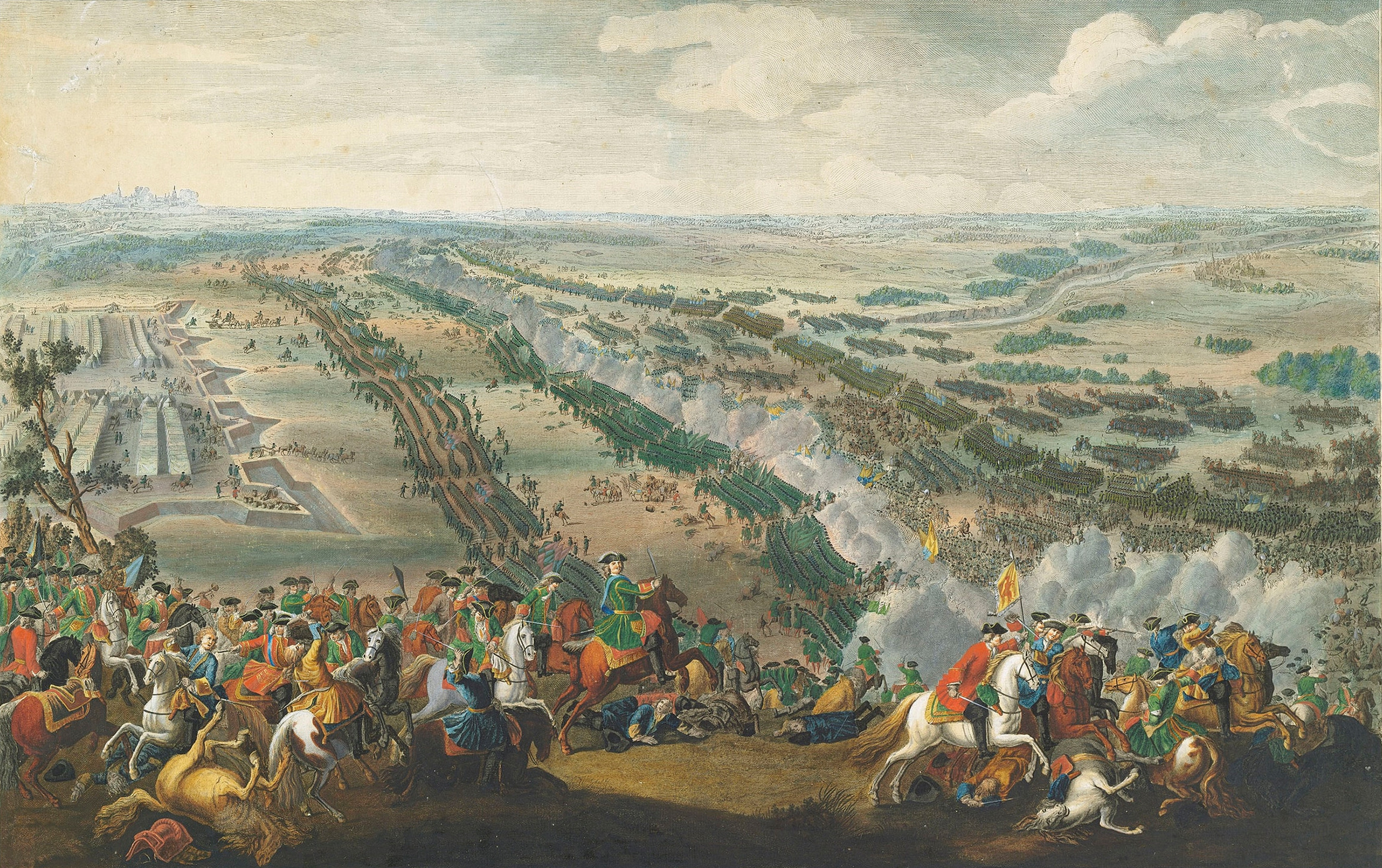
July 8, 1709 – Swedish Victory at Poltava

On a warm and humid night, Swedish troops under the command of Charles XII attacked and prevailed over a larger Russian army commanded by Peter I.

The Great Northern War had raged since 1700, when Denmark, Russia, and Poland attacked Sweden and its allies. Sweden under Charles XII turned back the tide of war, first opposing the Danish and Russian attacks, then in a counterattack defeating August the Strong (Elector of Saxony, King of Poland, and Grand Duke of Lithuania), driving him out of his throne and turning the lands into allies. With the Danes removed from the war by skillful maneuvers of the Swedish navy and army and August destroyed, Charles turned toward Russia.

Peter I, rarely known as Peter the Great, had spent the years Sweden fought into modernizing his army and making conquests in the eastern Baltic. His greatest stab at Sweden was founding Saint Petersburg in 1703 to solidify a port on what was once Swedish soil.

Charles marched into Russia and the Ukraine (a longtime conquest of Russia) in 1708, having waited for the winter to freeze the Vistula River. He sent General Lewenhaupt out to gather supplies, which he did speedily that spring, rejoining Charles in the Ukraine with news of the improved Russian troops, which he had narrowly evaded by the Sozh River. Skirmishes and small battles had quieted any arrogance Lewenhaupt might have about Russian infantry.

In 1709, having wintered with only minor losses thanks to the supplies secured by Lewenhaupt, Charles went to secure his supply lines in preparation for a campaign on Moscow. His first target was Poltava, which Peter had defended with improved bulwarks and 60,000 troops. Kalmyk allies to Russia were on their way to join Peter, so Charles acted quickly.

Swedish cannon pounded the defenses, and, at 3:45 AM, Lewenhaupt led a stout Swedish attack of infantry. Because of the effective use of artillery, the Russian defenses folded. At 8:30 AM, Peter himself led a desperate counterattack from the north aided by his cannons. While the Russians routed Swedes initially, they pursued outside of the range of fire, and were routed. Peter was killed at the head of his troops, reportedly not dying from musket wounds until being torn limb-from-limb by cannon-fire.

With the Tsar dead, the Russian troops retreated. Charles secured Poltava, rebuilt the defenses, and routed the incoming Kalmyk cavalry in such a defeat that they abandoned their Russian allies. Left with Peter's wife Catherine in command, Russia mounted a brave defense (though not daring enough for scorched earth). No armies could stand up against Charles' quick attacks. With newly liberated Ukraine giving supplies from the breadbasket of Europe, Charles arrived in Moscow in October, wintering there while working with Catherine over the details of her surrender. Rather than conquering Russia, Charles would make it an ally, a buffer against western Mongol bands. The Great Northern War had ended with Sweden victorious, effectively knocking Russia out of significance in Europe. Russia would remain an Asian power until its disastrous defeat by Japan in 1905.

In Europe, Swedish power continued to grow. Charles was ceded Saint Petersburg (he kept the name) and maintained Baltic dominance. In the following century, Sweden would begin many important colonies all over the world in Africa, the East Indies, and the West Indies to build its naval power. While it would lose ground in the Seven Year's War, Sweden would injure its new enemy Britain by aiding its rebellious colonies in the 1770s and gain great conquests as Napoleon's ally until his betrayal in his disastrous attempt to conquer Stockholm in 1812. Then fighting opposed to Napoleon, Sweden was given Norway in 1814 at the Congress of Vienna.

The nineteenth century would prove generous to Sweden, though World War I would devastate its navy as German U-boats tore through Swedish battleships. The loss of manpower in the Danish trenches and collapse of the world economy would tear the Swedish Empire apart, making way for the fascists to gain control in 1933. World War II would prove even more disastrous as the Allied Powers turned their attention to Sweden after the fall of Hitler. The Swedish Empire would be broken into pieces with liberated Norway, occupied Sweden, and Finland finally held once again by their old nemeses, the Russians. Gradually Sweden would fall to Communism in the late 1950s and try to reconquer its neighbor Norway, sparking the long and unresolved Scandinavian Conflict with its Demilitarized Zone stretching over 1000 miles. Car bombs and paramilitary attacks are common on the war-torn peninsula.


In reality, Lewenhaupt did not leave until late June on his mission to gather supplies. When his army did march, he was dogged by modernized Russian troops, losing the Battle of Lesnaya. He abandoned cannon and supplies, which caused a mutiny of his soldiers, who proceeded to drink. He left more than one thousand drunken troops in the woods, and only half of his 12,000-strong army managed to regroup with Charles.

The defeat at Poltava would spell doom for the Swedish Empire and make way for Russia as the next great power in eastern Europe.

Wednesday, July 7, 2010

July 7, 1947 – Howard Hughes Killed in Crash

While piloting an experimental aircraft for the US Air Force, Howard Hughes, one of the greatest American inventors and innovators, perished in a crash in Beverly Hills, California. The craft was the XF-11, a plane meant for reconnaissance with a range of 5,000 miles and a top speed of 450 mph. Later searches through the wreckage would point the failure to an oil leak, which thus ended the exciting and versatile life of Howard Hughes.

Born in 1905, Hughes was the son of Howard Hughes, Sr, a cunning inventor and entrepreneur who created the two-cone roller bit used in drilling for petroleum that allowed him to found the Hughes Tool Company in 1909. Hughes, Jr's, mother died in 1922, and his father in 1924 of a heart attack, leaving Hughes an emancipated minor in 1925 with full command of his family's immense wealth.

Hughes was known for many skills: He played golf with professional athletes through his twenties, but never pursued a career himself. He produced numerous films in Hollywood, including 1932's Scarface and 1928's Two Arabian Knights, which won an Academy Award. He also designed and flew aircraft, his greatest work.

Most famous was his H-1 Racer, a plane in which he set airspeed records (though later proven already accomplished) and records for flight time, such as his trip between LA & NYC in 7 hours, 28 minutes, 25 seconds in 1937. Awards were showered upon him. Hughes even received a Congressional Gold Medal in 1939, but he was much too busy to pick it up. It now rests in the wing dedicated to Hughes in the National Air and Space Museum.

At the time of his death, no one could say a bad thing about him. None can guess what would have come of the young genius had he survived. Perhaps with his designs and urgings, commercial airliners would have eclipsed the ever-popular train for travel within the country.


In reality, Hughes survived, despite third-degree burns, broken ribs, a collapsed lung, a crushed collar bone, and additional injuries. In the years that followed, he would design and fly the infamous H-4 Hercules (also known as the “Spruce Goose”), gain control of RKO films, and finally moved to Las Vegas, where he would descend into mental and physical illness. Today, Hughes is sadly much better known for his eerie lack of hygiene and various addictions than for his innovations in aviation.

Tuesday, July 6, 2010

July 6, 1535 – Thomas More Escapes

Mere hours before his execution, Catholic loyalists managed to sneak Sir Thomas More, once a favorite of Henry VIII and now a nemesis for his dedication to the Pope, from his prison in the Tower of London. Henry declared a nationwide search, but More was able to escape from England and into France under the guise of a book-trader.

In France, he shed his disguise and began to journey to Rome. Catholic supporters surrounded and protected him despite the impressive bounty offered on his head by Henry. Narrowly dodging two assassinations, More caught word that Henry himself was plotting war to capture the treasonous statesman by any means possible. He claimed no fear of the king or for his life, but he feared for bloodshed and sin resulting from war, and so he disappeared, falling in with Alpine monks under an assumed name.

While Henry's rage never ceased, his life did, and his son Edward VI assumed the throne. Moving away from Catholicism, Edward and Thomas Cranmer, the Archbishop of Canterbury, imposed Protestantism and the infamous Book of Common Prayer. Upon his death at only 15, crisis followed with Lady Jane Grey's attempt at the throne, but Edward's half-sister Mary I managed to lay successful claim.

Less than a month after her crowning, an elderly monk presented himself as the septuagenarian Thomas More. With his political craft as well as the advice of Cardinal Pole (replacement for Cranmer, whom Mary had burned at the stake), the queen was able to heal England's separation from Rome, albeit under a fairly reformed condition. Priests retained their right to marriage, but the Book of Common Prayer was destroyed alongside any editions of Tyndale's English Bible. The Marian Persecutions raged, chasing Protestants out of England and executing those who remained.

Mary died in 1558, succumbing to what medical historians would later determine a hormonal disorder brought on by tumors. The aged More lived only a few months more, seeing the succession pass safely to the Catholic Mary, Queen of the Scots, as Mary I's sister Elizabeth had died at Hatfield House in a fire often found suspicious. England continued Catholic, despite the Protestant Rebellion of Oliver Cromwell in the 1650s.

However, Henry VIII's short-lived separation from Rome always left its mark on the land and people, so much so that after the revolution of the American colonies led to the United States, the first amendment in their Bill of Rights read in 1789, “Congress shall make no law respecting an establishment of religion, or prohibiting the free exercise thereof.” While England called for a new Crusade against such unorthodoxy, the Enlightenment had shifted the interests of Europe, and Rome had lost much of its power. Humanism and material philosophy had made moot a question which, only a few centuries before, had nearly torn Europe apart.


In reality, Henry VIII successfully executed Thomas More, who would be canonized by the Catholic Church in 1935. England began its precarious march to Protestantism, which aided in the bloody separation of northern Europe from southern along religious lines, helping to spark altercations such as the Thirty Years War and English Civil War.

Monday, July 5, 2010

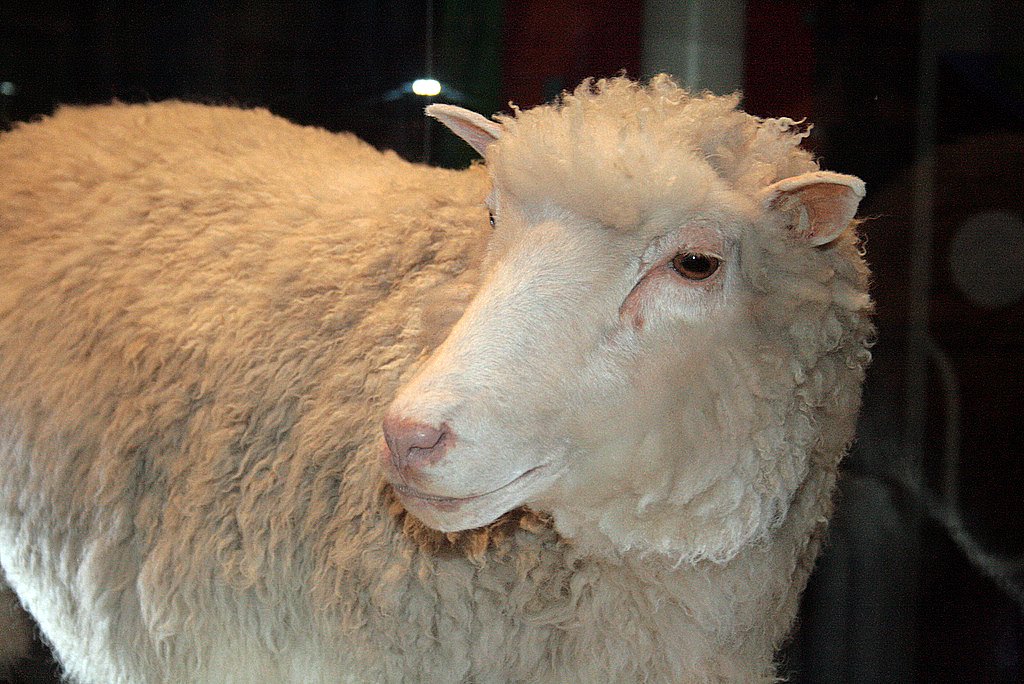
July 5, 1996 – Dolly the Dinosaur

Scientists at the Roslin Institute in Scotland created the first large mammal clone, a sheep named Dolly. Using emptied egg-cells and the nucleus from a mammary adult stem cell from another sheep, Dolly was, genetically, identical to the donor sheep. A haphazard process, Dolly was the only of 277 lambs to survive to adulthood.

While celebrating successes, an inebriated biology student beneath Wilmut and Campbell on the project, William Howard, boasted, “Well, so what, I'm gunna clone maself a dinosaur!”

Laughed off as the usual drunken banter of graduate students, the resulting angry spite from Howard caused him to pursue the project. He had no funding, but the widespread fame of Jurassic Park, the novel by Michael Crichton and film by Steven Spielberg, gained him notoriety. He used the newly developing Information Superhighway to start a message board, news group, and account for donations, usually only a few pounds, dollars, and, later, euros at a time. Picked up by the tabloids as perhaps a prank, Howard's popularity took off when he indicated that he was indeed serious.

Howard collected funds, began his lab, worked building relations with leading paleontologists (at least ones that would take him seriously), and created a team of innovative biological technicians. While the lab practiced cloning birds and amphibians, Howard waited for a specimen. Many rumors spread that he would attempt a wooly mammoth first, but Howard routinely refused.

In 2007, researchers at North Carolina State University under Mary Schweitzer claimed finding preserved material of a Tyrannosaurus Rex, clearly too good to be true as the king of the dinosaurs being the first to be cloned. Further research proved the material to be biological film, useless scattered bacteria.

In 2009, Schweitzer's team used similar techniques to discover actual bone cells and minute fragments of blood vessels of a Brachylophosaurus. This was Howard's chance. Over the next few years, his lab isolated usable DNA, sequenced it, and managed to reconstruct a whole system. After two months gestation, the first dinosaur in untold generations hatched from a nest of artificial eggs created from those of an ostrich. She was named “Dolly” after her sheep technological ancestor. Contained in a hyperbaric chamber made to mimic Cretaceous Earth, the first dinosaur lived only a few days, but more of its sisters successfully grew into adulthood.

Public outcry roared on positive and negative ends of the spectrum. Many claimed Howard was playing God, others said that he was leading mankind into a new era of ecological preservation. As he accepted his Nobel Prize, Howard repeated his drunken boast, affirmed it, and said he'd move on to mammoths now.

A hyperbaric terrarium later opened at the London Zoo, the first of many where eager tourists walk among peaceful herds of duck-billed dinosaurs munching on fronds. No interest has been made to reintroduce them to the wild in a world so changed from their own.


In reality, Dolly was successfully cloned, but no dinosaurs have come from her legacy. In 2009, a clone of a Pyrenean ibex, declared extinct in 2000, was successfully born, though she died shortly afterward.

Site Meter