Swedish-born Alfred Nobel worried over his legacy as his life came to an end. In 1867, he patented dynamite, a stable form of nitroglycerine soaked into an absorbent. It was to be a great boon to mankind: a tool for excavation for construction, for demolition of dangerous structures, and for swift, safe digging to mine Earth's bounty as well as build roads for travel and commerce. Afterward, he had invented further explosives, such as gelignite (blasting gel) and the smokeless propellant ballistite. All of these great leaps forward for the human race were quickly adapted to military use, however. Ballistite would even cause newspapers to accuse Nobel of treason against France as the Italians changed their rifles to use his compound.
His real concern came as he learned of an obituary that had been written about him, mistaking his death for that of his brother Ludvig. A French newspaper wrote “the merchant of death is dead” and said that he had become “rich by finding ways to kill more people faster than ever before.” His patents for artificial silk, artificial leather, and other improvements were never mentioned. A lifetime of devotion to invention had made him out to be a monster. To rectify this, he wrote his last will and testament in 1895, one year before his death by stroke, dedicating 94% of his vast fortune to a foundation to give out prizes in physics, chemistry, medicine & physiology, literature, and peace (supposedly brought on by his long relationship with the pacifist countess Bertha Kinsky, who had married another man). While writing at the Swedish-Norwegian Club in Paris, someone remarked that he had great notions of working toward the betterment of man, but nothing to study what the betterment was. His formulation of the literary prize was for works “in an ideal direction”, though it now seemed that the direction needed definition. To fill the gap, Nobel decided to add a sixth prize for the “sciences of society.”
In 1901, the prizes began (Austrian Sigmund Freud winning the first Social Science prize for his Interpretation of Dreams) and have continued yearly since. By 1906, however, it became obvious that the Prize for Social Science had unleashed a hailstorm of new ideas when Max Weber received the prize for discussions in his essay, “The Protestant Ethic and the Spirit of Capitalism.” The secularization and depth of scientific study of people in society had suddenly become very real to the largely Edwardian Western culture. In 1913, Émile Durkheim won in recognition of his comparisons of aboriginal societies to modern ones, giving further clout to the in-depth study of humanity as one would study the laws of gravity.
There would be many winners of the Social Science prize over the years in fields as diverse as economics, psychology, education theory, legal and political science, and behavioral science. Along with the progression encouraged by the growth of material and social benefits, there has been a good deal of questioning the morality of treating humans as Petri dish. B. F. Skinner's win in 1953 would cause many to suspect that it would only be a matter of time before humans were reduced to robots under an artificial paternalism. Encouragement from the Peace Prize and discoveries lauded in physics, chemistry, and medicine along with social commentary from Literature kept the prestige of the Nobel prizes strong.
Even with the fears of 1984 and A Clockwork Orange, it is evident that the Prize for Social Science has made positive impact on humanity. Following the act-reward programming for international diplomacy and the UN's Universal Declaration of Human Rights, the world has been studied and organized into all but eliminating starvation and death from preventable disease. On the other hand, opponents argue that the majority of the human race has been turned to salary-slave consumer-addicts, continually chasing upward mobility while enjoying momentary vicarious pleasures from politico-industrial sponsored sporting events and taking in well clad palatable pop-science as hope (or fear) for the future. Some naysayers of the naysayers ask simply, “What's wrong with that?”
–
In reality, Nobel founded the five prizes. In 1968, the Sveriges Riksbank established a prize for economics in Nobel's name during celebration of their 300th anniversary. While not initially a prize for social science, the prize has gradually become so, expanding from simple economics through game theory.
Showing events on this day in years past that shaped history... just, not our history.
Friday, December 10, 2010
December 10, 1896 – Nobel Leaves Legacy for Six Prizes
Labels:
alfred,
alternate history,
nobel
Thursday, December 9, 2010
December 9, 1945 – Patton Escapes Car Crash Unharmed
While on his way to a hunting trip in the German countryside, the Cadillac belonging to General George S. Patton collided with a left-turning 2 ½ ton truck. Patton’s driver, Private First Class Horace Woodring, rather than braking and hitting the truck at lower speed, briskly turned to dodge, and the two vehicles slammed into one another’s sides. Woodring and Patton’s chief of staff Major General “Hap” Gay both suffered bruises, but Patton seemed totally unhurt after tumbling sideways.
The accident seemed to follow the course of luck that could be traced through the old soldier’s life. Patton had attended the Virginia Military Institute and United States Military Academy, competed in the modern pentathlon at the 1912 Summer Olympics, finishing fifth overall and the only non-Swede in the top seven. He studied swordsmanship in Europe the next year, going on to become the youngest Master of the Sword in Army history. From there, Patton became an instructor, wrote pamphlets, and helped design the Army’s final saber in 1913, later nicknamed the “Patton saber.”
Peace soon gave way to war, and Patton’s real career began. He served as Pershing’s aide in the Mexican expedition in 1916 and then became a captain among the US Tank Corps in WWI. Campaigning for years to acquire funding for armored divisions for the US Army, but with little success, Patton spent the between-war years stationed in Hawaii (where, in 1931, he wrote a defensive plan for a potential air raid) and in Washington, D.C., (where he led tanks against the Bonus Army on the orders of General Douglas MacArthur). When WWII began, Patton’s arguments for armored divisions gained clout, and he was promoted to major general to head the 2nd Armored Division.
Patton’s leadership would give the Allies massive advantage in the African and European Theaters of the war. The “Desert Fox” Irwin Rommel was notoriously concerned of Patton, and the German military would routinely place their best troops against him, often to no great avail. Patton pressed his troops through North Africa, Sicily, and France.
While a master on the battlefield, Patton met with great controversy when bullets did not fly. Hoping to motivate his men, he maintained a powerful visage and carried nickel-plated revolvers with ivory handles. He swore constantly, even in public addresses. Patton’s belief in the honor of the military contradicted Eisenhower’s easy-going nature and cartoonist Bill Mauldin’s ridicule, both of whom chafed Patton’s temper. Most shocking was the “slapping incident” in Sicily where Patton had hit a soldier suffering from shellshock and ordered him back to the front. Patton would be stripped of command for a time, but he would use his time to confound German intelligence on where the European landing would begin. After Normandy, Patton would be back in command with the Third Army and helped in the liberation of Europe.
As the war came to an end, Patton began to give warnings about not being able to trust the Soviets. Some 25,000 American POWs had been liberated but not returned in Eastern Europe, where the communists were seemingly settling in. Patton suggested that the American Army be ready for war again to keep Russia in its place while they were low on supplies. Instead, the Army began dismantling itself for peacetime, and Patton was reassigned to the Fifteenth Army, which was mainly handling occupation and historical collection.
After the accident, the Fifteenth Army headquarters was inactivated on January 31, 1946, and Patton sent his request for retirement to the War Department, which was approved. According to Hap Gay, Patton would have resigned if retirement had been refused. The weight of peace seemed too much for the old soldier to bear. When Patton returned to his native California, he began a lecture circuit, which provided a great deal of scandal, and primarily wrote, commenting on his past as well as the present and future of America. He consistently warned of Soviet expansion, which gained the attention of political movements.
Patton was invited to the 1948 Republican National Convention in Philadelphia. He was surprised to be seen in politics and even more to hear that he had been placed on the ballot. While he campaigned rigorously after the invite, it was apparent that he had no real hope of taking the presidency as Dewey had cinched the vote and Patton’s infamy preceded him, not to mention that his military clout was blocked by votes going toward MacArthur. Instead, Patton returned to retirement, writing to several friends with the exclamation, “God, give me a war to fight!”
As if an answer to prayer, Patton was called up by Vice President Richard Nixon to be an adviser in the situation in French Indochina, which was quickly becoming known as Vietnam. Having watched the turmoil that was the Korean War from the sidelines in agony, Patton was eager to sort out the situation himself. Though he agreed with MacArthur’s suggestion to use atomic weapons, Patton was disgusted by his former commander’s disrespect of President Truman. Patton arrived in Saigon and met with CIA advisers, many of whom had connections back to the old Army OS. Upon his assessment, Patton shook his head over the situation and said of Ngo Dinh Diem, “I wouldn’t fight for him, even if it were against Stalin himself.” It was clear the people preferred Ho Chi Minh, who was a cunning warrior working to limit trouble upon the peasants.
Patton wrote an extensive description of the corruption in South Vietnam and suggested winning over the resistance-fighters of the Viet Minh rather than trying to fight the Viet Cong and their pro-populace support. The CIA worked to follow his plan, infiltrating North Vietnam and gaining leverage as the Sino-Soviet split began to appear in the late ‘50s and became clear by the ‘60s. With the American-backed regime change in South Vietnam in 1958, the short-lived Vietnam War of 1959-60 established firmly the division between the Communist North and the increasingly western South, as had been seen in Korea. Containment continued to be the policy of the United States as it subtly transformed itself over the twentieth century while Communism would self-destruct by the 1990s.
However, Patton would not live to see his influence on modern events. He died at age 72 in December of 1957 while touring Vietnam and suggesting military placements for defense along the northern border despite rainy weather. His body was returned to the US, where it was buried in Arlington Cemetery.
–
In reality, Patton suffered a broken neck from the collision when the Cadillac struck the front end of the truck. Patton was thrown forward and hit his head on the partition between the front seats and the back. He was paralyzed from the neck down and rushed to the hospital, where he would die of a pulmonary embolism twelve days later. He would be buried in Luxembourg, at the head of his fallen fellow troops in honor of Patton’s asking that he "be buried with my men."
Labels:
alternate history,
patton,
vietnam
Wednesday, December 8, 2010
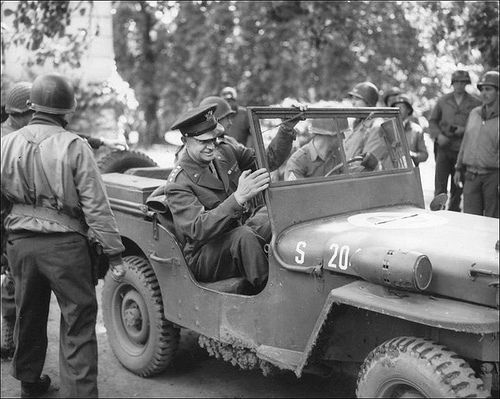
December 8, 1943 – Eisenhower Dies in Jeep Accident
One day after being unceremoniously appointed Supreme Commander in the coming Operation Overlord in a handwritten note from FDR to Stalin, General Dwight David Eisenhower died in a jeep accident while being transported from headquarters. While some speculate that the accident was in fact Nazi assassination or perhaps political intrigue, the majority of historians agree that it was simply the fault of a dog crossing the road. Funeral services were conducted in Europe and again in the United States with the war hero’s body being interred at Arlington National Cemetery. Having lost a great leader, FDR woefully appointed Chief of Staff George C. Marshall, whom he had earlier told, “I didn't feel I could sleep at ease if you were out of Washington” when explaining his choice.
Many considered the appointment a demotion for Marshall, as he was in key position in Washington to organize and manage the resources of the Allies. Churchill himself would call Marshall the “organizer of victory”, and now it was Marshall’s duty to exact that victory in Europe. With the landing at Normandy in June 1944, victory in Europe gradually became a reality. When the war ended, Marshall continued to his duties to America by his appointment to China by President Truman to broker peace between the Chinese Nationalists and Communists. No peace could be made (and Marshall argued against the Pentagon that the United States simply shouldn’t become involved), and Marshall returned to the US, soon appointed Secretary of State. Here he would win a Nobel Peace Prize for his “Marshall Plan” for the organization and rebuilding of post-war Europe, also being named Time Magazine’s Man of the Year for the second time.
After retiring on grounds of ill health, Marshall was again brought to duty on the call of President Truman to be Secretary of Defense. The Korean War had shown how poorly the post-war American armed forces had been organized, and no one organized better than Marshall. Marshall effectively prepared the military for demobilization in less than a year and retired again. Meanwhile, fellow Five Star General Omar Bradley would be instrumental in Truman’s decision to relieve MacArthur of command before he sparked a war with China.
In 1952, Marshall would be called up again, this time by the Democratic Party. General Bradley was running on the Republican ticket for president, and the Democrats sought a president that could surpass his military clout. Marshall declined, saying, “I’ll stick with retirement. When men like Joe McCarthy are running around, Washington is no place for me.”
While the Democratic nominee Adlai Stevenson would lose out against President Bradley, Marshall’s famous statement would cause a surge of unpopularity for McCarthy, costing him his reelection to the Senate. Bradley’s two terms would be famed for their time of prosperity, forward development with projects such as the Bradley Continental Highway, and his liberal leanings, continuing New Deal programs and combating segregation, as well as his openness in international policy with Communism. The Bradley Doctrine would prevent America from becoming something of a policeman, instead working to ensure that proper popular elections were held, preventing another Korea and MacArthur.
Through the course of the latter half of the twentieth century, Communism would grow throughout the world, taking over many nations in Southeast Asia, North Africa, and Central and South America. By the 1980s, however, the Stalinist nations would begin to fall apart after defeat in Iran and Afghanistan, leading to Germany reunifying and the Soviet bloc disappearing. The other “communist” nations of the world turned either into militaristic dictators or revolutionized themselves as seen in Red China, conflict with which Bradley had said would be "The wrong war, at the wrong place, at the wrong time, and with the wrong enemy."
–
In reality, Eisenhower lived to effective serve as Supreme Commander. Marshall conducted his administrative duties as necessary before retiring, while Eisenhower took up the election of 1952 to oppose the isolationism of Senator Robert Taft. In his presidency, Eisenhower set the precedent of fighting Communism as it grew up in nations, using the CIA and military advisers to prevent its spread.
Labels:
alternate history,
eisenhower,
marshall,
omar bradley
Tuesday, December 7, 2010
December 7, 1941 – Pearl Harbor Raid Destroys Two Carriers
At 7:48 AM, Hawaiian time, the air raid on the American fleet stationed in Pearl Harbor began as the Japanese Operation Z came to completion. For several hours, cacophony and pandemonium reigned over the base, with more than three thousand killed, thousands more wounded, and nine ships sunk with another dozen damaged. It was truly a date that would live in infamy, as President Franklin D. Roosevelt would report to the American public the next day as Congress began its proceedings to vote a declaration of war that would bring the United States into World War II.
What was a haven of misfortune for the American Pacific Fleet became even worse as fateful flukes brought two of America’s three aircraft carriers to the harbor. Bad luck had haunted the USS Lexington as it had prepared to venture with Task Force 12 to carry marine aircraft in reinforcement of Midway Island, long expected to be the battleground for a Japanese attack, if any. Engine troubles had kept the Lexington at Pearl Harbor with engineers baffled and working to improve repairs that had been overly hasty some time before. The Enterprise, meanwhile, had seemed to carry good luck, arriving into port a day ahead of schedule on December 6 thanks to catching favorable current from a distant storm. The two carriers were well placed near Battleship Row for the Japanese torpedo-bombers to destroy both.
By afternoon of December 7, the USS Saratoga was the only American carrier in the Pacific. It raced into action to reinforce Wake Island, stopping at the devastated Pearl Harbor along the way only long enough to refuel, but was forced to turn back when the Japanese conquered Wake with the remainder of its attacking fleet on its return from Hawaii. Running patrols and hoping to recoup, the States soon launched the USS Hornet, which had been laid down in 1939 and commissioned only two months before. In a strike that would be tactically negligible but key to American propaganda, the Hornet would serve and the launching platform for the Doolittle Raid against Tokyo on April 18, 1942,, showing the American and Japanese public alike that the US could strike wherever it wished.
In retaliation for Tokyo, Yamamoto realized the need for a strong buffer from US ships and determined to strike at Midway. The US Navy had always anticipated the attack, and the battle would be the second large-scale altercation of the Pacific War after the devastating loss at Coral Sea. Despite having broken Japanese code and inflicting heavy losses, the Americans would be forced to surrender with the sinking of the Hornet as they simply did not have the manpower to throw back the Japanese attack, much as had happened at Coral Sea the month before, where the Lexington had been sunk.
With these two major losses, the Japanese Empire stood almost unopposed in the Pacific. The Aleutian Campaign saw brutal US Marine defense against a Japanese island-hopping campaign that inflicted frustration among commanders. Meanwhile in the South Pacific, the Japanese fleet transported its army into swift invasions of New Zealand and Australia. While principle population centers such as Sydney and Auckland and important resources such as Australian copper mines were firmly controlled, the Aussies and Kiwis launched guerrilla campaigns from the mountains and Outback. Japanese soldiers would struggle through the war simply to maintain a semblance of control amid ambushes, sabotage, and assassination, which were traded by death-marches through the Australian desert and bitter treatment in prisoner-of-war camps.
It would not be until 1944 that Allied fortunes in the Pacific began to change for the better. The successful taking of the Gilbert Islands led to a new campaign that brought the liberation of New Zealand that June, followed by Australia that August. Challenging the Japanese oil supplies from the Dutch East Indies, General Douglas MacArthur finally made good on his promise to return to the Philippines in the counter-attacks of the fall of 1945. That December 7, four years after the war had begun, at President Truman’s authorization, the first atomic bomb was dropped on the city of Hiroshima. A second would be dropped shortly after, and the Japanese emperor, citing specifically the pressure of Soviet invasion from occupied Korea, surrendered.
While many speculate what might have happened had the US Pacific Fleet been at full strength with its carriers after Pearl Harbor, it is a somber memory of what did in fact occur. From the agony of occupied Oceana to the jungle warfare of Southeast Asia to the genocide in China and the vicious bloodlettings in the Aleutians, the Pacific theater of WWII serves as a grave reminder of the terrible actions of war-hungry men. Since then, we have seen the marginal peace of the Cold War and Pax Americana interrupted at times by greed and wrath such as communist Korea’s periodic baiting missile-launches toward capitalist Japan.
–
In reality, neither the Lexington nor the Enterprise were at Pearl Harbor the morning of the seventh. With undamaged carriers and incredible effort in repairing and embiggening the Pacific fleet, the Allies held Japan at Coral Sea and Midway, turning back the tide of war that could have spread its destruction much, much further.
Labels:
alternate history,
pearl harbor,
world war 2
Monday, December 6, 2010
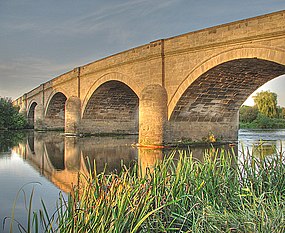
December 6, 1745 – Prince Charlie Crosses Swarkestone Bridge
In England's Revolution of 1688, often termed the “Glorious Revolution”, the Stuart dynasty was removed from the English and Scottish thrones once more, this time deposed by William of Orange at the invitation of Parliament. The Catholic kings of a Protestant nation had been a struggle through the seventeenth century, but many in Britain felt that the Stuarts would be best upon the throne, especially as non-English-speaking Germans from Hanover began to rule. The Stuart Cause would continue, even after “The Fifteen”, a bungled invasion by James III & VII after which the Old Pretender was no longer welcome in France as an embarrassment.
Prince Charles Edward Stuart (fondly known as “Bonnie Prince Charlie”) had been trained for war since his birth. He witnessed sieges, studied with commanders, and took up pursuit of the generalship that would win him back his throne. While his father was the exiled king, James III & VII still had enough influence to persuade France into sending an invasion fleet in 1744. In preparation, Prince Regent Charles went to Scotland and began to raise his army of supporters. While the French invasion never materialized, Charlie decided to carry out the reconquest of Britain himself in 1745.
With two ships and an army of eight men, Charlie landed at Eriskay on July 23. Finding great support among the Highlanders, Charlie raised his father's standard and formed up an army large enough to subdue Edinburgh. At Prestonpans on September 21, Charlie met with the only government army to stand against him in Scotland, which he soundly defeated, inflicting ten times the causalities his force took. From there, he pressed south, moving practically unopposed with 6,000 men through Cumbria and Derbyshire to Swarkestone Bridge. There, word said that few supported him in the south and, worse, the government was building a mass of force to counterattack. Charlie's commanders advised him to turn back and raise more of his own support.
Charlie decided to ignore them and pressed southward while momentum was with him. It was found that few did support him in the south, but few supported the Hannovers as well. As winter settled, Charlie made for London, hoping to besiege the city during its hungriest time. His only obstacle was a force comparable in size to his own, though hastily assembled, led by King George II's son, the Duke of Cumberland. They met at Hatfield on December 18, where Charlie's Highlanders made use of the ancient woods to minimize the effect of the government cannon. When the battle was won, Charlie seized the cannon and turned it on London for the winter siege.
By spring, the city was in an uproar against Parliament. Without hope of fresh food coming that spring, the winter starvation would grow even worse. Charlie welcomed anyone who would desert the city and join his cause, strengthening his ranks with generous Christmas and New Years' feasts. Finally, on April 16, Parliament conceded and voted to reinstate the House of Stuart and oust George II. Charlie's father James would be crowned later that year and rule until his death in 1766. The aged James was feared as being a Catholic tyrant, but he proved largely ineffectual, his most vivacious act being to keep Britain out of the Prussian War, where Frederick the Great established himself as a power on the Continent.
Charlie, meanwhile, traveled the British Colonies in hopes of expansion. He toured the Americas, also helping to establish the legitimacy of the Stuarts, and joined Robert Clive on his second journey in India. During his time in England, he converted to Anglicanism, which enraged his father but set many British minds at ease. Upon being crowned in 1766, Charles III began ambitious projects to expand British trade and endorsed exploration for new routes and potential settlements, especially in North America and in the Pacific with Admiral Cook's five voyages. His rigorous expansion inevitably led to further wars with the Dutch and French, expensive naval campaigns that drained the treasury of all.
When Parliament attempted to levy heavier taxes, uproar rose among the American colonists in the early 1780s with calls for representation, perhaps even independence. It is said that Charlie was fearful of losing his crown after fighting to win it, and he went quickly to work adding American seats to Parliament to guarantee his support. His “weakness” would be severely criticized by many Tories, but the heavy hand of the French king Louis XVI would lead to the brutal revolution in 1791.
Charlie stayed quiet through the remainder of his reign, depending more upon prime ministers such as William Pitt. His son Charles IV succeeded the throne upon his death in 1798, the same year the Egyptian War sparked as Republican France attempted to strike at India through the Suez. Upon the sound defeat of France and the seizure of many of its colonial claims, the nineteenth century would stand as the next golden age of Britain, continuing Charlie's legacy of progressive economics and social liberality.
–
In reality, Bonnie Prince Charlie retreated from the south at Swarkestone. The retreat gave time for the Duke of Cumberland actually to form an army such as they feared, and he would take up pursuit of Charlie until the Young Pretender's defeat at Culloden on April 16, 1746. Charlie would escape from Scotland in disguise and return to exile as a broken man. He took mistresses, reportedly drank heavily, and his physical abuse of his wife Princess Louise of Stolberg-Gedern drove her away. His brother Henry IX became a cardinal, outlived him, and, never taking a wife, would be the last of the Royal House of Stuart.
Labels:
alternate history,
bonnie prince charlie
Sunday, December 5, 2010
December 5, 1791 – Mozart Pulls Through
The life of one of the greatest composers in all of history was nearly cut short by fever when he was 35 years old. Wolfgang Amadeus Mozart was working on his Requiem for some time, and his death might have left it unfinished, depriving the world of one of its most incredible pieces of groundbreaking music. At the request of his wife, he put aside his work and focused on overcoming his “military fever” (believed to be acute rheumatic fever). After his fever broke in the night of December 4, Mozart began to return to work, much as he had done his entire life.
The compositions of Mozart date back to 1761, when five-year-old Wolfgang composed small pieces on the clavier that his father wrote down for him. Throughout his years traveling, serving in the court at Salzburg, visiting Paris, and eventually settling in Vienna, Mozart would produce hundreds of pieces of music of uncanny variety: symphonies, concertos for nearly every instrument, chamber music, serenades, divertimenti, marches, dances, masses, sonatas, operas, arias, canons, and works that cannot easily be classified, especially those of later in his life. As he worked in Vienna, he also gained great influence, eventually living comfortably though never achieving great financial wealth. Musicians like SĂ¼ssmayr, van Swieten, Salieri, Haydn, and, most significantly, Haydn's pupil Ludwig van Beethoven all counted him as competitor and friend through his lifetime. The young Beethoven had reportedly come to Vienna to study with Mozart but had ended under the tutorship of Haydn.
After Mozart's recovery, he finished his Requiem, which would finally establish his fortune as the Catholic Church encouraged its use throughout Europe and the world. He made another return to opera, and his works were quickly picked up for performance as his name spread. Around 1800, he decided that he no longer needed to work for money and became bold in his musical experimentation. For several years, he would dazzle the salons of Europe in improvisational competitions, often with the younger Beethoven, who seemed the only pianist who could match and challenge him. This knowledge that he could not dominate Beethoven completely by piano forte is said to have led Mozart into his exploration of other instruments, specifically the glass armonica. The two would try to outdo one another through the rest of Mozart's life, many speculating that Beethoven's twelve symphonies were made better through the competition.
Reportedly, Mozart had learned of the spinning armonica during his time in Paris, when its creator Benjamin Franklin was also there as ambassador from the rebelling American colonies. Though it is unknown whether the two had met, by 1805, Mozart began a personal quest to push out the piano forte in favor of the armonica. His influence may be questionable, but it is evident that the armonica had taken its place at the forefront of music as every family of note had one in its drawing room by the mid-nineteenth century.
Mozart's music continued to become “erratic” as his life progressed. He sought influences from the folk dances of Europe. In the 1820s, he took up partnerships with the young musicians of Vienna to discover new ways of creating music. Noted for his sponsorship of Johann Strauss and Joseph Lanner in their formalization of the waltz, the aged Mozart was quoted as saying, “Oh, to have been born forty years later!”
While his eagerness never left him, Mozart fell ill with fever again in 1825 and died in January of 1826. His funeral was attended by thousands in Vienna, and many historians credit his vibrant use of popular music as one of the leading causes of the push for civil liberties in the 1830s.
–
In reality, Mozart did not survive his illness. The details of his death have been popularized and fictionalized, for example, that a snowstorm struck Vienna in mourning of his death. Really, “the day was calm and mild” according to the Grove Dictionary of Music and Musicians. Beethoven did indeed take great influence from Mozart, but the piano won out in popularity to the armonica, which all but disappeared after 1820.
Labels:
alternate history,
beethoven,
mozart
Thursday, December 2, 2010
Mona Lisa Causes Uproar Among Christos
Upon its display in the Uffizi Gallery shortly after its recovery from the famed Louvre theft, the painting of the Mona Lisa caused a protest among the minority cult known as "Christos", the Italian branch of the international organization branched originally from Judaism. The Florentine Christos found the painting to be "discriminatory" to quote Venetian church leader Giuseppe Melchiorre Sarto. The cryptic smile that had so caught the attention of Symbolist movement of the 19th century is said to be hinting at "woman's domination of god."
According to the cult's history, their founder Yeshua was at Passover in Jerusalem despite warnings that the ruling religious leaders may try for an attempt upon his life. As spontaneously as a changed mind, he left the Garden of Gethsemane saying "This cup has passed from me" and sneaked out of the city with his followers. While he would continue to struggle with the religious norms, he would live more quietly in Galilee, marrying a woman from Bethany named Mary, and dying peacefully at the reported age of 120 years.
This offshoot of Judaism would spread quickly through the Greek world as Gentiles were allowed to convert without necessarily following the Jewish Law. It would join many of the savior cults of the mid-Roman Empire, such as those of Demeter and Mithras, this one specializing in grace and detachment from material possessions. While continuing despite its insistence upon a single god, the cult would ultimately be overshadowed by modern Isis-worship, evident today in temples and Ankh-necklaces seen throughout the world.
Subscribe to:
Posts (Atom)