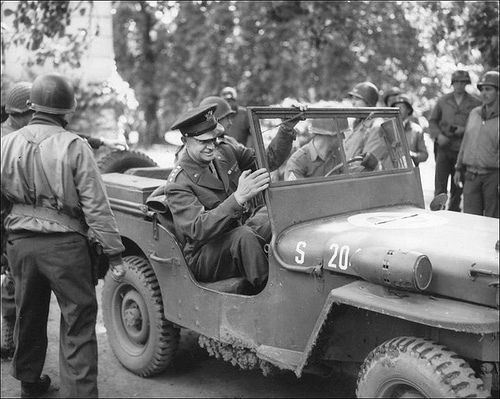
During his "Farewell Address," President and former Supreme Commander of Allied Forces in Europe, as well as first Supreme Commander of NATO, Dwight D. Eisenhower confirmed that his administration had done its part in limiting what he called the "military-industrial complex."
In the 1950s, the United States was in the midst of an ongoing arms-race with the Soviet Union that had continued to maintain unprecedented levels of troop mobilization despite the end of the Second World War. Fear of the spread of Communism fueled government contracts for new and better technology, giving birth to supersonic jet engines and even an artificial satellite in orbit of the Earth. However, during his administration, Eisenhower became concerned over the amount of public funds and interest tied into simply maintaining readiness for a war against Communists who, in Russia, were under collective leadership since the death of Stalin in 1953 and, in China, suffered under accidental famine from ill-planned agricultural Five-Year Plans. The Korean War had shown that conventional warfare mixed with modern politics to create a stalemate, and Eisenhower decided to keep the stalemate overt with America's readied nuclear arsenal capable of Mutually-Assured Destruction.
Citing examples from the 1956 work by sociologist C. Wright Mills, The Power Elite, Eisenhower's new policy turned to limiting the abilities of lobbyists in "The Higher Circles" who had direct influence and adding new levels of visibility to policy-creation as well as methods of direct review and polling upon budgetary issues. Numerous figures said that the policy was watering-down the leadership of America in tough times as Khruschev seized power in the USSR, but those such as Senator Robert Taft loudly questioned the ethics of those he considered fearmongers and warhawks. The FBI gained a new office investigating potential illicit lobbying, and numerous contracts between the government and large businesses were allowed to run out. The military gradually began to downscale, and research was limited to grants to universities only with direct proof of public benefit. Proposals, such as the National Aeronautics and Space Administration, which would largely guide civilian space efforts, were kept to what was pertinent given the defense of the United States.
In Eisenhower's last speech, he commented on having cleaned house in Washington and limited the possibility of special interests to dominate Congress under the table. Many believed that if anyone but the highest-ranking general in American history to become president since Washington had tried to decrease military-industrial spending, it would have blown up in his face. Ike's successor, John F. Kennedy, continued the regulation of Washington spending, preferring to use politics rather than numbers to maintain diplomacy. The standoff in the Cuban Missile Crisis proved that MAD was enough to limit Soviet threats to the United States. Some called for a Space Race after the Russians had put Sputnik into orbit as part of the festivities of the International Geophysical Year, but Kennedy noted that American missions to space would be the realm of private enterprise, much like the settling of the West.
As the twentieth century continued, the Domino Theory proved true with Soviet and Chinese power extending through Central and Southeast Asia, respectively. However, within a generation, the USSR had overextend itself with uprisings in Iran and Afghanistan as well as in old Eastern European trouble spots of Hungary and Czechoslovakia. Local resistance drained the authority of Moscow, which would collapse in the late 1980s, while China transformed itself with experimental limited capitalism and made acquaintance with the United States during the Nixon era.
By the end of the twentieth century, the world had changed drastically to what many considered a Pax Americana. There were certainly threats, primarily through terrorism, but international policing agencies as well as FBI were tasked with finding and capturing the nation's enemies. Meanwhile, everyday Americans continued improved lives as private funding took up where public funding had left off. As of the year 2000, radio systems are able to incorporate “mobile” phones as long as they were tied to a power source, such as a car. Personal computers have come into many homes, and many technologists predict a network of integration (or “Internet”) in the coming decades, though the investment required would be staggering. Meanwhile, rocket-launching companies have established a number of satellites in orbit to study weather and relay communications, while others hope for a manned mission to the Moon, although it would need to prove to be economically viable.
–
In reality, Eisenhower only warned America to be on "guard against the acquisition of unwarranted influence, whether sought or unsought, by the military-industrial complex." His "Farewell Address" made note of the changing America in the heightened time of the Cold War, but America continued its investment in industry, devising new defense technology that would trickle down into public use with items like cell phones, GPS systems, and the Internet.
Showing events on this day in years past that shaped history... just, not our history.
Showing posts with label eisenhower. Show all posts
Tuesday, December 6, 2011
January 17, 1961 – Eisenhower Confirms Restrictions of a Military-Industrial Complex
Wednesday, December 8, 2010
December 8, 1943 – Eisenhower Dies in Jeep Accident
One day after being unceremoniously appointed Supreme Commander in the coming Operation Overlord in a handwritten note from FDR to Stalin, General Dwight David Eisenhower died in a jeep accident while being transported from headquarters. While some speculate that the accident was in fact Nazi assassination or perhaps political intrigue, the majority of historians agree that it was simply the fault of a dog crossing the road. Funeral services were conducted in Europe and again in the United States with the war hero’s body being interred at Arlington National Cemetery. Having lost a great leader, FDR woefully appointed Chief of Staff George C. Marshall, whom he had earlier told, “I didn't feel I could sleep at ease if you were out of Washington” when explaining his choice.
Many considered the appointment a demotion for Marshall, as he was in key position in Washington to organize and manage the resources of the Allies. Churchill himself would call Marshall the “organizer of victory”, and now it was Marshall’s duty to exact that victory in Europe. With the landing at Normandy in June 1944, victory in Europe gradually became a reality. When the war ended, Marshall continued to his duties to America by his appointment to China by President Truman to broker peace between the Chinese Nationalists and Communists. No peace could be made (and Marshall argued against the Pentagon that the United States simply shouldn’t become involved), and Marshall returned to the US, soon appointed Secretary of State. Here he would win a Nobel Peace Prize for his “Marshall Plan” for the organization and rebuilding of post-war Europe, also being named Time Magazine’s Man of the Year for the second time.
After retiring on grounds of ill health, Marshall was again brought to duty on the call of President Truman to be Secretary of Defense. The Korean War had shown how poorly the post-war American armed forces had been organized, and no one organized better than Marshall. Marshall effectively prepared the military for demobilization in less than a year and retired again. Meanwhile, fellow Five Star General Omar Bradley would be instrumental in Truman’s decision to relieve MacArthur of command before he sparked a war with China.
In 1952, Marshall would be called up again, this time by the Democratic Party. General Bradley was running on the Republican ticket for president, and the Democrats sought a president that could surpass his military clout. Marshall declined, saying, “I’ll stick with retirement. When men like Joe McCarthy are running around, Washington is no place for me.”
While the Democratic nominee Adlai Stevenson would lose out against President Bradley, Marshall’s famous statement would cause a surge of unpopularity for McCarthy, costing him his reelection to the Senate. Bradley’s two terms would be famed for their time of prosperity, forward development with projects such as the Bradley Continental Highway, and his liberal leanings, continuing New Deal programs and combating segregation, as well as his openness in international policy with Communism. The Bradley Doctrine would prevent America from becoming something of a policeman, instead working to ensure that proper popular elections were held, preventing another Korea and MacArthur.
Through the course of the latter half of the twentieth century, Communism would grow throughout the world, taking over many nations in Southeast Asia, North Africa, and Central and South America. By the 1980s, however, the Stalinist nations would begin to fall apart after defeat in Iran and Afghanistan, leading to Germany reunifying and the Soviet bloc disappearing. The other “communist” nations of the world turned either into militaristic dictators or revolutionized themselves as seen in Red China, conflict with which Bradley had said would be "The wrong war, at the wrong place, at the wrong time, and with the wrong enemy."
–
In reality, Eisenhower lived to effective serve as Supreme Commander. Marshall conducted his administrative duties as necessary before retiring, while Eisenhower took up the election of 1952 to oppose the isolationism of Senator Robert Taft. In his presidency, Eisenhower set the precedent of fighting Communism as it grew up in nations, using the CIA and military advisers to prevent its spread.
In 1952, Marshall would be called up again, this time by the Democratic Party. General Bradley was running on the Republican ticket for president, and the Democrats sought a president that could surpass his military clout. Marshall declined, saying, “I’ll stick with retirement. When men like Joe McCarthy are running around, Washington is no place for me.”
While the Democratic nominee Adlai Stevenson would lose out against President Bradley, Marshall’s famous statement would cause a surge of unpopularity for McCarthy, costing him his reelection to the Senate. Bradley’s two terms would be famed for their time of prosperity, forward development with projects such as the Bradley Continental Highway, and his liberal leanings, continuing New Deal programs and combating segregation, as well as his openness in international policy with Communism. The Bradley Doctrine would prevent America from becoming something of a policeman, instead working to ensure that proper popular elections were held, preventing another Korea and MacArthur.
Through the course of the latter half of the twentieth century, Communism would grow throughout the world, taking over many nations in Southeast Asia, North Africa, and Central and South America. By the 1980s, however, the Stalinist nations would begin to fall apart after defeat in Iran and Afghanistan, leading to Germany reunifying and the Soviet bloc disappearing. The other “communist” nations of the world turned either into militaristic dictators or revolutionized themselves as seen in Red China, conflict with which Bradley had said would be "The wrong war, at the wrong place, at the wrong time, and with the wrong enemy."
–
In reality, Eisenhower lived to effective serve as Supreme Commander. Marshall conducted his administrative duties as necessary before retiring, while Eisenhower took up the election of 1952 to oppose the isolationism of Senator Robert Taft. In his presidency, Eisenhower set the precedent of fighting Communism as it grew up in nations, using the CIA and military advisers to prevent its spread.
Labels:
alternate history,
eisenhower,
marshall,
omar bradley
Subscribe to:
Posts (Atom)