The great expense of the Civil War and Reconstruction had prompted the federal government to pay expenses with bonds backed by credit alone. With such patriotic times, the public had no worry trusting the government to repay the bonds with gold upon maturity, solidifying not only the government's books but also its good name.
Speculators, however, saw a chance to make off with millions of dollars in the market. James Fisk and Jay Gould led a group of investors in cornering the gold market, buying up every ounce they could collect. The price of gold shot up, topping a 30% increase in less than a year. Meanwhile, Fisk and Gould came into contact with Abel Corbin, President Ulysses Grant's brother-in-law, who took them into Grant's social circle. There, they argued against sale of federal gold (saving it for rainy days and continuing the controversial use of greenbacks), planting the seeds of thought into Grant's head. Corbin, meanwhile, brought in Daniel Butterfield, a former general, as a suggested assistant to the Treasury. Grant agreed to his appointment, and Butterfield promised to give advance word of the inevitable sale.
According to biographers, Grant became wary of the issue of gold sometime around September 20. Initially, he was outraged by men attempting to profit out of the shadows, but Corbin (who himself was deeply invested in gold) convinced the President that it would be for good. The businessmen could use the money to invest and diversify, which would help the general economy by building more infrastructure and capital. The wealth would "trickle down", and it would help the average American overall by providing jobs and wider markets. Grant begrudgingly and bewilderedly agreed.
Speculators made millions by selling just before the announcement of the huge federal sale. By the time the gold was sold, the government earned a significantly smaller amount than they would have and was forced to sell more to make the dollar-benchmark set. Word gradually went out about the sale and enraged the populace. Already fed up with the paternal system of back-patting among engrained Republicans as well as the "moiety" through which bureaucrats became wealthy, such as Tax Commission Officer Chester A. Arthur of New York making a salary of $10,000 while receiving upwards of $50,000 from kickbacks and trimming underling's salaries for granting choice assignments.
Scandal rocked the Republican Party, and an investigation led by Congressman James A. Garfield of Ohio indicted the president. Grant resigned, and the new President Schuyler Colfax prompted Congress to dismantle the political corruption known as the "Era of Good Stealings."
--
In reality, when Grant learned of the gold speculation, he ordered $4 million worth of gold sold out of the US Treasury. The price of gold plummeted in minutes on what became known as Black Friday, Sept 24, 1869. Investors in the plot, such as Corbin, lost whole fortuntes. Fisk and Gould, however, escaped unscathed, as would many in what Twain nicknamed "The Gilded Age."
Monday, September 24, 2012

Friday, September 7, 2012
September 7, 1695 - Piracy Ends India-UK Relations
Henry Every, captain of the Fancy (formerly Charles II), and his crew of pirates raided the Indian Ocean after mutinying against England's ally, Spain. After a year of good hauls, Every joined up with other pirates to prey on the pilgrimage fleet of Grand Mughal Aurangzeb. There he took the greatest prize in pirating history: the Ganj-i-Sawai treasure ship, valued at between £325,000 and £600,000 (over $100,000,000 in 2011) in gold, silver, and gemstones. After seizing the great wealth, Every and his crew disappeared into history with only twenty-four ever being captured.
Also on board was "something more pleasing than jewels", believed to be Aurangzeb's daughter. She, too, was taken with rumors claiming she went willingly with the daring pirate captain. Aurangzeb was furious and announced an end to the treaties and trade that had grown up with the British East India Company. Despite Company efforts to pay the insured amount for the lost ship, Mughal forces marched on Bombay and chased the English out of India.
With an enormous market at stake, the East India Company made efforts to strike back into India, but Aurangzeb turned to another European power, France. Frenchman Francois Bernier had served as his physician for twelve years, and the Mughal offered the new vacuum in Bombay to the French East India Company, which happily seized profits and ended the expansive British control there. As Mughal power began to fade in the eighteenth century, French domination expanded.
The British, meanwhile, began to focus more on holdings in the Caribbean and expanding into further markets in the Pacific such as China and Japan, which were opened by force. Colonies continued to trade hands with war, but India remained under French influence and served as a conduit to expand French colonial control into the Middle East and Southeast Asia.
--
In reality, though the East India Company had records suggesting a relative of Aurangzeb was on board the Ganj-i-Sawai, there is no solid evidence as to it being his daughter. He later agreed to the East India Company's apologies (agents pleaded prostrate before the emperor) and £600,000 repayment. The Company battled with French influence for decades as Mughal power waned, eventually coming to control India as the jewel of the British Empire.
Also on board was "something more pleasing than jewels", believed to be Aurangzeb's daughter. She, too, was taken with rumors claiming she went willingly with the daring pirate captain. Aurangzeb was furious and announced an end to the treaties and trade that had grown up with the British East India Company. Despite Company efforts to pay the insured amount for the lost ship, Mughal forces marched on Bombay and chased the English out of India.
With an enormous market at stake, the East India Company made efforts to strike back into India, but Aurangzeb turned to another European power, France. Frenchman Francois Bernier had served as his physician for twelve years, and the Mughal offered the new vacuum in Bombay to the French East India Company, which happily seized profits and ended the expansive British control there. As Mughal power began to fade in the eighteenth century, French domination expanded.
The British, meanwhile, began to focus more on holdings in the Caribbean and expanding into further markets in the Pacific such as China and Japan, which were opened by force. Colonies continued to trade hands with war, but India remained under French influence and served as a conduit to expand French colonial control into the Middle East and Southeast Asia.
--
In reality, though the East India Company had records suggesting a relative of Aurangzeb was on board the Ganj-i-Sawai, there is no solid evidence as to it being his daughter. He later agreed to the East India Company's apologies (agents pleaded prostrate before the emperor) and £600,000 repayment. The Company battled with French influence for decades as Mughal power waned, eventually coming to control India as the jewel of the British Empire.
Tuesday, August 7, 2012
June 29, 626 – Avars Storm Constantinople
Following the fall of Rome to the
Visigoths, Constantinople took up the mantle of Roman Empire and
again established rule through the Mediterranean under the emperor
Justinian (527-565). Such a massive empire again proved unwieldy,
and Justinian had to install massive bureaucracy to achieve the
continuation of his empire. While maintaining order, the bureaucracy
was also incredibly expensive, which ironically created unrest as the
populace grew weary of heavy taxes despite the wealth of empire.
Emperor Maurice (582-602) created cost-saving measures whenever
possible, such as refusing in 598 to pay ransom to the Avar Khaganate
for thousands of Byzantine prisoners-of-war. The result was the
soldiers being slaughtered, but the coffers of the Empire remaining
full. In 602 as another measure, he ordered the army to make winter
quarters on the frontier north of the Danube rather than march home.
This action caused the army to rebel and march on Constantinople,
dragging Maurice out of sanctuary in a monastery to execute him.
Their leader Phocas was installed the new emperor.

The
Avars continued their sweep across the Balkans to the capital itself
with some eighty thousand men and siege equipment with the goal of
wiping out the Byzantines altogether. An army twelve thousand strong
and featuring cavalry defended the city, but it was the bureaucracy
who managed life there. A bureaucrat named John determined that food
the coming siege was of crucial value and began work to maintain the
bread supply. He moved to cancel the free bread ration for the
imperial guard (who had ample money of their own to spend) and
enacted that overall bread prices be increased from three to eight
folles to ensure none was wasted. On May 14 and
15, people gathered at the Great Church and chanted in protest. The
local governing body under Bonos discussed what to do and ultimately
decided that austerity must be retained in the face of the oncoming
barbarians. After days of protest, the government sent loyal
soldiers to chase away the chanters. Rioting began, and soon the
city was set aflame. Order was restored at times, but the populace
proved unresponsive even to zealous religious appeals. In the end,
most of the citizenry abandoned the city and fled by sea in convoys
to avoid attack Persians. City bureaucrats attempted to stop the
retreat with control of the sea walls, but defenses were sabotaged by
the people hoping to escape.
When the Avars
arrived on June 29, few soldiers were left loyal to Byzantium. A
short battle followed, and, despite superior defensive technology
with its walls, the Avars broke into Constantinople. Barbarians
looted what remained of the city and burned the rest, ending what had
been a key position of trade in the known world. Heraclius found
himself without a capital, and his allies lost all confidence. He
began an overall evacuation to Africa and established himself there,
though the empire continued to crumble with Visigoths seizing lands
to the west in Spain. The Persians and the Avars reached agreement
on a border along the Hellespont, giving both access to trade there
while making it a dangerous haven for pirates on the newly
unprotected strait.
Although victorious
over their Byzantine rival, the Sassanids soon found themselves
overwhelmed by the Arab Empire that grew up following the spread of
Islam in the 630s and 640s. It eclipsed Zoroastrianism and spread
through Africa to Spain, India, and northward to become the principal
religion of the Huns and Rus. Charlemagne maintained Christendom in
central Europe, and the Scandinavian nations joined as well. Western
Europe continued as a marginal corner of the world with trade
centering on the vast holdings of the Caliphates. Eventually
European explorers seeking a westward route around the Muslim
monopoly discovered the New World, which brought a new age of empire
upon the out-of-the-way continent.
--
In reality, the government removed John
(who earned the name “Seismos” or “Earthquake”) and instead
worked to reinforce the spirit of the Constantinopolitans to stand
against the heathen hordes. After a short siege that summer, the
Avars “lacked the technology and the patience to take the city”
(Walter Kaegi) and gave up when they deemed Heraclius' victories
divinely inspired. Heraclius defeated the Persians and established
Byzantine security, which was reaffirmed by the Crusades against the
Turks beginning in 1095. Constantinople would not be conquered until
1453.
Monday, August 6, 2012
June 28, 1519 – Frederick the Wise Elected Holy Roman Emperor
After
the death of Archduke of Austria, King of the Romans, and Holy Roman
Emperor Maximilian I in January of 1519, many of his titles went
directly by inheritance to his Habsburg grandson Charles V. The
title emperor, however, would be given by decision of the seven
elector-princes of the Germans, Albert of Mainz; Richard von
Greiffenklau zu Vollrads of Trier; Hermann of Wied of Cologne;
Frederick III of Saxony; Joachim I of Brandenburg; Louis V, Elector
Palatine; and Louis II Jagiellon, King of Bohemia. Charles was most
obvious choice as brother-in-law to Louis of Bohemia, but others were
nervous about too much power being placed in one man's hands. Along
with his grandfather's titles, Charles had also recently inherited
the title “King of Spain”, which he ruled alongside his mother,
Joanna the Mad of Castile.
Francis I of France also wished to hold
the powerful title, rejoining lands that had all once been
Carolingian. Francis and Charles
were bitter rivals since a French victory at the Battle of Marignano
the year before brought the twenty-one-year-old Francis to the
forefront of European politics. The two began a bribing war for
votes, which made some electors all the more nervous.
The suggestion of eliminating outside influence arose, and Frederick II of Saxony (called "the Wise") was offered the election. The task would be monumental and place him at the forefront of politics among much wealthier and more powerful figures, but Frederick determined it to be the right path and agreed. To the dismay of Francis and Charles both, Frederick was elected.
Problems quickly arose in the empire. The knights of Rhineland rebelled, using Protestant rhetoric to rally their people against the growing "new money" as Feudalism began to break down. Frederick met with the knights and created the Diet of the Germans to address issues. The Diet was proven successful as the communistic Peasants' War was put down and undercut by expanding religious freedom to the growing factions of Protestants. Germany became a powerful center to the new Europe, but would eventually be torn apart into its smaller kingdoms due to religious strife.
June 28, 1519 – Henry VIII Elected Holy Roman Emperor
After
the death of Archduke of Austria, King of the Romans, and Holy Roman
Emperor Maximilian I in January of 1519, many of his titles went
directly by inheritance to his Habsburg grandson Charles V. The
title emperor, however, would be given by decision of the seven
elector-princes of the Germans, Albert of Mainz; Richard von
Greiffenklau zu Vollrads of Trier; Hermann of Wied of Cologne;
Frederick III of Saxony; Joachim I of Brandenburg; Louis V, Elector
Palatine; and Louis II Jagiellon, King of Bohemia. Charles was most
obvious choice as brother-in-law to Louis of Bohemia, but others were
nervous about too much power being placed in one man's hands. Along
with his grandfather's titles, Charles had also recently inherited
the title “King of Spain”, which he ruled alongside his mother,
Joanna the Mad of Castile.

In
1520, Francis and Henry met in a garish display at the Camp du
Drap d'Or (“Field of the Cloth of Gold”) in northern France as
Henry began a tour of his new lands. Wolsey orchestrated this
meeting as well, but it proved ineffectual as, despite Francis'
generosity, Henry declined forging an alliance. Wolsey, who was
quietly campaigning for himself as pope, also organized a meeting
with Charles while in Germany, but this meeting also came to no
avail. Instead, Europe was in a tense peace as Henry threatened to
attack whoever began a war.
Meanwhile, Henry
focused on the problems of the Reformation beginning in his new
empire. Reacting to the sale of indulgences as part of the funding
for construction on St. Peter's Basilica, Augustinian friar Martin
Luther had posted Ninety-Five Theses critiquing
the Catholic Church. During the latter part of Henry's tour in 1521,
he heard Luther's case at Worms. In the end, and to the frustration
of Pope Leo X, Henry determined to appease his subjects and declared
the matter religious debate and did not seek any punishment for him.
The support for Luther won over the respect of disgruntled knights in
the Rhineland who were nervous of new money but reaffirmed by Henry
out of his fanaticism for jousting. The knights' loyalty proved key
to Henry's defeat of the German Peasants' Uprising a few years later.
Despite
his great realms, Henry struggled to produce an heir. His wife,
Catherine of Aragon, six years his senior, had not had a pregnancy
since the birth of their daughter Mary. Henry had become fascinated
with one of Catherine's maidens, Anne Boleyn. Anne refused to become
a mistress and replied that she could only meet Henry's advances if
she were queen. Henry asked Pope Clement VII for an annulment of his
marriage as Catherine had earlier been married to his brother Arthur,
but the pope declined. After the debate dragged for years, Henry
decided to break with Rome as the Swedes has had done, name himself
Supreme Head of the Church of England in 1533, and bring about
his marriage to Anne.
This led to the question of what to do
with his holdings in the Holy Roman Empire. Catholic regions saw
Henry as an adulterer, but the Protestants saw a chance for freedom
from Rome. When Henry dissolved the monasteries of England and
seized their valuables, Charles took a stand as defender of
Catholicism and invaded the Holy Roman Empire to seize the title he
long believed to have been stolen. Henry counterattacked with
Swedish assistance, and the war spilled across the Alps as Italian
states saw a chance to rebel. Germany served as the principal
battleground with towns razed and re-razed as Protestant and Catholic
armies carried on campaigns. France attempted to remain neutral as
internal strife with the Huguenots grew up, and eventually Francis I
determined a policy of religious freedom to maintain his allies. The
war threatened to expand further with an unprecedented alliance with
Suleiman the Magnificent of the Ottoman Empire who had previously
besieged Vienna and threatened Hungary, and Charles knew when to
capitulate and agreed to a treaty.
Upon the death of
Henry in 1547, the electors met again and, thanks to Henry's urgings,
named his son Edward VI of England as the new, ten-year-old emperor.
Edward proved a great mover in Protestantism, but he was sickly,
dying in 1553. His half-sister Mary ascended the throne of England;
the electors, however, could not have a female emperor and instead
chose Henry II of France, whose consort Catherine de Medici had great
influence and policies of religious tolerance were a healthy
compromise between electors optioning Protestant King Christian of
Denmark or staunchly Catholic Habsburg Ferdinand I. Bourbons
continued to be Holy Roman Emperors until 1685 when Louis XIV worked
to affirm his autocracy by promoting Catholicism as the single state
religion. Many Protestants fled to Germany, but when Louis began to
enact strict religious rule in the Empire as well, the electors
refused and stripped him of his title. The Franco-German War brought
about a liberated Germany at the expense of France. The electors
named Frederick, King in Prussia, as emperor; Augustus II of Saxony,
King of Poland, also stood had allegiances outside of Germany, and
the time had come for German self-rule. United Germany became a
powerful central figure in Europe, leading modernization and
industrialization through the next two centuries.
--
In reality, there was no alliance
between Francis I and Henry VIII, even at the later a lavish meeting
at the Field of the Cloth of Gold. Wars between Catholics and
Protestants would flare up in Germany to a height in the Thirty Years
War (1618-1648). The Habsburgs held onto the Holy Roman Empire
nearly continuously for hundreds of years until it was dissolved by
Napoleon in 1806.
Friday, August 3, 2012
June 27, 1950 – US Decides Not to Fight in South Korea
Communism was seen as creeping into post-war Europe,
but the success of the Marshall Plan injecting billions of dollars into the
West suppressed the growth of communist parties in countries such as France and
Italy. Czechoslovakia, which had turned
down the Marshall Plan due to political pressure from the Soviet Union, fell to
a coup in 1948. Shortly after, the Berlin
Airlift successfully ended Stalin’s plans of forcibly reuniting Germany. President Truman enacted his doctrine of stemming
the spread of Communism through dollar diplomacy, which proved effective in
Greece and Turkey. An Iron Curtain
descended across Europe, establishing clear borders between the capitalist West
and communist East.
 Halfway across the world, however, Communism
continued to spread. China’s decades-long
civil war ended with a Communist victory as the Nationalists fled to Taiwan in
1950. Even before that war was over,
North Koreans from the area that had been occupied by Soviets after the war
invaded the South. South Koreans
appealed to the United Nations, who on June 25 enacted United Nations
Security Council Resolution 82 (the Soviets had boycotted the UN over the refusal
to recognize the PRC) and following resolutions calling up forces to help
defend the country. This put US
President Truman in a delicate position between a war-weary populace and the
prediction of losing Japan if Communism spread across the Sea of Japan. After much discussion with Secretary of State
Dean Acheson, he determined not to repeat the mistakes of appeasement as had
been seen with Hitler, but he doubted the desire of fellow Americans to enter
another war.
Halfway across the world, however, Communism
continued to spread. China’s decades-long
civil war ended with a Communist victory as the Nationalists fled to Taiwan in
1950. Even before that war was over,
North Koreans from the area that had been occupied by Soviets after the war
invaded the South. South Koreans
appealed to the United Nations, who on June 25 enacted United Nations
Security Council Resolution 82 (the Soviets had boycotted the UN over the refusal
to recognize the PRC) and following resolutions calling up forces to help
defend the country. This put US
President Truman in a delicate position between a war-weary populace and the
prediction of losing Japan if Communism spread across the Sea of Japan. After much discussion with Secretary of State
Dean Acheson, he determined not to repeat the mistakes of appeasement as had
been seen with Hitler, but he doubted the desire of fellow Americans to enter
another war.
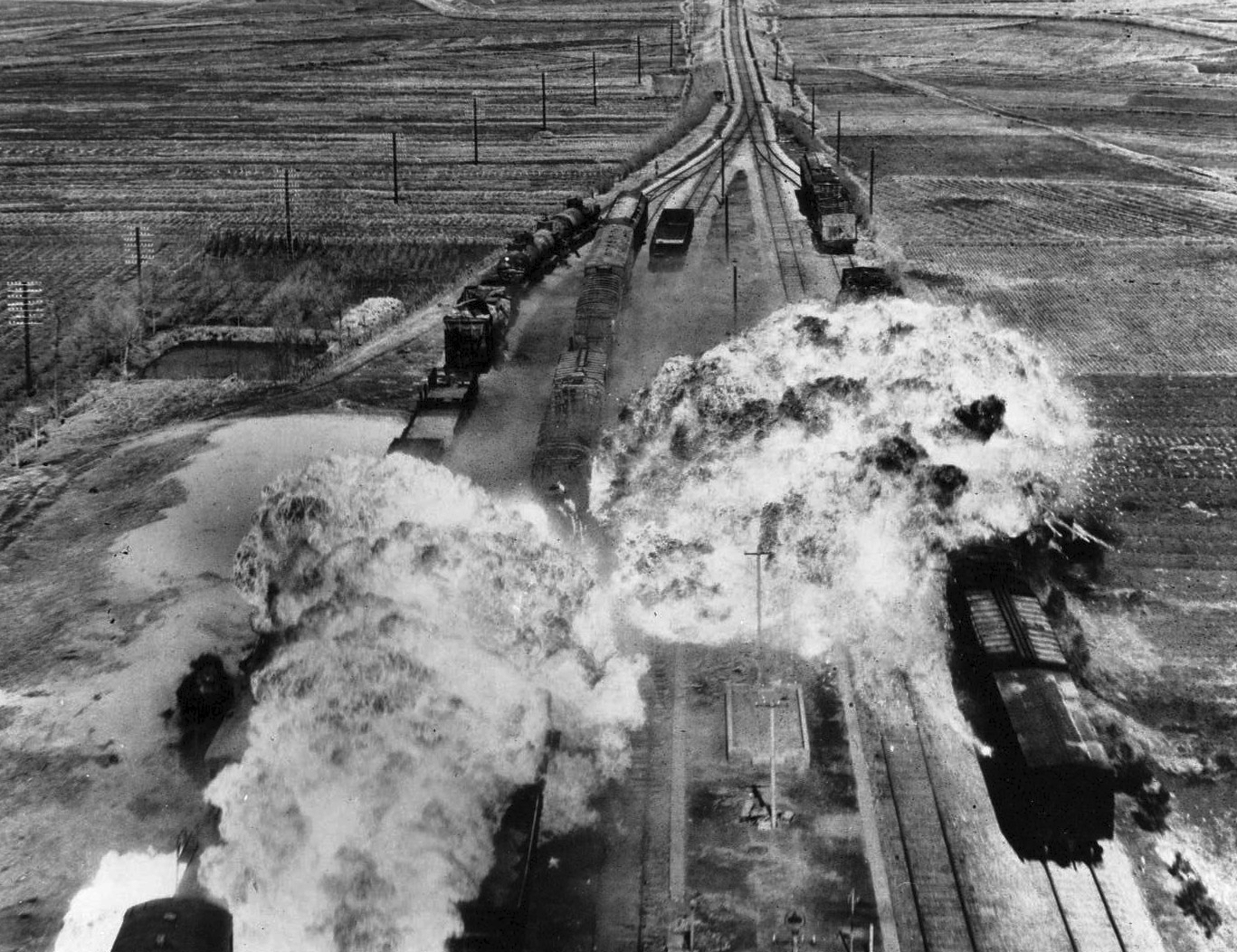
On
June 27, 1950, Truman announced before Congress that the United States would offer
support from its bases in Japan, funding, advisers, and arms, but only a
voluntary expeditionary force would be dispatched rather than a renewal of the
draft and a full declaration of war. The
UN and its allies would be supportive, but the US would not be “running the
show.” The first evidence of support was
the movement of the US Seventh Fleet into the Taiwan Strait, which ended the
PRC’s hopes of fully crushing the Nationalists.
Mao Zedong reorganized what would have been the invasion army for Taiwan
into the People’s Liberation Army North East Frontier Force to intervene in
Korea, whom Premier Zhou Enlai called “China’s neighbor.”
Reinforcements
from the UN arrived in September, as the South Koreans had been nearly pushed
off the peninsula. At the Battle of
Inchon, US, Canadian, and British naval attacks provided cover as a mixed group
of Allied marines stormed the beach and seized Kimpo Airfield. The largely unorganized Allies made some
advancement toward Seoul, but the lack of troops slowed progress despite the
clear supply line. That fall, the Chinese
again warned of intervention of the UN crossed the 38th Parallel
that had initially divided the North and South.
The UN obliged, preparing for winter as the South Koreans made their own
strikes across the border. Many, such as
General Douglas MacArthur in Japan, criticized the move, stating that victory
against North Korea should be absolute.
If the Chinese joined the war, then it would be another communist
country to defeat and liberate.
Instead,
the war became a stalemate as the South Koreans bolstered their defenses and
gradually replaced UN soldiers. In the
North, China and the Soviet Union gave aid, but neither side could legally
enter the fight. For the remainder of
his term, Truman kept up his doctrine of aid for communist-threatened countries
but felt glad he had kept America at large out of another war. Chinese expansion continued southward,
however, as they seized Tibet in 1950 and gave aid to rebels against
colonialism in French Indochina. The
Eisenhower Administration gave similar aid, but was unsuccessful in halting the
fall of Vietnam and Laos. Closer to
home, however, economic support to Cuba won over Castro’s new government.
In
the Middle East, meanwhile, the Soviets began to make political maneuvers to
expand their political influence. Americans
drew up their own allies, but notions of Pan-Arabism stilted the effect of
both. Instead, the US limited its efforts
while the Soviets pressed all the harder, leading up to the invasion of
Afghanistan in 1979. The war would prove
too costly for the Soviet Union, which had been decaying internally for years,
and contribute to its collapse in 1991.
Chinese
communism began to suffer similar decay, but the death of Mao Zedong in 1976
brought in a new generation of leaders who put into effect economic reforms
that brought a new era of prosperity. The
death of Hu Yaobang in 1989 led to protest for similar reforms on
democratization and freedom of speech, but the ideas were suppressed. The prosperity of smaller Asian communist
states has not followed as readily while some, such as Vietnam, do well with
tourism and manufactures while others still suffer repression.
North
Korea remained under the control of guerilla leader Kim Il-sung until he left
for Moscow in 1956 to stand up to Khrushchev’s de-Stalinization. Former followers seized the government and
worked to stop his return as his popularity had never recovered from his futile
invasion. This coup won over much of the
support of the military and of Mao Zedong, who had begun to question Kim’s stability. Kim was exiled to Russia, where he remained
despite attempts to reinvade his country.
North Korea continued as a satellite of China, but began to seek a more
independent stance in the 1980s. In
August 2000, the Koreas became reunified.
--
In reality, the US was the primary contributor to
the Korean War, and General Douglas MacArthur led the UN forces there. Early victories came swiftly with the UN
crossing the 38th Parallel on October 1 and even marching into China
itself in pursuit of North Korean armies.
The Chinese entered the war with over a million soldiers, and the
fighting became a stalemate near where it had started. An armistice was announced in 1953 with a
formal division in 1954 that lasts even today, though talks of reunification
are beginning to blossom.
Aug 3, 1949 - MacArthur Declares Himself Japanese Dictator
Douglas MacArthur, born 1880 and in 1925 made the youngest major general the in US Army, proved his military record in World War II with a 30:1 kill ratio against the Japanese as well as being awarded a Medal of Honor, multiple distinguished service medals on land, sea, and air, and two purple hearts. When the war ended, he was given the title Supreme Commander of the Allied Powers and ordered to oversee the Occupation of Japan. He drafted a new constitution in 1946 that became ratified the following year, reformed land ownership to put millions of acres into the hands of owner-operators, and reorganized and rebuilt the nation's industry as a peacetime leader.
One of his most significant moves was to recommend immunity to Japanese scientists such as those in the infamous Unit 731 who conducted human experiments. In exchange for their information (which would remain secret), the doctors would not be tried for crimes against humanity. Rather than handing the data on biological weapons over to the United States government, he kept the information to himself, an action believed to be the first on his road to megalomania.
In 1948, MacArthur was among those put forth for the Republican nomination for the presidency. Democrats had held the White House since 1932, and it seemed like a good chance to bring about needed post-war change. When MacArthur lost to Dewey, who in turn lost to Truman, he became despondent about his homeland. Meanwhile, the great changes he had made to Japan continued, and he began to focus more on his life in Japan.
MacArthur became unruly in the eyes of Washington as he too-often traded out military personnel, eventually creating a power structure completely loyal to him. He had won over the respect of the Japanese with his land reforms and encouragement of trade unions in the new industry, creating grassroots support. Censorship boards, which MacArthur began to direct personally, equated all good news with himself and bad news with other American figures. When President Truman called for MacArthur's removal, he refused and pronounced himself dictator of Japan. His title became Gaijin Shogun ("foreign military ruler"), and he stated that any threat to remove him would be met with military-grade biological weapons cultivated from Unit 731's experiments.
Americans balked, but war-weariness caused them to leave him as MacArthur allowed any of the 30,000 Americans stationed in Japan to evacuate peacefully. Much of the military equipment had "disappeared" into MacArthur's personal army's hands, leaving no paper record to prove claims for return of American materiel. After obligatory reorganization and crackdown, MacArthur sealed the Japanese borders with rearmed fishing vessels, allowing trade only through approved channels.
Until 1964, Japan was an isolated state controlled by rationing and fear of MacArthur's release of plagues. Sanctions were placed on the nation, but they only contributed to the seclusion. International forces reacting to the Korean War were believed to be staging for a campaign of liberation, but as the war became stalemated, the idea was never explored. Instead, for fifteen years, Japan returned to a feudal period and did not return to the world scene until MacArthur died and his son Arthur MacArthur refused to continue rule, fleeing to Switzerland. Since then, Japan has been a figure of East Asian politics despite economic struggles.
--
In reality, General MacArthur was a loyal American. Under his leadership, the Japanese, as he told Congress in 1951, "have from the ashes left in war's wake erected in Japan an edifice dedicated to the supremacy of individual liberty and personal dignity, and in the ensuing process there has been created a truly representative government committed to the advance of political morality, freedom of economic enterprise, and social justice." Shortly before his death, the Japanese respectfully referred to him as the Gaijin Shogun.
One of his most significant moves was to recommend immunity to Japanese scientists such as those in the infamous Unit 731 who conducted human experiments. In exchange for their information (which would remain secret), the doctors would not be tried for crimes against humanity. Rather than handing the data on biological weapons over to the United States government, he kept the information to himself, an action believed to be the first on his road to megalomania.
In 1948, MacArthur was among those put forth for the Republican nomination for the presidency. Democrats had held the White House since 1932, and it seemed like a good chance to bring about needed post-war change. When MacArthur lost to Dewey, who in turn lost to Truman, he became despondent about his homeland. Meanwhile, the great changes he had made to Japan continued, and he began to focus more on his life in Japan.
MacArthur became unruly in the eyes of Washington as he too-often traded out military personnel, eventually creating a power structure completely loyal to him. He had won over the respect of the Japanese with his land reforms and encouragement of trade unions in the new industry, creating grassroots support. Censorship boards, which MacArthur began to direct personally, equated all good news with himself and bad news with other American figures. When President Truman called for MacArthur's removal, he refused and pronounced himself dictator of Japan. His title became Gaijin Shogun ("foreign military ruler"), and he stated that any threat to remove him would be met with military-grade biological weapons cultivated from Unit 731's experiments.
Americans balked, but war-weariness caused them to leave him as MacArthur allowed any of the 30,000 Americans stationed in Japan to evacuate peacefully. Much of the military equipment had "disappeared" into MacArthur's personal army's hands, leaving no paper record to prove claims for return of American materiel. After obligatory reorganization and crackdown, MacArthur sealed the Japanese borders with rearmed fishing vessels, allowing trade only through approved channels.
Until 1964, Japan was an isolated state controlled by rationing and fear of MacArthur's release of plagues. Sanctions were placed on the nation, but they only contributed to the seclusion. International forces reacting to the Korean War were believed to be staging for a campaign of liberation, but as the war became stalemated, the idea was never explored. Instead, for fifteen years, Japan returned to a feudal period and did not return to the world scene until MacArthur died and his son Arthur MacArthur refused to continue rule, fleeing to Switzerland. Since then, Japan has been a figure of East Asian politics despite economic struggles.
--
In reality, General MacArthur was a loyal American. Under his leadership, the Japanese, as he told Congress in 1951, "have from the ashes left in war's wake erected in Japan an edifice dedicated to the supremacy of individual liberty and personal dignity, and in the ensuing process there has been created a truly representative government committed to the advance of political morality, freedom of economic enterprise, and social justice." Shortly before his death, the Japanese respectfully referred to him as the Gaijin Shogun.
Subscribe to:
Posts (Atom)
