Showing posts with label korean war. Show all posts

Thursday, March 31, 2016

Guest Post from Chris Oakley


August 15, 1962--Defection Attempt Sparks Second Korean War

A disillusioned U.S. Army private’s attempt to cross the 38th parallel and defect to North Korea touched off a second war in the Korean Peninsula just over nine years after the signing of the armistice that ended the first one.

Private 1st Class Joseph Dresnok, a Virginia native whose marriage had failed during a previous stint in the Army, had made up his mind to abandon his post rather than face a court-martial for forging his commanding officer’s signature on a pass into the nearby town. As he was attempting to make his way over the DMZ to reach the nearest North Korean outpost, a U.S. sentry spotted him and called for him to come back to the South Korean side of the line. In response, Dresnok fired off a round from the twelve-gauge shotgun he carried with him. The sentry immediately returned fire, and even though neither Dresnok’s shotgun blast nor the sentry’s answering bullet hit anything, the noisy exchange of gunfire was enough to persuade a nearby Korean People’s Army border patrol that an American attack on the North was imminent.

Just minutes after the sentry fired on Dresnok, U.S. outposts all along the 38th parallel came under heavy North Korean artillery bombardment, which in turn provoked retaliatory U.S. and South Korean air strikes. By nightfall, U.S. and ROK infantry were engaging the NKPA at six key points along the Demilitarized Zone, and a somber President John F. Kennedy told the American people that the U.S. was once again at war with North Korea.

In contrast to the first Korean conflict, which had ground on for over three years before concluding in a stalemate, the Second Korean War ended after just ten weeks with a decisive U.S.-ROK victory. The Soviet Union and China, North Korea’s main foreign allies, were caught off guard by the rapid pace with which events unfolded and had no time to act before U.S. and South Korean troops routed the NKPA in a series of set-piece battles that culminated with the fall of Pyongyang to U.S. Marines on October 18, 1962. North Korean dictator Kim Il Sung was fatally wounded as he was attempting to escape the city; his son Kim Jong Il fled to China and would later be granted political asylum there by the Mao Zedong regime. Although scattered groups of Communist insurgents would continue to harass U.S. and South Korean forces until mid-January of 1963, the capture of Pyongyang effectively marked the end of North Korea as a separate country. Without military placements able to back their bravado, Chinese and Soviet Union diplomats judged the US harshly for imperialism but kept themselves out of the war rather than facing early defeats before the bulk of their forces could move. The formal re-establishment of a unified Korean nation was announced by President Park Chung-Hee on March 2, 1963; the anniversary of that proclamation would then become a Korean national holiday, Reunification Day.

Post-reunification Korea quickly established itself as one of the strongest military and economic powers in Asia. In foreign affairs, the Korean government took a largely pro-U.S. policy line, particularly after the Pueblo incident of 1968 in which a U.S. Navy communications ship was fired upon by a Chinese submarine while on the Korean side of the China-Korea maritime boundary line. During the Vietnam War, over 30,000 ROK troops fought on the U.S. side against the Viet Cong and NVA; the Koreans also provided air support and intelligence data to U.S. forces and gave political asylum to North Vietnamese defectors. The ROK armed forces’ most notable success in Vietnam came in the summer of 1974 with a raid on the port of Haiphong by Korean air force fighter jets which destroyed thousands of tons of supplies and equipment meant for the Viet Cong.

By 1978, fifteen years after Korea was officially reunified, the ROK had the highest standard of living of any country in Asia and the third-highest in the entire world. In the 1980s, Korean athletes would make their presence felt at the Olympics, most notably at the 1988 Summer Games when the Korean women’s gymnastics team upset Romania to win the group bronze medal and the men’s boxing squad won golds in the lightweight and welterweight divisions. In 1991, Korea became the third country in the world to send human beings into space, launching a two-man capsule from the Yongbyon rocket facility on a three-day orbital flight.

The former DMZ was re-purposed into a national park complex that included nature preserves, historical and cultural museums, and a memorial site commemorating the thousands of ROK soldiers who died over the course of the two Korean Wars. The old “truce village” of Panmunjom, evacuated after the end of the First Korean War, became a private retreat for the Korean president and a meeting place for Korean and foreign officials. In Pyongyang, the headquarters of the defunct Korean Workers’ Party was converted to an archive storing millions of documents and files related to the human rights abuses and war crimes committed by the fallen Kim Il Sung regime. While the United States would substantially reduce its military presence in Korea after the Vietnam War ended, a sizable garrison would remain on station along the Korean-Russian frontier until the Soviet Union’s dissolution in 1988. In the 1991 Gulf War, Korea would serve as a critical transit stop for coalition troops being deployed to Kuwait and Iraq. As Korea entered the twenty-first century, its economy would enter a new era of rapid growth thanks to “green” technology and the resurgence of the country’s automotive industry.

PFC Dresnok never knew the consequences his actions had wrought; when North Korean soldiers finally sighted him, they shot him dead on the spot. His body was left to decay in the rough countryside between the northern and southern sides of the DMZ, and his fate would continue to be a mystery until 1965, when a group of hikers on a nature walk found his skeletal remains near the site of his execution. Larry Allen Abshier, a GI who had gone over to North Korea three months before Dresnok’s defection attempt, was hanged as a spy not long after Dresnok was shot. Charles Robert Jenkins, a sergeant who’d been contemplating defection to North Korea himself, changed his plans and decided instead to defect to the Soviet Union, where he would live until its collapse at the end of the Cold War.

                                                                          ******

In reality, the only shot fired during Joseph Dresnok’s defection was the shotgun round from Dresnok himself as he was walking across the Korean DMZ. He was briefly detained at an NKPA border outpost before being sent to Pyongyang; he would spend the next decade there being indoctrinated in Kim Il Sung’s juche ideology before being granted North Korean citizenship in 1972.

As of this writing, Dresnok is the only living American expatriate left in North Korea; Larry Allen Abshier died of a heart attack in 1983 while Jerry Wayne Parrish, a U.S. Army Specialist 4 who defected to the North shortly after Dresnok crossed over, succumbed to kidney problems in 1998. Charles Robert Jenkins left North Korea in 2007 and emigrated to Japan, where he subsequently turned himself in to U.S. authorities and served a 30-day jail term for desertion. The DMZ today constitutes the most heavily fortified border on Earth.

Friday, August 3, 2012

June 27, 1950 – US Decides Not to Fight in South Korea

Communism was seen as creeping into post-war Europe, but the success of the Marshall Plan injecting billions of dollars into the West suppressed the growth of communist parties in countries such as France and Italy.  Czechoslovakia, which had turned down the Marshall Plan due to political pressure from the Soviet Union, fell to a coup in 1948.  Shortly after, the Berlin Airlift successfully ended Stalin’s plans of forcibly reuniting Germany.  President Truman enacted his doctrine of stemming the spread of Communism through dollar diplomacy, which proved effective in Greece and Turkey.  An Iron Curtain descended across Europe, establishing clear borders between the capitalist West and communist East.

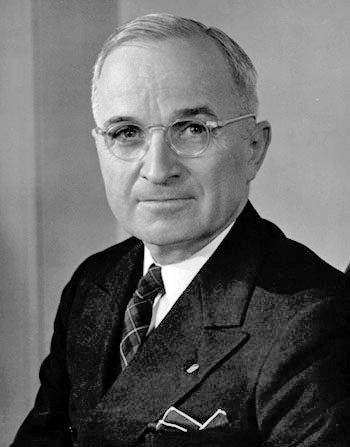
Halfway across the world, however, Communism continued to spread.  China’s decades-long civil war ended with a Communist victory as the Nationalists fled to Taiwan in 1950.  Even before that war was over, North Koreans from the area that had been occupied by Soviets after the war invaded the South.  South Koreans appealed to the United Nations, who on June 25 enacted United Nations Security Council Resolution 82 (the Soviets had boycotted the UN over the refusal to recognize the PRC) and following resolutions calling up forces to help defend the country.  This put US President Truman in a delicate position between a war-weary populace and the prediction of losing Japan if Communism spread across the Sea of Japan.  After much discussion with Secretary of State Dean Acheson, he determined not to repeat the mistakes of appeasement as had been seen with Hitler, but he doubted the desire of fellow Americans to enter another war.

On June 27, 1950, Truman announced before Congress that the United States would offer support from its bases in Japan, funding, advisers, and arms, but only a voluntary expeditionary force would be dispatched rather than a renewal of the draft and a full declaration of war.  The UN and its allies would be supportive, but the US would not be “running the show.”  The first evidence of support was the movement of the US Seventh Fleet into the Taiwan Strait, which ended the PRC’s hopes of fully crushing the Nationalists.  Mao Zedong reorganized what would have been the invasion army for Taiwan into the People’s Liberation Army North East Frontier Force to intervene in Korea, whom Premier Zhou Enlai called “China’s neighbor.”

Reinforcements from the UN arrived in September, as the South Koreans had been nearly pushed off the peninsula.  At the Battle of Inchon, US, Canadian, and British naval attacks provided cover as a mixed group of Allied marines stormed the beach and seized Kimpo Airfield.  The largely unorganized Allies made some advancement toward Seoul, but the lack of troops slowed progress despite the clear supply line.  That fall, the Chinese again warned of intervention of the UN crossed the 38th Parallel that had initially divided the North and South.  The UN obliged, preparing for winter as the South Koreans made their own strikes across the border.  Many, such as General Douglas MacArthur in Japan, criticized the move, stating that victory against North Korea should be absolute.  If the Chinese joined the war, then it would be another communist country to defeat and liberate.

Instead, the war became a stalemate as the South Koreans bolstered their defenses and gradually replaced UN soldiers.  In the North, China and the Soviet Union gave aid, but neither side could legally enter the fight.  For the remainder of his term, Truman kept up his doctrine of aid for communist-threatened countries but felt glad he had kept America at large out of another war.  Chinese expansion continued southward, however, as they seized Tibet in 1950 and gave aid to rebels against colonialism in French Indochina.  The Eisenhower Administration gave similar aid, but was unsuccessful in halting the fall of Vietnam and Laos.  Closer to home, however, economic support to Cuba won over Castro’s new government.

In the Middle East, meanwhile, the Soviets began to make political maneuvers to expand their political influence.  Americans drew up their own allies, but notions of Pan-Arabism stilted the effect of both.  Instead, the US limited its efforts while the Soviets pressed all the harder, leading up to the invasion of Afghanistan in 1979.  The war would prove too costly for the Soviet Union, which had been decaying internally for years, and contribute to its collapse in 1991. 

Chinese communism began to suffer similar decay, but the death of Mao Zedong in 1976 brought in a new generation of leaders who put into effect economic reforms that brought a new era of prosperity.  The death of Hu Yaobang in 1989 led to protest for similar reforms on democratization and freedom of speech, but the ideas were suppressed.  The prosperity of smaller Asian communist states has not followed as readily while some, such as Vietnam, do well with tourism and manufactures while others still suffer repression.

North Korea remained under the control of guerilla leader Kim Il-sung until he left for Moscow in 1956 to stand up to Khrushchev’s de-Stalinization.  Former followers seized the government and worked to stop his return as his popularity had never recovered from his futile invasion.  This coup won over much of the support of the military and of Mao Zedong, who had begun to question Kim’s stability.  Kim was exiled to Russia, where he remained despite attempts to reinvade his country.  North Korea continued as a satellite of China, but began to seek a more independent stance in the 1980s.  In August 2000, the Koreas became reunified.


--

In reality, the US was the primary contributor to the Korean War, and General Douglas MacArthur led the UN forces there.  Early victories came swiftly with the UN crossing the 38th Parallel on October 1 and even marching into China itself in pursuit of North Korean armies.  The Chinese entered the war with over a million soldiers, and the fighting became a stalemate near where it had started.  An armistice was announced in 1953 with a formal division in 1954 that lasts even today, though talks of reunification are beginning to blossom.

Sunday, November 13, 2011

January 13, 1950 – Soviet Union Remains Active in the United Nations

Upon the 6 to 3 defeat of his proposal to oust the Nationalist Chinese representatives in the United Nations in favor of the People's Republic, Soviet ambassador Jacob Malik walked out of the voting chamber and announced his boycott of the Security Council. He blamed the United States for "lawlessness" and noted that anyone could see the illegality of refusing to recognize the PRC. Until the Nationalist Chinese were removed, Malik vowed that the Soviet Union would not be bound by UN declarations.

Although Malik was willing to make the gamble, higher-ups in Moscow were not, and he was replaced as the Soviets determined to keep their power of veto that had been part of the original agreements to joining the UN in 1945. The early days of the UN were rife with difficulties as the Soviets initially balked at the inclusion of India and the Philippines, the former colonies who were believed to be just extra votes for the dominant UK and US. Further issues arose when the USSR wanted each of its republics within to gain recognition, but the US countered saying each of its 48 states would then, too. A compromise was met with recognition of Belorussia and Ukraine, and the United States was proposed two additional seats but declined rather than choose among its states.

With the balance of the Cold War thusly struck for the early days, the defining moment of the renewed troubles was the refusal to recognize the People's Republic of China after the Nationalist Republic moved its capital to Taipei. Malik hoped for a shut down of the UN by walking out and relying on the power of the Eastern European Bloc. However, the West had worked to create another political union, The North Atlantic Treaty Organization. It had begun with the Treaty of Brussels on March 17, 1948, as a mutual defense agreement and continued to expand from the original states of Luxembourg, Belgium, Netherlands, France, and UK. As the Cold War heated up with the tense days of the Berlin Blockade, Portugal, Italy, Norway, Denmark, Iceland, Canada, and the United States were included by 1949. Seeing the potential for such an overwhelming position by the West, the Soviets decided to keep their veto with the UN to stymie the spread of renewed imperialism.

The resolute stance soon proved useful as the invasion of South Korea by North Korea arose in debate that June. Korea, which had been occupied by the Empire of Japan for years before its defeat in 1945, was split into occupation zones. The Soviets, who had invaded Manchuria and were much closer to the agreed upon 38th Parallel, held the north while the Americans stationed soldiers in the capital and south. North Korea came under the influence of communism and supported the People's Liberation Army during the Chinese Civil War. After the war ended with the Nationalists retreating to Taiwan and the formation of the People's Republic in 1949, some 70,000 Koreans who had volunteered for service returned to North Korea. North Korean leader Kim Il-sung gained Mao Zedong's blessing in May of 1950, and an invasion took place soon after in retaliation to provocative raids under "bandit traitor Syngman Rhee." They vowed to capture and execute the South Korean leader, who was evacuated, but not before he ordered the Bodo League Massacre in which hundreds of thousands of suspected communists were slaughtered by military and police.

Meanwhile, the invasion came to notice by the United States. Truman and his Secretary of State Dean Acheson agreed that appeasement could not be repeated and the expansion of Communism was a threat to the Free World. They knew that unilateral action would cause a massive upheaval, however, and so the matter was introduced into the United Nations on June 25 with a proposed demand that North Korea remove its forces, which would have been United Nations Security Council Resolution 82, had the Soviet Union not vetoed it. Arguing on the grounds of national sovereignty, the Soviets continued to veto potential resolutions, blocking the US's chance at stopping the flow of Communism. As the months passed and the ambassadors' hands were tied, Kim Il-sung's forces overwhelmed the peninsula, and it was all the US could do to organize a massive evacuation to the heavily militarized American bases in Japan.

Although many were frustrated, the primary mood of the West was one of conservatism. When the People's Republic of China occupied Tibet that November, again the United Nations sat with hands tied although the matter was widely debated. The nation most considered to have grave concern for the matter, India, held that the Chinese would be peaceful and refused to support military action. Truman's doctrine of "containment" seemed to largely fall apart on the impossibility of military action, though it had succeeded with its $400 million donation to support the government of Greece in its civil war. A new form of Dollar Diplomacy, famous from the Taft presidency, came into power during Eisenhower’s terms, fed by the vast economic expansion of the 1950s.

Instead of becoming militarily involved, the United States would invest heavily in surrounding nations, such as the famous New Society programs expanding support for Thailand and Cambodia after the fall of Vietnam under the Johnson administration. Meanwhile, covert CIA operations would aid enemies of communist influence, which would bring about the downfall of the cash-strapped Soviet Union after its invasion of Afghanistan. Despite its overall success, the policies were widely condemned by the often pro-USSR debates in the United Nations as "New Imperialism" and many countries such as Korea continued under what Truman called "totalitarian regimes", evident at night when the bright lights of Japan are compared with the darkness on the whole of the Korean peninsula.


--

In reality, the Soviet boycott lasted until August, absent from UN SC Resolution 82, 83, 84, and 85, which established the Korean War with peace-keeping forces from around the world, though largely American with General Douglas MacArthur as commander. Years of brutal fighting would return the demilitarized zone to the 38th Parallel, but further wars such as that in Vietnam would expand the fighting of the Cold War.

Tuesday, October 19, 2010

October 19, 1950 – Chinese Invade Korea; Truman Approves The Bomb

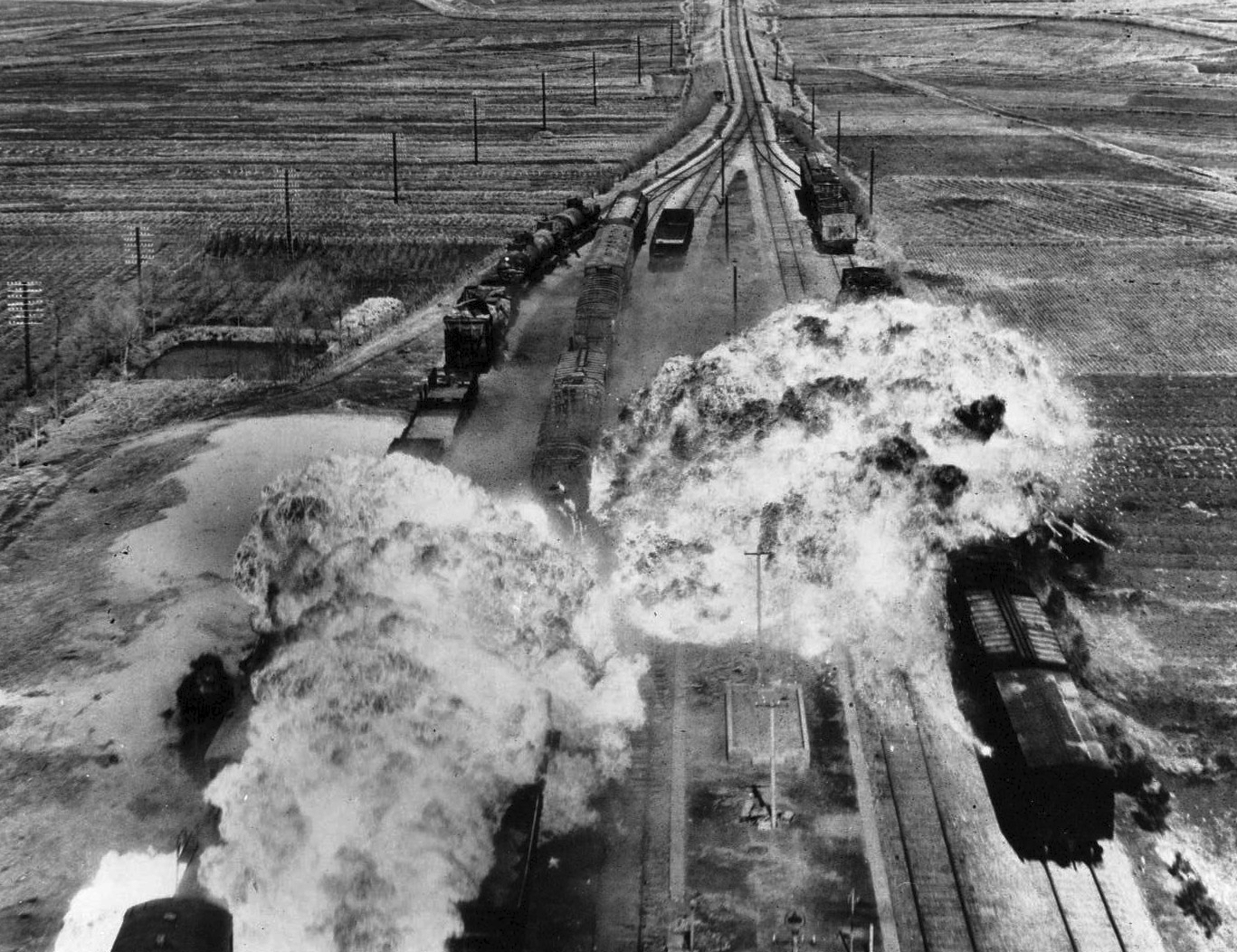
Extra UN patrols sent by United States General MacArthur came upon massive Chinese troop movements across the Yalu River, the border between China and Korea, the latter of which had been torn apart by war for years. MacArthur had been haunted by nightmares of the Chinese invading, throwing back the UN peacekeeping force that had battled the Communist North Koreans since June. Because of his nightmares, the general had courteously met with President Truman in Washington on October 15 and advised an end to the war before an estimated 300,000 Chinese troops in Manchuria and 120,000 along the Yalu turned the war against the UN.

While MacArthur’s estimates were the entire troop strength for the region, most of whom would stay for defensive reasons, Truman noted such an escalation to the war. His approval rating had come into question over the Korean War with the Americans wondering if they had blundered into an unending war in miniature to World War I. At MacArthur’s humble request, Truman agreed to consider the using America’s atomic bombs, despite the risk that it may spark outright war with Russia.

Upon returning to Korea, MacArthur redoubled his aerial patrols to spy on Chinese movements. Chinese troops in the “People’s Volunteer Army” had moved secretly, mostly through the night under camouflage, but the overwhelming number of spotters finally picked them moving across the Yalu as lights flickered on water. MacArthur relayed the information to Truman, who ordered the move of nuclear weapons to airfields. At the disastrous defeat of the Battle of Unsan at the beginning of November, it became obvious that the Chinese meant total war. Truman approved MacArthur’s use of the atomic bomb, but only at key locations within northern Korea.

Since Unsan had been a surprise attack, MacArthur repaid in kind with seven atomic bombings of military positions on November 20. The strikes were followed by the Home-by-Christmas offensive on the 24th of November, turning what could have been a disastrous ambush into an overwhelming rout. Further atomic bombings destroyed key passes to China, irradiating the landscape and making troop movements possible only with protective gear. The trapped Chinese armies began to surrender while others made desperate attempts to escape through radiation-infested lands.

Appealing to Stalin, Mao began the campaign opposing the United States’ use of nuclear weapons. The USSR was the only other country to have an atomic bomb and the only that could challenge the might of the US. The Cold War had been obvious even before the end of Hitler’s regime, and now it had come to actual conflict. Stalin declared war December 12, and strikes in Europe against American allies began immediately.

Truman caught the blame for starting the Red War (also known as World War 3), and he would spend the rest of his term defending his decision. If he had not acted, he noted that the two nations would continually stockpile ever-more-powerful weapons until one destroyed the other or itself. Atomic weapons would play a key role, but the vast majority of the fighting would be traditional bombings, armor offenses, and infantry marches. For the third time in four decades, Europe would be torn apart by warfare. The Korean theater would serve as a radiation-protected launching ground against eastern Siberia and China, where the US Navy would also see support from new bases in Japan. In recently invaded Tibet, Chinese troops newly arrived in October of 1950, were driven out by NATO-supported Tibetan troops.

Facing a new war, perhaps even worse than that against Hitler, the West turned to the leaders that had gotten them through the last. Churchill was reelected Prime Minister in 1951, and the Americans elected General Eisenhower as President almost unanimously. Russia held to Stalin until his death in 1954, while the Chinese supported Mao until his Great Wall program to turn all of China into defense began logistical collapse. Credited with lasting leadership and bringing the front to the enemy first, the Capitalists of the world won the war with the liberation of Moscow in 1955 and then the overthrow of Mao in 1957.

With the restructuring of the world along the grounds of the Pax Americana, economic and technological improvement flourished over the course of the latter part of the twentieth century. In 2010, the radiation levels of the first of the cobalt-based nuclear weapons used in Korea have depleted to livable standards. The world looks forward to new areas of Germany, the Ukraine, Manchuria, and Siberia becoming survivable once again for renewed development after the world’s bloodiest war.


In reality, MacArthur had been discourteous to Truman, forcing the president to meet him at Wake Island on the 15th. Throughout the war, MacArthur would be eager to use up to thirty-four atomic bombs on China, but Truman would allow no more than the threat. In the week-long Battle of the Ch’ongch’on River, Communist forces would regain all North Korean territory above the 38th Parallel. MacArthur was relieved of command April 11, 1951, for his aggressiveness toward pushing for total war against the Communists. Ceasefire would be declared on July 27, 1953, but the war continues to this day.

Site Meter