Sunday, November 25, 2018

January 15, 2013 – White House Inadvertently Spurs Secessionists


Later blaming harsh words on a bout of food poisoning, Director of the White House Office of Public Engagement Jon Carson addressed a series of petitions asking for an executive order to allow secession with a response that the petitioners had “no idea how the nation worked.” What was meant as an appeal to the legal system (Congress would have to grant secession, not the president) was instead taken as an admission of rigged government by the secessionists, who spun Carson’s words into a campaign that rattled and ultimately split the nation.

Image courtesy Wikimedia Commons
The petitions arose on whitehouse.gov’s We the People online petitioning system following the 2012 elections. Those upset by Obama’s reelection joined ranks with those already disgruntled by federal government to sign petitions asking for the right to secede. The notion was ridiculous to many, citing the obvious example of the Civil War, but the petitions actually gained momentum despite not having legal status as actual requests from states themselves. By January, eight states had petitions above the required 25,000 names to affirm a response from the White House. The petition from Texas garnered signatures into the six figures.

With the secessionists dominating the news cycle in objections to the White House’s response, more and more politicians made their feelings known, such as Texas legislature Speaker of the House Joe Straus III noting, “Our economy is so vast and diverse that if Texas were its own country — and no, don’t worry, that isn’t something we’re going to do this session — but if we were, we’d be the 14th-largest economy in the world.” Texas Governor Rick Perry admitted sharing frustrations with federal government, while Tennessee governor Bill Haslam stated, “I don’t think that’s a valid option for Tennessee.”

Even though Tennessee and others refused to go forward, proposals began to materialize from five states: Texas, Louisiana, Georgia, Alabama, and Florida. The issue divided the Republican-dominated House of Representatives as the party would lose their control with so many departing Republican seats. Believing the bill would be killed in the Democratic Senate, however, the House passed the Independence for FGALT Bill. The plans behind closed doors were said to blame Democrats for tyranny and build momentum toward shifting control in 2014 elections. To their surprise, along with the rest of the nation, the Senate passed the bill.

Many reasons were cited for voting for IFGALT, such as many just wanting to say “good riddance” to that whole voting block, but the primary voice was economics. Other than Texas, the states were a drain on federal spending, sending more tax dollars into the states than were procured out of them. After major efforts in balancing the budget over the past four years, a single bill would create a federal budget surplus, the first since 2001. The bill passed with more than the numbers needed to override presidential veto. President Obama, who said he would have refused to sign the bill into law if fewer senators had voted for it, stated that the hard actions of the day would make a stronger union for those who remained, though he feared for his legacy.

The transition toward independence for the states was surprisingly smooth as each formed new constitutions and representatives joined NAFTA to ensure continuance of open trade. The Republic of Texas and the Republic of Louisiana maintained independence while Alabama, Georgia, and Florida joined together in a new nation: the Allied States of America. The name prompted a lawsuit from CBS Paramount as it had been used in their 2006 television series Jericho. The suit was quietly settled in the end, but it did establish precedent between the nations to serve later legal issues.

A sizeable migration followed the 2013 departures of the five states with many citizens dedicated to the ideals of independence moving into the new nations while others departed to maintain their United States citizenship. Texas grew in population while the ASA remained steady; Louisiana, however, suffered as a major economic collapse that caused people to pack up in search of work. Politics became radicalized in Louisiana with many calling for a return to the Union. The Hillary Clinton White House, which handily won the 2016 election, dispatched aid but could do little more without congressional approval. The Republic of Texas, too, refused Louisiana’s request to join as a partner state despite close ties to its oil industry.


Other secessionist movements broke out across the nation, although most went silent seeing the collapse of Louisiana, shocking legal changes in the Republic of Texas, and the ASA’s struggles to find international relations distinct from the US. South Carolina had several factions calling for independence, but they could not come to agreement on how the new nation would be governed afterward. The state of Oklahoma campaigned to break in two, with the southern and western parts planning to join the Republic of Texas while the northeast sought to maintain US ties. East Oregon did succeed in splitting away from the more liberal coast, though it did not leave the Union. Several Native American groups announced their own campaigns for independence; however, none were recognized on a large enough scale to win congressional approval.


--

In reality, the White House’s Jon Carson wrote that the framers of the Constitution “enshrined in that document the right to change our national government through the power of the ballot — a right that generations of Americans have fought to secure for all. But they did not provide a right to walk away from it.”

Monday, October 29, 2018

Guest Post: Dec 7, 1941: Station HYPO Destroyed

This scenario appeared on Today in Alternate History with further thoughts on my end.

"The [Battle of Midway was] the most stunning and decisive blow in the history of naval warfare" ~ military historian John KeeganOn this day in alternate history Fleet Radio Unit Pacific (a.k.a. Station HYPO) was destroyed by a stray Japanese bomb that exploded in the basement of the Old Administration Building at Pearl Harbor.

Aside from another human tragedy on the "day of infamy" it was another set-back to the Allies in the Far East because the late Commander Joseph Rochefort had assembled a team of the U.S. Navy's best cryptanalysts. However, despite their potential for changing the course of the Pacific War, they had actually made little progress to date in the decryption of the Imperial Japanese Navy's most secure cypher systems. In LCDR Rochefort's last report to OP-20-G Naval Intelligence section in Washington, he estimated that less than 10 percent of traffic had been decrypted. Fatefully, this report was sent before a new system was introduced on the eve of the attack on Pearl Harbor.

Of course, losing the ability to read Japanese coded messages was quite a blow, but not a fatal one, to the Allied cause. After all, the Japanese were already over-extended, and the US just had too many resources for Japan to conquer it. Moreover, naval radio intelligence centers in Australia, Ceylon, and later Kenya would continue the work of Station HYPO.

The lack of really meaningful progress was highlighted by a second surprise attack on Midway Atoll in which all three US Yorktown class carriers were sunk. This outcome gave Tokyo complete control over the Solomon Islands and Port Moresby. The supply lines between the USA/Panama and Australia would be interrupted, but, despite Allied fears, Australia itself would not fall. Still, the decisive battle of the Pacific War would be fought in the Gilbert Islands nearly eighteen long months after Pearl Harbor when the Essex-class fleet carriers and Independence-class light carriers had become available.


Terror of Japanese raids on the western coast of America spurred monumental naval construction with citizens rallying to fund war bonds and donate scrap metal. While the US Navy struggled to rebuild its ships, the Marines redoubled efforts to strengthen the hold on Aleutian Islands. Vicious island-hopping campaigns pushed forward every summer until a strong link had been built to allied USSR Kamchatka, where Americans began assembling for a push across the Sea of Okhotsk toward the sparsely populated northern Japanese islands. Near-constant air-battles raged from land bases on either side, which wore down the Japanese air force that did not have as expansive resources as the Allies to recover from losses. With Allied naval fleets pushing northward from the re-taken Philippines and air fleets pushing from the south to dominate with air superiority, Japan was caught in a devastating pincer that prompted defeat.


At the same time, President Roosevelt and British Prime Minister Winston Churchill were finalizing the Quebec Agreement under which the US and UK would pool their resources in order to accelerate the development of nuclear weapons. The merging the British Tube Alloys project with the American Manhattan Project would create a Combined Policy Committee to control the joint project. Of course by the time of the successful Trinity Test, the outcome of the Pacific War had been long settled. Yet the availability of nuclear weapons provided the opportunity to dramatically shorten the remainder of the conflict, and what is more, to reduce the need for Soviet intervention in the Far East. 

However, the logistical constraint was that the atomic bomb was simply not deliverable by bomber due to the lack of range of the B-29 from the nearest Allied airbase and because the B-29 could not be launched from the Essex-class carriers. In reality, the conclusion of the war was predicated upon the occupation of Okinawa. By this stage, Roosevelt was already dead, and his successor, Harry Truman, was far less accommodating to the interests of the Soviet Union. The combination of these factors would draw the Pacific War out into 1946 by which time the US had sufficient stockpile of nuclear weapons to force the outcome on their own terms.

Wikipedia Note: the work of Station HYPO allowed Admiral Nimitz to gamble on the ambush that resulted in the Battle of Midway, the loss of four Japanese carriers and many naval aviators for much lower Allied losses, and what is generally agreed to have been the turning point of the Pacific War. Nevertheless, the precise importance and role of HYPO in penetrating the Japanese naval codes has been the subject of considerable controversy, reflecting internal tensions amongst US Navy cryptographic stations.

Thursday, July 26, 2018

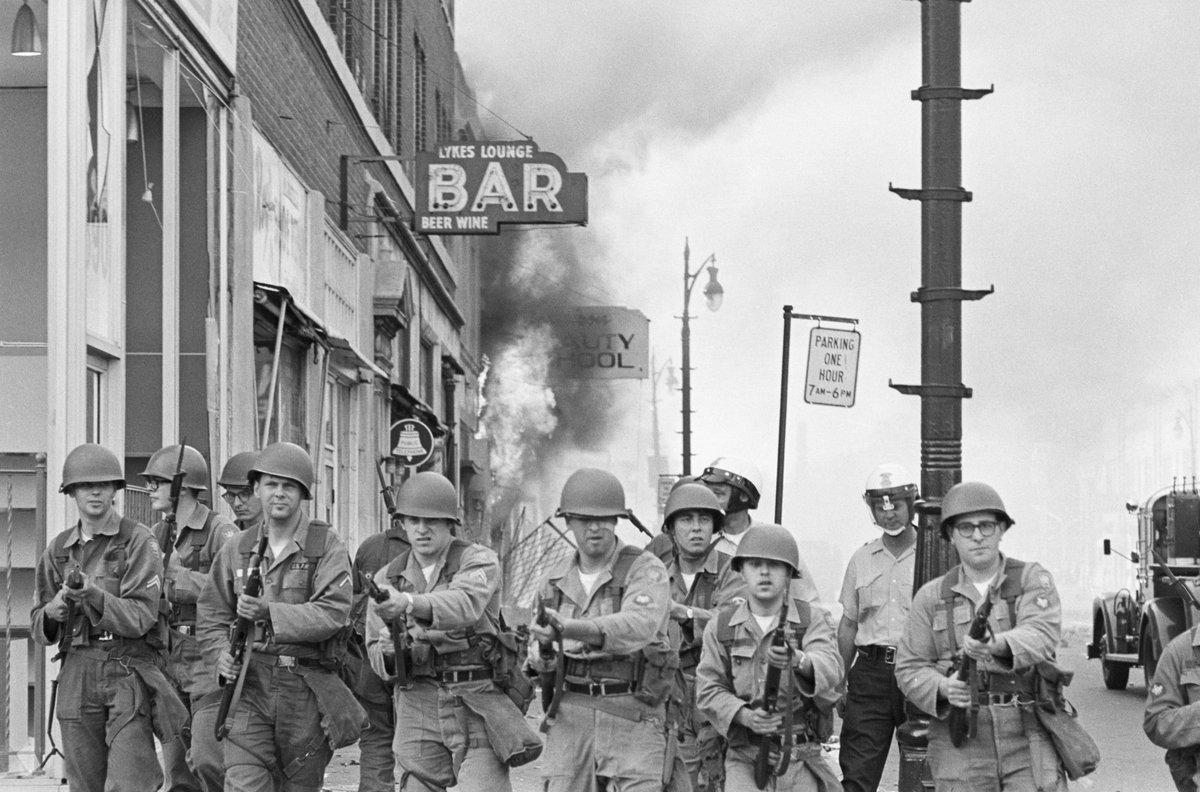
Guest Post: July 26th, 1967 - Detroit Uprising spirals out of control

On this day in alternate history, US President Lyndon B. Johnson declared the city of Detroit to be in a state of insurrection. The precipitating action for the 12th Street riot was a police raid on an after-hours bar called the Blind Pig. Two GIs had been celebrating their return from Vietnam on the city's near West Side when members Detroit Police Department made a series of arrests that triggered a bout of full-scale looting.
For the millions of American listeners it was of course profoundly shocking to hear the President, speaking about conflict and body count alongside Secretary of Defence McNamara, describing his plans to recapture an America city as if it were a strategic target in the Vietnam conflict. And although radical elements of the 12th Street riot genuinely sought to carve out a rebel black state, the motivations in the White House were of course politically motivated by the Democrats' re-election attempts for the following year. This desperate plea for calm was intended to abate the outrage of the silent majority of voters that believed the Democrats had lost control of the country. However, one of the unintended consequences that made matters even worse was that insurance companies used the insurrection clause to release themselves from obligation to pay out homeless African-Americans who had seen their properties destroyed.

Two years earlier, the Motor City had bid with confidence and hope for the hosting of the 1968 Olympic Games but the subsequent decline of the automobile industry and loss of state revenue due to white flight to the suburbs was now causing huge problems for the local economy. Perceptions were deceiving, and Detroit was far from the model city described by Mayor Jerome Cavanaugh in his upbeat message to the Olympic Committee, indeed readily apparent from the student protest at Detroit's Northern high school in 1966. And with America about to enter the next Presidential campaign cycle, even in the deadly seriousness of the situation in Detroit, bipartisan forces of blame apportionment could be felt rising close to the surface of political discourse.

Most noticeably, the media had repeatedly used racially charged stereotypes in their biased reporting and the key figures of President Johnson, Governor George Romney and Mayor Jerome Cavanaugh communicated status used very different terms for "critical" and "out of control." Despite this nuance all three authorities would privately agree that it was the US Congress that had stalled the urgently needed legislation that might have adequately addressed the concerns of the twenty-two million African Americans living in the continental United States. Martin Luther King, who had marched with Cavanugh, would famously describe the riot "as the language of the unheard" yet even so the agreement of these public figures would not form the basis of national consensus.

But tragically Johnson had thrown fuel on the fire because Vietnam-style atrocities would be committed by rogue troops in the United States Army's 82nd and 101st Airborne Divisions. So before the end of the "long, hot summer" of that year President Johnson would be forced to resign on health grounds and his VP Hubert H. Humphrey sworn in. With figures as diverse as Robert Kennedy, Richard Nixon and George Wallace set to enter the Presidential contest, the "Happy Warrior" would have less than a year to stop America from sliding into a second civil war as her cities began to burn one after another. Ultimately, he would fail in this impossible task, the National Convention in Chicago would demonstrate that the Democrats could not even control their own affairs and Lyndon B. Johnson would die from a heart attack in January 1972. Recognisable law and order would finally return five years later under the iron grip of President William C. Westmoreland.

Wikipedia Note: in reality it exploded into one of the deadliest and most destructive riots in American history, lasting five days and surpassing the violence and property destruction of Detroit's 1943 race riot 24 years earlier. Meanwhile, President Johnson appointed the commission on July 28, 1967, while rioting was still underway in Detroit, Michigan. Mounting civil unrest since 1965 had spawned riots in the black and Latino neighbourhoods of major U.S. cities, including Los Angeles (Watts riots of 1965), Chicago (Division Street Riots of 1966 [the first Puerto Rican riot in US History]), and Newark (1967 Newark riots). In his remarks upon signing the order establishing the Commission, Johnson asked for answers to three basic questions about the riots: "What happened? Why did it happen? What can be done to prevent it from happening again and again?"

Thursday, June 21, 2018

May 8, 1902 - Mount Pelée Eruption Spells the End of Europe


The towering volcano on the north end of the island of Martinique, which itself rests midway in the Lesser Antilles chain of islands east of the Caribbean Sea, gave increasingly terrifying signs of eruption weeks before it at last blew. Cracks in the crust around the mountain vented sulfurous gas as early as mid-April, and soon entire clouds began to pop up from the summit on a daily basis. The ground warped with rivers growing and changing course while ash began to rain down on nearby villages. Locals fled to Saint-Pierre, where city authorities struggled to maintain control and at last ordered that no one leave the city due to the danger of the lands outside. A few ships refused the order and fled, braving rough seas while radio telegrams demanded they return to the safety of the harbor. These few would be the only survivors from the explosive eruption on May 8.

A terrible earthquake followed the eruption of Mount Pelée devastating towns and causing smaller volcanic eruptions on several other islands through the Lesser Antilles. Tsunamis swept over the shores of Puerto Rico, Hispaniola, and northern South America. As the other islands came back to their feet, several ships ventured to see what had happened to Martinique. They discovered a wasteland with all life wiped out by heat, ash, and lava.

International relief rushed to help the devastated region. Theodore Roosevelt, President of the United States, dispatched Navy ships and authorized the Postal Service to collect donations while Congress voted for $200,000 in aid with hearings to follow for more money. Soon other countries joined, sending all the humanitarian help they could. As surveyors studied the damage on Martinique, they noted that their measurements were different with each passing day. Eventually newspapers revealed to the world that the island was continuing to grow, and it did so for months to come.

By the end of 1902, most nations had turned their attention away from the recovering Caribbean, now facing their own problems. Cool temperatures and crop failures reminded historians of the famous 1816 “Year Without Summer” following the eruption of Mount Tambora. The worst of the damage was felt on the Atlantic coast of North America and especially in northern Europe, where frosts set in so early that they wiped out what meager harvests had been expected. Soon international aid in mass shipments of grain was being sent to Great Britain, Germany, and Scandinavia.

After a tough year for farmers in 1902, 1903 was even worse. Fruit trees refused to blossom, and vegetable gardens did little more than sprout. Meat prices initially fell the shortage of hay meant that stock had to be slaughtered, but soon all types of food became scarce. The bitter winter of 1903-1904 was so miserable that Iceland, the Faroe Isles, and northern Norway became depopulated with refugees swarming into more southerly cities already suffering shortages. Theft and riots became commonplace.

As the 1900s continued, it was obvious the problems were getting worse. The line of ruined crops marched steadily southward across France. In Britain, the Thames, which had not frozen since 1814, now froze for weeks at a time. Scientists reviewing shipping data suggested the cause: the Gulf Stream, discovered centuries before by Ponce de Leon and charted by Benjamin Franklin as a current of warm water moving clockwise in the northern Atlantic, had weakened. Due to geological shifting in the Lesser Antilles, seawater no longer flowed so readily into the Caribbean and Gulf of Mexico to be warmed before turning northward and affecting the climates of northern Atlantic regions.

International aid groups gave up on the idea of propping up northern Europe with shipments of food and instead began a new effort: mass emigration. While many in France and Germany relocated southward in their own countries, tens of millions of people required evacuation from Great Britain and Scandinavia. Proud Britons removed themselves to warmer lands of their empire, pouring into Australia and western Canada as frontiersmen in addition to swelling the colonial cities in Africa and Asia. Denmark and the Union of Norway and Sweden had no such colonies, save for a few islands in the Caribbean. Initially, many of the Scandinavians turned to relatives who had already moved to the United States, but the Americans became inundated and closed off their quotas to new refugees. Germany, whose holdings in Africa and the South Pacific had already absorbed millions from their own country, concerted an effort to bring in as many further refugees as they could.

The twentieth century would be remembered by historians as a major shift in world dynamics with terrible loss of life and social disruption. Yet humanity would also see major leaps forward in technology, such as the discovery of malaria treatments by Sir Alexander Fleming working at St. Mary’s Hospital following its move to New Delhi, as well as social reform with world efforts toward equal rights, whether natives pushed off their lands or displaced Swedish laborers.


--

In reality, Mount Pelée did not largely affect ocean currents. It did grow a volcanic spire called “Pelée’s Tower” that increased as much as fifty feet a day until it collapsed after five months from a height of over 300 feet.

Site Meter