Showing posts with label 1812. Show all posts

Saturday, May 12, 2012

May 11, 1812 - Bellingham's Reign of Terror Begins

The life of merchant John Bellingham seemed cursed.  Believed to have been born in 1769, he became a midshipman on The Hartwell, which came under mutiny and ran aground four years later.  In 1794, he opened a factory in London, which went bankrupt.  Finally he found work as a clerk in an import/export firm between Britain and Russia.  Shortly after his marriage in 1803, he was sent to Russia on business.  The Russian ship Soleure had been lost at sea, and its owners claimed insurance from Lloyd's of London.  When an anonymous note to Lloyd's warned that the ship had been sabotaged, the owners blamed Bellingham and accused him of a debt of nearly 5000 rubles.  While he would be eventually found innocent, the charge stripped him of his traveling visa and kept him in prison in Russia for four years just as he was about to sail home to his wife.

Upon his eventual return to London, Bellingham appealed to the British government for restitution, but Britain had ceased diplomatic relations with Russia due to its switching sides in the Napoleonic Wars.  For years, the bad luck tortured him, despite his wife suggesting he drop the matter.  He worked until 1812, when he saw the Luddite movement growing in the North as industrialized looms put hundreds out of work.  Like-minded laborers joined the movement, blossoming it until crowds of thousands of protestors clashed with British troops and breaking looms was made a capital crime.

Bellingham at last discovered his chance to join with others who were devastated by the politicians of the government.  Using his expertise in trade and organization, he began to build a secret society dedicated to the destruction of a government who sat idly (or at least busily fighting foreign wars) while its people suffered an unjust world.  Bellingham decided to use assassination to get the points of the people across, using something of an inverse of the French Revolution's Reign of Terror.  Rather than a council oppressing its people by use of guillotine, the people would strike out against their oppressors to make their will known, one assassination at a time.

The first target was Prime Minister Spencer Perceval, political champion of the Peninsular War and suppressor of the Luddite riots.  A lone gunman waited in the lobby of Parliament until Perceval came in, then shot him, and (according to Bellingham's orders) sat quietly on a bench to be apprehended.  The man was executed within a week, but an anonymous letter (written by Bellingham) was read in court,

"Recollect, Gentlemen, what is our situation. Recollect that our families were ruined and ourselves destroyed, merely because it was Mr Perceval's pleasure that justice should not be granted; sheltering himself behind the imagined security of his station, and trampling upon law and right in the belief that no retribution could reach him. We demand only our rights, and not a favour; we demand what is the birthright and privilege of every Englishman. Gentlemen, when a minister sets himself above the laws, as Mr Perceval did, he does it as his own personal risk. If this were not so, the mere will of the minister would become the law, and what would then become of your liberties? I trust that this serious lesson will operate as a warning to all future ministers, and that they will henceforth do the thing that is right, for if the upper ranks of society are permitted to act wrong with impunity, the inferior ramifications will soon become wholly corrupted. Gentlemen, my life is in your hands, we rely confidently in your justice."

On the same day the gunman was "hanged by the neck until... dead... body to be dissected and anatomized", the ambassador to Russia was assassinated by another of Bellingham's agents.  Panic struck London, and many of the ministers of Parliament returned home under guard.  Others stayed under heavier guard.  Letters flowed out from Bellingham's society, explaining it was not a revolution but an act of justice.  He had no designs on injuring royalty, only those elected to serve their people but did not.

A war in counterespionage launched from the Earl of Liverpool's new government, which was losing members weekly.  Eventually Bellingham was found out, but he went into hiding, and believers in his cause moved him from place to place ahead of army searches.  Despite murders continuing throughout the summer and into the fall, the government refused to change its position.  Assassinations and executions took place for months until Bellingham was finally caught aboard a smuggler's ship headed for the United States of America, which had recently declared war with Britain and, Bellingham believed, would take him in with political understanding.  Bellingham was executed and his society dispersed.

To quote Sir Adam Roberts, emeritus professor of international relations at Oxford University and president of the British Academy, to the BBC, "In fact tyranny, or whatever form of government you have, usually has a broader social basis. The idea that one cleansing act of violence will transform the political landscape has been disproved time and time again because it has messier results."

Rather than realizing a revolution by carefully placed targets, Bellingham contributed to dispelling to many the idea of eliminating a figurehead on the behemoth that is government.  Later taken as a folk-figure much like Guy Fawkes, he would be rarely taken under serious academic study, with the exception of writers such as Thoreau and Marx, who used him as an example of what not to do.


--

In reality, Bellingham went himself to make his point.  Already a figure in the lobby of the House of Commons and having repeatedly attempted to find compensation, he was easily identified after the shooting.  He made his case in court in hopes he might be understood, but Bellingham again found bad luck as he was sentenced to death.

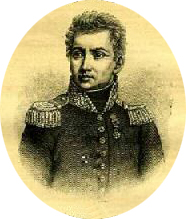
Saturday, October 23, 2010

October 23, 1812 – Malet's Coup Accidentally Succeeds

Claude Francois de Malet loved his country and felt that so much more could come from a France not chained under autocratic rule. When he had come of age at seventeen, he had enlisted as a Musketeer, as was common for minor nobles like himself to do under the reign of the Bourbons. Louis XVI disbanded the guard in 1776, and Malet realized the abuse of power one man could hold.

When the French Revolution began, he found common interest among the republicans. His family disinherited him, but Malet was content to fight for his own way and the way of his countrymen. He volunteered for the revolutionaries' army and became captain in the Army of the Rhine. Malet reenlisted after his first tour lapsed, and he fought valiantly until 1802 with many honors, being promoted to brigadier general in 1799.

Malet returned to France and found that the Revolution for which he had fought much of his life had given way to a new heavy-handed system. As the Consulate came to power, Malet voted against Napoleon as the First Consul. While a member of the Legion of Honor and thus a powerful enemy, Napoleon worked to push Malet's vehement voice away from public ears. Napoleon crowned himself emperor, and Malet resigned from service. Despite their differences, both Napoleon and Malet worked toward the greatness of France, and Malet accepted governorships in the Kingdom of Italy. He served in Italy for several years before being sent to prison for ten months in 1807 on charges not even considered in court as he was released without trial in 1808.

Returning to Paris after yet another stint of national service abroad and now seething from lost months of his life, Malet found himself arrested on suspicion of being a member of the Philadelphes, a society of Masons who had dedicated themselves to republicanism and, especially, opposition to Napoleon. From 1810, he sat under house arrest and began to plot. He built a network of allies and careful forgeries that would overthrow the dictator upon the false news of his death. Even if Napoleon were to return, Malet felt that the people of France would consider not taking back the emperor. When Napoleon marched on Moscow, Malet knew his chance had come.

October 23, 1812, Malet escaped and released his fellow conspirators from their prisons with forged documents, the presence of his general's uniform, and his sense of command. He marched to the barracks of the Gendarmerie, woke up the troops, and displayed further forgeries of orders to establish a republican Paris. The provisional government was established, and Malet's plan went smoothly.

Word of the coup filtered to Napoleon, who was sitting atop the ashes of Moscow. He passed command of the remnants of the Grande Armée to Marshall Joachim Murat and returned to Paris by fast-moving sleigh. Near Krasnoy, Russian snipers spotted the sleigh, thought it a messenger, and shot the passengers dead. After the disappearance of the emperor, emergency patrols would be launched, and his blood-soaked sleigh would be found November 14. When the news spread of the emperor's actual death, the Russians launched a renewed campaign against the devastated French troops.

In Paris, the news of Napoleon's death would be met with confusion. Malet worked to weave his lies and the truth into powerful propaganda that the French determined one was a false report, but no one knew which. In either case, they already had their provisional government established, and there was no need for a Napoleon II.

With the return to the republic, Malet worked to rally the army and peacefully disassemble Napoleon's web of satellite states, puppet kings, and forced alliances. While many in Europe called for a Sixth Coalition to defeat France wholly, the Continent was weary of war. Malet swore to fight defensively for French soil, but the diplomats were eager to take back their conquered lands without further bloodshed. A new balance of power was struck at the Treaty of Leipzig in October of 1813. Britain assumed dominance of the seas, Austria regained its holdings in Germany and Italy, and Russia grew in influence over Poland and Finland. France, meanwhile, would rebuild.

Malet was said to have “retired” France, and several groups rose up in dissension about his parceling up of the empire. Still, he argued if he had fought, the Coalition would have torn France apart, and his righteous anger proved that the age of old empires had come to an end. The colonies of Spain and Portugal would gain independence, and Germany under the Bavarians then Italy would unify themselves into European powers. Malet would die in 1826, not seeing the latter two actions, but living long enough to see the establishment of a new generation of free Frenchmen. Their republican ideals would spark waves of revolution across Europe in the 1830s and again in the 1850s, gradually dissolving the power of autocracy.

In its place, a sense of nationalism would grow up, sparking competition and, in the 1870s, the Great War. As the Prussians balked under Bavarian rule to began a civil war, all of the nations of Europe drew sides to divide the Continent and cost over a million lives. New systems would rise from its shadow, such as anarchism, communism, and progressive republicanism.


In reality, Napoleon did return to Paris. He quickly resumed power as the people loved him, but he was annoyed that no one had called for the continuation of his dynasty. Malet and his conspirators were gathered before trial on October 29 and executed by firing squad.

Site Meter