Showing posts with label benedict arnold. Show all posts

Monday, January 30, 2012

February 19, 1777 – Benedict Arnold Promoted

After much political infighting and discussion, the Continental Congress announced promoting five men to the rank of major general. The move was largely bureaucratic, but attempts influence came from every direction with much of the decision being a balance of generals from the various states of the new republic. Thirty-six-year-old Benedict Arnold was nearly passed over for the promotion largely due to his poor relations with other officers, but a final decision to promote him over Scotsman Arthur St. Clair came as both he and Thomas Mifflin were of Pennsylvania, and Thomas Mifflin was necessary as the Quartermaster General. Arnold was not popular, but his connections with Washington gave him some credence, and St. Clair proved more useful as a commander beside Washington.

Arnold’s record would prove impressive. Orphaned by the age of twenty but highly successful in business, Arnold quickly joined the Sons of Liberty in resistance against the Sugar and Stamp Acts. He was away on business in the West Indies at the time of the Boston Massacre, of which he wrote, “good God, are the Americans all asleep and tamely giving up their liberties?” When the Revolutionary War began, Arnold became a member of the Connecticut militia and suggested the capture of Fort Ticonderoga in New York, which was so strategically significant it was known as the “Gibraltar of the North” but had an insufficient British garrison. Gaining the rank of colonel, he joined with Ethan Allen in the successful capture of Ticonderoga. During the failed invasion of Quebec (also believed to have been Arnold’s suggestion), Arnold’s wilderness route gave extra support and earned him the rank of brigadier general at the cost of wounds. He commanded Montreal until forced to retreat by British advancing forces, but ordered the construction of the defensive fleet for Lake Champlain that slowed the British advance to Ticonderoga by months and was noted by James Wilkinson to be the last to leave.

While supervising the defense of Rhode Island and remarrying (his first wife had died while he was conquering Ticonderoga), Arnold received his promotion and was dispatched to command the defense of Ticonderoga while St. Clair was kept at Washington’s side with great praise for his strategy at Princeton. General Phillip Schuyler, then in command of the North, requested 10,000 men for the defense of Ticonderoga, but Washington expected British advance to come from the south following the Fall of New York. Arnold was to command only 2,000 men against the approaching forces of General John Burgoyne. Realizing that he had far too few troops to defend the large fort, Arnold ordered an immediate reconstruction of the fort, breaking up much of it and moving it to the higher, more defensible Sugar Loaf height (later known as Mount Defiance). John Trumball had shown the year before it was too high to be shot by cannon from the fort, and Arnold countered opinions that it was impossible for cannon to be set there as he himself had climbed it while injured.

The new works were established shortly before Burgoyne’s 7,800 troops arrived on June 30, 1777. Many of Arnold’s advisers suggested a withdrawal and regrouping with American troops to the south, but Arnold determined to stand firm and call for reinforcements. Burgoyne took the small fort at Crown Point and the remains of Ticonderoga with ease, but then found himself under fire from the American forces atop Mount Defiance. Burgoyne laid siege and was unable to move south, giving General Gates the time needed to collect thousands of local militia and march northward to raise the siege. Burgoyne counterattacked despite recommendations to retreat, and the resulting victory for Americans would be the turning point of the war. While Gates received much of the credit, Arnold won great new political connections through the commander and went with him to the southern theater following the loss of Charleston, where Arnold would manage the retreat at the Battle of Camden in 1780 to keep it from becoming a disastrous rout. Under Nathanael Greene, Arnold would be instrumental in the victories of the South, where his Tory leanings were appreciated.

When the war came to conclusion in 1783, Arnold continued in politics. He joined with the Federalists and determined to keep Georgia and the Carolinas, where he was very popular, from falling under the sway of Jeffersonian Virginia. Campaigning extensively over the value of unity, he took the place of John Adams as the Federalists’ bid for president, giving Adams his desired position of Chief Justice of the Supreme Court in return. Arnold’s presidential term would be a disaster as he used his position of Commander-in-Chief to extremes during the military build-up in the Quasi-War with France while many hoped for a recall of Washington to arms.

Arnold was soon seen as a potential dictator, and he was expunged from office in 1800, dying of dropsy after complications from gout the next year. Federalism came under great suspicion despite Alexander Hamilton’s attempts to distance his party from Arnold. Under Jefferson, the Twelfth Amendment would see a great restriction of executive power, clarifying many rights to the states.


--

In reality, Benedict Arnold was passed over for promotion. He made enemies with men such as Moses Hazen, the commander of the 2nd Canadian Regiment, nicknamed “Congress’ Own”, and John Brown of Pittsfield, a member of the Massachusetts Committee of Correspondence, who had been in charge of failed diversionary tactics that led to American defeat at the Battle of Quebec. Arnold would ultimately turn traitor to the American cause with his offer to surrender West Point, then later serve the British in commanding a number of raids. After the war, Arnold attempted to set himself up in business in Saint John, Canada, but found himself unpopular anywhere he went.

Friday, September 24, 2010

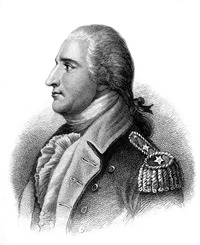
September 24, 1780 – Benedict Arnold Meets Washington for Breakfast

Major General Benedict Arnold had served his country well, even taking a wound to his leg, but he felt the young America had not returned the kindness. Arnold had been repeatedly passed over for promotion and robbed of commands that were given to men of much lesser quality. In 1778, he had been accused of profiteering in Philadelphia, but the later court martial proved him innocent of all but a few minor charges. Despite his innocence, his name was blackened, and he wrote Washington, “Having become a cripple in the service of my country, I little expected to meet ungrateful returns.” The final straw came after his Quebec campaign, a military disaster, in which his retreat had run up severe costs. The Continental Congress was to reimburse him, but due to lack of proper documentation, Arnold was told he owed over £1,000.

Arnold was newly married to Peggy, the daughter of Philadelphia Loyalist Judge Edward Shippen. His Loyalist ideals were piqued, and, over the course of the next year, Arnold would begin a plan to change sides in the war. Communications exchanged between himself and various British officials until he made his demands of £20,000, coverage for his losses, and the rank of a brigadier general. In exchange, he gave troop positions, army strengths, and supply information to Clinton in his Hudson Valley campaign. In a final offer, Arnold promised to turn over the Continental fort at West Point, New York.

On September 21, Arnold met with British spy Major John André, but the forces under American Colonel John Jameson had attacked the HMS Vulture, chasing away André's escape. The major would have to return overland through enemy lines, and Arnold supplied him with the appropriate papers for safe passage. André did not go far before he was caught by Patriots, who took him to Jameson after finding suspicious notes in his socks. These papers were sent to Washington, and André asked Jameson to send him back to Arnold. Major Benjamin Tallmadge, a member of Washington's intelligence service, convinced the colonel to hold onto the spy, and, though Jameson was highly suspicious of the divergence from the chain of command, not to mention the capture to the suspect Arnold.

That Sunday morning, Benedict Arnold, blissfully ignorant of André's capture, met with Washington for breakfast. The commander-in-chief had read the indicting papers, but he remained calm. Fellow military leaders said that the breakfast was pleasant and full of conversation about plans for winter. As he stood, Washington said to the soldiers, “Men, do the Major General the honor of arrest on suspicion of treason.” Arnold reportedly tried to fight his way from the room, but the Patriots, including Washington, subdued him. Just before he was dragged away, Arnold made a last request to Washington to allow his wife Peggy safe passage back to her family in Philadelphia. Washington would fulfill the request.

The investigation would take up the next week. Being found completely guilty, Benedict Arnold would be hanged alongside André on October 2. Just after his death, a letter from Arnold entitled “To the Inhabitants of America” would be published in Loyalist newspapers throughout the former colonies. In it, Arnold redressed his grievances: the independence of the Articles of Confederation despite offers to meet pre-war demands and return to the British Empire, a rejection of treaty with the French (whom he described as “the enemy of the Protestant faith”), and the lack of rebels to follow simple “common sense”, as had been recommended by Thomas Payne's pamphlet.

With a popular martyr, the Loyalist movement in the Colonies would begin anew. Washington would spend years settling uprisings and defeating British troops as they moved. The Crown, meanwhile, began a scheme of amphibious attacks that were intended to wear down the rebels but only dragged on an expensive war, inciting riots of war-weary cities. Internationally, the Dutch, Spanish, and French preyed heavily on the British shipping and conquered other colonies. Finally, in 1785 after the bloody defeat of British General Cornwallis at the Battle of Williamsburg, the Revolutionary War would end. International fighting would continue until the humiliating Treaty of Paris of 1788 was signed.

In the wake of the successful, though hard-fought, revolution in America, emulated revolutions would break out in France and over the Continent. What papers called “democratic chaos” caused uproars and wars against the French Republic until finally the kings of Europe agreed that they had gone too far in giving the Americans republican rule. The American Invasion would begin in 1815 and force upon them as king Prince Edward, George III's fourth son. In the coming years, his daughter Victoria would become queen of both America and England, finally reuniting the wayward colonies, though with separate parliaments.


In reality, Arnold received word about the capture of Major André, and he would quickly flee to the British fleet. There he would be granted his rank and serve in violent attacks in Connecticut and Virginia. After the war, Arnold would go to London, where he would try his hand at mercantilism before retiring to his death in 1801.

Site Meter