Showing posts with label charlie chaplin. Show all posts

Saturday, February 5, 2011

February 5, 1919 – Studios Unite to Take Down Artists

In a bold move, the greatest actors and directors of their day joined to form a studio where they would be in control of their creations. Mary Pickford, “America’s Sweethart;” Charles Chaplin, “The Tramp;” D.W. Griffith, whose epic film Birth of a Nation had rocked the country with controversy; and Douglas Fairbanks, the leading actor as well as a powerful producer of Hollywood, sought more control over their films and decided to pool their impressive resources for a new studio dubbed “United Artists.” Metro Pictures head Richard Rowland noted, "The inmates are taking over the asylum." While the action may have produced a new wealth of art for the growing medium of film, it struck a nerve in Hollywood’s business arena. If the greatest artists were to gain complete control of their productions, which might be the best sellers, then the millions of dollars to be made would be lost to those who had built up the movie business.

Worst yet was the ramifications for America. One producer noted, “We can’t have the eyes of the country glued to the works of a lady Canuck, a Limey, a Clansman, and an adulterer.” Only hours after the public release of photos showing Pickford, Chaplin, Griffith, and Fairbanks signing the contracts, a more secret meeting brought together the powerhouses of Hollywood such as Rowland, Loew, Fox, and Laemmle (though none would admit to being part of the conspiracy). While some suspected that the artist-run company would die from overspending as artists tended to do, the conspirators sought to bring United Artists down before it took root. The stars shone over the public with considerable popularity, which became the target for the studios.

Feeding press releases to newspapers, especially those owned by the powerful Hearst, the first major break was the announcement of the “discovery” of the affair between Fairbanks and Pickford. The two had met at a party in 1916 and begun the affair, but the civility of the times kept such things quiet. Fairbanks was currently in proceedings to finalize his divorce with wife Anna Beth in preparation to marry Pickford (herself married to Owen Moore), and the legal papers became fodder for an enormous scandal. With news slow since the end of the Great War and the fights between President Wilson and Congress only marginally interesting, the public was hungry for shocking gossip. The following months tore into Pickford and Fairbanks, ending their careers in America and eventually forcing them to sell out their shares of UA to Chaplin. They left California and moved to Canada, where they would begin new careers filming outside of Toronto. Studio-owned theaters practically refused to show their films in America, so they turned to exporting films, establishing new popularity almost worldwide.

Griffith dropped out soon after, seeing that the resources of United Artists were even less than those offered by penny-pinching studio executives. He returned to creating epics under Louis B. Mayer, whose theaters proved to return Griffith to his blockbuster standing, but his career would fall off as sound transformed filmmaking. Ultimately he would be a consulting director, giving his expertise on epics, such as the film San Francisco in 1936.

Chaplin stood alone with his studio and sought help from wherever he could find it. After barely producing The Gold Rush, he discovered that almost no theater would show it. Quitting America, he returned to London and joined the growing film industry there, which would make him into a titan as audiences across Europe and the British Empire swarmed over his work.

Having successfully defended the business, the studios returned to work creating what many referred to as “hash” or “schlock”, depending upon one’s standing with Semitism. Still, audiences demanded entertainment through the Depression, and they were given cheaply produced, yet memorable, films. Actors, writers, and directors attempted to unionize numerous times, but the studios crushed each attempt. After World War II, studios fell under suspicion of monopoly, which they clearly were with vertically and horizontally integrated firms controlling nearly every theater, production company, and the distributors connecting them. The studio system collapsed under government pressure and rebellious casts and crews, and the desperate epics of the 1950s only hastened their demise. While international films began to swarm the newly freed American theaters, Hollywood would reinvent itself in the late ‘50s and ‘60s into smaller production houses forced to create powerful, though inexpensive, films that mirrored the more triumphant American medium: television. Hollywood today is well known for its productions as well as its Andy Warhol Factory-style, but it is a lesser powerhouse to the Canadian Academy, British Film Corporation, and growing golden age of Bollywood.


In reality, United Artists was allowed to run its course. Although facing initial financial issues, Chaplin’s The Gold Rush would give it solvency that would allow it to fund lesser known producers such as Walt Disney and Orson Welles. It was reborn in the 1950s with John Huston and thrived as the rest of Hollywood seemed to go into decline. United Artists would eventually be bought as a subsidiary by Metro-Goldwyn-Mayer in 1981 and continues to produce films (such as the James Bond and Rocky series) in the spirit of artistic freedom upon which it was founded.

Wednesday, November 24, 2010

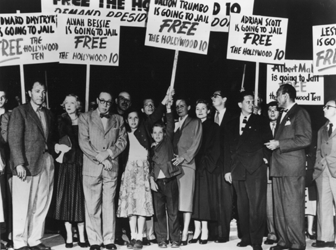
November 24, 1947 – Hollywood Ten Exonerated thanks to Charlie Chaplin

In the days of the post-war conservatism, the House Un-American Activities Committee stepped up its investigations of the suspected Communist threat to the United States. Created in 1938, the committee served the same purpose as several before it, such as under Overman in 1918 and Fish in 1930. Special committees had worked to investigate fascist or socialist plots in the 1930s and early ‘40s, and Congress finally voted to create a standing committee for the HUAC at the close of WWII. They had considered investigating the actions of the Ku Klux Klan, but instead focused on communism as a more direct threat to the US Constitution.

After two years, hearings began to investigate communism in Hollywood. The West Coast city was a powerful player in American society, feeding media to the populace that may subvert the Constitutional government. Certain films such as Song of Russia and Mission to Moscow were obviously pro-Soviet, but they had been created in the time Russians were needed to combat Hitler. Now Congress readied to clean out the communists as the Cold War would turn former allies into potentially dangerous enemies.

Accusations of Hollywood had not been uncommon already. For years, J. Edgar Hoover and his FBI had kept files on actors, directors, and writers. Charles Chaplin, a native of London, was a particular target, especially in 1942 after Chaplin had pressed publically for opening a second front in Europe. While the front did open with the invasions of Italy and France in 1944, Chaplin was considered something of a warmonger despite his 1940 film The Great Dictator lampooning Hitler and his regime.

Hollywood weights such as Walt Disney and president of the Screen Actors Guild Ronald Reagan testified that there was in fact a communist threat in Hollywood. Other Hollywood leaders such as Humphrey Bogart and John Huston organized the Committee for the First Amendment to resist government crackdown. From a list of alleged members of the Communist Party was created, and ten screenwriters and directors refused to answer questions as to their membership in the Party (an illegal activity at the time), citing their rights under the First Amendment for assembly and free speech.

While the Screen Actors Guild voted to allow officers only if they took pledges against communism, the House of Representatives prepared to vote on a citation of the “Hollywood Ten” under contempt for Congress. In the speeches leading to the vote, Charlie Chaplin, who had flown to Washington specially, was asked to speak. Several congressmen groaned and the word “clown” was heard, but Chaplin firmly took his place and began his speech with, “I am not an American. But, I am not Un-American. I know what Americans stand for, and I have seen it make great victory in Europe against a terrible enemy. To let the outstretched hand of America tighten back into a fist at this time would create a land of fear and anger when what Americans truly want is peace and prosperity.” Quoting the United States Constitution and Lincoln’s Gettysburg Address, Chaplin railed the notion that judging a person by thought and not action went against Jeffersonian principles that had founded the nation. He concluded by reiterating, “I am not an American, but I support Americans. It is up to the vote of this House to decide whether their America is true to its name.”

The vote for citation would fail only slightly, 180 to 183. December 3, MPAA president Eric Johnson and a collection of film makers would issue a press release from the Waldorf Hotel stating that Hollywood would not take collective business actions against the ten suspected men. While some might be fired or hired on the principles of free market employment, a “blacklist” would be unthinkable. The Red Scare of the ‘40s would die back, though the Communist Party would not make any great gains in the conservative Greatest Generation.

Some, such as J. Edgar Hoover, would continue to investigate anti-American activity, discovering the espionage of Alger Hiss. While Hoover would have great success, he would go too far in his bitterness against Chaplin. In 1952, while Chaplin was in London to attend the premiere of his film Limelight, Hoover would attempt to revoke Chaplin’s re-entry permit. The Immigration and Naturalization Service would erupt in scandal that would end with Hoover’s forced resignation in 1953. Chaplin would return to America and gain citizenship in 1961 at age 72.


In reality, Charlie Chaplin did not speak before Congress. The House voted to cite the Hollywood 10, and the MPAA followed with its Blacklist. Over 300 people would suffer the crackdown on left-leaning actors, writers, and directors with only a few able to recreate their careers. Chaplin would be exiled from the United States, not returning until 1972 for business reasons. In his exile, Chaplin wrote, “. . . Since the end of the last world war, I have been the object of lies and propaganda by powerful reactionary groups who, by their influence and by the aid of America's yellow press, have created an unhealthy atmosphere in which liberal-minded individuals can be singled out and persecuted. Under these conditions I find it virtually impossible to continue my motion-picture work, and I have therefore given up my residence in the United States.”

Site Meter