Showing posts with label fdr. Show all posts

Friday, September 13, 2013

April 12, 1945 - FDR Suffers Minor Stroke


While resting at his private retreat of the Little White House in Warm Springs, Georgia, to renew his energies before the UN Conference on International Organization in San Francisco in the coming weeks, President Franklin Delano Roosevelt announced, "I have a terrific pain in the back of my head." The president went quiet and his body convulsed. The others in the room hurried to his side and tended to him until doctors arrived. Due to strain from his many years of political work and high cholesterol combined with a predisposition to the same congestive heart failure that ended his father's life, Roosevelt suffered a terrible, but not debilitating, stroke.

The president's health had been troubled for some time. Rumors about illness circulated widely during the 1944 election, but the press seemed to steer clear of the issue, potentially due to orders from the Office of Censorship that had also kept reporters off the battlefields as the war dragged on. His doctor ordered bed-rest, but Roosevelt took it upon himself to exercise more regularly, even though his bout with polio left him confined to a wheelchair and steel braces. This time, he lost much of the use of his left arm, but was fortunate to keep his abilities in speech.

As with his previous illness, Roosevelt soldiered on. News of the stroke was controlled by the White House, simply stating that he still suffered from the affects of fatigue. He managed to be in San Francisco for the organization of the United Nations, a term he had created from the Allies who signed the Atlantic Charter in 1942. While the papers stated he was in attendance, he spent nearly all of his time behind closed doors with only a few select meetings.

Through tenacity, Roosevelt continued to work as president. Upon the collapse of Nazi power in Europe, Roosevelt gave a radio address to Americans pronouncing Victory Day, though others such as Vice-President Harry S Truman became the faces seen in photos and movie reels. Roosevelt saw out the end of the war, skillfully defending the use of atomic weapons to end the war with Japan early, though there were some who said that the declaration of war by the Soviet Union was what had truly brought Japan to surrender unconditionally.

Roosevelt, who had long trusted Stalin, had begun to doubt his trustworthiness as the war began to come to a close and the Soviets’ plans to set up puppet governments began to show. Churchill had long warned Roosevelt about Stalin, seeing him as at-best a necessary evil until Hitler was destroyed, and soon warned of an Iron Curtain behind which Stalin plotted. Britain edged Churchill out of office in 1945, looking to break cleanly from the troubled days of the war. Roosevelt pressed on and, though his widespread popularity, managed to keep the nation voting Democrat while the Republicans cried for change.

Roosevelt promised change and continued to campaign for his Second Bill of Rights, completing the work he felt he had begun with the social measures of the New Deal. Echoing the measures of the first Bill of Rights, Roosevelt argued that the right of “pursuit of happiness” had not yet been fulfilled. Gradually, programs came into play to employment in CCC-style grants and organizations, housing, education, and medical care. With enough Democrats in Congress, he was able to push through legislation blocking the powers of big business and monopolies, reversing many of the anti-labor policies that had been in place due to necessity of production during the war.

Abroad, Roosevelt kept up pressure on Stalin and refused to allow Communism to spread. While many of the soldiers from WWII returned home, much of the materiel and provisions were shifted to the KMT forces of the Republic of China, finally squashing Mao’s armies in 1947. It became painfully clear that the Soviets would not remove themselves as the Americans, British, and French were doing. Roosevelt began to threaten use of atomic weapons, which outmatched anything the Russians had in their arsenal. Stalin tested Roosevelt again and again with false deadlines and empty promises until the tension burst in 1948 in Berlin over Soviet restrictions over passage to Berlin. Through the UN (which Soviets increasingly called a “puppet of the West”), Roosevelt demanded Stalin pull Soviet troops out of all occupied areas by that fall. Stalin refused, so Roosevelt began a bombing campaign targeting the Soviet military.

Republicans noted that the bombing began shortly before the election and accused Roosevelt of starting another war so he could maintain control of the White House as well as flat-out tyranny. Roosevelt replied that he was doing what he felt best and would understand if the American public trusted him. In the narrowest election of his career, Roosevelt won yet another unprecedented fifth term in 1948. As in 1944, much of the campaigning was done vicariously.

War with the Soviets finally drove them back to the borders of Russia in 1949, which was when Stalin announced the USSR had successfully developed its own atomic bomb in Kazakhstan. An uneasy armistice began even though much of Europe had been liberated. Preparations were made for peace talks, but the travel to a neutral summit proved too taxing for FDR, who died before he could meet Stalin face-to-face again. The war was never officially declared over, leaving a huge demilitarized “Iron Curtain” surrounding the Soviet border.


At home, the Democratic Party lost its driving force, and, in 1952, the consolidated conservatives from the Republicans pushed out the moderate Republican choice, General Dwight D. Eisenhower, calling for an end to America’s militarism with a return to isolationism within the UN. Democrat Estes Kefauver of Tennessee was no match for Robert Taft in the polls. As the new conservatives attempted to break down the New Deal in the 1950s, however, public outcry began a new era of reform, including new rights for minorities and women, furthering Roosevelt’s Bill of Rights further than he had ever imagined.


--

In reality, Roosevelt died on April 12, 1945, of a large cerebral hemorrhage after following orders of two hours of rest a day and no lunch meetings. Only a few weeks later on May 8, Germany fell, ending the war in Europe. VP-turned-President Truman pronounced the day in honor of Roosevelt's efforts and wished publicly that "Franklin D. Roosevelt had lived to witness this day."

Thursday, April 18, 2013

April 19, 1916 - Neiu Nederlanders back Americans

In response to unrestricted submarine warfare by the Germans, American President Woodrow Wilson delivered on April 18, 1916, an ultimatum that continued attack on American ships would provoke war.  The next day, Neiu Nederlander President Theodoor van Rosevelt traveled to Washington to show his agreement.  If the US went to war, the American Dutch would bravely join them.

The two nations had grown up alongside one another as Europeans colonized North America.  The English threatened to eliminate the Dutch from their holdings of New Amsterdam when four frigates occupied the harbor.  Director-General Peter Stuyvesant, after considering ceding the land in hopes of retaking it, decided to head off a Second Anglo-Dutch War and refused.  After firing on the city, the frigates were rebuffed and returned to England empty-handed.

Since that time, New Amsterdam quickly expanded.  Jews ousted from Brazil as Portugal retook Dutch conquests flooded into the city, and immigrants from all over the world were accepted.  The economy flourished as pelts were harvested from the upper Hudson and established shipping.  When the twin states of New England and Great Virginia declared independence from Britain, the Dutch granted support first financially and then through its impressive navy.  When Napoleon conquered the Netherlands in Europe, Neiu Nederlands announced its own independence.

Relations between Neiu Nederlanders and Americans were amicable.  They were particularly close with New England due to ties in shipping and manufacturing, although relations were at times strained while the United States to the south determining water rights of Lake Erie.  When New England broke off trade with the US over slavery, the Nederlanders maintained a lucrative neutrality.  The sudden surge of trade brought about a new golden age, which led to a great deal of corruption that responded in a powerful Progressive Movement, headed by the young Theodoor van Rosevelt.

Rosevelt was part of the wealthy and politically influential family that had begun with Claes Maartenszen van Rosevelt, who purchased a large farm on Manhattan Island that would translate into enormous wealth as the city grew.  Theodoor was born in 1858 and struggled through his childhood suffering from asthma.  He overcame the disease by determination and exercise with seeming limitless energy, features that would define his life.  After his education, Theodoor traveled extensively to the American West as well as Dutch holdings in the Caribbean and South America.  He returned and entered civil service, soon becoming Director of the Navy where he built a canal through Panama and led the Great White Fleet on its tour around the world.  By 1910, he was elected President.

When war erupted in Europe, Rosevelt hoped to join quickly and use the impressive New Dutch fleet, but business was too good trading through the neutral Netherlands.  Despite his extensive campaigning, it wasn't until the Americans threatened Germany that he finally gained the agreement of shipping interests who disapproved of attacks by uboats.  In 1917, unrestricted submarine warfare resumed, and a joint declaration of war was announced.  Thanks to Rosevelt's anticipation, New Dutch troops joined the front almost immediately.

Tuesday, February 14, 2012

February 29, 1932 – Alfalfa Bill Murray Begins his Road to the White House

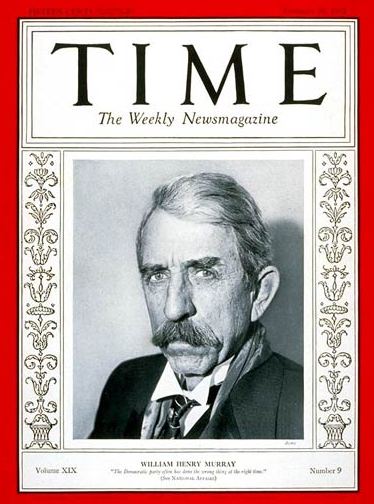
Future President of the United States William Henry Davis “Alfalfa Bill” Murray appeared on the cover of Time Newsmagazine with a quote from comedian Will Rogers who noted, "I guess he ain't got much chance." Murray’s chances were indeed slim as he did not win a single primary, but he still appeared at the Democratic National Convention, where he came in eighth on the first ballot with 23 votes. He was set to jokingly endorse Will Rogers as a write-in and head home when William Randolph Hearst broke news of a long-running affair by frontrunner New York Governor Franklin Delano Roosevelt with his wife’s secretary. It was well known that FDR was a playboy before contracting polio in 1921, but the news exploded with the sensation that he was still carrying on with his wife’s secretary after some fifteen years. Additional articles added another affair with his personal secretary Marguerite “Missy” LeHand, and the news-hungry Depression public went crazy. Roosevelt bowed out of the race, leaving over six hundred votes suddenly up for grabs. It was understood by the party machine that their pick, former New York Governor Al Smith, would collect the votes, but his old rivalry with FDR turned off supporters, including Joseph P. Kennedy, Sr. In a midnight call between Kennedy and Hearst, who supported Speaker of the U.S. House John Nance Garner despite him never asking to be president, they determined to select the biggest Blackhorse candidate since 1844’s James K. Polk. Murray seemed someone they could influence, and he was already famous for his relief activities in Dustbowl-stricken Oklahoma. Much to his own surprise and frustration of Al Smith, Murray found himself picked as the Democratic candidate on the fourth ballot.

Murray was born in 1869 in Toadsuck (later renamed “Collinsville), Texas. He worked as a laborer while attending public school and tried a number of careers before passing the Texas bar exam in 1895. Murray soon started a law practice in Indian Territory, where he earned his nickname from speaking tours in which he often mentioned his alfalfa field. In 1905, he served as the Chickasaw Nation representative to the constitutional convention of the proposed state of Sequoyah and a year later in the convention that created the singular state of Oklahoma. Using connections through his wife’s uncle, former Territorial Governor Douglas Johnston, and first state governor Charles N. Haskell, Murray managed a moderately successful political career with stints as Speaker of the Oklahoma House of Representatives and U.S. Representative. He retired from politics in 1918 after losing his bid for governor and aided local ranchers in founding a colony in Bolivia during the 1920s.

In 1930, Murray reappeared in Oklahoma and again ran for governor. He won handily, with a margin of some 100,000 votes. When he came to office, the state was crippled with the Dust Bowl as well as a $5 million budget deficit as the government made attempts to provide work and welfare as the Great Depression began. Murray proved a creative and effective leader. He collected money voluntarily for food programs for the poor, donating even his own salary. To save on government expenses, he ordered the capital lawn to be used to raise sheep, limiting the need for landscaping. When any need arose, he called up the Oklahoma National Guard and declared martial law, such as enforcement of his executive order to limit oil production in 1931 to keep prices strong and support state exports. In July of 1931, he instigated the Toll Bridge War in which he forced open a bridge on the Red River closed on its Texas end by an injunction due to a disagreement with a toll company. Perhaps most beneficial was his June call for a national convention on relief to be held in Memphis, TN, which shot him into the press. Riding his wave of fame, he announced his intentions to run in 1932.

The race against Republican incumbent Herbert Hoover was a firm victory for the Democrats. Votes poured in from the South and West, where the ravages of the Great Depression had been the deepest and President Hoover’s plans for relief agencies had not yet reached. The Northeast was firmly for Hoover, even New York where stalwart Roosevelt fans rejected Murray’s “yokel” (and notoriously racist) policies. Inaugurated on March 4, 1933 (the last late inauguration before the Twentieth Amendment came to be), Murray’s first one hundred days proved to be among the busiest in American history, responding to an earthquake in California only a week later and the Akron airship disaster in New Jersey the next month. When “Machine Gun” Kelly kidnapped Oklahoma oilman Charles Urschel, Murray gave the FBI unprecedented powers and reinforcement through US Army, including spotter planes. Beer became legalized, cannabis was outlawed, and the dollar was taken off the gold standard to enable more free-flow of cash. Roosevelt, still holding political clout, criticized Murray’s use of armed forces and suggested instating agencies, but Murray showed himself as a man of action, appearing himself at many of the trouble-spots.

Most famous, however, was Murray’s reaction to the “Business Plot” of 1933. Retired Marine Corps Major General Smedley Butler testified in 1934 to the Special Committee on Un-American Activities (founded to investigate propaganda contrary to the Constitution, particularly Nazism) that a group of businessmen responding to “socialist” possibilities after the removal of the gold standard had contacted him about the possibility of a coup d’état. While many contemporaries ignored the accusations or, at most, chuckled (General Douglas MacArthur called it “the best laugh story of the year”), Murray’s increasing paranoia after the death of his friend Haskell latched onto the idea of conspiracy. He tasked J. Edgar Hoover with finding conspirators and pressured the McCormack–Dickstein Committee to call in every name under suspicion, including banker Thomas Lamont and Admiral William Sims. Many accused Murray of fear-mongering and distracting from his only somewhat successful relief programs. Murray and his supporters, however, reacted violently to potential fascists, even though Murray himself had applauded the busy activities of Mussolini and Hitler. In the Battle of Wall Street, FBI agents supported by US soldiers seized several New York banks and firms, clearing out papers to be reviewed by the Justice Department.

In 1936, the Democratic convention in Philadelphia became a circus of accusations. Kennedy had long removed himself from Murray and hoped to reinvent the Democrats despite him. Murray eventually broke away with his own Plowman’s Party after his quote that “civilization begins and ends with a plow.” The move split would-be Democratic votes and handed the election to centrist Republican Alf Landon, whom Murray once proclaimed was a Nazi spy. Landon, however, proved himself much less rightist than Murray and achieved the bulk of the Black vote. He won a second term in 1940 as he prepared America for another world war as Nazism was generally feared thanks to Murray’s stand. After the war, the Republican dynasty continued under Thomas Dewey and General Dwight Eisenhower.

Murray, meanwhile, returned to Oklahoma where he wrote extensively and lost further attempts at election. His son, Johnston, would become the governor of Oklahoma in 1951, but did not seek higher office.


--

In reality, Murray’s presidential run was unsuccessful. Roosevelt (whose alleged affairs would not be spoken of until the ‘60s) would go on to be elected four times as president, serving through the Great Depression and much of World War II. His policies of moderated socialism and extensive spending in the New Deal established modern American government.

Site Meter