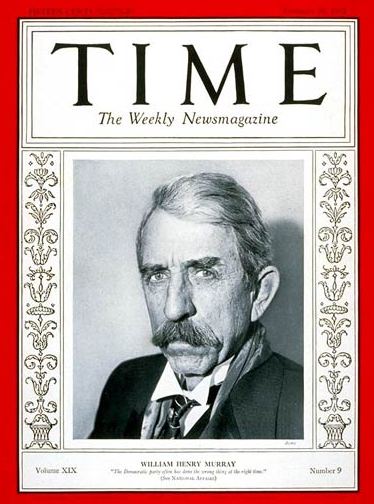
Future President of the United States William Henry Davis “Alfalfa Bill” Murray appeared on the cover of Time Newsmagazine with a quote from comedian Will Rogers who noted, "I guess he ain't got much chance." Murray’s chances were indeed slim as he did not win a single primary, but he still appeared at the Democratic National Convention, where he came in eighth on the first ballot with 23 votes. He was set to jokingly endorse Will Rogers as a write-in and head home when William Randolph Hearst broke news of a long-running affair by frontrunner New York Governor Franklin Delano Roosevelt with his wife’s secretary. It was well known that FDR was a playboy before contracting polio in 1921, but the news exploded with the sensation that he was still carrying on with his wife’s secretary after some fifteen years. Additional articles added another affair with his personal secretary Marguerite “Missy” LeHand, and the news-hungry Depression public went crazy. Roosevelt bowed out of the race, leaving over six hundred votes suddenly up for grabs. It was understood by the party machine that their pick, former New York Governor Al Smith, would collect the votes, but his old rivalry with FDR turned off supporters, including Joseph P. Kennedy, Sr. In a midnight call between Kennedy and Hearst, who supported Speaker of the U.S. House John Nance Garner despite him never asking to be president, they determined to select the biggest Blackhorse candidate since 1844’s James K. Polk. Murray seemed someone they could influence, and he was already famous for his relief activities in Dustbowl-stricken Oklahoma. Much to his own surprise and frustration of Al Smith, Murray found himself picked as the Democratic candidate on the fourth ballot.
Murray was born in 1869 in Toadsuck (later renamed “Collinsville), Texas. He worked as a laborer while attending public school and tried a number of careers before passing the Texas bar exam in 1895. Murray soon started a law practice in Indian Territory, where he earned his nickname from speaking tours in which he often mentioned his alfalfa field. In 1905, he served as the Chickasaw Nation representative to the constitutional convention of the proposed state of Sequoyah and a year later in the convention that created the singular state of Oklahoma. Using connections through his wife’s uncle, former Territorial Governor Douglas Johnston, and first state governor Charles N. Haskell, Murray managed a moderately successful political career with stints as Speaker of the Oklahoma House of Representatives and U.S. Representative. He retired from politics in 1918 after losing his bid for governor and aided local ranchers in founding a colony in Bolivia during the 1920s.
In 1930, Murray reappeared in Oklahoma and again ran for governor. He won handily, with a margin of some 100,000 votes. When he came to office, the state was crippled with the Dust Bowl as well as a $5 million budget deficit as the government made attempts to provide work and welfare as the Great Depression began. Murray proved a creative and effective leader. He collected money voluntarily for food programs for the poor, donating even his own salary. To save on government expenses, he ordered the capital lawn to be used to raise sheep, limiting the need for landscaping. When any need arose, he called up the Oklahoma National Guard and declared martial law, such as enforcement of his executive order to limit oil production in 1931 to keep prices strong and support state exports. In July of 1931, he instigated the Toll Bridge War in which he forced open a bridge on the Red River closed on its Texas end by an injunction due to a disagreement with a toll company. Perhaps most beneficial was his June call for a national convention on relief to be held in Memphis, TN, which shot him into the press. Riding his wave of fame, he announced his intentions to run in 1932.
The race against Republican incumbent Herbert Hoover was a firm victory for the Democrats. Votes poured in from the South and West, where the ravages of the Great Depression had been the deepest and President Hoover’s plans for relief agencies had not yet reached. The Northeast was firmly for Hoover, even New York where stalwart Roosevelt fans rejected Murray’s “yokel” (and notoriously racist) policies. Inaugurated on March 4, 1933 (the last late inauguration before the Twentieth Amendment came to be), Murray’s first one hundred days proved to be among the busiest in American history, responding to an earthquake in California only a week later and the Akron airship disaster in New Jersey the next month. When “Machine Gun” Kelly kidnapped Oklahoma oilman Charles Urschel, Murray gave the FBI unprecedented powers and reinforcement through US Army, including spotter planes. Beer became legalized, cannabis was outlawed, and the dollar was taken off the gold standard to enable more free-flow of cash. Roosevelt, still holding political clout, criticized Murray’s use of armed forces and suggested instating agencies, but Murray showed himself as a man of action, appearing himself at many of the trouble-spots.
Most famous, however, was Murray’s reaction to the “Business Plot” of 1933. Retired Marine Corps Major General Smedley Butler testified in 1934 to the Special Committee on Un-American Activities (founded to investigate propaganda contrary to the Constitution, particularly Nazism) that a group of businessmen responding to “socialist” possibilities after the removal of the gold standard had contacted him about the possibility of a coup d’état. While many contemporaries ignored the accusations or, at most, chuckled (General Douglas MacArthur called it “the best laugh story of the year”), Murray’s increasing paranoia after the death of his friend Haskell latched onto the idea of conspiracy. He tasked J. Edgar Hoover with finding conspirators and pressured the McCormack–Dickstein Committee to call in every name under suspicion, including banker Thomas Lamont and Admiral William Sims. Many accused Murray of fear-mongering and distracting from his only somewhat successful relief programs. Murray and his supporters, however, reacted violently to potential fascists, even though Murray himself had applauded the busy activities of Mussolini and Hitler. In the Battle of Wall Street, FBI agents supported by US soldiers seized several New York banks and firms, clearing out papers to be reviewed by the Justice Department.
In 1936, the Democratic convention in Philadelphia became a circus of accusations. Kennedy had long removed himself from Murray and hoped to reinvent the Democrats despite him. Murray eventually broke away with his own Plowman’s Party after his quote that “civilization begins and ends with a plow.” The move split would-be Democratic votes and handed the election to centrist Republican Alf Landon, whom Murray once proclaimed was a Nazi spy. Landon, however, proved himself much less rightist than Murray and achieved the bulk of the Black vote. He won a second term in 1940 as he prepared America for another world war as Nazism was generally feared thanks to Murray’s stand. After the war, the Republican dynasty continued under Thomas Dewey and General Dwight Eisenhower.
Murray, meanwhile, returned to Oklahoma where he wrote extensively and lost further attempts at election. His son, Johnston, would become the governor of Oklahoma in 1951, but did not seek higher office.
--
In reality, Murray’s presidential run was unsuccessful. Roosevelt (whose alleged affairs would not be spoken of until the ‘60s) would go on to be elected four times as president, serving through the Great Depression and much of World War II. His policies of moderated socialism and extensive spending in the New Deal established modern American government.
Showing events on this day in years past that shaped history... just, not our history.
Showing posts with label great depression. Show all posts
Tuesday, February 14, 2012
February 29, 1932 – Alfalfa Bill Murray Begins his Road to the White House
Tuesday, July 20, 2010
July 20, 1934 – Socialist Uprising begins in Minneapolis
Minneapolis Teamsters were in their second strike of the summer. The Great Depression had hid the Midwest hard, and laborers were among the most struggling of Americans to make ends meet. In an effort to better their position, the teamsters organized themselves into a union. A constitution had been written, and drivers were organized into different locals, each representing a type of worker: milk, freight, ice-wagon, etc. The leadership of Daniel Tobbs created an efficient headquarters staffed by a women's auxiliary, and they had even allied themselves with the Communist Party to achieve political clout. The past winter, a strike of coal drivers had made great progress, and now seemed time to achieve workers' rights.
In May, the strike began. The teamsters shut down the city, allowing only farmers to transport their produce directly to grocers. Fighting almost immediately broke out with the unions and the Minneapolis police trading blows with clubs and pipes. After a week of carnage, negotiations began, and Governor Floyd Olson was ready with the mobilized (but not deployed) National Guard. The unions and their employers came to agreement, and workers returned to business by the end of the month.
However, it became apparent that they had missed a key point. Warehouse workers (who had allied themselves with the drivers) were meant to receive benefits as understood by the unions, but the employers refused to give them. The strike resumed on July 17.
The union leadership decided that, if battle were to escalate, they would be ready. Guns were stockpiled, but only clubs were allowed until otherwise provoked. On July 20, the provocation would come as fifty police officers escorted a single truck into the picketed market. Club-bearing teamsters made to block the truck's path, and then police opened fire with shotguns loaded with buckshot. Union workers charged forward to aid the injured, and the police continued to fire. Within minutes, teamsters from the rear of the picket came forward with their own weapons. The brawl turned to battle.
Minneapolis descended into a war zone. Olson deployed the National Guard, but the soldiers expected riot control rather than urban combat. After two days, the Guard fell back to take up siege of the city. All across the nation, in Hoovervilles and breadlines, people seemed to come alive to the sounds of gunfire. Longshoremen all along the West Coast rose up, shutting down ports. A strike of auto workers in Toledo that had been thought to have been settled ignited again and began a wildfire that would consume Ohio.
President Roosevelt watched as his country became engulfed it what appeared to be civil war. He pleaded for ceasefires over his weekly addresses, but the words fell on deaf ears. Finally he would call forth the Army and Marines to join faltering National Guard deployments (many of whom were beginning to side with the union workers). The action would cause a reaffirmation of faith in the Federal government among some and calls for a total separation among others. With the Convention of Minneapolis, the anarchy would become a revolution.
Violence would tear across the Midwest. Allied with them, but unable to hold such independence, were the Workers of the West, a mass in California and the Pacific Northwest that locked down the western part of the country. Riots shredded New York City during the Thirty Days' Fire, but neither the Federalists nor the Socialists could gain ground.
The war changed when Stalin offered aid to the rebel workers. Many happily took up Soviet arms, but many others became suspicious of foreign entanglement. Following ruptures in the Socialist leadership, desertion became rampant, and order was gradually restored. FDR began his extensive projects in the New Reconstruction, which would solve unemployment issues as many major cities in the Union needed to be rebuilt.
Europe fell into the Second World War, the United States was in no position to aid their allies. Without the hope of American arms, Britain fell before the month-long onslaught of the Blitz, and Germany turned against Russia in a bloodthirsty war that tore apart both countries. In 1944, Japan would conclude its India Campaign and launch new attacks on the south to secure oil, assaulting the American bases at Manila. The US, perhaps stronger than ever and sporting a ready government-based manufacturing system, was the sleeping giant awoken. Aid poured into the French, Norwegian, and British Resistances, and the Americans mobilized over a million troops. Stalin kept Hitler occupied by scorched earth, costing the lives of untold millions of Russians. Even as Hitler took Moscow in 1943, Stalin fought on with his loyal comrades against insurmountable assaults.
With the successful testing of the atomic bomb at Trinity Site in New Mexico, the United States would bring the war to an end in 1947 with a series of eighteen bombings in Germany and Japan. Stalin seemed hopeful to emulate the technology, but his nation was too destroyed to seek to match the capitalist West. Holding the bomb as the highest prize, President Truman kept the United States as the only superpower, rushing aid to allies to rebuild, but keeping military dominance to the US. Russia would struggle, but the death of Stalin in 1956 would lead to a new revolution (rumored to be backed by American funds).
The earth became nearly uniform in its American capitalism, and the latter half of the twentieth century would see untold growth. A feeling of paternalism would come over Americans, and investment would be the new colonialism. With the United Nations as something of a front, the US would assume control of every government by means of controled federated spending. Many would call the Pax Americana the greatest age of the earth, but others would disagree as the disenfranchised suffered low wages in sweatshops.
September 11, 2001, a great rebellion would emerge throughout the Muslim world. Capitalism would fall to its knees in a third world war that would bring an end to American control and a rebirth of leftist and conservative radicals that would parcel up the devastated nations.
–
In reality, the leadership of the teamsters at the beginning of the July strike called for a new strategy of using no weapons. Unarmed, the union would face police, who would indeed attack them, calling up much sympathy from all over the nation. Communism was given something of a respectable face, but red scares and fear of foreigners would bring about the eventual suppression of socialist ideals for America.
In May, the strike began. The teamsters shut down the city, allowing only farmers to transport their produce directly to grocers. Fighting almost immediately broke out with the unions and the Minneapolis police trading blows with clubs and pipes. After a week of carnage, negotiations began, and Governor Floyd Olson was ready with the mobilized (but not deployed) National Guard. The unions and their employers came to agreement, and workers returned to business by the end of the month.
However, it became apparent that they had missed a key point. Warehouse workers (who had allied themselves with the drivers) were meant to receive benefits as understood by the unions, but the employers refused to give them. The strike resumed on July 17.
The union leadership decided that, if battle were to escalate, they would be ready. Guns were stockpiled, but only clubs were allowed until otherwise provoked. On July 20, the provocation would come as fifty police officers escorted a single truck into the picketed market. Club-bearing teamsters made to block the truck's path, and then police opened fire with shotguns loaded with buckshot. Union workers charged forward to aid the injured, and the police continued to fire. Within minutes, teamsters from the rear of the picket came forward with their own weapons. The brawl turned to battle.
Minneapolis descended into a war zone. Olson deployed the National Guard, but the soldiers expected riot control rather than urban combat. After two days, the Guard fell back to take up siege of the city. All across the nation, in Hoovervilles and breadlines, people seemed to come alive to the sounds of gunfire. Longshoremen all along the West Coast rose up, shutting down ports. A strike of auto workers in Toledo that had been thought to have been settled ignited again and began a wildfire that would consume Ohio.
President Roosevelt watched as his country became engulfed it what appeared to be civil war. He pleaded for ceasefires over his weekly addresses, but the words fell on deaf ears. Finally he would call forth the Army and Marines to join faltering National Guard deployments (many of whom were beginning to side with the union workers). The action would cause a reaffirmation of faith in the Federal government among some and calls for a total separation among others. With the Convention of Minneapolis, the anarchy would become a revolution.
Violence would tear across the Midwest. Allied with them, but unable to hold such independence, were the Workers of the West, a mass in California and the Pacific Northwest that locked down the western part of the country. Riots shredded New York City during the Thirty Days' Fire, but neither the Federalists nor the Socialists could gain ground.
The war changed when Stalin offered aid to the rebel workers. Many happily took up Soviet arms, but many others became suspicious of foreign entanglement. Following ruptures in the Socialist leadership, desertion became rampant, and order was gradually restored. FDR began his extensive projects in the New Reconstruction, which would solve unemployment issues as many major cities in the Union needed to be rebuilt.
Europe fell into the Second World War, the United States was in no position to aid their allies. Without the hope of American arms, Britain fell before the month-long onslaught of the Blitz, and Germany turned against Russia in a bloodthirsty war that tore apart both countries. In 1944, Japan would conclude its India Campaign and launch new attacks on the south to secure oil, assaulting the American bases at Manila. The US, perhaps stronger than ever and sporting a ready government-based manufacturing system, was the sleeping giant awoken. Aid poured into the French, Norwegian, and British Resistances, and the Americans mobilized over a million troops. Stalin kept Hitler occupied by scorched earth, costing the lives of untold millions of Russians. Even as Hitler took Moscow in 1943, Stalin fought on with his loyal comrades against insurmountable assaults.
With the successful testing of the atomic bomb at Trinity Site in New Mexico, the United States would bring the war to an end in 1947 with a series of eighteen bombings in Germany and Japan. Stalin seemed hopeful to emulate the technology, but his nation was too destroyed to seek to match the capitalist West. Holding the bomb as the highest prize, President Truman kept the United States as the only superpower, rushing aid to allies to rebuild, but keeping military dominance to the US. Russia would struggle, but the death of Stalin in 1956 would lead to a new revolution (rumored to be backed by American funds).
The earth became nearly uniform in its American capitalism, and the latter half of the twentieth century would see untold growth. A feeling of paternalism would come over Americans, and investment would be the new colonialism. With the United Nations as something of a front, the US would assume control of every government by means of controled federated spending. Many would call the Pax Americana the greatest age of the earth, but others would disagree as the disenfranchised suffered low wages in sweatshops.
September 11, 2001, a great rebellion would emerge throughout the Muslim world. Capitalism would fall to its knees in a third world war that would bring an end to American control and a rebirth of leftist and conservative radicals that would parcel up the devastated nations.
–
In reality, the leadership of the teamsters at the beginning of the July strike called for a new strategy of using no weapons. Unarmed, the union would face police, who would indeed attack them, calling up much sympathy from all over the nation. Communism was given something of a respectable face, but red scares and fear of foreigners would bring about the eventual suppression of socialist ideals for America.
Labels:
alternate history,
great depression,
socialism,
teamsters
Subscribe to:
Posts (Atom)