Showing posts with label fire. Show all posts

Tuesday, December 21, 2010

December 21, 1937 – Fire Breaks out at Carthay Circle Theater

Never before or since has Hollywood seen as terrible of a disaster as it did on the night of the premier of the ill-fated Snow White and the Seven Dwarfs. Created by Silly Symphonies animator Walt Disney, the film’s doom seemed to be prophesied. Hollywood executives, as well as Disney’s own brother Roy and his wife, Lilian, tried to talk him out of the notion of a full-length animated feature film as they were certain no audience would want to sit through something so ridiculous as a cartoon dwarf movie. Disney persisted, however, even mortgaging his own home to pay for the $1.5 million production costs, astronomical for the day.

The film was set to premier at the Carthay Circle theater, which was growing in popularity with premiers such as Romeo and Juliet and The Life of Emile Zola in the last two years. The theater was Spanish Colonial Revival style, featuring an exterior of painted concrete and a bell tower sporting a colossal neon sign. As the star-studded audience sat waiting in the circular auditorium, an electrical fire from the neon sign began atop the roof. It went unnoticed for some time, spreading behind the walls raised above the roofline to create a tent effect. Survivors said that they smelled smoke, but it was blamed on a number of cigarettes and cigars.

Rumors say that Disney, desperate not to let a small technical fire ruin the premier of the film into which he had thrown his whole life, preempted the warning and stopped ushers from beginning an evacuation. The truth will never be known as Disney’s body was found after the fire in the projection room, apparently trying to save the film reels, the same that ignited in the burst that would be the first signal of danger to the auditorium. By the time fire alarms began to ring, the fire itself had spread over the roof and destabilized the theater’s famed tower. Moviegoers began to flee toward the exits when the roof collapsed and flaming debris instantly killed dozens. Over a hundred more would be dead by the end of the night despite the race by rescuers to pull trapped victims from under the inferno.

Among the victims of the Carthay Fire were Disney himself, radio comedian George Burns (whose wife Gracie Allen would go immediately into retirement, saying, “The act is over”), young singing sensation Judy Garland, It Girl Mary Pickford, columnist Ed Sullivan, and, most famously, Clark Gable, who, after making certain his girlfriend Carole Lombard had gotten to safety, returned to the fire and saved Shirley Temple. He escaped the fire itself but died the next morning due to complications from smoke inhalation.

It is said that the Golden Age of Hollywood ended with the fire, but the town recovered and continued to produce. In a move that many considered poor taste, the Carthay Circle was rebuilt, hoping to open for the premier of The Wizard of Oz in 1939. Shirley Temple, starring as Dorothy Gale, refused to set foot in the building again, and the premier was moved. Instead, the first new show at the Carthay Circle was the notorious flop Gone with the Wind. Gary Cooper had passed on the film’s role of Rhett Butler, which came to Errol Flynn. While his acting was defined by critics as superb, too many audience members expected sword fighting, and the film’s budget of $4 million ruined MGM Studios as the box office did not pay out.

Whether out of respect for the disaster, because Disney was no longer living to push for the genre, or from a simple lack of public interest, it would be decades before another full-length cel-animated feature film would be attempted, gradually coming into mainstream out of the underground comix movement. Few films would be seen as largely profitable until 1986’s Oscar-winning animation Howard the Duck restarted the genre with its biting social commentary, though overall moviegoers would care more for monster films featuring costumes and camera tricks, robotics, and stop motion.

In 1974, the acclaimed disaster film The Towering Inferno would give a semi-fictional account of the evening with Paul Newman as Gable and Steve McQueen as Charles Chaplin, who was partially crippled when a beam crushed his leg. Critics and Hollywood historians alike routinely name Inferno the best disaster film of all time.


In reality, Snow White and the Seven Dwarfs was a hit. The Animated Classics genre would be born to great applause, literally a standing ovation from the star-filled audience. Disney and his dwarfs appeared on the cover of Time less than a week later, and he would go on to revolutionize the entertainment industry with his film and TV productions, innovations, and amusement parks. The Carthay Circle soon premiered another great hit, Gone with the Wind, in 1939.

Friday, October 8, 2010

October 8, 1871 – Great Lakes Fires Blamed on Meteors

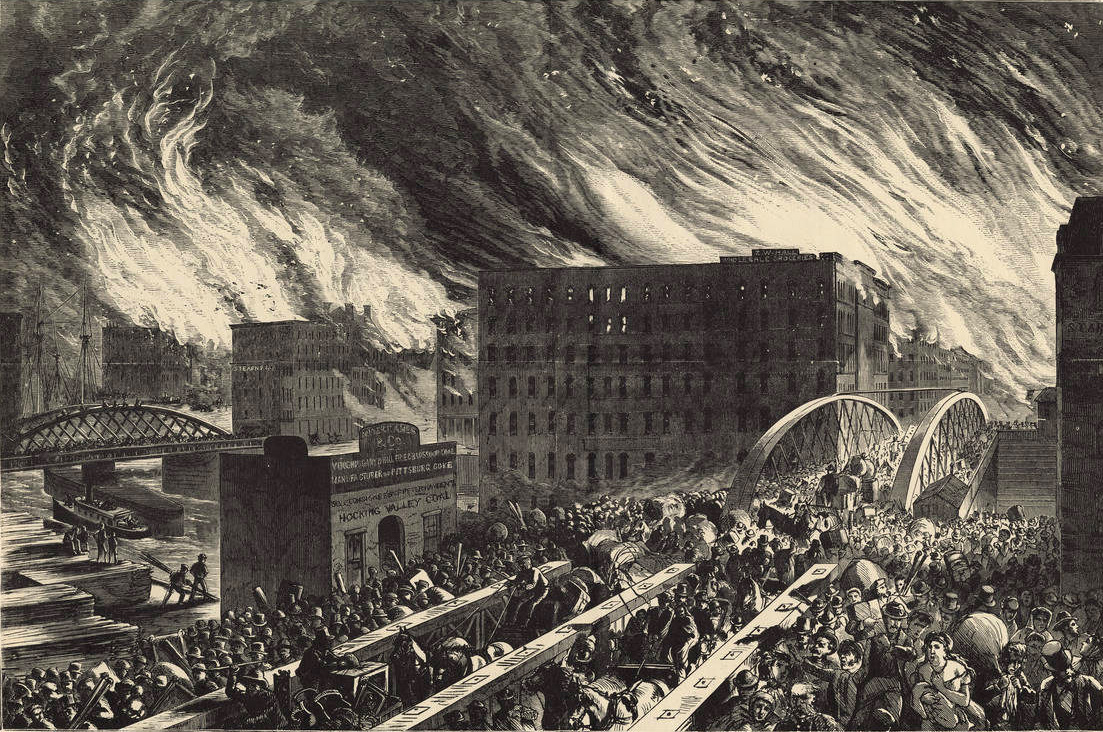
In the early night hours of Sunday, October 8, a fire started on the O'Leary property at 137 DeKoven Street that would spread to destroy some four square miles in Chicago and kill hundreds of people. There had been something of a drought, not much in the way of concern for local fire departments, but enough to propel destruction among wooden buildings on a strong wind. With its sudden start and widespread disaster (famously, even the Moody church burned), citizens were highly suspicious of arson and searched for a scapegoat.

At the time, Michael Ahern was a reporter for the Chicago Republican. He had heard the rumor that the O'Learies (Catholic immigrants, prime targets for suspicion already) had negligently allowed their cow to kick over a lantern and then letting the fire go out of control. Other stories told of sneaked smokes by youngsters and thieves starting the blaze while attempting to steal milk. Ahern was about to write a story blaming specifically Mrs. O'Leary as some "colorful copy" when he came upon an even more exciting topic.

Fires had started suddenly throughout the Great Lakes region nearly simultaneously over the weekend. Peshtigo, WI, and surrounding villages had undergone an enormous blaze that killed some 2,000 people and torched millions of acres. Urbana, IL, over one hundred miles south of Chicago had also burned, as had Holland, Mansitee, and Port Huron in Michigan. Even Windsor, Ontario, in Canada burned on the 12th. News about the disasters trickled out slowly, but various cases of eyewitnesses noted smokeless balls of blue fire falling from the sky. After some consideration, Ahern wrote a shocking story that the origin of the Chicago fire had come from the heavens.

Other tabloids picked up the notion, and the idea seared into the Chicagoan public imagination. Scientific persons scoffed at a "rain of meteors" since they would be cool to the touch by the time they landed, but few listened to them. Instead, as Chicago underwent an incredible reconstruction program, observatories and atmospheric study stations were included. In 1882, a more serious proposal of the meteors was announced, and now the scientific community listened. Some began to argue for the mysterious "ball lightning", but the suggestion was now officially in the journals. By the time of the 1893 World's Fair in Chicago, a great wealth of knowledge was collected in the Meteor Hall, which afterward would be donated to Northwestern University.

Two decades later, Robert H. Goddard, a sickly part-time instructor at Clark University began soliciting funding for experiments with rockets. While the Smithsonian offered a princely sum of $5000, Northwestern seized the chance and offered funding as well as a position and student aides. Rockets, the departments affiliated with the study of the cosmos thought, would allow for first-hand exploration of outer space. With his arrival in Chicago, Goddard began intensive plans for high-altitude meteorological instruments and, eventually, designs for a possible, though impractically expensive, orbital rocket. Arguments about propulsion in vacuum dominated much of the rest of Goddard's career.

When the Nazis proved rocketry for military use was successful in the Battle of Britain, the US Army and Navy hurried to update Goddard's designs. While students at the Massachusetts Institute of Technology worked on programmable trainers leading to computing, research at Northwestern led to development of “The Eagle,” or what a jealous Werner von Braun would later call the “V-3.” After the war, USSR would begin the Space Race by launching Sputnik, but Americans would swiftly turn and beat the Russians to the first man in orbit with Alan Shepard. Continual challenges would put men on the Moon with the Apollo program in 1963 and a short-term research station on Mars in 1974. The funding for exploratory rocketry along with the Cold War. By that time, short-range space-travel would prove profitable with hour-long sub-orbit intercontinental flights, zero-g tourism, communication and observation satellites, and Solar Energy Collection stations.


In reality, Ahern wrote the story blaming Mrs. O'Leary for the fire. In 1893, he would boastingly confess that he had made up the tale. Catherine O'Leary would die in 1895 of pneumonia, though descendants would say spending the rest of her life under public distrust caused her death from broken heart. Robert Wood would reexamine the meteor theory in 2004, claiming that it might have been methane released from the breakup of Biela's Comet, which would give a brilliant meteoric display in 1872.

Sunday, July 18, 2010

July 18, AD 64 – Fire Successfully Contained

As recorded by the Roman poet Tacitus, a fire broke out in the merchant district of the city of Rome, consumed a warehouse, and was defeated by brave workers dragging sand and water from the Tiber. Nero praised the men’s actions even though some of them were of the Christian cult, a band of Jews who had begun accepting Gentiles after worshiping the Son of a God. One of them, Paul of Tarsus, had been brought on an appeal to Caesar after being accused of treason, of which Nero would later find him innocent.

After the fire, Nero would continue his campaign to lower taxes on the poor, keep foreign diplomacy afloat (he had already maintained conquest of Britain after the rebellion of Boudicca as well as defeated Parthia in the east), and improve culture throughout the empire. Later, in 66, a revolt in Judaea would arise, and Nero would dispatch his great general Vespasian to put it down. Distrust of the Christians would mix with the fervor of the revolt, and a great divide would split the cult between the Gentiles and those who still held to the Jewish Law, the latter being removed from Rome and facing legal segregation. Gradually, the religion would blend with other Roman beliefs, such as had been done with the Egyptian Isis and the Persian Mithras.

In 65, a conspiracy by the statesman Piso to overthrow Nero and return the Republic was discovered and destroyed. The senators complained that they had lost all power despite Nero’s promise in 54 to return their influence to levels under the Republic. Nero liked the power in his own hands and refused to give up any of it, using his sway to launch his massive construction projects. While Italia and the provinces struggled economically, taxes were never levied enough to cause rebellion. The successful end of the Jewish rebellion and looking of Jerusalem and their temple in AD 70 was enough to alleviate many of Nero’s empty coffers.

As Nero grew older, he began to slow down his pace and draw more to distraction with his own arts. Meanwhile, Nero’s son Antonius grew in military strength under the tutelage of the Governor Agricola of Britain during his conquest of Caledonia. Antonius would spearhead the conquest of Hibernia before returning to Rome after the death of Nero. More concerned with expansion than rule, Antonius would finally begin the return of Roman government back to the Senate, so long as it maintained funds for his expeditions into Germania. After the bloody conquest of the Germans, Rome would grow stagnant and corrupt, eventually falling in the north to the predatory Vikings of the 900s and the south to renewed Arab and Parthian attack.


In reality, the fire raged for five and a half days, destroying nearly half the city. The emperor Nero did much to aid the victims, but nothing could squelch their smoldering discontent (there were even rumors of singing while his city burned, though Tacitus recorded him being in Antium at the time). To redirect public ill sentiment, Nero blamed the grown Christian population of the city. Several Christians even admitted to the conspiracy (though this was proven to be under torture). Christians were thusly thrown to dogs, crucified, and even dipped in oil and burned alive as streetlights, beginning centuries of persecution throughout the empire. Despite the torment, Christianity would survive and even thrive to the Edict of Milan 250 years later when tolerance was declared by the Emperor Constantine.

Meanwhile, Nero used the newly cleared space in Rome to build his Domus Aurea, a palace for which he paid by levying tribute from every province of the empire. It would be another dark badge on the bad emperor’s toga. Later taxation policies on the provinces would cause Governor Vindex of Gallia Lugdunensis to rebel, the first link in a chain that would bring about the rise of Galba, who would declare himself emperor and drive Nero to suicide.

Site Meter