Showing posts with label france. Show all posts

Tuesday, February 3, 2015

April 27, 1578 – Henry III Prevents a Duel

In the midst of the French Wars of Religion, decadence flooded the royal court. Many blamed the queen of Henry II, Catherine de Medici, who had brought Italian fashion along with intrigue that fostered duels, poisonings, and her “Flying Squadron” league of female spies. Others saw it as the weakness of the new generation of sons, particularly Henry, who preferred art and reading to hunting and was the favorite of his mother, Catherine.
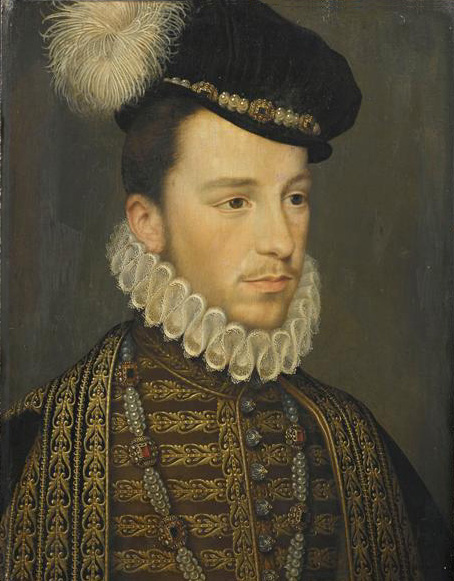
While his older brothers sat on the throne, first Francis II and then Charles IX, Henry performed the duties of a prince conducting treaties and fighting battles, primarily against the growing Protestant powers of northern Europe. Rumors planning his marriage to Elizabeth I of England circulated in 1570, though she was twice his age and he referred to her as “an old bag with a sore leg.” Instead, Henry preferred to spend his time with his friends in court, a wild party of handsome, affluent, and adventurous youths that their enemies had nicknamed “Les Mignons.” They wore the cutting edge of fashion: starched white ruffle collars that stretched past their shoulders, black velvet, and gold embroidery. Wherever the entourage went, they were raucous gamblers always looking for a new thrill.

There was another Henry at court, the young Duke of Guise, born one year before Henry III in 1550. Guise was a vehement Catholic in the Wars of Religion after his father was assassinated during the Siege of Orleans. Many believe that, at only twenty-two, he was one of the masterminds of the assassination of Gespard de Coligny, a Huguenot admiral, and the resulting St. Bartholomew’s Day Massacre that wiped out thousands of Protestants in France. His many injuries in battles against Protestants and Turks earned him the nickname “Scarface” (“Le Balafré”), a name he kept with endearment as it had been his father’s as well. He went on to become the leader of the powerful Catholic League in France. While Henry III was seen as a degenerate out of touch with reality, the Duke of Guise was well loved for his generosity and good deeds.

The rivalry of the two groups came to a head in 1578. Five years before, Henry III had left France when he was elected King of Poland and Lithuania. He stayed there only a few months, irritated by the Polish political system, and left as soon as word arrived of the death of his brother Charles IX. Despite having given up the right to succession as part of his election, Henry returned to Paris as king and simply walked away from his kingship of Poland. The sudden arrival of a new king brought rapid changes. Some were technological, like the introduction of sewage lines to palaces and the dinner fork, but the most tumultuous were his Les Mignons.

In April 1578, members in the entourages of the two Henries determined to prove their finesse for dueling by recreating the Battle of the Horatii and Curiatii from antiquity. The famous battle pitted triplet brothers from ancient Rome against triplets from their rival, Alba Longa, with both cities agreeing their latest war would be settled by the six-man duel. Despite initially gaining the upper hand by killing two of the Horatii, the Curiatii were hunted and killed one at a time by the surviving brother, Publius.

Excitement rose through the court, but the Duke of Guise had a tinge of guilt due to the Church’s condemnation of dueling. He appealed to the king to stop the duel, saying, “Only your word could stop your men.” While some historians see the phrase as a reference to the sycophantic nature of his entourage, Henry III took it as praise of his great leadership. He canceled the duel, and Guise became a new favorite, even though he did not fit in with the king’s usual friends.

Their companionship was tested in 1584, when Henry III’s brother Francis, Duke of Anjou, died while campaigning in the Netherlands. Without a direct heir, the next in line to the throne was the distant cousin Henry of Navarre, a Protestant. Guise was able to convince Henry III to suspend Henry of Navarre and all Protestants from eligibility, naming his successor to be another cousin, Cardinal Charles du Bourbon. In return, Guise awarded Henry III a partnership in the Catholic League.

Twenty-eight years the king’s senior, Charles du Bourbon, and Henry III agreed to an electoral system as he had seen in Poland with roots deep in Church power. Upon his death, Henry III was succeeded by Richelieu, the first of many Cardinal-Kings to rule over the seventeenth and eighteenth centuries. Huguenots were stamped out of France, but the era of Enlightenment brought a new wave of thinkers that spawned a secular revolution that tore France apart repeatedly over the nineteenth century in a new series of Wars of Religion.


--

In reality, the Duke of Guise had no qualms about fighting, and the duel went forward. Just as with the Roman battle, it left five men dead: two on the field and three heavily wounded passing one day, one month, and six weeks later. Rather than solving any rivalry, the battle led to further distance between Henry III and the Duke of Guise. In 1588, Guise entered Paris to such a grand ovation by the public that the king fled and joined forces with Henry of Navarre. The War of the Three Henries ultimately won the throne for Henry of Navarre, but only after his proclamation of conversion to Catholicism (and the assassination of the Duke of Guise by the king's order). Henry IV’s son and grandson would consolidate political power by exiling the Medicis, putting down revolt of nobles, and reducing influence of the Church.

Monday, May 30, 2011

May 30, 1431 – Jeanne d’Arc Takes Vows

Against the backdrop of the bitter Hundred Years War, Saint Joan of Arc completed her novitiate and took her first vows to become a nun. Daughter of moderately wealthy farmer and local magistrate Jacques d’Arc, Joan had been a pious and upstanding girl. Around the age of 12 in 1424, she began claiming visions from God. In a field, she saw Saint Catherine (patron of girls), Saint Margaret (patron of peasantry and suffering), and Saint Michael (patron of war) stand before her and tell her to end the English domination of France, particularly by orchestrating the crowning of the Dauphin and reviving French nationalism. Four years later, she asked to go to the remnants of the French court, but her every request was denied, particularly by Count Robert de Baudricourt, leader of the local garrison who literally laughed at her. Discouraged, Joan returned home and decided to forget warfare.

The rest of France was similarly discouraged. For nine decades, the French had suffered defeat after defeat with the English gaining ground. The Hundred Years War had begun in 1337 when a birthright to the throne of France was claimed by Edward III (1312-1377), who was the only surviving male heir to Philip IV and closest relative to Charles IV of France. The French nobility refused to have a foreign king and instead chose Philip of Valois, to be crowned as Philip VI, grandson of Philip III. When the Second War of Scottish Independence broke out and Edward moved to put down the rebellion, the French held up their side of the Auld Alliance, attacking English shipping and seizing Gascony. England attempted to counterattack, but the lack of support from the Lowlands and cost of German mercenaries dragged the war into a stalemate until the Battle of Crécy, where the English longbow devastated the French knight and ended the Age of Chivalry in many respects.

Through temporary peaces, ongoing warfare, and even the Black Death, the Hundred Years War continued to roll onward. England made its greatest success at the Battle of Poitiers in 1356, where Edward’s army, outnumbered nearly three-to-one, defeated the French and even captured King John II. Mercenaries on either side ravaged the countryside already bled out by heavy taxation, leading to peasant uprisings such as the Jacquerie, which had to be suppressed violently. Afterward, the French began to reassemble, gradually taking back lands taken by the English. Irish rebellion, the Peasants’ Revolt against poll tax, and courtly intrigue with the death of Richard II slowed the English war effort, and the French faced their own problems as a civil war broke out between the House of Burgundy and the House of Armagnac, led by the French king, Charles VI who supported the antipope of the Western Schism.

The entire region of France was thusly split and split again by varying loyalties. There seemed no rational way of sorting out the political difficulties except through killing the opposition. The English took up an alliance with Burgundy, whose head John the Fearless had been assassinated while under King Charles’ protection, deepening the rift between the French. Burgundy insisted that Charles was illegitimate, and England hoped to use the division to firmly conquer France.

Joan wished to aid the French war effort, but her exclusion seemed final, and instead she turned toward aiding the national spirit through the Church. The French, meanwhile, pieced together an expedition in 1429 to lift the siege of Orleans and capitalize on the death of English King Henry V in 1422. Though it is questionable what impact an untrained girl could have had to change it, the expedition was a catastrophe. While the French initially made great impact on the English forces, the English stand at the fort of St. Loup turned back the tide. French troops, disheartened by the seemingly unbreakable English hold on France, retreated and suffered great causalities. The new English king, Henry VI, did not seem to have the heart to continue the bitter wars as his forefathers had, giving over rule increasingly to regents and his Burgundian allies.

Finally, in 1453, the war came to an end with a divided France. England faced bankruptcy and an empire that it could not afford to control. Instead, it sold much of its southerly holdings to Burgundy, who established their own kingdom in the north, creating a buffer between England and France proper, which stretched from Chinon southward. The two French kingdoms would routinely fight wars, finding themselves on either side of international conflicts in the coming centuries: the English Wars of the Roses, colonial wars among the Spanish, Dutch, and English, and the Republican War of 1789-95.

Through all of them, nuns of the famous Order of Joan would aid both sides with food and care, encouraging French cooperation and brotherhood. Visions of reunification, however, would not become realized, even after the toppling of communist south France in 1990.


--

In reality, Joan persevered her way though to the Dauphin and even passed a theological inquiry, gaining the support of French looking for a prophet of deliverance. She was instrumental in victory at Orleans, which gave Charles VII a militaristic upper hand and encouraged his coronation in 1429. Joan became captured at Margny in 1430 by Burgundians while leading the rear guard and covering retreat. She was sold to England, who put her on trial for witchcraft and burned her May 31, 1431. In 1456, she would be given a posthumous retrial and found innocent, then beatified in 1909 and finally canonized in 1920 as a patron of France.

Friday, April 8, 2011

April 8, 1904 – Entente-Cordiale Talks End without Agreement

England and France had long stood as rivals and outright enemies for many centuries. Massive campaigns had been fought between the two in the Hundred Years' War, Seven Years' War, Napoleon's Wars, just to list a few. In the seventeenth and eighteenth century, England had grown to dominance and merged with Scotland and Ireland into Great Britain, only to have its American colonies lost by French intervention. Britain struck back by ending Napoleon's empire, and then, over the course of the nineteenth century, the two political juggernauts came to something of a truce. First used in 1844, Entente-Cordiale ("cordial understanding") became the term for the common interest and mutual advantages between France and Britain. The two had even worked as allies in the Crimean War to halt the expansion of the Russian Empire, but old colonial rivals kept them apart.

Even by 1900, the happy agreements toward peace between the two were still informal. Britain had long enjoyed its policy of Splendid Isolation, focusing on its empire and leaving alone the matters of the Continent. However, with the taxing and often humbling Boer Wars and the growth of German power both in Europe and in Africa, Britain looked back toward Europe to reevaluate its position. Talks were held about Britain potentially becoming a member of Germany's Triple Alliance, but Edward VII nixed the idea in preference to isolation. The position of neutrality became more and more difficult to maintain as Britain's new ally Japan and France's longtime ally Russia turned toward war in 1904. Diplomats led by British Foreign Secretary Lord Lansdowne and French foreign minister Théophile Delcassé scrambled in an attempt to sort out the colonial matters that still plagued France and England to draw up a fashionable alliance. For a time, an agreement looked promising, but arguments over Newfoundland fishing rights broke down talks. Finally, two months after Russia and Japan had gone to war, the talks ended with simple neutrality as the best the France and Britain could muster.

While the old empires watched, young empires came fully onto the scene. Japan won the war effectively against Russia, whose people erupted in revolt. US President Theodore Roosevelt ended the war with the Treaty of Portsmouth through back channel diplomacy that won him the Nobel Peace Prize in 1906. Britain returned to its policies of isolation and protecting her vast empire. France, meanwhile, made brisk attempts to aid Russia and to coax Italy away from Germany's Triple Alliance, which it did by supporting the Italo-Turkish War in 1911.

The web of international treaties and alliances broke with the single shot that killed the Archduke Ferdinand. Austria-Hungary invaded Serbia, Russia invaded Austria-Hungary, Germany invaded Russia, and France declared war on Germany. With Britain and its neutral ally Belgium diplomatically out of the war without antagonism, German command saw fit to alter the Schlieffen Plan and assault the French forces more directly rather than invade through innocent Belgium. Initially, the French stood in a mighty defense against the German onslaught, but the German wehrmacht enabled the resources to roll the trench warfare backward toward Paris. With the collapse of Russia and Italy quickly changing sides, the war ended in 1917 with the Treaty of Berlin inside a suddenly powerful Germany. Britain and the United States felt grateful for being spared the massive bloodshed of the war and in fact prospering as Europe hurried to rebuild.

Renewed nationalism in the decaying Austro-Hungarian Empire spurred its collapse in 1931 as the Great Depression ground on. Socialism, which had been long nurtured in France and triumphant in Russia, took the losing countries of the war by storm. A grand socialist alliance grew powerful as the nearly fascist monarchies of Germany and Japan struggled. In 1942, the World War broke out as Stalin invaded Poland and much of Eastern Europe in an attempt to "liberate and unify the workers of the world." His expansionism continued into the Middle East while France fought to take German colonies in Africa, and Italy fell to civil war. Britain was finally drawn into the war it had always feared when the French Mediterranean fleet struck Egypt and blockaded the Suez Canal while other troops occupied disputed territories in West Africa. Socialist riots broke out in India, and the widespread war caused Britain simply to evacuate one of its greatest jewels. The United States, too, lost its neutrality as Russia pressed through Japanese forces in China and made a surprise attack on Midway Island.

Bitter warfare continued to 1952 when Russia finally capitulated under the onslaught of American atomic bombs and it became known that Josef Stalin had died due to heart failure.


--

In reality, the Entente-Cordiale was a great diplomatic success. Conflicts between the empires were solved with recognition of influence in Morocco, Madagascar, Siam, New Hebrides, and West Africa, free use of the Suez Canal guaranteed, and British supremacy in Newfoundland. France and Britain became allies, and Germany followed the Schlieffen Plan, which brought Britain into World War I in defense of Belgium, as it would have soon in aid of France.

Sunday, February 6, 2011

February 6, 1934 – Riots Ignite French Civil War

As the Great Depression dragged on worldwide, France along with the rest of Europe writhed with quasi-revolution. As the middle class depleted and a full belly approached luxury status, people began to approach the political extremes in desperation. Votes were wild in France with each party seeking to cure the nation’s woes, and five governments were elected and suspended between May 1932 and January 1934. People lost faith in the parliament and searched for other options such as socialism or fascism. In the elections leading up to the great uprising of the right, the moderate leftists had won the government under Camille Chautemps. When the scandal of the Stavisky Affair broke, it became obvious how many ministers were involved in the embezzling and false bonds schemes. Chautemps resigned, giving his presidency to party-member Édouard Daladier, who began firing “anti-government” officials such as the rightist prefect of the Paris police, Jean Chiappe.

The dismissal of Chiappe brought out the wrath in the growing right. They organized demonstrations and parades in the streets of Paris that evolved into an all-out riot. While initially still very loose in confederation, François de La Rocque, leader of the nationalist Croix de Feu, decided that action must be taken. He called for the citizens to unify around him and announced a new constitution that would make France bold and rich again, revitalized with the morals of Catholicism and spirit of Gaul. The coup d'état did not work initially as the leftists still held many of the reigns of government and rallied against the right. Within days, the riots turned to organized warfare with battles around government offices. Daladier called in the army to protect the constitution, but few actually appeared. In the chaos, it is said that only the Anarchist party was pleased.

Gradually the army formed up into support of the Nationalists or the Republicans. The Nationalists established a new government in the south, electing hero of Verdun Philippe Pétain as president after the recommendation of the newspaper Le Petit Journal. Noted commander of the armored divisions in Poland during the Great War, Lieutenant-Colonel Charles de Gaulle, became a hero in the battles of advanced armored vehicles attacking the many outposts of the leftist Republicans attempting to hold Paris. Support for the Nationalists poured out of fascist Italy as well as the growing Nazism of Germany. The Republicans, meanwhile, garnered voluntary support from the international community, especially the Soviet Union, while few nations were keen to become directly involved.

The war eventually went the way of the Fascists, and France became another bastion for the right in 1936, the same year a similar civil war erupted over the Pyrenees in Spain. Again, Fascism would win the day as Emilio Mola became dictator. Meanwhile, France would put its new rigorous political system to work spreading through its many colonies, which had gone into various degrees of decay after the World War. New Imperialism would seize the public mood, as it would in Italy and Germany, who made their own expansions into Ethiopia and Eastern Europe, respectively.

When Germany invaded Poland, Britain began to take a stand, but it seemed alone as France quietly applauded the sentiment of Lebensraum. With the invasion of Denmark, however, Britain declared war on Germany and soon found itself on the defensive from Axis French colonial forces in Africa, the Middle East, and South Asia. The German pushes eastward, however, would eventually throw Hitler into war with the Soviet Union. The United States would eventually be brought into the fight by Japanese attack on Pearl Harbor, which would spur the invention of atomic weapons that would finally settle the war.

As the war ended, the colonial landscape would take very different form. The dependence on locals for defense and administration would spark the decolonization of the British Empire into a commonwealth. The French colonies, meanwhile, would be managed by joint missions from the Allies. As the Cold War settled in, numerous former colonies in regions such as French Indochina, the Caribbean, and West Africa would fall to communism as corruption and lack of First World support caused locals to appeal to extremism to alleviate economic woes.


In reality, La Rocque became a moderating force wishing to adhere to the constitution for change in France. Daladier resigned after re-establishing public order, and a counter-demonstration by the left on the 9th proved that the right was not in a dominant conspiracy. A National Union government formed under former president Gaston Doumergue, and France would find itself divided only after being invaded by Germany in the early days of the Second World War.

Site Meter