Showing posts with label hoover. Show all posts

Saturday, August 13, 2011

October 29, 1929 – Banker’s Committee Stops Panic of ‘29

The wild financial speculation of the Roaring Twenties came to a sudden halt in October when the stock market began to slide. Worries spread through the economic community about the passing of the Smoot-Hawley Tariff Act. Tariffs had always been a point of contention among Americans, even spurring South Carolina to threaten secession over the Tariff Act of 1828. Producers such as farmers and manufacturers called for protective tariffs while merchants and consumers demanded low prices. The American economy soared while post-war Europe rebuilt in the ‘20s, and the Tariff Act of 1922 skimmed valuable revenue from the nation’s income that would otherwise have been needed as taxes. The country barely noticed, and the economy surged forward as new technological luxuries became available as well as new disposable income.

Meanwhile, however, the nation faced an increasingly difficult drought while food prices continued to drop during Europe’s recovery. Farmers were stretched thinner and thinner, prompting calls for protective agricultural tariffs and cheaper manufactured goods. In his 1928 presidential campaign, Herbert Hoover promised just that, and as the legislature met in 1929, talks on a new tariff began. Led by Senator Reed Smoot (R-Utah) and Representative Willis C. Hawley (R-Oregon), the bill quickly became more than Hoover and the farmers had bargained for as rates would increase to a level exceeding 1828 for industrial products as well as agricultural. The revenue would be a great boon, but it unnerved economists, who wondered if it could kill the economic growth already slowing by a dipping real estate market.

The weakened nerves shifted from economists to investors, who took the heated debate in the Senate as a clue that times may become rough and decided to get out of the stock market while they could. Prices had skyrocketed over the course of the ‘20s as the middle class blossomed and minor investors came into being. Another hallmark of the ‘20s, credit, enabled people to buy stock on margin, borrowing money they could invest at what they hoped would be a higher percentage. The idea of a “money-making machine” spread, and August of 1929 showed more than $8.5 billion in loans, more than all of the money in circulation in the United States. The market peaked on September 3 at 381.17 and then began a downward correction. At the rebound in late October, panicked selling began. On October 24, what became known as “Black Thursday”, the market fell more than ten percent. On Friday, it did the same, and the initial outlook for the next week was dire.

Amid the early selling in October, financiers noted that a crash was coming and met on October 24 while the market plummeted. The heads of firms and banks such as Chase, Morgan, and the National City Bank of New York collaborated and finally placed vice-president of the New York Stock Exchange Richard Whitney in charge of stopping the disaster. Forty-one-year-old Whitney was a successful financier with an American family dating back to 1630 and numerous connections in the banking world who had purchased a seat on the NYSE Board of Governors only two years after starting his own firm. Whitney’s initial strategy was to replicate the cure for the Panic of 1907: purchasing large amounts of valuable stock above market price, starting with the “blue chip” favorite U.S. Steel, the world’s first billion-dollar corporation.

On his way to make the purchase, however, Whitney bumped into a junior who was analyzing the banking futures based on the increase of failing mortgages from failing farms and a weakening real estate market. He suggested that the problems of the new market were caused from the bottom-up, and a top-down solution would only put off the inevitable. Instead of his ostentatious show of purchasing to show the public money was still to be had, Whitney decided to use the massive banking resources behind him to support the falling. He made key purchases late on the 24th, and then his staff worked through the night determining what stocks were needlessly inflated, what were solid, and what could be salvaged (perhaps even at a profit). Stocks continued to tumble that Friday, but by Monday thanks to word-of-mouth and glowing press from newspapers and the new radio broadcasts, Tuesday ended with a slight upturn in the market of .02%. Numerically unimportant, the recovery of public support was the key success.

With the initial battle won, Whitney spearheaded a plan to salvage the rest of the crisis as real estate continued to fall and banks (which were quickly running out of funds as they seized more and more of the market) would soon have piles of worthless mortgaged homes and farms. Banks organized themselves around the Federal Reserve, founded in 1913 after a series of smaller panics and determined rules that would keep banks afloat. Further money came from lucrative deals with the wealthiest men in the country such as John D. Rockefeller, Henry Ford, and the Mellons of Pittsburgh. Businesses managed to continue work despite down-turning sales through loans, though the unemployment rate did increase from 3 to 5% over the winter.

The final matter was the question of international trade. As the Smoot-Hawley Tariff Act continued in the Senate, economists predicted retaliatory tariffs from other countries to kill American exports, but Washington turned a deaf ear. Whitney decided to protect his investments in propping up the economy by investing with campaign contributions. Democrats took the majority as the Republicans fell to Whitney’s use of the press to blame the woes of the economy on Congressional “airheads.” Representative Hawley himself lost his seat in the House, which he had held since 1907, to Democrat William Delzell. President Hoover, a millionaire businessman before entering politics, noted the shift, but remained quiet and dutifully vetoed the new tariff.

By 1931, it became steadily obvious that America had shifted to an oligarchy. The banks propped up the market and were propped up themselves by a handful of millionaires. If Rockefeller wanted, he could single-handedly pull his money and collapse the whole of the American nation. Whitney took greater power as Chairman of the Federal Reserve, whose new role controlled indirectly everything of economic and political worth. As the Thirties dragged on, the havoc of the Dust Bowl made food prices increase while simultaneously weakening the farming class, and Whitney gained further power by ousting Secretary of Agriculture Arthur Hyde and installing his own man as a condition for Hoover’s reelection in ’32.

Chairman Whitney would “rule” the United States, wielding public relations power and charisma to give Americans a strong sense of national emergency and patriotism during times like the Japanese War in ’35 (which secured new markets in East Asia) and the European Expedition in ’39. He employed the Red Scare to keep down ideas of insurrection and used the FBI as a secret police, but his ultimate power would be that, at any point, he could tamper with interest rates or stock and property value, and the country would spiral into rampant unemployment and depression, dragging the rest of the world with it.


--

In reality, the bottom of the market fell out on Black Tuesday, the worst day in the Stock Market Crash with sixteen million shares traded, a record that would hold until 1968. Whitney’s plan of using “blue chip” stocks was too little much too late. Though he was considered a Wall Street guru for much of his life, it would be proven in 1938 that his company was insolvent and he was an embezzler. Whitney would plead guilty and was sentenced to Sing Sing, where he served as a model prisoner and afterward became a successful small businessman. Despite a petition signed by 1028 economists, President Hoover did not veto the Smooth-Hawley Tariff after it was approved in the Senate in March of 1930.

Wednesday, July 28, 2010

July 28, 1932 – Bonus Army Counterattacks

The Great Depression had ground on for years. While President Herbert Hoover had enacted breadlines and other minor alleviations for the out-of-work populace, the country as a whole continued to suffer unemployment and lack of cash. The people themselves began to call for direct aid, and none more vigorously than the veterans of the World War. In 1924, Congress had voted a bonus for each soldier in recognition of their service, giving one dollar for every day of domestic time ($1.25 for each day abroad) to a maximum of $500 ($625 abroad). The bonuses were paid via certificates and a trust fund, giving percentages until full payment was achieved in 1945.

By the troubled year of 1932, one-third of the payments had been made, and now Congress hoped to aid out-of-work veterans by advancing the payment to full. Hoover and his Republican allies were opposed to the idea, saying that it would strain the budget of the Federal government and take away funds needed for other relief programs. Veterans, however, pressed their representatives for the payment, and the House passed the Patman Bonus Bill to accelerate the giving of the money.

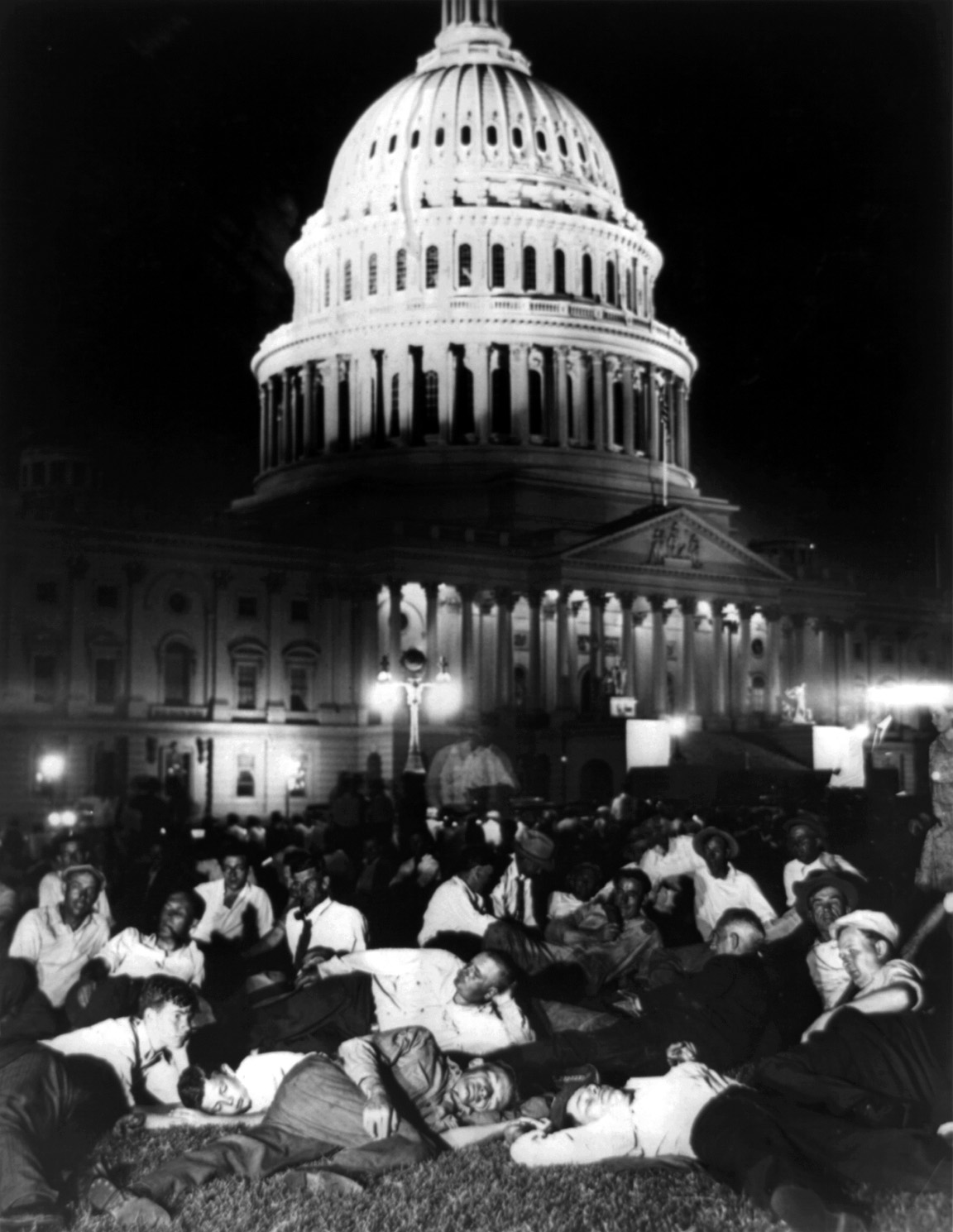
In June of 1932, the bill went before the Senate, and veterans marched on Washington to show their support for it. Seventeen thousand veterans came to the capital, bringing their families with them to total nearly 43,000 people. Most of them lived in Hooverville camps outside Washington proper, the biggest one being across the Anacostia River. Rather than disease-ridden slums, the camps were well organized with streets, clean water, sanitation facilities, and even parades. Despite the public support, the Senate blocked the bill, and now the “Bonus Army,” as they called themselves, began to protest in earnest for the funds that were rightfully theirs.

By July 28, the government had taken their fill. Protesters had marched on the White House, leading to a scuffle that resulted in police brutalizing several of them. Attorney General William D. Mitchell ordered the removal of all protesters from government property on grounds of trespassing. Police tried to clear a camp, but the veterans resisted. Shots were fired, and two veterans were left dead.

When he heard of the violence, Hoover decided to clear the district before things turned worse. He called General Douglas MacArthur from Fort Howard in Maryland with infantry and tanks from Fort Myer, Virginia, commanded by Major George S. Patton. The Bonus Army was in the midst of a march when the army arrived and took the appearance of the troops as a show of support. Instead, the cavalry and infantry charged, bayonets affixed.

Washingtonians who had come out to watch were horrified, crying “Shame!” at the army, but the soldiers took little notice. The veterans were chased back to the Anacostia Flats on the other side of the river, and Hoover ordered the troops to stop. MacArthur, however, ignored the President and took it upon himself to clean out the “communists.” Gas attacks, fire, and violent soldiers chased the veterans and their families out of the camp.

Before midnight, however, the veterans began to regroup. Making sure their families were safe in Maryland where the Federal troops did not have jurisdiction, they collected weapons and covertly marched back into Washington. As the army and police were busy breaking down the camp, the veterans organized their mob into ranks on the Washington Mall. Just as locals began to become suspicious of the nighttime activity, they charged into the Capitol and seized the building. Securing all exits, they advised the clerks, officials, and congressmen working late that they were not hostages and were free to go at any time.

MacArthur returned to Washington and began an assault up the main steps with his infantry. With shotguns, hunting rifles, and sheer moxie, the veterans held the doors and finally forced back the infantry, injuring many. As MacArthur began to call for artillery to blast open the Capitol, Hoover stopped him and removed him from command for disobeying orders. The infamous general would never serve with the United States Armed Forces again.

Major Patton offered to force entry with his tanks, but Hoover declined. Instead, a day-long standoff began as Washington police and Federal soldiers circled the building, but could not get close. Government workers, however, were allowed in, and the Senate was finally called to order. The block on the Bonus Bill was lifted, and the veterans collected their money and left peacefully. As soon as they were outside, they allowed themselves to be arrested.

National outrage over the incident poured into Washington. Some called for execution of the rebellious soldiers as traitors, but most were angry with the president and army for being so callous toward the veterans. Hoover would save face by shifting blame, dismissing Attorney General Mitchell and turning his whole campaign into the “cleansing” of the federal government. While his budget suffered greatly from the two-billion-dollar shortfall, he refused to go over-budget more than absolutely necessary. Touting thriftiness and earning wherever possible, as well as gaining a great deal of support from veterans, Hoover would narrowly win the 1932 election over New York Governor Franklin Roosevelt.

Hoover's next term would be four more years of struggle for the country. Prohibition would be overturned by Congress in 1933, but the economic issues would not be solvable by mere tenacity. Relief efforts struggled to keep up with unemployment. In the elections of 1934, people had had enough, and Democrats were voted into power in Congress. The Great Depression did nothing but worsen.

In 1936, FDR came into office overwhelmingly, and he brought his New Deal into full swing. Ignoring budget constraints, FDR started enormous works projects to employ as many of the unemployed as possible. The changes were radical, which was just as well since radical groups became increasingly powerful over the country. By 1940, people said that the US was all but socialist in name with resources in food, oil, electricity, public water, and health insurance all regulated by the government.

While the populace was suspicious of such control in the Land of the Free, World War II would solidify FDR's political maneuvers. Through the second half of the twentieth century, so much of the basics of American life would be guaranteed that LBJ's New Society would create a welfare state of nearly one-half government employees (or, as many social critics would call them, “government slaves”).

In 2002, President Albert Gore would even expand American human rights to guarantee Internet service.


In reality, the veterans did not regroup and counterattack. The Bonus Army maintained a presence in Washington, but they did not trifle with protests against Hoover again. The incidents would haunt Hoover and doom him in the 1932 election. FDR and his New Deal programs would alleviate much of the poverty of the Great Depression, though it would balance against capitalism and private innovation that Americans have always taken as a part of the national spirit.

Site Meter