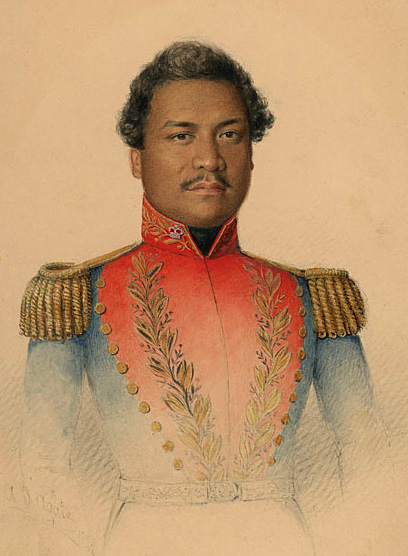
Since its discovery for the West by Captain James Cook in 1778, Hawaii, then known as the Sandwich Islands, served as an important harbor in the Pacific Ocean. The island chain was united soon after the coming of the Europeans by King Kamehameha the Great in 1795 after deposing his cousin and militarily dominating the other chieftains. Meanwhile, Europeans used the island as a port in the vast Pacific, refilling their stores aboard merchant ships and whaling vessels. Along with the Europeans came diseases that devastated the population, which had never experienced flu, small pox, and measles before. Missionaries soon arrived on the islands, aiding the sick and spreading the Word, converting even King Kamehameha III in 1833 after a youth of raucous rebellion.
Kamehameha III would prove to be the final native king of the islands. In 1843, Captain Lord George Paulet arrived aboard the HMS Carysfort to settle land claim disagreements between British citizen Richard Charlton and the Hawaiians. Paulet won an audience with Kamehameha by way of American translator Gerrit P. Judd, who had come to Hawaii as a missionary-physician and eventually served as a chief minister in Kamehameha’s government. Paulet had been warned by Charlton that Judd was acting as a dictator and refused the audience, listing specifically the demands of British citizens and writing to the USS Boston also in harbor that he was “prepared to make an immediate attack upon this town, at 4 o'clock P.M. to-morrow, (Saturday) in the event of the demands now forwarded by me to the King of these Islands not being complied with by that time.” Rather than fight, however, he received word that the Hawaiians would negotiate, and Paulet began three days of meetings that culminated in Kamehameha ceding the islands to British control.
Kamehameha announced, “"Where are you, chiefs, people, and commons from my ancestors, and people from foreign lands? Hear ye! I make known to you that I am in perplexity by reason of difficulties into which I have been brought without cause, therefore I have given away the life of our land. Hear ye! but my rule over you, my people, and your privileges will continue, for I have hope that the life of the land will be restored when my conduct is justified.”
Worries arose about the rights of Americans and others living on the islands, however, not mentioned in Kamehameha’s announcement. A march that night turned into a riot as drunken protestors turned weapons on Paulet’s men. Paulet responded with a bombardment from the Carysfort that scattered the rabble and left two natives and one American worker, all affiliated with the growing sugar plantations on the east side of Oahu, dead in the streets. Before dawn the next morning, Paulet set out to find the source of the protest, arresting Judd as well as anyone who disobeyed British rule and keeping them carefully watched for revolutionary behavior. Rumor circulated that Charlton had instigated the fight to blame it on the Americans, but there was little proof one way or another, and Paulet meant primarily to keep Hawaii peacefully within the British Empire. He destroyed any Hawaiian flag his men were able to find and ended the land-claim issues by clearing out 156 people on Charlton’s property.
Paulet dispatched Alexander Simpson to London to affirm the annexation and kept Americans from sailing with him, holding traders in the capital while his clerks reviewed business practices. While Paulet could prevent shipping from leaving Hawaii, a few traveled secretly, spreading the rumors of the British takeover. In July, the USS Constellation came into port, followed by the USS United States, carrying American Commodore Thomas ap Catesby Jones, who had mistakenly captured Monterrey from Mexico the year before. Just after, Paulet’s superior, Rear-Admiral Richard Darton Thomas, arrived in Honolulu to observe what had become a standoff between the British and Americans.
The standoff would be resolved in London, where Foreign Secretary Lord Aberdeen had answered the boundary dispute between Maine and New Brunswick with the Webster-Ashburton Treaty only the year before. Among his many other issues was the Oregon Dispute of overlapping territory claims beyond the Rocky Mountains. Discussions finally turned to dividing the islands, as they did with Oregon. The British would control the smaller islands, while Americans gained the Big Island of Hawaii, where Kamehameha III moved his court and became elected to the new territorial government as a representative. The French called for a reinstatement of independence, but further diplomacy ensured rights to Catholic missionaries and merchants there.
After the shuffling of Americans off Oahu to resettle in Hilo, the islands continued to be a bustling center for Pacific trade. Tension rose between the growers there, but international diplomacy headed off war potential war in the 1890s. After the Japanese raid on Midway in 1941 in which British patrols detected the fleet and gave adequate warning to the US, Hawaii became an important staging ground for the Allies with more Americans than ever stationed in hastily built bases while the British guard was minimized to aid the war effort in Europe. After the war, Britain began the process of decolonization, and, for the first time in over a century, Kamehameha’s descendants were allowed to return to Oahu, though Hilo continues to be the bustling center of the modern tourism-oriented islands.
--
In reality, there were no riots, and Judd worked in diplomatic secrecy to sneak merchant James F. B. Marshall aboard the same ship carrying British agent Alexander Simpson. Marshall spread word to the American press and traveled to London to plead the Hawaiians’ case. Rear-Admiral Thomas arrived to apologize to Kamehameha III and officially return his kingdom.
Showing events on this day in years past that shaped history... just, not our history.
Showing posts with label kamehameha iii. Show all posts
Wednesday, February 8, 2012
February 25, 1843 – Paulet Seizes Hawai’i over American Protest
Labels:
alternate history,
hawaii,
kamehameha iii,
paulet
Wednesday, August 25, 2010
August 25, 1849 – Hawaii Declared Colony of France
The Hawaiian Islands had increasing connections with the outside world following its discovery by the Englishman Captain James Cook in 1778. Known as the Sandwich Isles for some time, Europeans and Americans would make visits for trade on the islands and some to create permanent settlements. In 1817, Russians had come to retrieve stolen goods and forced a treaty upon Chief Kaumuali'i of the island of Kauai to establish three Russian forts there. More significant, however, were the missionaries who settled the various islands and worked with natives. As missionaries began to intersect, their differing dogma caused issues between them. Gradually, the Protestant missionaries convinced the king to make Catholicism illegal, causing the imprisonment of Catholic natives and deportation of foreign priests.
In 1839, the French came to the island to defend Catholics' religious freedom. They threatened war, but Kamehameha III staved off battle with the Edict of Toleration allowing some rights to Catholics and paying $20,000 in compensation for damages. Still, Catholics were not given full rights, and, in 1849, French Admiral Louis Tromelin learned about the persecution as well as tariffs against French goods while in harbor at Honolulu. Tromelin drew up a list of grievances and had them delivered to Kamehameha on August 22.
By the 25th, there had been no reply to demands. Feeling that Hawaii must be made safe for French interests, Tromelin decided to seize control of the island nation. With 140 marines, cannon, and a few Hawaiian sympathizers, Tromelin stormed the palace and captured Kamehameha. Riots broke out over Oahu, but generations of plague and the superiority of European weapons stopped the populace from overthrowing the French. Tromelin had marginal control for a few months until reinforcements arrived from Tahiti and France and a more formal colonial government was established. Following the Crimean War, the French also legally controlled the island of Kauai, occupying Russian forts.
Gerrit Judd, an American physician and missionary, left for Paris to plead for the overthrow of Tromelin's action. However, with the testimonies of Admiral Tromelin and William Patrice Dillon, Consult to Hawaii, France decided to uphold the conquest. Over the next years, Hawaii would become an important Pacific port as well as grounds for sugar and fruit plantations. While American businessmen would seek to purchase Hawaii in the 1890s, the French would remain stalwart on the islands.
With the coming of World War II, France would fall to Hitler, and Hawaii would be under the control of Vichy France. In 1940, Japan made agreements with the French to establish bases on the islands, mostly on the Big Island of Hawaii. On December 7, 1941, Japanese fleets would use Hawaii as one of many starting points for a combined force that attacked Midway Island, bringing the United States into the war. From that point, Hawaii would be used as the farthest eastern Japanese military port, launching submarine patrols harassing the American West Coast.
Americans struck back with the bloody Invasion of Hawaii in November of 1943. Throughout the war, liberated Hawaii served as a key base for the Americans and other Allies. When the war was over, Hawaii was granted its independence for the first time in a century, though the Americans signed leases to continue a small airbase north of Pearl Harbor to make up for what was lost at Midway.
Today, Hawaii is a secure republic and leader among the Pacific islands. Its economy is based on tourism from America as well as Japan, despite its lack of first world comforts because of limited political support.
–
In reality, Tromelin only raided Honolulu instead of seizing control. He destroyed government offices and pillaged a few goods, then returned to the French fort, leaving by September 5. Hawaii would maintain independence until 1897 when it was annexed by the United States after the kingdom had been toppled in 1894.
In 1839, the French came to the island to defend Catholics' religious freedom. They threatened war, but Kamehameha III staved off battle with the Edict of Toleration allowing some rights to Catholics and paying $20,000 in compensation for damages. Still, Catholics were not given full rights, and, in 1849, French Admiral Louis Tromelin learned about the persecution as well as tariffs against French goods while in harbor at Honolulu. Tromelin drew up a list of grievances and had them delivered to Kamehameha on August 22.
By the 25th, there had been no reply to demands. Feeling that Hawaii must be made safe for French interests, Tromelin decided to seize control of the island nation. With 140 marines, cannon, and a few Hawaiian sympathizers, Tromelin stormed the palace and captured Kamehameha. Riots broke out over Oahu, but generations of plague and the superiority of European weapons stopped the populace from overthrowing the French. Tromelin had marginal control for a few months until reinforcements arrived from Tahiti and France and a more formal colonial government was established. Following the Crimean War, the French also legally controlled the island of Kauai, occupying Russian forts.
Gerrit Judd, an American physician and missionary, left for Paris to plead for the overthrow of Tromelin's action. However, with the testimonies of Admiral Tromelin and William Patrice Dillon, Consult to Hawaii, France decided to uphold the conquest. Over the next years, Hawaii would become an important Pacific port as well as grounds for sugar and fruit plantations. While American businessmen would seek to purchase Hawaii in the 1890s, the French would remain stalwart on the islands.
With the coming of World War II, France would fall to Hitler, and Hawaii would be under the control of Vichy France. In 1940, Japan made agreements with the French to establish bases on the islands, mostly on the Big Island of Hawaii. On December 7, 1941, Japanese fleets would use Hawaii as one of many starting points for a combined force that attacked Midway Island, bringing the United States into the war. From that point, Hawaii would be used as the farthest eastern Japanese military port, launching submarine patrols harassing the American West Coast.
Americans struck back with the bloody Invasion of Hawaii in November of 1943. Throughout the war, liberated Hawaii served as a key base for the Americans and other Allies. When the war was over, Hawaii was granted its independence for the first time in a century, though the Americans signed leases to continue a small airbase north of Pearl Harbor to make up for what was lost at Midway.
Today, Hawaii is a secure republic and leader among the Pacific islands. Its economy is based on tourism from America as well as Japan, despite its lack of first world comforts because of limited political support.
–
In reality, Tromelin only raided Honolulu instead of seizing control. He destroyed government offices and pillaged a few goods, then returned to the French fort, leaving by September 5. Hawaii would maintain independence until 1897 when it was annexed by the United States after the kingdom had been toppled in 1894.
Labels:
alternate history,
hawaii,
kamehameha iii,
tromelin
Subscribe to:
Posts (Atom)