Showing posts with label nixon. Show all posts

Friday, March 13, 2015

May 4, 1970 - Students Fight National Guard at Kent State

On April 30, 1970, President Richard Nixon announced a new campaign into Cambodia as the latest strategy to overcome the Viet Cong who had been operating outside of the recognized combat areas. The war in Vietnam had already dragged on for years, and, rather than seeing this as a clever move of aggression to end the war according to Nixon’s Madman Policy, the American public feared that it was reigniting a fire that had been dying. College students were especially among those upset as the exemptions that had protected them from the draft had changed in 1969.

Protests at Kent State University in Ohio began the next day. Initially, it was a peaceful demonstration with a ceremonial burying of the Constitution, which protestors felt had died in the face of administrative action. Students went back to class as the day went on, but that Friday night the protest turned violent. What began with a bonfire and a few tossed beer bottles exploded after police responded to a shattered bank window. Bars were ordered closed early, which only turned out more people to join the mob. Police eventually broke up the riot with tear gas.

Over the coming days, threats and outbursts washed over the town, centered on the university campus. City officials appealed to Governor Jim Rhodes, who called out the National Guard to restore security. Rather than judging the violence as a symptom of overall unrest, Rhodes announced that the activity was spurred by a few who “move from one campus to the other and terrorize the community. They're worse than the brown shirts and the communist element and also the night riders and the vigilantes.” He threatened to obtain orders to end demonstrations and declare martial law.

Rather than quelling the protestors, Rhodes’s speech prompted a sit-in that Sunday night. Soldiers carried out orders to disperse the students, stabbing a few with bayonets when they did not comply with the newly instated curfew. Two thousand students attended a noon protest. When a policeman attempted to read them the order to disperse, he was driven away by shouts and rocks. The National Guard soon arrived with bayonets fixed.

The push by the Guard drove the students out of the Commons. Students fled out of their way but regrouped as the soldiers returned. They threw more rocks and returned tear gas canisters. Suddenly surrounded, the guardsmen acted erratically and aimed their guns. According to later court cases, the soldiers were fired upon by a sniper. Other witnesses said that it was the guardsmen who fired first: sixty-seven shots that left four students dead and nine injured.

Faculty raced to appeal for a sense of calm after the tragedy, but students began a counterattack with Professor of Geology Glenn Frank being hit in the face by a thrown empty gas canister. Students with improvised weapons like bats and trashcans assaulted the soldiers, who resumed shooting while attempting to retreat. Arsonists soon started fires in buildings around the Commons, and the riot spread. More National Guard stormed into the area, at last securing it with over seventy-eight dead and countless wounded.

The events of Kent State proved contagious. A student strike swept the nation, shutting down campuses and sponsored more shootings and stabbings. National media fed the frenzy with powerful images of fallen students, yet polls showed the average Americans either blamed the students themselves or held no opinion; only eleven percent blamed the government. Counter-demonstrations, such as the Hard Hat Riot in New York City, only contributed to the violence.

One hundred thousand protestors marched on Washington, where their leaders were met by President Richard Nixon. Nixon held similar views to Governor Rhodes that the instigators were only a few communist-agent “bums” acting against the “silent majority,” who supported the war in Vietnam. As the riots settled, Nixon called for a President's Commission on Campus Unrest, which investigated.

For further investigation (and to avoid future violence), Nixon put into effect the Huston Plan. It was a comprehensive outline of actions by the FBI, CIA, DIA, and NSA that would secure the authority of Nixon’s administration. J. Edgar Hoover, who had begun his career battling gangsters through PR, initially argued against the plan, but he caved seeing how much damage had been done to Kent State, which closed permanently soon after the riots. Under White House aide Tom Charles Huston’s plan, the agencies performed wiretaps, burglaries, mail-seizure, and even firebombs on a list of enemies as they rooted out campus leaders. Political prisoners were shipped to a specially-built facility in the West.

The usefulness of the Huston Plan was evident when investigative journalists could prove no connection between a break-in at the Watergate Hotel and the White House, embarrassment said to have ended their careers. Afterward, it proved capable of even choosing elected officials. California Governor Ronald Reagan was politically destroyed after an intensive IRS investigation when he challenged Spiro Agnew before the Republican primary in 1976. Later that year, the character of the Democratic candidate, Georgia Governor Jimmy Carter, was devastated in a scandal involving prostitutes. Republicans continued in office until the 1990s, when the Democrat Bill Clinton proved able to have any scandal slide off his back. Under new leadership, he “cleaned house” in many of the agencies responsible, causing an intelligence overhaul that would later be blamed as opening the country up to terrorism.


--

In reality, the faculty successfully intervened. Prof. Glenn Frank gave a twenty-minute appeal, stating, “If you don't disperse right now, they're going to move in, and it can only be a slaughter.” Students were convinced and left the Commons. For many Americans, Kent State stands to this day as a warning of government overreach, as does the resignation of President Nixon in 1974 following the Watergate Scandal.

Monday, September 26, 2011

September 26, 1960 - Nixon-Kennedy Debate Faces Technical Difficulties

What would have been the first-ever televised debate among presidential candidates came under technical difficulties that cut out the visual transmission, leaving only the audio and a test pattern, leading many Americans to turn off their TVs.

Television was fast becoming the dominant medium for mass communication. By 1960, the inclusion of televisions in American households had increased some tenfold to 88%. There had been presidential debates broadcast by radio for some time, but this would be the first live coverage of presidential candidates in what would prove to be one of the closest races of the twentieth century. It was estimated that some 70 million people had tuned in for the debate, though they would be disappointed and would have to wait another week to see their candidates.

The Republicans had dominated the White House since former general Dwight Eisenhower had taken over for Truman in '53. Eisenhower's two-time vice-president Richard Nixon was now up to bat, having practically clawed his way up to the top of politics from a childhood of poverty. An economic recession had come into play, weakening the Republican grip and turning the attention to the Democratic Party's new poster boy, John Fitzgerald Kennedy. He was son of Joseph Kennedy, Ambassador to Britain before World War II and millionaire spirits-importer. Kennedy was Catholic, which proved to make many Protestants wary of a potential Vatican-dominated Washington but also bolstered the polls with many Catholics who had not participated in politics much before. Both men were young and had served in the Navy, but Kennedy had the advantage of being obviously more physically attractive.

Nixon, however, proved to carry the more powerful voice. At the time of what would have been the first televised debate, Nixon had just recovered from a hospital stay due to illness while campaigning and was pale, skinny, and still looked very exhausted. Attendees took great notice at the difference between the healthy, tanned playboy of Kennedy and the frail Nixon, but when the camera transmission failed, Nixon won handily. He would continue his luck when the second debate successfully went on the air (by this time he would be plumper from his famous "milkshake diet", well rested, and use professional stage makeup) as well as the third, though Kennedy would make up ground and cause the fourth to be pronounced a draw.

The election itself would be fraught with supposed corruption. Mob influence may have pushed Cook County in Chicago to be taken by Kennedy, which nearly tilted the whole of Illinois into his favor. Further questions were raised in Texas, the home of Kennedy's would-be vice-president, Senator Lyndon Johnson. Nixon reportedly refused to point fingers, which many believed would only lead to scandal on even his own end if investigations began about election fraud, such as the conspiracy that his aides had sabotaged the televised debate that September. Key Democratic votes were taken away from Kennedy by electors calling for conservative Democrat Senator Harry Byrd, and it would be enough for Nixon to take the White House the next year.

Nixon's term would be one of international turmoil. He would grant the order for air support at the Cuban exiles' victory at the Bay of Pigs, which would begin the Cuban War that lasted for almost two years before Castro's regime fell. Tensions with the Soviet Union would be constantly high, but the fighter in Nixon refused to ever back down. He poured resources into the American space program, paving the way for a Moon landing by the end of the decade. The Berlin Wall went up, strengthening the Iron Curtain, but Nixon would be instrumental in opening relations with the People's Republic of China, tilting the balance of world power into a wider mix than simply NATO against the Warsaw Pact.

While people debated his “soft on communism” approach, Nixon would continue to be popular and ever more so after his sudden assassination in Dallas while campaigning in November of 1963 with hopes of securing Texas for his next election. His vice-president Henry Cabot Lodge, Jr, would fill out his term and continue Nixon's international diplomacy with East Asia after his own election in 1964. Nixon is routinely ranked among the most loved of American presidents.


--

In reality, the debate was televised, and Kennedy took the lead in the polls for the first time in the election season. He would win that November in the closest election since 1916. Nixon would refuse to debate again on television during his presidential campaigns in 1968 and '72, both of which he would win.

Wednesday, August 18, 2010

August 18, 1969 – Music Festival Descends into Violence

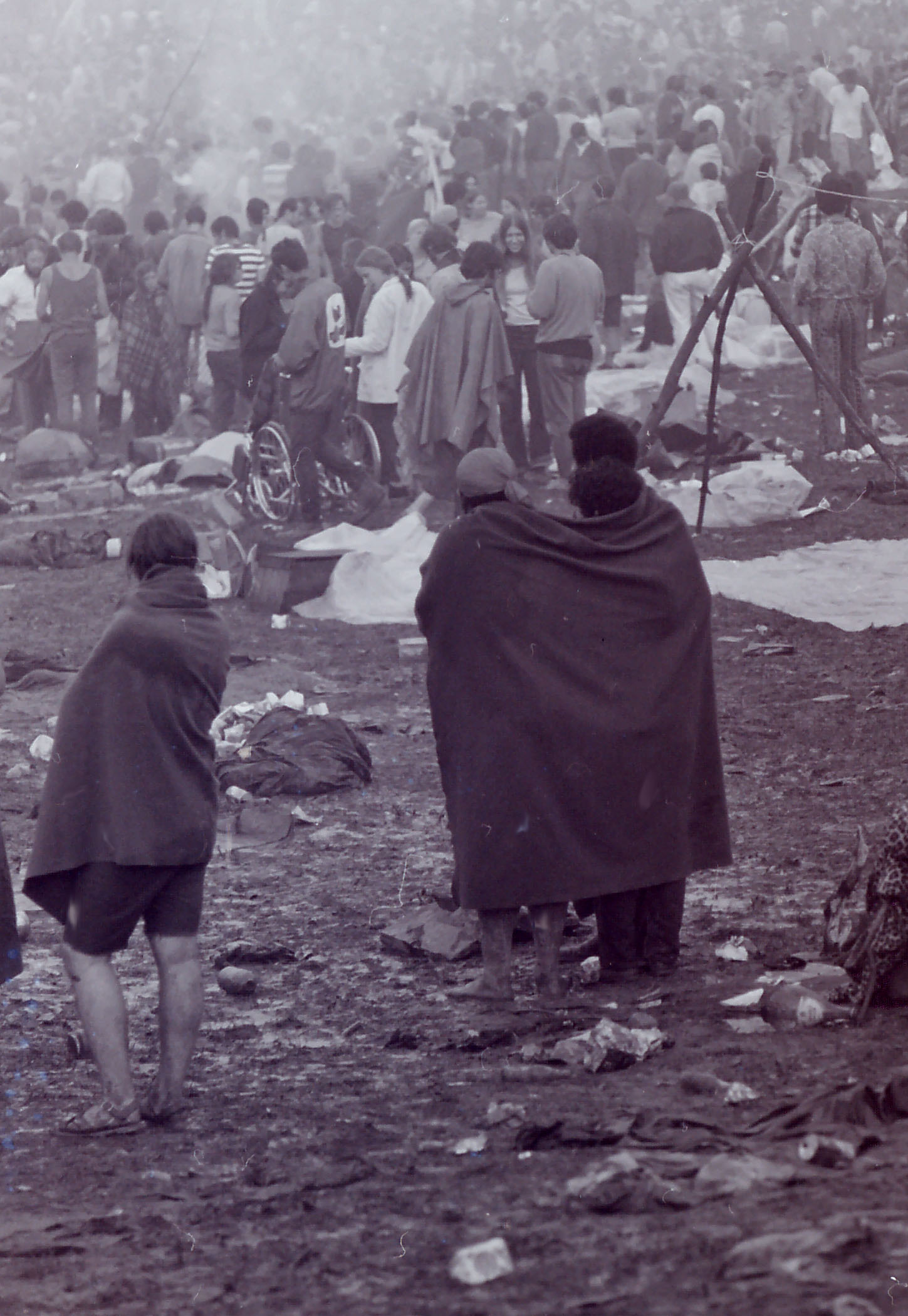
For three days, a massive outdoor concert of a half-million listeners had reigned over an upstate New York dairy farm owned by Max Yasgur. Organizers for the Woodstock Music & Art Festival had chosen the farm for its natural bowl shape, perfect for acoustics. Originally the festival was to charge, but as funds ran dry and far more attendees appeared than expected, the organizers decided to skip setting up fences and security, instead focusing on readying the music.

The concert seemed on the brink of disaster from the beginning. With so many people, there was little or no access to food, water, or sanitation. Attendees camped or slept in the elements, much of which was rain over the course of the weekend. Yasgur's fields turned to giant mud pits. Despite the discomfort, or perhaps because of it, people embraced nature and enjoyed the concert featuring stunning performances by Santana, Grateful Dead, Creedence Clearwater Revival, Janis Joplin, The Who, Jefferson Airplane, Johnny Winter, and Jimi Hendrix.

As the concert came to a close in the wee hours of Monday morning, people began to pack up after listening to a wobbling rendition of the national anthem on Hendrix's guitar. According to various reports in the apocryphal film Woodstock, someone, somewhere, said, “Hey, this is groovy. Why do we have to leave?”

The idea spread through the crowd like wildfire. While thousands left the area, tens of thousands more stayed. A cluster seized the stage, declared it public property, and began something of an “open mic” day. John Roberts, one of the festival organizers, attempted to regain control with his crew of security guards, but they were booed, used as targets for rotten food, and finally beaten with various blunt instruments. Yasgur called the police, and the festival quickly escalated to a riot. New York Governor Nelson Rockefeller sent in 10,000 National Guard, as he had been prepared to do the day before when Roberts had calmed his fears. Now 10,000 scarcely seemed enough.

Journalists, who had been covering the massive traffic tie-ups throughout the weekend, covered the escalation live. The National Guard began to arrive as well as protesters from around the area. Evening settled, and the National Guard took up a siege of the farm, only to find themselves surrounded by more protesters pouring in from around the country, some having driven through the night from as far away as Missouri and Wisconsin. Thrown rocks and chants were traded with tear gas and rubber bullets. The riot spread to neighboring counties, and Rockefeller declared a wide state of emergency, inviting President Nixon to take charge of the wild situation.

Though later denied and subject of the investigation that would find Nixon impeached, ultimately resigning in 1971, the order was given to use live ammunition on the “damn hippies” that were “tearing up” the state of New York. Peace and love had fallen, conquered by blood and steel. Social upheaval would spread throughout the nation, causing sit-ins, demonstrations, and further riots, primarily centered around universities. At Kent State in Ohio, the fall semester would be broken up by further shootings, and calamity would spread anew throughout the country. The New Years' Bloodbath in San Francisco would result in the deaths of over one thousand rioters.

Nixon declared a state of emergency and began systematically to crack down on the counter-culture movement, even to the point of calling back troops from Vietnam. Curfews were enforced with heavy fines, substance control penalties were raised to military executions, and even dress and living codes were adopted to eliminate hippie culture. A “black list” of rock and roll songs was created, though immediately tied up in courts from the First Amendment. Over the course of 1970, America would become something of a police state. Gradually, the tempers would calm, and people began to cry out for peace or at least “some kind of sanity,” to quote journalist Walter Cronkite.

With elections in 1970, the government wrung itself out to establish moderate rule. Nixon and many others were put on trial, but many of their policies were kept with weaker punishments. In 1972, Democrat George McGovern won narrowly over Republican John Ashbrooke. In the following decade, the United States would turn away from international involvement and return to isolationism, praising the ideals of forefathers like George Washington and Thomas Jefferson.

International power shifted to the Soviet Union, which would overstretch itself in the late '70s and '80s with invasions of Afghanistan and Iran. The collapse of Soviets came in 1992, soon followed by the liberation of many dependencies, such as the reunited Germany of 1994. The world stood without a clear leader for more than a decade, but gradually the growing strength of the European Union came to shadow world policy. Many suggest the military successes of China in the '90s and early new millennium in the policing of Southeast Asia suggest it as the new superpower, but others doubt their lackluster economy with allow them sufficient clout.


In reality, the Woodstock Festival stood as one of the greatest moments in the Peace and Love movement. Despite the constant potential for violence, goers were more concerned with music and merriment. Farmer Max Yasgur, who did not rent his farm for another festival the next year, was nonetheless impressed by the hippies, saying that they “can turn those adversities that are the problems of America today into a hope for a brighter and more peaceful future.”

Site Meter