Showing posts with label pope. Show all posts

Saturday, January 26, 2013

March 25, 1409 – Violent Council of Pisa Begins


The Western Schism had separated the Catholic Church in Europe for over thirty years.  As the Middle Ages began to come to a close, the worldly authority of the Church was evident.  With the Crusades, the Pope had displayed his ability to exert power over the kings of Europe, who in many ways were subordinate to papal will and arguably commanders for Christendom's armies.  Because it was such an important seat of power, the Vatican became fraught with corruption and factional infighting, much of which came from the wealthy families of Italy.  In an effort to escape these trappings, the Pope moved to Avignon, France, in 1305.  There, however, the corruption grew to a new higher level, and the papacy came under heavy influence from the French king Paul IV, who instigated the destruction of the Knights Templar.

After seventy years, the Papal Curia moved back to Rome under the guidance of Pope Gregory XI.  The Italian city-states had organized to shrug off the rule of the Church, and thusly France, and the Church responded by massacring thousands of rebels in Cesena and excommunicating all of Florence.  To quell further uprising, the French Pope moved back to Rome to have more direct influence.  Two years later, however, Gregory died.  The city of Rome rioted, demanding that a Roman be elected pope despite none being eligible.  The cardinals finally elected the Neapolitan Urban VI, who had been an effective administrator, but as pope was distrustful and brutal.  After five months, disapproving cardinals reconvened and elected a new pope, Clement VII, who returned to Avignon.

Europe was thrown into chaos as no one could agree who was the real pope and what to do with the antipope.  Royal families became divided, causing wars in Portugal and Castile.  When the town of Bruges declared itself a supporter of Avignon, it became partially depopulated as supporters for Rome simply left.  The division weighed on Europe even to the point that Charles VI of France suggested that the Avignon pope, whom he supported, to step down.  As the fifteenth century dawned, both popes agreed to a meeting but later refused.  The cardinals gave up hope and determined to solve the matter.

They convened in the college town of Pisa at the cathedral beside the leaning tower along with 80 bishops, representatives of 100 more, and ambassadors of the kings.  Famous universities such as those in Cologne, Paris, and Oxford sent over 300 doctors of theology and cannon law to contribute.  Each morning for three days, the meetings opened with a call for the popes to present themselves.  The popes did not, and so the testimonies began without them.  A group of Germans in support of Rome did appear in April, but their case only caused anger to rise up among those gathered.  Two months later, representatives from Avignon appeared as well.  Their argument caused laughter to break out among the council, and when the Avignon-supporting Chancellor of Aragon spoke, the Archbishop of Tarragona made a declaration of war.

The people of Pisa heard the rumor of war and misunderstood it to be a declaration of war by the Church against the antipope rather than an ungrounded call-to-arms in Spain.  They seized the ambassadors and hauled them up the tower, throwing them to their deaths.  The council was shocked, but they determined to finish their business.  Antipope Benedict XIII in Avignon took the declaration of war seriously and immediately called upon his supporters to launch a crusade against the Pisans.  Not to be outdone, Gregory XII in Rome did the same.  The council continued its business with the Patriarch of Alexandria stating, "Benedict XIII and Gregory XII are recognised as schismatics, the approvers and makers of schism, notorious heretics, guilty of perjury and violation of solemn promises, and openly scandalising the universal Church… to be driven out of the Church."  They unanimously elected a new pope, Alexander V, and sent letters to the kings of Europe calling for a crusade to remove both former popes.

Europe became even more divided.  War broke out between pro-Avignon Scotland and pro-Rome England, in Portugal, and, especially, among the various cities of the Holy Roman Empire.  Emperor Charles IV had died in 1378, and the electors had not yet met due to the Schism.  With three popes willing to grant the title, the electors began to tear into one another, backed by France for Pisa, Spain for Avignon, and Poland for Rome.  The war became worse as Hussites in Bohemia rebelled after the Pisan pope issued a bull condemning Wycliffism.  Sigismund, King of Hungary, worked to suppress the revolt, but his resources proved stretched too thinly to snuff out the movement.  The Ottoman Empire, fresh from its own civil war, made great advances in the Balkans while the Christians were divided.

After years of war, an armistice was pronounced, and Europe formally divided.  Spain led a coalition of supporters of Avignon (who retreated to Madrid), Rome held Naples and Poland, while the rest of Europe recognized Pisa.  Pisa weakened to northern Italy as Protestantism swept northern Europe, limiting Rome's influence to southern Italy, which would never unify with the north again despite a series of small wars attempting to do so in the nineteenth century.

In the sixteenth century, another war of religion would be fought as the Protestants came to the aid of the Huguenots, eventually turning France into a nation without a state-church.  England, too, would fall to Protestantism as Calvinists pushed out the influence of the Pisan Church.  Eastern Europe, meanwhile, was increasingly swallowed by the Ottomans up to Hussian Bohemia and Orthodox Russia.  As the age of empires began, the many different churches of the nations of Europe were spread throughout the world, which became increasingly secular to survive religious disunity.


--

In reality, the Council of Pisa confined its orders to within the Church.  While the ambassadors from Avignon were insulted and threatened, they sneaked out of the city safely.  Ultimately, most of Europe sympathized with Pisa, but little was done to back the new antipope.  The groundwork was laid, however, for the Council of Constance in 1414, which prompted the Pisan and Roman popes to step down and excommunicated Benedict XIII, who fled to Spain.  It also elected a new unifying pope, Martin V, and condemned Hus, affirming Catholic rule in Europe.

Monday, January 24, 2011

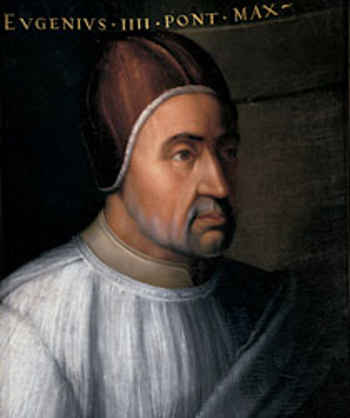
January 24, 1438 – Suspension of Eugene IV Takes Hold

The world-unifying Council of Basel had been convened in Switzerland in 1431 by Martin V to continue the reforms under his papacy that had solved the Western Schism, which had torn apart Catholic Christendom for nearly forty years. In 1417, the Council of Constance had determined agreements to have the Roman Pope Gregory XII and Pisan Pope John XXIII, while the Avignon Pope Benedict XIII was excommunicated, undercutting his support and effectively ending the schism. Conciliarism had solved the issues of whom to trust with ultimate authority and many sought for it to reign supreme in Western Europe.

Councils were to take place every seven years, and Martin V convoked Basel shortly before his death of apoplexy. His cunning assistant Gabriele Condulmer was appointed Pope Eugene IV quickly afterward, and he immediately began to struggle with the Council. In December, Eugene called a dissolution for the Council, but the electors refused to leave and continued reforms. Eugene, a native Venetian, gave papal support to his city and allied Florence against Milan during the Lombardy Wars, which spawned great unrest among the Romans. After two years of contrary bulls, the two were reconciled by the newly elected Holy Roman Emperor Sigismund, who allowed for the retaining of papal powers (and protection) while Eugene IV revoked the dissolution.

Following his settlement with those at Basel and looking toward presiding over a peace treaty in Ferrara, Eugene attempted to escape Rome disguised as a Benedictine monk. While in the Tiber, he was spotted and had stones thrown at him until a band of Romans supporting the Colonnna Family swam into the river and dragged him back to the Vatican. The city turned to an uproar that even the papal armies under Cardinal Vitelleschi could not reestablish control with the Pope under hostage. The peace talks in Ferrara disintegrated without the pope, and his influence began to become questioned as balance struck itself out.

While the Pope's power waned, the Council at Basel continued to grow in prestige. They wrote reform (such as banning circumcision as a mortal sin), judged lawsuits, acted as mediators, and even influenced the Treaty of Arras ending the Hundred Years' War between France and England. As the Council worked to achieve union with the church in the East, Eugene IV finally had to give them recognition to align his own political agendas. The parties worked to determine a place of meeting with the Council wanting an inland city far from Roman influence and the Greeks of Constantinople hoping for an easily reached port city. On January 10, 1438, the convention met, and the two churches began discussing ways of reconciling their dogma. Eugene worked to gain advantage in the discussion, but on January 24, the Council suspended him. It was the first step on the downward spiral of papal power, followed soon after of gaining the support of Frederick III, King of the Romans, that would eventually be relocated to a main seat representing overall Western Catholicism on the Council.

In the meantime, the Council was able to achieve an agreement with Patriarch Joseph II of Constantinople early in 1439. He would die that June, but by then the union would be in action, and, though unpopular, would prove to be mutually beneficial as the West ended its infighting and launched fresh crusades to beat back the Ottoman advances on the East. The reunification of the Church continued as the Coptic Christians arrived from Ethiopia with delegates in 1441. Further unification came as the Jacobites of Syria, Maronites of Lebanon, and even Nestorians of Persia came into the fold, joining Armenians and Russians who had already come. They managed to incite rebellion through the growing Ottoman Empire in Greece and Turkey, ending the expansion of Muslim political power while eclipsing it with a new Christian coalition.

The strong unity came as the Council debated issues such as purgatory and the Processions of the Holy Spirit. Theological debates will continue eternally, but the loose Constitution of Christendom would define a common ground that would be used by political leaders throughout Europe, Asia, and Africa to determine trade agreements, terms of war and peace, and overall morality. Missionaries and conquerors would stretch the reach of Christendom through Africa (in a crusade against slavery once dreamed by Martin V), Mongol-controlled Asia, and even to the newly discovered Americas.

Noted Pope Martin VI, formerly Augustinian monk Martin Luther, would lead internal matters of reformation by separating Church and State, the holy and the secular, solving many of the issues rising by the very different beliefs of the many churches that could not be rectified with his famous bull, “...Therefore I declare that neither pope nor bishop nor any other person has the right to impose a syllable of law upon a Christian man without his own consent.”


In reality, Eugene IV escaped Rome in 1433. War paused in northern Italy, and he maintained significant political influence. When the Council of Basel, moved to Ferrara and then Florence, attempted to suspend and depose Eugene while electing their own antipope. The schism would last ten years, and the political disagreements would break down attempts of unifying the world's Christian churches while establishing papal authority over councils.

Site Meter