Showing posts with label stalin. Show all posts

Thursday, July 26, 2012

June 25, 1948 – Berlin Airlift Begins World War III


Postwar Europe became divided when territory liberated by the Soviet Union from Nazi Germany came under seemingly permanent communist rule.  The Potsdam Agreement in 1945 divided Germany itself into sectors held by differing Allies.  Berlin, one hundred miles inside the Soviet sector, was divided into four sectors with the West held by Britain, France, and the United States while the Soviets controlled East Berlin.  Stalin reorganized the communist and socialist parties into the Socialist United Party and told his comrades that he worked toward a Germany reunited under communism.  As part of his plan, he ended food delivery to West Berlin and limited Western allies to a single train per day, encouraging West Berliners to come to the Soviet sector for groceries.  The plan backfired, however, as the local elections in 1946 proved to be overwhelmingly pro-democracy.
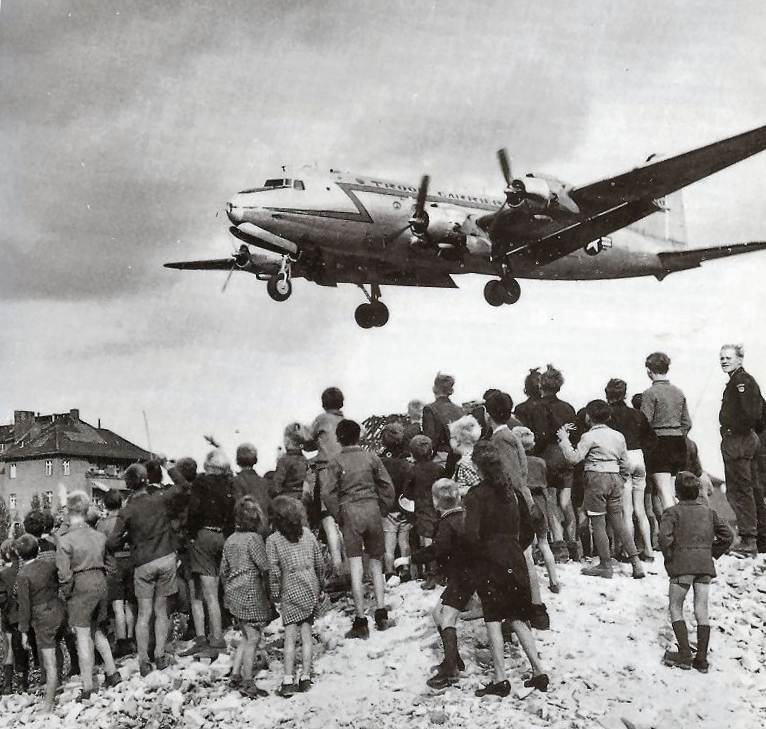
Stalin was further infuriated by the 1947 announcement of the Marshall Plan to rebuild Europe.  He preferred his hard-won “war booty”, seeing the American move as “dollar imperialism.”  Soviets further restricted travel through their sector in the spring of 1948.  Americans responded by delivering military material by air, and Soviets sent up planes to buzz the cargo planes.  A crash occurred between a Soviet fighter and a US airliner, killing everyone on both planes.  The Soviets reduced their interference with train travel but considered the exercise a victory as they seized all communication beacons within the Soviet sector for air security.

Stakes were raised again when the western Allies proposed the new Deutsche Mark to replace the devalued Reichsmark.  Currency had been so over-printed by the Soviets that bartering had replaced cash, creating a weak economy that forced German reliance on Moscow.  The British and Americans announced their attempt to revamp the economy on June 18, 1948, stating that the Deutsche Mark would be considered legal tender on June 21.  The Soviets refused and began halting all ground travel to prevent the flood of marks into Berlin, even though 250 million had already been shipped in.  Outraged, the Soviets announced the “Ostmark” as their own currency and forbade the use of Deutsche Marks.  On June 24, the Soviets ended all rail and water traffic from West Germany.  Travel by road was permitted, though heavily dogged.  Electricity produced by Soviet-held power plants outside of the city was cut off.  The Americans under General Lucius D. Clay refused to leave, and he announced an airlift of food and coal supplies as had been seen months before, expanding plans already put into place by the British. 

The endeavor required 1,500 tons of food and 3,500 tons of fuel to be transported daily into the city when the combined aircraft of the British and Americans in the area could carry only 700 tons.  Clay launched Operation Vittles, and planes were flown in to increase the tonnage.  The United States had already begun to demilitarize in Europe, and Britain was still recovering from the damage of the Blitz (the 1948 London Olympics, which the Soviets did not attend, featured no new construction of venues or housing).  The Soviet Union watched, eagerly anticipating the West to admit the transport cost was too great and to abandon Berlin.

All through July, the planes flew.  The Soviets carried out massive propaganda programs in print and on radio, lambasting the Western efforts.  However, nothing seemed to stop the planes until “Black Friday”, August 13, when a C-54 crashed at the end of the runway and two more planes crashed after it.  All planes awaiting landing were sent home, and the Soviets decided to make their move.  They publically claimed the airlift “unsafe” and moved troops to take the airfields under the guise of aiding in cleanup.  Fights began, and soon Soviet tanks rolled in to besiege the city.  War was declared between the Soviet Union and the Anglo-British alliance with France, fighting in Indochina already, seeking neutrality.  French forces were returned to their sector in the south, but the rest of West Berlin continued under heavy siege.  Despite psychological warfare, West Berliners refused to give up, such as the rousing speech by city councilor Ernst Reuter, "You peoples of the world, you people of America, of England, of France, look on this city, and recognize that this city, this people, must not be abandoned — cannot be abandoned!"  As winter approached, supplies ran out, and thousands of Americans, British, and Germans were taken prisoner.

American and British troops began campaigns attempting to penetrate the Soviet defenses, but the armies were unable to overwhelm heavy fortifications.  While the US had been demobilizing, Stalin had kept up his urgency of military preparedness.  Soviet forces swept into West Germany, finally realizing Stalin’s plans of reunifying the country.  Content with a French buffer and strong air defense, the Soviets moved toward Iran, seizing oilfields that had been the object of debate between Moscow and the British and recreating the People’s Republic of Mahabad.

The Americans threatened counterattack with atomic weapons, but the threat was hollow until 1949 when the first atomic-adapted B-29 Silverplate arrived in Britain.  The question of whether to use atomic weapons in Germany was brought to President Truman (who had won the 1948 election by a wide margin against isolationist Thomas Dewey), but he determined to use it only against Russia itself and encourage uprising from the “liberated” nations under Soviet control.  He expanded the war to a new front in Turkey and pushed for new air bases in preparation for wide-scale attack from the Black Sea on the Caucasus and across Ukraine.  After a great deal of deliberation, the US also joined the nationalists in the Chinese Civil War, reinforcing Chiang Kai-shek with aid and advisors.

In late 1949, the first atomic bomb fell on Russian territory, followed by dozens more.  Stalin used the fallout to his advantage through propaganda, but, while much of Russia continued to support him, the edges of his the bloc began to collapse.  Starting in 1950 after a revolt in Berlin, bloc countries began to rebel one after the other with American support, prompting stiff Soviet response.  Russian resources became strained while the Americans continued to remobilize, pushing up through the Caucasus into Stalin’s birthplace in Georgia and atomically bombing Stalingrad in 1951.  On the first of March 1953, Stalin was discovered dead in his bunker west of Moscow.  He had not left a clear successor, and internal squabbles destroyed the peoples’ faith in Soviet government.  Ukraine became liberated that summer in Operation King Cobra, and the road to Moscow was open to be taken by September.

Following the Third World War and the breakup of the USSR, capitalism and democracy had proven itself the victor over communism and fascism.  The Anglo-American alliance dominated the United Nations and began the long era of rebuilding in the Pax Americana.  Technology flourished, and international communication satellites began being launched in the 1970s, uniting the world on a new level, even though a manned mission into space had never gone beyond experimentation by the USAF.


--

In reality, the Soviets did not move on the “Black Friday” crash of the Berlin Airlift.  On August 1, they offered free food to West Berliners who registered their ration cards with the Soviets, but few accepted.  Instead, Berlin was supported by air for eleven months in an unprecedented feat.  Crews began bringing in record tonnage, as was seen in the “Easter Parade” that carried nearly 13,000 tons of coal.  The Soviets decided to lift the blockade, opening the gates on May 12, 1949, and the Cold War would drag on for another four decades.

Wednesday, June 6, 2012

June 6, 1942 and 1944 – A Cursed Day for the Allies


On two occasions two years apart during the Second World War, the sixth of June proved to be a day of disaster.  The first was in the Pacific Theater as the Imperial Japanese Navy looked to take Midway Island and push American control 1,200 miles backward.  Since the war in the Pacific had begun for the Americans with the Japanese raid on Pearl Harbor on December 7, 1941, it had been mostly a calculated retreat.  FDR ordered General Douglas MacArthur to relocate from the Philippines to Australia in February, 1942, prompting the famous “I shall return” speech.  The Japanese swept through the Dutch East Indies until finally being stopped at the Battle of Coral Sea.  While the Allies took heavier losses, they hindered the Japanese enough to stop their invasion of southern New Guinea.

In the next weeks, Yamamoto collected a massive fleet to make an attack on Midway Island, America’s most forward holding in the northern Pacific.  The attack had been expected by command since the 1930s, but there seemed no way to beat Japanese numbers with victory at Coral Sea being granted by superb American flight crews since ships did not even sea one another.  Code-breakers attempted to trick the code for Midway out of the Japanese naval code JN-25 by falsely broadcasting in May that the Midway water distillation plant had broken and requesting supplies.  While Japanese radio-operators were preparing to pass along word that “AF” (Midway) was short of water, command stopped them, having been suspicious over the American carriers seeming to appear exactly in the right place and time at Coral Sea.  Yamamoto, who had spread his fleet widely to avoid detection, decided Americans were already suspicious and reordered his ships into a tighter pack that struck Midway and the few American reinforcements there.  Most of the American Pacific fleet was in Hawaii, with the U.S.S. Lexington carrier under extensive repair.

After the fall of Midway, the Japanese and Americans fought endlessly between Midway and Hawaii, with the Americans finally pushing the Japanese back in November of 1942.  They had allowed the Japanese to dig in at places such as the Eastern Solomons and Guadalcanal, but the full industrial might of America finally outpaced early Japanese advantages.  With the loss of nearly 1000 pilots over the month-long Battle of Hawaii, the Japanese were unable to replace their crews, and the navy became impotent, relying on the army to hold the islands conquered early in the war.  The Second Battle of Midway in 1944 restored it to American hands at the cost of thousands of Marines’ lives.  By December 1945, the Americans had overtaken outlying Japanese bases at Okinawa and Iwo Jima, making routine firebombing of the mainland possible.

June 6 was also the day of the disastrous attempt at an amphibious landing on the north coast of France.  Weather had delayed the attack from June 5, but the Allies made an eager assault at Normandy on the morning of June 6, 1944, without full air support.  While many of the German High Command were absent (Hitler was reported to have slept late that day) or more fearful of attack at Calais, communications broken up by Allied paratroopers ironically inspired reserve commanders to act on their own initiative.  The Allies held the beach for a time, but Panzers under Rommel drove the troops back into the sea by afternoon (thanks to winning out before Hitler in an argument with Field Marshal Gerd von Rundstedt about mobile defense).

Eisenhower and the Allies retreated to prepare for another amphibious invasion, but the “worst channel storm in 40 years” delayed them through June.  Instead, the Allies determined to feint at Calais and made an assault Marseille in the South, for which Churchill had long campaigned.  Italy had been occupied by the Germans after capitulating, slowing advance up the Italian peninsula into a stalemate.  Operation Dragoon created a fresh front through southern France, causing the Germans to move their attention southward.  Shortly afterward, the Allies struck at Brittany, finally establishing a lasting beachhead at Brest.  Meanwhile, on the Eastern Front, Stalin began ferocious counterattacks, pushing westward and catching whole German armies in pincer movements.  By May of 1945, Russians had marched into Bavaria, taking as much ground as possible as the Western forces attempted to catch up for the Battle of Berlin a month later.

The war in Europe ended on May 28 with the Soviets controlling almost the whole of Germany.  Issues immediately began to arise with occupation zones as French demanded an area of Germany.  At Potsdam that July, the quickly fracturing Allies determined that the Soviets could control Germany as long as it followed the Potsdam Agreement and Russia would declare war on Japan to end the Pacific theater.  President Truman’s use of the atomic bomb and the Soviet invasion of Manchuria led to VJ Day on January 14/15.  Again, the Soviets made great leaps in occupation, taking Korea and the northern islands of Japan while the beleaguered American forces worked to disarm southern islands still held by imperial forces.

With so much Soviet influence in the East, Stalin refused to give up Manchuria to the Chinese as a result of the ongoing Chinese Civil War, explaining they needed secure railways to support the occupational forces in Korea.  Both Nationalist and Communist Chinese balked at the invasion and called another truce as they had during Japanese invasion, although each was willing to injure the other whenever possible.  The occupation of Manchuria began the Sino-Soviet War, which dragged on as Western powers watched.  With the development of Russian atomic weapons in 1949, the West finally acted with a NATO ultimatum banning the use of atomic weapons.

NATO-Soviet relations continued to crumble until the death of Stalin in 1956 ignited revolutions beginning in Hungary and spreading throughout Europe.  Already stretched thin with fighting in China and occupation in Central Asia, the stress was enough to break the Soviet Bloc and bring the experiment of Russian Communism crashing down.  War in China continued until NATO influence finally brought Kai-shek’s Nationalists into power, spreading capitalism into other former Soviet nations such as Korea and Xinjiang.


--

In reality, the US had broken the Japanese naval code and was able to appear at Midway with reinforcements, including the Yorktown, which had been repaired round-the-clock in Hawaii over 72 hours at Nimitz’s urging.  German High Command, however, was not as able and delayed counterattacks on D-Day until much too late to reverse Allied advances into Normandy.

Wednesday, June 22, 2011

June 22, 1941 – Hitler Calls off Invasion of Soviet Union

Upon the receipt of confirmed espionage of the military preparedness of the Soviet Union, German Fuhrer Adolf Hitler gave the last-minute order scrubbing his intended invasion. Knowledge of Stalin's military buildup was well known, but the exact numbers were suddenly daunting. As seen by Hitler then and later calculated upon declassified documents by state historian Mikhail Meltyukhov in his work, Stalin's Gift, Russians outnumbered the Germans and their allies 1.4-to-1 in infantry and artillery, 2.6-to-1 in aircraft, and stunningly more than 3.8-to-1 in tanks. Hitler had surprise on his side as Stalin, despite the advice of several spies who had given him the exact date of invasion, believed Hitler would hold longer than two years to the Molotov-Ribbentrop Pact and wait until he finished war with Britain. Hitler had already postponed the intended Operation Barbarossa several weeks from its initial deadline in May due to logistical problems, and now he knew certainly he was too late.

Germany and the Soviet Union seemed doomed to fight each other, however. Stalin addressed military academy graduates with, “War with Germany is inevitable,” just weeks before the intended invasion. Both nations were diametrically opposed with policies in Hitler's fascism and Stalin's communism. Both were hopeful for expansion as Hitler called for “elbow room” and Stalin worked to rebuild the Russian Empire, such as dominating Finland in the 1939-40 Winter War. Because Stalin understood Hitler's need for oil to fuel his power would bring him to Baku, the Soviet leader began programs to expand the Russian military by leaps. From '39 to '41, he more than doubled the size of the army and especially built aircraft, which increased from 7,700 to 18,700.

As Hitler and his staff reviewed the numbers, he knew that Germany would be unable to maintain the blitzkrieg he had used successfully against Poland and France without control of the air and against numerically superior tanks, with Russian heavy tanks even arguably superior to Panzers one-on-one. Finally Hitler realized that the Russians were simply too powerful by weight and determined that he would need new kinds of weapons to fight, redoubling his already heavy investment in research and development for rockets, atomic bombs, and more. He let continue the lie that his massing troops on the border with the Soviet Union was keeping them away from attacks by Britain and eventually recalled them for Operation Sea Lion, which had been postponed indefinitely since September, 1940.

Japanese attack on Pearl Harbor brought Britain's near-ally America into the war fully that December. With American resources turned toward the Pacific, Hitler's invasion of Britain began, which quickly turned into a quagmire of resistance and sabotage of nearly every public work. Although Hitler held Western Europe for several years, the Allied counter-attack through Africa enabled Britain to be liberated by the D-Day landing at Devon, June 6, 1944.

In early 1945, with Hitler reeling despite some Soviet support Stalin made good on his original strategy of waiting. Called the “Icebreaker” theory by exiled historian Viktor Suvorov, Russia swept in as liberators across Europe, meeting with American and British allies as they took Berlin and continued toward the Western Front, spreading as far as France and Italy. Churchill and Roosevelt encouraged Russia to relinquish their control of Europe as soon as order could be maintained, but Stalin decided to stay. As war with Japan ended with the new A-bomb, political stakes were raised with the Americans holding a powerful card, but Russia practically fresh for a fight.

War-weary President Truman decided to leave the Russians in Europe, establishing doctrine that would work just to keep the Soviets from expanding further. This, too, would prove a blunder of waiting as the Russians would use captured German scientists, now pampered celebrities outside Moscow, to surpass the atomic bomb with an H-bomb and rocketry capable of intercontinental delivery by the 1950s. An Iron Curtain fell from East France to North Italy and across the Soviet Balkans that looked to expand through the Middle East, Africa, even Latin America, and absorb Chinese Communism into the Soviet-led World Community. Any opposition to the world superpower had to be covert, such as escapes across the Swiss border and arming of Afghan guerillas, as no nation could stand against Stalin's legacy until it eventually collapsed into corruption and civil war.


In reality, Operation Barbarossa proceeded. With army strengths of more than seven million, Hitler and Stalin fought bitterly over Eastern Europe for months until the Germans were finally stopped and held by sheer numbers. Eventually, the tide would favor the Russians, who would come to take much of Eastern Europe under their influence after World War II and hold it until the wave of independence movements in 1989.

Thursday, November 25, 2010

November 25, 1940 – Russia Joins Axis

After nearly two months of dealing, Russia announced that it would be joining Hitler’s Axis. Stalin had ordered his minister Molotov to widen the scope of the discussions in Berlin to solve potential problems with spheres of influence. Simultaneously, Soviet ambassadors appeared in Sofia, promising the Bulgarian Prime Minister that Russia’s objection to Bulgaria joining as well would be withdrawn as per the shared military rights among the Axis nations. The world was shocked by the news, especially Britain as it faced the horrors of the Blitz against an even stronger foe.

Hitler, too, was shocked. Months ago, he had ordered “Instruction Number 18” on November 13 to plan for an invasion of Russia to solidify control of oil reserves and begin the enslavement of the Slavs. Now, Stalin had agreed to Hitler’s terms with a few added secret terms:

• German troops leaving Finland in exchange for guarantee of Soviet peace with Finland as well as supplies of nickel and wood.
• A mutual assistance treaty Bulgaria.
• The southern boundary of the Soviet Union guaranteed at Baku and Batumi with special consideration given to Germany to supply oil from Azerbaijan.
• Japanese handover of Sakhalin oil and coal in exchange for compensation and similar consideration.
• Soviet bases established in Bulgaria.

While the renewed pressure on the Bosporus irked Hitler, the guarantee of oil impressed him too much. He shelved his invasion plans, for the time, and met with Stalin in Sofia for the signing ceremony December 7, 1941. Though unknown at the time, Hitler had also been pressuring Japan into a sneak attack on the United States, but, seeing his war with Britain over soon, reneged on the plan, prompting Japanese command to call back the fleet hours after its launch on November 26. Franklin Roosevelt, wary of the significance of the diplomatic dealing, referred privately to the signing of the pact as “a date which will live in infamy.”

Hitler realigned his troops into new position and re-activated the invasion of Britain through Operation Sea Lion for 1942. Though the Germans were unable to achieve full air superiority, the German Navy managed to hold off the Royal Navy long enough for the largest amphibious assault in human history behind a screen of mines. Initially, the Germans would overcome British defenses, pressing nearly to London, but Churchill kept his vow of continuing the fight from his bunker beside Parliament and held the Germans at the GHQ line. While the Royal family was evacuated to Scotland, thousands of Brits rose up in defiance with sabotage behind German lines. The Royal Navy and the RAF continually challenged German superiority at sea and in the air, leaving historians to claim that the defense of Britain counted as the longest siege of the modern day.

The Invasion of Britain would prove to be Hitler’s quagmire. At last the American people would stand against German aggression as well as Japanese invasion of the Philippines, sending thousands of troops to the British lines. Nearly 3.9 million German troops would be involved in the effort, but the resilience of the British and her allies became unbreakable over the course of two years. After the introduction of the V-2 rocket, which struck targets after sub-orbital arches and beyond the speed of sound, the Germans gained the upper hand by devastating the defending fleets. With secure supply lines, German forces finally overwhelmed the island. In 1948, Hitler would tour conquered London while the Crown established a government-in-exile in Canada.

Meanwhile, Stalin began his “liberation” of the Turks from British influence. The invasion and occupation of Turkey would lead Soviet forces to further “peacekeeping”, marching into the Middle East and securing Iraq and Iran’s rich oil fields. The sites proved instantly rebellious, and millions would die as Stalin attempted to purge any anti-Soviet thought from the deeply rooted Muslims. The continual struggle against imperialism wore down the Russian people, prompting a revolution after the Stalin’s death in 1953.

Russia turned on itself, and an aging Hitler finally saw his chance. He had been held at the Atlantic by Allied submarines, pushing southward into Africa in association with the Spanish and Italians. In 1955, under the pretext of defending German economic interests and the pledge of Russian oil, the Red Army marched on Moscow as it had meant to do 14 years before. While the various parties of Russia had fought one another, they all agreed upon the goal of ridding Russia of invaders, and the whole of the nations turned on Hitler.

Atomic bombs, which had been used by Americans to bring down the Japanese Empire, proved an ineffective strategy for Hitler’s army as the peoples of the former Soviet Union were ubiquitous rather than isolated. It is said that the stress of the Russian occupation delivered the stroke that killed Adolph Hitler April 30, 1957, at age 68. Infighting among his potential heirs weakened the Nazi regime, which would fall apart as Stalin’s had done.

With renewed opportunity, the stalemate across the Atlantic had broken, and the Allied forces charged into Europe through the rebellion of Britain. Conquered lands erupted in anti-Nazi revolution, and soldiers routinely deserted than fight for a colony whose mother country was in such peril. By 1964, the last Axis government in Bulgaria would surrender, and World War II would be declared over. Led by the United States, a new world order under democracy through the United Nations would be attempted with its founding in 1966.


In reality, Stalin did not offer Hitler rights to oil. Albert Speer, Minister for Armaments and War Production for Germany, would later admit “the need for oil certainly was a prime motive” for Operation Barbarossa, the German invasion of the Soviet Union. Predicting war as inevitable, Hitler signed War Directive No. 21 on December 18, just weeks after refusing to reply to Stalin’s counteroffer of an alliance.

Site Meter