Tuesday, December 6, 2011

January 17, 1961 – Eisenhower Confirms Restrictions of a Military-Industrial Complex

During his "Farewell Address," President and former Supreme Commander of Allied Forces in Europe, as well as first Supreme Commander of NATO, Dwight D. Eisenhower confirmed that his administration had done its part in limiting what he called the "military-industrial complex."

In the 1950s, the United States was in the midst of an ongoing arms-race with the Soviet Union that had continued to maintain unprecedented levels of troop mobilization despite the end of the Second World War. Fear of the spread of Communism fueled government contracts for new and better technology, giving birth to supersonic jet engines and even an artificial satellite in orbit of the Earth. However, during his administration, Eisenhower became concerned over the amount of public funds and interest tied into simply maintaining readiness for a war against Communists who, in Russia, were under collective leadership since the death of Stalin in 1953 and, in China, suffered under accidental famine from ill-planned agricultural Five-Year Plans. The Korean War had shown that conventional warfare mixed with modern politics to create a stalemate, and Eisenhower decided to keep the stalemate overt with America's readied nuclear arsenal capable of Mutually-Assured Destruction.

Citing examples from the 1956 work by sociologist C. Wright Mills, The Power Elite, Eisenhower's new policy turned to limiting the abilities of lobbyists in "The Higher Circles" who had direct influence and adding new levels of visibility to policy-creation as well as methods of direct review and polling upon budgetary issues. Numerous figures said that the policy was watering-down the leadership of America in tough times as Khruschev seized power in the USSR, but those such as Senator Robert Taft loudly questioned the ethics of those he considered fearmongers and warhawks. The FBI gained a new office investigating potential illicit lobbying, and numerous contracts between the government and large businesses were allowed to run out. The military gradually began to downscale, and research was limited to grants to universities only with direct proof of public benefit. Proposals, such as the National Aeronautics and Space Administration, which would largely guide civilian space efforts, were kept to what was pertinent given the defense of the United States.

In Eisenhower's last speech, he commented on having cleaned house in Washington and limited the possibility of special interests to dominate Congress under the table. Many believed that if anyone but the highest-ranking general in American history to become president since Washington had tried to decrease military-industrial spending, it would have blown up in his face. Ike's successor, John F. Kennedy, continued the regulation of Washington spending, preferring to use politics rather than numbers to maintain diplomacy. The standoff in the Cuban Missile Crisis proved that MAD was enough to limit Soviet threats to the United States. Some called for a Space Race after the Russians had put Sputnik into orbit as part of the festivities of the International Geophysical Year, but Kennedy noted that American missions to space would be the realm of private enterprise, much like the settling of the West.

As the twentieth century continued, the Domino Theory proved true with Soviet and Chinese power extending through Central and Southeast Asia, respectively. However, within a generation, the USSR had overextend itself with uprisings in Iran and Afghanistan as well as in old Eastern European trouble spots of Hungary and Czechoslovakia. Local resistance drained the authority of Moscow, which would collapse in the late 1980s, while China transformed itself with experimental limited capitalism and made acquaintance with the United States during the Nixon era.

By the end of the twentieth century, the world had changed drastically to what many considered a Pax Americana. There were certainly threats, primarily through terrorism, but international policing agencies as well as FBI were tasked with finding and capturing the nation's enemies. Meanwhile, everyday Americans continued improved lives as private funding took up where public funding had left off. As of the year 2000, radio systems are able to incorporate “mobile” phones as long as they were tied to a power source, such as a car. Personal computers have come into many homes, and many technologists predict a network of integration (or “Internet”) in the coming decades, though the investment required would be staggering. Meanwhile, rocket-launching companies have established a number of satellites in orbit to study weather and relay communications, while others hope for a manned mission to the Moon, although it would need to prove to be economically viable.


In reality, Eisenhower only warned America to be on "guard against the acquisition of unwarranted influence, whether sought or unsought, by the military-industrial complex." His "Farewell Address" made note of the changing America in the heightened time of the Cold War, but America continued its investment in industry, devising new defense technology that would trickle down into public use with items like cell phones, GPS systems, and the Internet.

Saturday, December 3, 2011

January 15, 1919 – Spartacist Uprising Overthrows Weimar Republic

After a humiliating outcry condemning the use of paramilitary soldiers, President Friedrich Ebert was forced to step down and the united workers of Germany created a new, socialist government. It was another phase in what would be a tumultuous decade for what had been the proud and powerful German Empire.

Following the defeat of Russia in 1917, the Kaiser and his generals had great hope for the winter campaigns. The people of Germany had suffered through the Turnip Winter of 1916-17, eating vegetables usually fit only for livestock. It seemed the chance to turn the war around as hundreds of thousands of troops came home from the eastern front and were re-trained with new “storm-trooper” tactics that were designed to break the trench-warfare stalemate before the American soldiers arrived. Unfortunately, the strategy failed in 1918, and Americans began pouring onto the battlefield at a rate of ten thousand a day. Amid the depressed morale of the people and soldiers, orders went out to launch the fleet for a final fight with the Royal Navy, and the sailors refused. The October mutiny spread into outright revolution, and the Kaiser abdicated along with the rest of Germany royalty, which handed control of the state over to the Social Democratic Party.

Meanwhile, the Independent Social Democratic Party (USDP) broke away from the SDP with stronger demands for worker’s rights and an overall socialist state. It was joined by the Communist Party of Germany (KPD) led by the “Spartacist” Karl Liebknecht, newly released from prison, and Rosa Luxemburg, whose ideals would form many of the economic policies of the party. The last chancellor of the Empire, Friedrich Ebert, held his power through popularity with the SDP and was elected president in the carefully timed elections in late 1918. For a time, the USDP worked in an uneasy alliance with the SDP, both wary of the Freikorps, a name dating back to voluntary guerilla soldiers against Napoleon and now meaning paramilitary groups made primarily of retiring soldiers who held very right-wing ideals.

When Ebert fired the Chief of Police for Berlin for not using force against strikers during the Christmas troubles, KPD and USDP began a new revolution, forming a “Revolution Committee” on January 5, 1919, that called for a general strike to show support. More than 500,000 workers in Berlin flooded the streets, and the city shut down. After the initial success, however, the Committee began to falter. No one was able to agree on whether to negotiate with Ebert or began an armed revolt to topple him. Liebknecht and other KPD members worked to gain the support of the Volksmarine who had initially begun revolution the October before as well as the army regiments. Most of the soldiers, however, had either given up their posts or sworn loyalties to the present government.

Seeing the failure to bring real soldiers onto their side and the meager arms taken up by the workers that would have been soundly defeated if Ebert’s government cracked down, a new plan was determined. Just as the KPD and USDP were about to break their Committee on January 8, a flyer was discovered telling that Ebert had made a call for the Freikorps to “take revenge” on the leftists that had lost the war for them. Outrage was shared among the leaders, and Luxemburg suggested the outrage could be spread to the rest of the country. Using expert propaganda as had been perfected over the course of the Great War, the workers were persuaded to put away their weapons and Ebert was portrayed as a backstabber who called up brutes while promising to meet for deliberations (an image of the French turning away the 1916 German offer of armistice just before the bloody Battle of Verdun). When the Freikorps attacked on January 12, the workers refused to fight back and were easily defeated. However, as propaganda of the atrocities by the paramilitary flooded the country, outrage turned public support to the socialists. Freikorps members were pelted with clods of earth in the streets, symbolizing their loss of ground during the fighting, and Ebert was blamed for the deaths of over 100 workers as the strike continued.

Under public pressure, Ebert and his government left Berlin and new elections were held. The united USDP and KPD won overwhelmingly, and their representatives attended the Treaty of Versailles that summer. The resulting treaty would be viewed with great suspicion by the Americans, whose Senate soundly rejected it, and the Germans took it as a solid display that the communists had sold out their country. The Allied blockade had stood for months after the armistice, and more Germans than ever had died of malnutrition, which was also blamed on the communists. While France rested on its laurels, Americans fearful of the expansion of communism called for occupation of Germany to settle the matter there as only a Red Scare could overcome the sense of non-interventionism.

When the Socialist government collapsed in March of 1920 in yet another wave of revolution under Kapp and Lüttwitz, a coalition army marched into Germany aiding the institutions established by and the return of a limited monarchy under Wilhelm III (who famously declared the War “the most stupid, senseless and unnecessary war of modern times” as Crown Prince). The international soldiers were begrudgingly hosted as they kept the peace and supported the flow of aid, particularly money under the Dawes Plan of 1921, which not only stymied potential hyperinflation with capital investment but also tied together the two nations’ economies and political theories. After the Great Crash, the monarchy and its vibrant Chancellor Adolph Hitler were blamed for mismanagement, and Germany fell into a civil war that would later return the Republic.


--

In reality, there was no plan to oust Ebert peacefully. The workers attempted to fight the Freikorps only briefly before surrender. In 1920, Ebert would use the workers’ general strike to thwart the Kapp Putsch, and the Weimar Republic would continue through foreign aid until the Great Depression brought on hopes of genuine prosperity through fascism.

Thursday, December 1, 2011

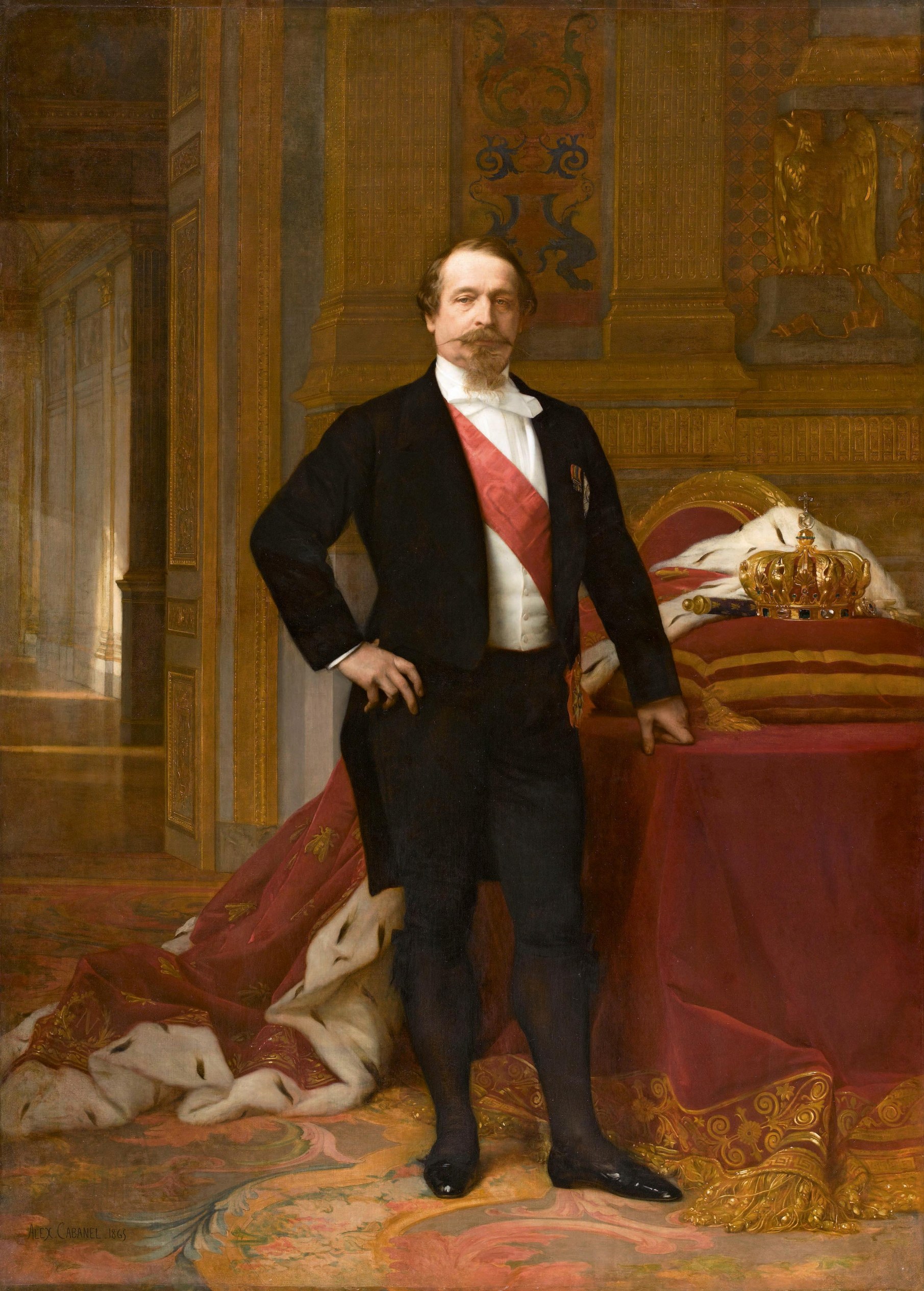
January 14, 1858 – Napoleon III Assassinated in Bombing

In an organized attack by Italian independence radicals led by Felice Orsini, Louis-Napoléon Bonaparte, nephew of the famous Napoleon I and reigning emperor of France since 1852, was killed in a firestorm of bombs. The emperor and his consort, Eugénie de Montijo, were on their way to the opera when Orsini and his fellow assassins hurled bombs that exploded on impact, following a design created by Orsini the year before. The first two bombs struck at the front of their carriage, the second wounding animals and breaking the protective glass, while the third and final landed inside the carriage itself. A policeman was the first to reach the wreckage and cried out, "l'Empereur est mort!"

It was a tragic end to what had seemed an epic life. Louis-Napoléon was born in 1808 as the third son of Napoleon's brother Louis, puppet-ruler of the Napoleonic Kingdom of Holland. After the fall of the French Empire, Louis-Napoléon grew up in Switzerland comfortably while his cousin Napoleon II was held under royal trappings under the Austrian court. Following the deaths of Napoleon II and the earlier generation, Louis-Napoléon became the head of the Bonapartist movement and dedicated his life to reestablishing the glory days under Napoleon I. In 1836, he attempted to begin a coup at Strasbourg much like the Hundred Days, but, rather than join him, the garrison arrested him and sent him back into exile. Another failed coup came in 1840, and Louis-Napoléon was sentenced to perpetual imprisonment in the fortress at Ham.

There, Louis-Napoléon began formulating his ideals of the liberal emperor. He wrote L'extinction du paupérisme, defining Bonapartism as autocracy for the good of the masses and outlining economic policies bordering on socialism. Following six years of imprisonment, he escaped after trading clothes with a mason and came to England, where he remained until the Revolutions of 1848 toppled King Louis-Philippe and established a new republic. Louis-Napoléon returned to Paris after the June Days uprising proved the reforming efforts of the Republic were ineffective, and he won the new presidential election with more than 75% of the total vote. He was wildly popular, "all things to all men" with progressive economic policies for the poor, being dubbed "least bad" by the Monarchists, and holding the historic Napoleon name. His term proved beneficial, but problems began as Louis-Napoléon requested an amendment to the 1848 Constitution so that he might run again after his term ended in 1852. The National Assembly refused and instead amended voting laws with a three-year residency requirement, which would cut out many traveling workers of the lower class who would have voted for him. Calling for maintenance of universal male suffrage, Louis-Napoléon secured the support of the army and at last had his successful coup in 1851.

Now ruler of the Second French Empire, Napoleon III worked to create anew what his uncle once held. A new constitution kept universal male suffrage and the Parliament, but all real power lay with Louis-Napoléon. He exiled political rivals to Devil's Island and other penal colonies and married the Spanish Eugénie de Montijo (after being turned down by higher nobles from the houses of Sweden and Britain) to produce his heir, Louis Napoléon the Prince Impérial, born in 1856. Louis-Napoléon also worked to overcome the colonial restrictions placed on France by aiding European powers in the Crimean War (using Russia as an excuse for the return of French influence) and the Anglo-Persian War. More notably, he also gave influence in the militaristic attempts at Italian unification, such as his providing troops to restore Pope Pius IX and defeat the short-lived Roman Republic of Garibaldi and Mazzini in 1849.

This action had caused an uproar in France (which had been calmed by Louis-Napoléon's popularity), but it had also instilled in the minds of Orsini and others that Louis-Napoléon was a stumbling block to an Italian nation, leading to his assassination. The assassins were caught and executed with Orsini notably going to the guillotine quietly and with a sense of satisfaction. Meanwhile, France became a political vacuum as Napoleon IV was only two years old. Bids for an advisor turned into factionalism, and power gradually fell back to the Parliament, making the young emperor a figurehead. Anti-Italian sentiment led to the French assistance of the Austrians (a large reversal from the old Napoleonic enemy) in the Second Italian War of Independence in 1859, which formed the alliance that narrowly defeated the Prussians in the Austro-Prussian War of 1866, giving Emperor Franz Josef political clout to build his Southern German Confederation opposing Prussia and its northern German allies.

Prussia would eventually have its victory in the Great War (spawned from another assassination in 1914 of Austria's archduke) when it joined with Russia and Britain against France, the Austro-Hungarian Empire, and the Ottoman Empire, leading to the dissolution of the latter two and the formation of South Germany and, finally, an independent unified Italy. With its humiliating defeat, France gave up its empire as the aging Napoleon V abdicated. The new republic lasted only briefly before the fascist Third French Empire arose in the 1930s. The resulting imperialism with its Japanese allies would be opposed by a congress of nations, including the century-old Republic of Mexico and the liberated Vietnamese who suffered under years of Japanese colonialism before becoming a republic under American encouragement.


--

In reality, the third bomb landed underneath the carriage, injuring the police officer but leaving the imperial couple unscathed. Napoleon III survived to put into action many of his foreign policies including military intervention in Mexico, the conquest of Indochina, and aiding Sardinia in victory over Austria and the unification of Italy. In 1870, he would go to war against Prussia after being pressured by Chancellor Otto von Bismarck, and the resulting loss would give way to the German Empire while the French collapsed. Napoleon III died from complications in surgery in 1873 while in exile in England.

Sunday, November 13, 2011

January 13, 1950 – Soviet Union Remains Active in the United Nations

Upon the 6 to 3 defeat of his proposal to oust the Nationalist Chinese representatives in the United Nations in favor of the People's Republic, Soviet ambassador Jacob Malik walked out of the voting chamber and announced his boycott of the Security Council. He blamed the United States for "lawlessness" and noted that anyone could see the illegality of refusing to recognize the PRC. Until the Nationalist Chinese were removed, Malik vowed that the Soviet Union would not be bound by UN declarations.

Although Malik was willing to make the gamble, higher-ups in Moscow were not, and he was replaced as the Soviets determined to keep their power of veto that had been part of the original agreements to joining the UN in 1945. The early days of the UN were rife with difficulties as the Soviets initially balked at the inclusion of India and the Philippines, the former colonies who were believed to be just extra votes for the dominant UK and US. Further issues arose when the USSR wanted each of its republics within to gain recognition, but the US countered saying each of its 48 states would then, too. A compromise was met with recognition of Belorussia and Ukraine, and the United States was proposed two additional seats but declined rather than choose among its states.

With the balance of the Cold War thusly struck for the early days, the defining moment of the renewed troubles was the refusal to recognize the People's Republic of China after the Nationalist Republic moved its capital to Taipei. Malik hoped for a shut down of the UN by walking out and relying on the power of the Eastern European Bloc. However, the West had worked to create another political union, The North Atlantic Treaty Organization. It had begun with the Treaty of Brussels on March 17, 1948, as a mutual defense agreement and continued to expand from the original states of Luxembourg, Belgium, Netherlands, France, and UK. As the Cold War heated up with the tense days of the Berlin Blockade, Portugal, Italy, Norway, Denmark, Iceland, Canada, and the United States were included by 1949. Seeing the potential for such an overwhelming position by the West, the Soviets decided to keep their veto with the UN to stymie the spread of renewed imperialism.

The resolute stance soon proved useful as the invasion of South Korea by North Korea arose in debate that June. Korea, which had been occupied by the Empire of Japan for years before its defeat in 1945, was split into occupation zones. The Soviets, who had invaded Manchuria and were much closer to the agreed upon 38th Parallel, held the north while the Americans stationed soldiers in the capital and south. North Korea came under the influence of communism and supported the People's Liberation Army during the Chinese Civil War. After the war ended with the Nationalists retreating to Taiwan and the formation of the People's Republic in 1949, some 70,000 Koreans who had volunteered for service returned to North Korea. North Korean leader Kim Il-sung gained Mao Zedong's blessing in May of 1950, and an invasion took place soon after in retaliation to provocative raids under "bandit traitor Syngman Rhee." They vowed to capture and execute the South Korean leader, who was evacuated, but not before he ordered the Bodo League Massacre in which hundreds of thousands of suspected communists were slaughtered by military and police.

Meanwhile, the invasion came to notice by the United States. Truman and his Secretary of State Dean Acheson agreed that appeasement could not be repeated and the expansion of Communism was a threat to the Free World. They knew that unilateral action would cause a massive upheaval, however, and so the matter was introduced into the United Nations on June 25 with a proposed demand that North Korea remove its forces, which would have been United Nations Security Council Resolution 82, had the Soviet Union not vetoed it. Arguing on the grounds of national sovereignty, the Soviets continued to veto potential resolutions, blocking the US's chance at stopping the flow of Communism. As the months passed and the ambassadors' hands were tied, Kim Il-sung's forces overwhelmed the peninsula, and it was all the US could do to organize a massive evacuation to the heavily militarized American bases in Japan.

Although many were frustrated, the primary mood of the West was one of conservatism. When the People's Republic of China occupied Tibet that November, again the United Nations sat with hands tied although the matter was widely debated. The nation most considered to have grave concern for the matter, India, held that the Chinese would be peaceful and refused to support military action. Truman's doctrine of "containment" seemed to largely fall apart on the impossibility of military action, though it had succeeded with its $400 million donation to support the government of Greece in its civil war. A new form of Dollar Diplomacy, famous from the Taft presidency, came into power during Eisenhower’s terms, fed by the vast economic expansion of the 1950s.

Instead of becoming militarily involved, the United States would invest heavily in surrounding nations, such as the famous New Society programs expanding support for Thailand and Cambodia after the fall of Vietnam under the Johnson administration. Meanwhile, covert CIA operations would aid enemies of communist influence, which would bring about the downfall of the cash-strapped Soviet Union after its invasion of Afghanistan. Despite its overall success, the policies were widely condemned by the often pro-USSR debates in the United Nations as "New Imperialism" and many countries such as Korea continued under what Truman called "totalitarian regimes", evident at night when the bright lights of Japan are compared with the darkness on the whole of the Korean peninsula.


--

In reality, the Soviet boycott lasted until August, absent from UN SC Resolution 82, 83, 84, and 85, which established the Korean War with peace-keeping forces from around the world, though largely American with General Douglas MacArthur as commander. Years of brutal fighting would return the demilitarized zone to the 38th Parallel, but further wars such as that in Vietnam would expand the fighting of the Cold War.

Thursday, November 10, 2011

January 12, 1904 – Automobile Enthusiast Henry Ford Dies in Crash

Atop the frozen Lake St. Clair near Detroit, Michigan, USA, automobile engineer Henry Ford died when his experimental Ford 999 broke through a spot of unseasonably thin ice. The car flipped at speeds estimated beyond ninety miles per hour, and Ford was instantly killed.


Ford had already built an illustrious career in engineering and was gathering investors for his newly incorporated Ford Motor Company. He had begun on his own farm and sawmill and, in 1891, accepted a job at the Edison Illuminating Company. In 1893, the same year as the birth of his son, Edsel, Ford was made chief engineer, which gave him the resources to experiment with gasoline engines and culminated in the invention of his Ford Quadricyle in 1896. With Edison's encouragement, Ford continued to develop his machine and in 1899 left to found his own company. The initial Detroit Automobile Company did not meet Ford's standards, and he later began again with Alexander Malcolmson, taking in a partnership with the Dodge brothers, whose company produced parts.

As part of his self-publicity, Ford drove his latest automobile design, the "999", which he had perfected from the old model created alongside bicyclist Tom Cooper. It had won races in the past, and Ford meant for it to be a display of his capabilities at setting a new land speed record far and above that made by William Vanderbilt in his internal combustion Mors at seventy-six miles per hour over one kilometer. Although the new record was estimated, it was partially considered out of respect of the late Henry Ford, though L'Automobile Club de France did not recognize it at all as the run had taken place on a frozen lake.

Despite Ford's disaster and numerous other birth pangs, the automobile industry blossomed across the world. Ford's company would shift ownership to the Dodge brothers, who eventually sold the automobile component and put in manufacturing with other Detroit automobile companies such as Olds and Buick before starting their own car line. Other countries such as France, Germany, and Britain manufactured their own automobiles, though America would take up a lead in numbers overall. The growing middle class in America was able to support more of the luxury of an automobile while much of the world transitioned from the horse and buggy to trains. The car remained a badge of wealth, costing between $2000 and $3000, a large amount as the average annual salary in 1910 was $750. Even more expensive luxury cars such as those from Cadillac would cost as much as $5000 by 1920.

Through the Twenties, manufacturing improved and many Americans purchased their cars on credit only to lose them as the Great Depression began. Much of the United States continued using horses, bicycles, and the cheaper motorcycle, but the manufacturing burst of the 1940s set the groundwork that after World War II just about anyone could afford an automobile. Just as prefabricated houses became widely available, so did the many varieties of American cars. Internationally, the American car would continue its lead into the rebuilding of Europe, though every nation seemed to have its own variety.

By the '50s when the industrial sector managed to cross over into mass production of cheap cars, however, the wartime perfection of the rail system and air travel did not leave much interest in long-range driving. President Eisenhower was able to secure some funding for his Interstate Highway System, but the roads would be rarely used by the public who preferred the ease of passenger travel. Cars, meanwhile, were typically saved for leisure on day-trips or commuting for those who lived outside of cities' widespread mass transit systems. Counter-culture beatniks and later hippies popularized the “road trip”, but it would be another generation before it could be considered a family activity.


--

In reality, Henry Ford's test run was impeccable, and the car went onto a racing tour that spread his name across the country. Ford would be instrumental in the making of the modern world with his Model-T, introduced October 1, 1908, as “a car for the great multitude.” At only $825 initially and as cheap as $360 in 1916, by 1927 over fifteen million Model-Ts had been produced. Ford also helped introduce the moving assembly belt, which revolutionized manufacturing. While severely anti-union, Ford believed in high wages and benefits for employees, hiring and keeping the best workers to maximize efficiency.

July 27, 1794 - Robespierre's Defense Published

At the height of the Reign of Terror, the French Revolution held its climax as forces loyal to the ideals of Maximelien Robespierre overwhelmed the Convention army arranged by men such as Billaud, Barras, and Barère. The loyalist soldiers had been rallied by the overnight and secret publication of Robespierre's speech defending himself from charges of tyranny. Instead, he warned France of a conspiracy to seize power in the Republic, which caused his enemies to leap to action and call for Robespierre's execution, bringing all cards to bear.

It was a harried time in the chaos that seemed to dominate Paris since the storming of the Bastille in 1789. Through the next five years, the National Assembly would attempt to create constitutions, women would march on Paris, property of the Church was publicly seized, the king fled, was captured, and eventually executed, and nearly every king in Europe declared war on the new Republic. Meanwhile, even the forces of revolution began to splinter, forming political clubs such as the Feuillants and the Girondins. Many of them encouraged the wars, hoping for war to be declared against Austria, but lawyer and political leader Robespierre said in 1792, "such a war could only favour the forces of counter-revolution, since it would play into the hands of those who opposed the sovereignty of the people. The risks of Caesarism were clear, for in wartime the powers of the generals would grow at the expense of ordinary soldiers, and the power of the king and court at the expense of the Assembly."

The war began anyway after the death of Leopold II of Austria, but France took major victories in Belgium and the Rhineland, cementing the position of the Republic on the continent. The fledgeling government turned inward to its problems of food shortages, insurrections, and outright treason. The Tribunal was established in 1793, leading to a Committee of Public Safety, and Robespierre was one of the nine elected. Here began a "Reign of Terror" during which Robespierre wrote, "...the spring of that government during a revolution is virtue combined with terror: virtue, without which terror is destructive; terror, without which virtue is impotent. Terror is only justice prompt, severe and inflexible." The report of enemies of the state became a major part of clearing up the factionalism and counter-revolutionaries of the time, and it grew further with the Law of 22 Prairial on June 10, 1794. By it, the Tribunal could condemn an enemy of the state through direct order and without witnesses. Through the next eight weeks, nearly 1300 people would be guillotined.

Robespierre's system of purification nearly ricocheted back at him when he was called before the Convention, accused of treason. That July, Robespierre had recalled several envoys who had been accused of extravagance with their positions to Paris to account for their actions. One of them, Joseph Fouché, evaded arrest and sneaked from house to house of Convention members, explaining that Robespierre would come for them too. With the groundwork set for a coup d'état, the Convention called in Robespierre on suspicion of tyranny, and he delivered a two-hour speech giving already his knowledge of the conspiracy. The guilty members (though unnamed) hurried to act. The next day, Robespierre's ally Saint-Just (whom Robespierre had been before sent to the front to garner support from the army) was shouted down during his defense. Robespierre also attempted to speak, but the chaos and outright mockery closed him off. At the conclusion, the Convention ordered the arrest of Robespierre and many of his allies.

Commune soldiers under General Coffinhal marched in to defend Robespierre, aiming for the Convention itself, who ordered up soldiers of their own. The soldiers of the Commune began to falter, and it was then that copies of Robespierre's speech was delivered to them, printed in secret after the debate in the Convention had attempted to censor them. Instead, the soldiers realized that they must continue to fight for the good of the revolution against conspiracy and were joined by many free Parisians from the mob. The Battle of Paris raged for only a few hours initially, but when the conspirator's army broke in the early morning, the rioting spread to follow them. Barras, who led the Convention soldiers, was killed in the fighting, Jacques Nicolas Billaud-Varenne was captured and executed, and Bertrand Barère (who had already come under suspicion of treason) managed to escape, eventually ending up in England before disappearing into the Caribbean as an adventurer.

After the Battle of Paris, Robespierre succeeded in his plans to end counter-revolutionary movements. By winter, the Law of 22 Prairial came to an end and the Terror expired. Instead, Robespierre continued his place maintaining the Committee of Public Safety and keeping the political elements of pure to his ideal of republic. Meanwhile, the wars with Europe (and even the Quasi-War with the United States until the matter of privateering was settled) continued until the Treaty of Lunéville with Austria in 1801 and the Treaty of Amiens with Britain in 1802. The war was finished by General Moreau as the great Corsican general Napoleon Bonaparte was dispatched to the West Indies as "punishment" for his lateness in returning from Egypt in 1799 due to poor communication, but also to get a potential tyrant away from the young republic as well as to organize the former slaves who had been freed under the Rights of Man.

Robespierre himself would retire from political office in 1815, but he would continue to lead the Jacobin political party and encourage the spread of Republicanism to other countries. After the success of the Society of United Irishmen liberating the Republic of Ireland and later the Republic of Australia, Robespierre was instrumental creating a Republican Bloc of nations such as Batavia and Saint-Domingue that spurred conservatism in the royal houses of Europe. In 1821, Robespierre left to observe General Simón Bolívar in his carving out of republics from the old Spanish Empire in the Americas, which rejected Robespierre's Cult of the Supreme Being. Elsewhere, primarily in Europe and then in French republican dependencies, the deist Le culte de l'Être suprême remains the state religion with its festival on June 8 as the largest holiday of the year. Robespierre himself led the festivities in Paris until his death in 1836.


--

In reality, Robespierre's speech was never published, though repeated and applauded at the Jacobin Club. According to Napoleon Bonaparte, "Robespierre was overthrown because he wanted to become a moderator and stop the Revolution. Cambaceres told me that the day before his death, he delivered a wonderful speech that was never printed. Billaud and other terrorists, seeing that he was weakening and he would invariably have their heads, conspired against him and stirred up the so-called decent people to overthrow the 'tyrant,' but in reality to take his place and extend the reign of terror."

*Special thanks to Nicolas Gregoire for idea and background

Wednesday, October 12, 2011

December 20, 1989 – Canal Sabotage as Panama Invasion Commences

As part of the growing War on Drugs that had been declared by President Richard Nixon in 1971 and redoubled by President George Bush, Panamanian dictator Manuel Noriega was indicted on drug-trafficking charges and endangering American nationals in addition to his more obvious crime of suppressing democracy. Sparked by the shooting death of a US Marine at a roadblock on December 16, nine thousand US troops entered Panama in Operation Just Cause, joining the some 12,000 others that were already there as part of the defense of the jointly owned Panama Canal (set to revert to Panamanian control in the year 2000 under the Torrijos–Carter Treaties). Noriega’s pet army of the Panamanian Defense Forces was easily defeated with minimal resistance, except for a devious counterattack with an unassuming small freighter that rested in the Canal near the Gatun Locks.


Rigged with explosives on a timer, the freighter exploded while unoccupied, killing several sailors on nearby boats and one canal worker. While the damage to the Canal was not catastrophic, it would take months to repair back to full capacity, frustrating international shipping and making a noticeable dent on the world economy with the Dow Jones dropping briefly below 1,000 points. News of the strike shocked military commanders and President Bush, who had been largely in control of the situation. Although only twenty-three US soldiers and three American civilians were killed (opposed to 150 PDF and some 500 Panamanian civilians), the invasion would have a black smear in the public view.

While the fighting ended shortly after it had begun, Noriega found asylum in the Vatican anuncio and did not surrender until arrested by US Drug Enforcement agents on January 3. During this time, the US scrambled to polish its image. Polls sponsored by CBS and articles by the New York Times showed that Panamanians were pleased that the dictator had been overthrown and the properly elected Guillermo Endara sworn into office; even those who had suffered property damage or the loss of loved ones supported the US invasion by as much as 80 percent. Other news sources were not as friendly, giving accounts such as those from Paul Eisner of Newsday describing blacklists and “sapo” informers upon neighbors as well as the Miami Herald’s report of "Neighbors saw six U.S. truck loads bringing dozens of bodies to a mass grave” and a mother’s "voice rose over the crowd's silence: 'Damn the Americans.'"

International disapproval arose, made all the louder by the economic fallout of the damaged Canal. The Organization of American States and the European Parliament made formal protests, calling the move a violation of international law. As public criticism grew, more stories began to come out about Noriega’s past. Most recognized him as a money-launderer and drug-trafficker, but the story of his origins by CIA support became widespread. Noriega had been picked by the CIA as a potential block to fears of Central American communism in 1970, but was dropped from the payroll in 1977 after he had become mixed in drugs. Two years later, the Sandinista National Liberation Front came to power in Nicaragua, and Noriega was tapped again to keep communism from spreading and became dictator in 1983. Throughout the Reagan Administration, which came into its own problems with illegal activity in the Iran-Contra Affair, Noriega enjoyed American support as he rigged elections and was condemned by US Senate committee reviews of drug traffic. Upon word that Noriega may have been connected with Cuba and the Sandanistas, he was cut off by the US government. After his arrest in 1989, he would be sentenced in 1992 to federal prison for forty years.

President Bush raced to salvage his administration, citing his own experience with the CIA and admitting that certain intelligence activities were necessary to stop the spread of communism. With the Berlin Wall falling in August and the Soviet departure from Afghanistan earlier in February, he noted that American fears of international instability had been satiated and now was the time to “clean up the mess.” With new policies on cutting international aid from dictators and new CIA transparency, a wave of revolution watched over by UN and largely American forces came in several countries such as Nigeria with free elections. Most famous would be the removal of Saddam Hussein at the end of the Persian Gulf War in 1991 after his invasion of Kuwait. The actions would give Bush a narrow election victory for a second term after successfully winning support in Maine and Colorado from Ross Perot’s dropping out of his campaign in July of 1992. The fall of the Soviet Union that December would be a further feather in Bush’s hat.


--

In reality, there was no strike against the Panama Canal. Although sometimes condemned, Operation Just Cause would remove one of many dictators established by CIA and US support as part of Cold War strategies.

Site Meter