On approximately December 21, 75 BC, as recorded by the Roman poet Suetonius in his historical morality lessons, pirates murdered a mouthy and ambitious young aristocrat from the Caesar family.
Julius had fled Rome as the dictator Sulla began his purges of all those he found treasonous, including Julius' uncle Marius and his father-in-law Cinna. He was stripped of his titles and wealth and may very well have been executed upon refusing to divorce his wife Cornelia, but intervention by his maternal allowed him to escape into hiding. He joined the military and served in the alliance with King Nicomedes of Bithynia, in whose court he remained until he heard of the death of Sulla and determined it was safe to return to Rome.
On his way across the Aegean Sea, however, Julius and his companions were captured by pirates. As per custom when they ran across wealthy travelers, the pirates would hold him for some ransom and then planned to let him go. The pirates demanded twenty talents of silver, and Julius replied with a laugh. He told them they had no idea who he was, and he suggested they demand fifty. While his servants went away to borrow the money, Julius entertained the pirates with stories and promised, upon gaining his freedom, to raise up a fleet, capture the pirates, and crucify all of them. The pirates had a turn at laughing at such a proud young man.
However, as the winter solstice approached, the pirates began to become nervous as the young Julius insisted he would carry through on the promise. In a violent disagreement, the pirates became divided, and several stormed the "too ambitious" Julius' cell, stabbing him only once, but enough to kill him. The pirates left the body with Julius' remaining servants and fled, never to be captured. The body would be returned to Rome, where it was received by the remainder of the Caesar family, which continued as minor nobility among the Romans for some time to come.
Rome itself continued for several centuries under heavy bureaucratic rule until invasions from Gauls displaced by Germans eventually toppled the city, breaking the empire into various pieces, many under the influence and authority of the Kingdom of Egypt.
--
In reality, the pirates thought Caesar was joking. He wasn't, and upon payment of his ransom did raise a fleet, attacked and captured the pirates, and crucified them. Out of pardon, he ordered their throats slit before crucifixion, sparing the pirates much pain before death. This leniency would be seen throughout Caesar's career as he rose through the ranks of Rome, conquered Gaul, and was made dictator-for-life before being stabbed 23 times by a conspiracy of senators wary of his ambition.
Friday, April 13, 2012

Monday, February 20, 2012
March 9, 1566 – David Rizzio Defends Mary, Queen of Scots
The life of Mary I of Scotland was surrounded by intrigue from the beginning. Less than a week after she was born as the only legitimate offspring of James V to survive, her father died, leaving the infant Mary as monarch in 1542. At fifteen, she was married to Francis II of France (two years her junior), strengthening the Auld Alliance between France and Scotland that had gone on for more than 250 years. Francis soon became king, but his reign lasted only a year before illness took him. The throne passed to his younger brother Charles IX, while real power was held by the Queen Consort, Catherine de Medici. Mary returned to presumed security in Scotland while France descended into the Wars of Religion between the Huguenots and Catholics. Meanwhile, England faced its own religious turmoil during the years of Henry VIII, Bloody Mary, and Protestant Elizabeth I. Mary Stuart claimed the throne of England herself through the Third Succession Act, though Henry VIII’s last will had excluded the Stuarts.
 Scotland also felt the tension between the Catholics and Calvinist Protestants. Mary was a devout Catholic, but she tolerated Protestants and had a majority of them in her privy counsel. In 1562, she allied herself with the Earl of Moray (her illegitimate half-brother) to break the Catholic rebellion in the Highlands led by Lord Hunt. While she settled into power in Scotland, tensions with her cousin Elizabeth in England remained troubled. Mary refused to ratify the Treaty of Edinburgh in 1560, which her secretaries had approved and would limit the alliance between Scotland and France while acknowledging Elizabeth as the rightful queen of England. Visits between the queens were canceled, and Mary turned down Elizabeth’s suggestion that she marry the Robert Dudley, 1st Earl of Leicester. Instead, to secure her position in Scotland at the cost of outraging Elizabeth, she married her cousin, Henry Stuart, Lord Darnley, in 1565.
The marriage proved a bad match. Although initially filled with affection, the two soon turned to jealousy. Darnley demanded more and more power while despising Mary’s relationship with her secretary, David Rizzio, an Italian courtier she had met while in France who used his talent in music to work his way into courtly politics. Rumors swarmed around Rizzio and Mary, fed further by the general dissatisfaction among the increasingly Protestant Scottish lords with their Catholic queen. Finally Darnley chose to act, joining with the rebelling lords who had been beaten down at the Chaseabout Raid in August of 1526 to overthrow Mary. While soldiers stalled guards, Patrick Ruthven, Darnley, and others burst into Mary’s supper chamber where she was meeting with Rizzio. The Italian jumped to his feet and defended the seven-month-pregnant queen even before they could make their demands known. Mary’s screams from Holyroodhouse Palace awoke the people of Edinburgh, who arrived by the hundreds with makeshift weapons. The rebels found themselves surrounded, and, while Rizzio fought single-handedly to keep the lords at the narrow point of the doorway, Mary ordered the people of Edinburgh to free them.
The conspirators were captured and executed, wiping out a generation of rebels. Darnley was stripped of his title and imprisoned for life in Edinburgh Castle. Their marriage could not be annulled as James VI arrived that June and would be declared illegitimate without Darnley as his father (though it was widely believed that James VI was in fact Rizzio’s, even to the point Henry IV of France noted that he could only hope that “he was not David the fiddler's son"). Moray, who had fled Scotland after Chaseabout, was spared and even pardoned by Mary upon his return. Many called for him to lead a new rebellion to support the Protestants, but Mary managed to convince him of her intentions to keep Scotland religiously tolerant, meeting with popular preacher John Knox even though he routinely rebuked her habits of dancing and lavish living. Moray would serve as her secretary of domestic affairs while Rizzio continued his position as secretary of foreign matters, primarily continuing diplomacy with France and other Catholic nations.
In 1569, the Rising of the North began in England as Catholics supporting Mary were eager to overthrow Elizabeth. While the rebellion was put down by Elizabeth and the Earl of Sussex, Mary was implicated in sending support to the rebels. The tensions grew worse as the rebellion had prompted Pope Pius V to excommunicate Elizabeth and declare Mary the rightful queen. Plots to assassinate Elizabeth, such as that headed by Roberto di Ridolfi, prompted swift action, such as the execution of the Duke of Norfolk. Many in Mary’s camp wished to go to war, but she realized doing so would prompt another Protestant uprising, and so she remained neutral, even after the Anglo-Spanish War broke out in 1585. Her neutrality proved beneficial to Scotland, whose economy improved while the English and Spanish badgered one another in the Atlantic.
Mary I died in 1596, giving James VI reign over Scotland after a mixed Catholic-Protestant upbringing. Elizabeth followed her cousin in death in 1603, leaving behind a declaration that the Stuarts would be cut out of English succession, akin to her father’s will the generation before, as Mary had never ratified the Treaty of Edinburgh. Due to numerous deaths of relatives during Elizabeth’s long life and the invalid marriage of Lady Catherine Grey to Edward Seymour, the crown was passed to the unmarried Anne Stanley with Robert Cecil as Secretary of State. Queen Anne was courted by numerous Europeans, including a planned match with Ulrik of Denmark, but would ultimately marry an Englishman in 1607, Grey Brydges, 5th Baron Chandos. Their first son, Robert, died in 1611, and the surviving George, born in 1620, assumed the throne upon his mother’s death in 1647. With a stable English line of succession, England lived through the seventeenth century quietly other than colonial wars with the Spanish, French, and Dutch, with whom they fought as each gradually spread into North America.
Scotland, meanwhile, erupted in civil wars as lords contested James’ beliefs on absolute rule as outlined in The True Law of Free Monarchies and Basilikon Doron. While many considered him a great patron, others blamed him for the constant bankruptcy of Scotland.
--
In reality, Rizzio hid behind Mary’s skirts. The queen attempted to defend him, but she was forced at gunpoint to give him up and dismiss the attention roused from Edinburgh. Rizzio was stabbed more than fifty times in front of the pregnant queen, who fell into a stupor that some hoped would kill her out of shock. She recovered to escape and raise armies in a tumultuous rule that would caused her to flee to protection and then imprisonment under Elizabeth, who had her executed because of the Ridolfi Plot in 1570.
The marriage proved a bad match. Although initially filled with affection, the two soon turned to jealousy. Darnley demanded more and more power while despising Mary’s relationship with her secretary, David Rizzio, an Italian courtier she had met while in France who used his talent in music to work his way into courtly politics. Rumors swarmed around Rizzio and Mary, fed further by the general dissatisfaction among the increasingly Protestant Scottish lords with their Catholic queen. Finally Darnley chose to act, joining with the rebelling lords who had been beaten down at the Chaseabout Raid in August of 1526 to overthrow Mary. While soldiers stalled guards, Patrick Ruthven, Darnley, and others burst into Mary’s supper chamber where she was meeting with Rizzio. The Italian jumped to his feet and defended the seven-month-pregnant queen even before they could make their demands known. Mary’s screams from Holyroodhouse Palace awoke the people of Edinburgh, who arrived by the hundreds with makeshift weapons. The rebels found themselves surrounded, and, while Rizzio fought single-handedly to keep the lords at the narrow point of the doorway, Mary ordered the people of Edinburgh to free them.
The conspirators were captured and executed, wiping out a generation of rebels. Darnley was stripped of his title and imprisoned for life in Edinburgh Castle. Their marriage could not be annulled as James VI arrived that June and would be declared illegitimate without Darnley as his father (though it was widely believed that James VI was in fact Rizzio’s, even to the point Henry IV of France noted that he could only hope that “he was not David the fiddler's son"). Moray, who had fled Scotland after Chaseabout, was spared and even pardoned by Mary upon his return. Many called for him to lead a new rebellion to support the Protestants, but Mary managed to convince him of her intentions to keep Scotland religiously tolerant, meeting with popular preacher John Knox even though he routinely rebuked her habits of dancing and lavish living. Moray would serve as her secretary of domestic affairs while Rizzio continued his position as secretary of foreign matters, primarily continuing diplomacy with France and other Catholic nations.
In 1569, the Rising of the North began in England as Catholics supporting Mary were eager to overthrow Elizabeth. While the rebellion was put down by Elizabeth and the Earl of Sussex, Mary was implicated in sending support to the rebels. The tensions grew worse as the rebellion had prompted Pope Pius V to excommunicate Elizabeth and declare Mary the rightful queen. Plots to assassinate Elizabeth, such as that headed by Roberto di Ridolfi, prompted swift action, such as the execution of the Duke of Norfolk. Many in Mary’s camp wished to go to war, but she realized doing so would prompt another Protestant uprising, and so she remained neutral, even after the Anglo-Spanish War broke out in 1585. Her neutrality proved beneficial to Scotland, whose economy improved while the English and Spanish badgered one another in the Atlantic.
Mary I died in 1596, giving James VI reign over Scotland after a mixed Catholic-Protestant upbringing. Elizabeth followed her cousin in death in 1603, leaving behind a declaration that the Stuarts would be cut out of English succession, akin to her father’s will the generation before, as Mary had never ratified the Treaty of Edinburgh. Due to numerous deaths of relatives during Elizabeth’s long life and the invalid marriage of Lady Catherine Grey to Edward Seymour, the crown was passed to the unmarried Anne Stanley with Robert Cecil as Secretary of State. Queen Anne was courted by numerous Europeans, including a planned match with Ulrik of Denmark, but would ultimately marry an Englishman in 1607, Grey Brydges, 5th Baron Chandos. Their first son, Robert, died in 1611, and the surviving George, born in 1620, assumed the throne upon his mother’s death in 1647. With a stable English line of succession, England lived through the seventeenth century quietly other than colonial wars with the Spanish, French, and Dutch, with whom they fought as each gradually spread into North America.
Scotland, meanwhile, erupted in civil wars as lords contested James’ beliefs on absolute rule as outlined in The True Law of Free Monarchies and Basilikon Doron. While many considered him a great patron, others blamed him for the constant bankruptcy of Scotland.
--
In reality, Rizzio hid behind Mary’s skirts. The queen attempted to defend him, but she was forced at gunpoint to give him up and dismiss the attention roused from Edinburgh. Rizzio was stabbed more than fifty times in front of the pregnant queen, who fell into a stupor that some hoped would kill her out of shock. She recovered to escape and raise armies in a tumultuous rule that would caused her to flee to protection and then imprisonment under Elizabeth, who had her executed because of the Ridolfi Plot in 1570.
Tuesday, February 14, 2012
February 29, 1932 – Alfalfa Bill Murray Begins his Road to the White House
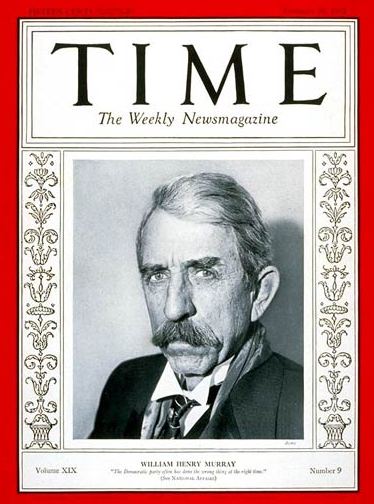
Future President of the United States William Henry Davis “Alfalfa Bill” Murray appeared on the cover of Time Newsmagazine with a quote from comedian Will Rogers who noted, "I guess he ain't got much chance." Murray’s chances were indeed slim as he did not win a single primary, but he still appeared at the Democratic National Convention, where he came in eighth on the first ballot with 23 votes. He was set to jokingly endorse Will Rogers as a write-in and head home when William Randolph Hearst broke news of a long-running affair by frontrunner New York Governor Franklin Delano Roosevelt with his wife’s secretary. It was well known that FDR was a playboy before contracting polio in 1921, but the news exploded with the sensation that he was still carrying on with his wife’s secretary after some fifteen years. Additional articles added another affair with his personal secretary Marguerite “Missy” LeHand, and the news-hungry Depression public went crazy. Roosevelt bowed out of the race, leaving over six hundred votes suddenly up for grabs. It was understood by the party machine that their pick, former New York Governor Al Smith, would collect the votes, but his old rivalry with FDR turned off supporters, including Joseph P. Kennedy, Sr. In a midnight call between Kennedy and Hearst, who supported Speaker of the U.S. House John Nance Garner despite him never asking to be president, they determined to select the biggest Blackhorse candidate since 1844’s James K. Polk. Murray seemed someone they could influence, and he was already famous for his relief activities in Dustbowl-stricken Oklahoma. Much to his own surprise and frustration of Al Smith, Murray found himself picked as the Democratic candidate on the fourth ballot.
 Murray was born in 1869 in Toadsuck (later renamed “Collinsville), Texas. He worked as a laborer while attending public school and tried a number of careers before passing the Texas bar exam in 1895. Murray soon started a law practice in Indian Territory, where he earned his nickname from speaking tours in which he often mentioned his alfalfa field. In 1905, he served as the Chickasaw Nation representative to the constitutional convention of the proposed state of Sequoyah and a year later in the convention that created the singular state of Oklahoma. Using connections through his wife’s uncle, former Territorial Governor Douglas Johnston, and first state governor Charles N. Haskell, Murray managed a moderately successful political career with stints as Speaker of the Oklahoma House of Representatives and U.S. Representative. He retired from politics in 1918 after losing his bid for governor and aided local ranchers in founding a colony in Bolivia during the 1920s.
In 1930, Murray reappeared in Oklahoma and again ran for governor. He won handily, with a margin of some 100,000 votes. When he came to office, the state was crippled with the Dust Bowl as well as a $5 million budget deficit as the government made attempts to provide work and welfare as the Great Depression began. Murray proved a creative and effective leader. He collected money voluntarily for food programs for the poor, donating even his own salary. To save on government expenses, he ordered the capital lawn to be used to raise sheep, limiting the need for landscaping. When any need arose, he called up the Oklahoma National Guard and declared martial law, such as enforcement of his executive order to limit oil production in 1931 to keep prices strong and support state exports. In July of 1931, he instigated the Toll Bridge War in which he forced open a bridge on the Red River closed on its Texas end by an injunction due to a disagreement with a toll company. Perhaps most beneficial was his June call for a national convention on relief to be held in Memphis, TN, which shot him into the press. Riding his wave of fame, he announced his intentions to run in 1932.
The race against Republican incumbent Herbert Hoover was a firm victory for the Democrats. Votes poured in from the South and West, where the ravages of the Great Depression had been the deepest and President Hoover’s plans for relief agencies had not yet reached. The Northeast was firmly for Hoover, even New York where stalwart Roosevelt fans rejected Murray’s “yokel” (and notoriously racist) policies. Inaugurated on March 4, 1933 (the last late inauguration before the Twentieth Amendment came to be), Murray’s first one hundred days proved to be among the busiest in American history, responding to an earthquake in California only a week later and the Akron airship disaster in New Jersey the next month. When “Machine Gun” Kelly kidnapped Oklahoma oilman Charles Urschel, Murray gave the FBI unprecedented powers and reinforcement through US Army, including spotter planes. Beer became legalized, cannabis was outlawed, and the dollar was taken off the gold standard to enable more free-flow of cash. Roosevelt, still holding political clout, criticized Murray’s use of armed forces and suggested instating agencies, but Murray showed himself as a man of action, appearing himself at many of the trouble-spots.
Most famous, however, was Murray’s reaction to the “Business Plot” of 1933. Retired Marine Corps Major General Smedley Butler testified in 1934 to the Special Committee on Un-American Activities (founded to investigate propaganda contrary to the Constitution, particularly Nazism) that a group of businessmen responding to “socialist” possibilities after the removal of the gold standard had contacted him about the possibility of a coup d’état. While many contemporaries ignored the accusations or, at most, chuckled (General Douglas MacArthur called it “the best laugh story of the year”), Murray’s increasing paranoia after the death of his friend Haskell latched onto the idea of conspiracy. He tasked J. Edgar Hoover with finding conspirators and pressured the McCormack–Dickstein Committee to call in every name under suspicion, including banker Thomas Lamont and Admiral William Sims. Many accused Murray of fear-mongering and distracting from his only somewhat successful relief programs. Murray and his supporters, however, reacted violently to potential fascists, even though Murray himself had applauded the busy activities of Mussolini and Hitler. In the Battle of Wall Street, FBI agents supported by US soldiers seized several New York banks and firms, clearing out papers to be reviewed by the Justice Department.
In 1936, the Democratic convention in Philadelphia became a circus of accusations. Kennedy had long removed himself from Murray and hoped to reinvent the Democrats despite him. Murray eventually broke away with his own Plowman’s Party after his quote that “civilization begins and ends with a plow.” The move split would-be Democratic votes and handed the election to centrist Republican Alf Landon, whom Murray once proclaimed was a Nazi spy. Landon, however, proved himself much less rightist than Murray and achieved the bulk of the Black vote. He won a second term in 1940 as he prepared America for another world war as Nazism was generally feared thanks to Murray’s stand. After the war, the Republican dynasty continued under Thomas Dewey and General Dwight Eisenhower.
Murray, meanwhile, returned to Oklahoma where he wrote extensively and lost further attempts at election. His son, Johnston, would become the governor of Oklahoma in 1951, but did not seek higher office.
--
In reality, Murray’s presidential run was unsuccessful. Roosevelt (whose alleged affairs would not be spoken of until the ‘60s) would go on to be elected four times as president, serving through the Great Depression and much of World War II. His policies of moderated socialism and extensive spending in the New Deal established modern American government.
In 1930, Murray reappeared in Oklahoma and again ran for governor. He won handily, with a margin of some 100,000 votes. When he came to office, the state was crippled with the Dust Bowl as well as a $5 million budget deficit as the government made attempts to provide work and welfare as the Great Depression began. Murray proved a creative and effective leader. He collected money voluntarily for food programs for the poor, donating even his own salary. To save on government expenses, he ordered the capital lawn to be used to raise sheep, limiting the need for landscaping. When any need arose, he called up the Oklahoma National Guard and declared martial law, such as enforcement of his executive order to limit oil production in 1931 to keep prices strong and support state exports. In July of 1931, he instigated the Toll Bridge War in which he forced open a bridge on the Red River closed on its Texas end by an injunction due to a disagreement with a toll company. Perhaps most beneficial was his June call for a national convention on relief to be held in Memphis, TN, which shot him into the press. Riding his wave of fame, he announced his intentions to run in 1932.
The race against Republican incumbent Herbert Hoover was a firm victory for the Democrats. Votes poured in from the South and West, where the ravages of the Great Depression had been the deepest and President Hoover’s plans for relief agencies had not yet reached. The Northeast was firmly for Hoover, even New York where stalwart Roosevelt fans rejected Murray’s “yokel” (and notoriously racist) policies. Inaugurated on March 4, 1933 (the last late inauguration before the Twentieth Amendment came to be), Murray’s first one hundred days proved to be among the busiest in American history, responding to an earthquake in California only a week later and the Akron airship disaster in New Jersey the next month. When “Machine Gun” Kelly kidnapped Oklahoma oilman Charles Urschel, Murray gave the FBI unprecedented powers and reinforcement through US Army, including spotter planes. Beer became legalized, cannabis was outlawed, and the dollar was taken off the gold standard to enable more free-flow of cash. Roosevelt, still holding political clout, criticized Murray’s use of armed forces and suggested instating agencies, but Murray showed himself as a man of action, appearing himself at many of the trouble-spots.
Most famous, however, was Murray’s reaction to the “Business Plot” of 1933. Retired Marine Corps Major General Smedley Butler testified in 1934 to the Special Committee on Un-American Activities (founded to investigate propaganda contrary to the Constitution, particularly Nazism) that a group of businessmen responding to “socialist” possibilities after the removal of the gold standard had contacted him about the possibility of a coup d’état. While many contemporaries ignored the accusations or, at most, chuckled (General Douglas MacArthur called it “the best laugh story of the year”), Murray’s increasing paranoia after the death of his friend Haskell latched onto the idea of conspiracy. He tasked J. Edgar Hoover with finding conspirators and pressured the McCormack–Dickstein Committee to call in every name under suspicion, including banker Thomas Lamont and Admiral William Sims. Many accused Murray of fear-mongering and distracting from his only somewhat successful relief programs. Murray and his supporters, however, reacted violently to potential fascists, even though Murray himself had applauded the busy activities of Mussolini and Hitler. In the Battle of Wall Street, FBI agents supported by US soldiers seized several New York banks and firms, clearing out papers to be reviewed by the Justice Department.
In 1936, the Democratic convention in Philadelphia became a circus of accusations. Kennedy had long removed himself from Murray and hoped to reinvent the Democrats despite him. Murray eventually broke away with his own Plowman’s Party after his quote that “civilization begins and ends with a plow.” The move split would-be Democratic votes and handed the election to centrist Republican Alf Landon, whom Murray once proclaimed was a Nazi spy. Landon, however, proved himself much less rightist than Murray and achieved the bulk of the Black vote. He won a second term in 1940 as he prepared America for another world war as Nazism was generally feared thanks to Murray’s stand. After the war, the Republican dynasty continued under Thomas Dewey and General Dwight Eisenhower.
Murray, meanwhile, returned to Oklahoma where he wrote extensively and lost further attempts at election. His son, Johnston, would become the governor of Oklahoma in 1951, but did not seek higher office.
--
In reality, Murray’s presidential run was unsuccessful. Roosevelt (whose alleged affairs would not be spoken of until the ‘60s) would go on to be elected four times as president, serving through the Great Depression and much of World War II. His policies of moderated socialism and extensive spending in the New Deal established modern American government.
Monday, February 13, 2012
February 28, 1844 – President Tyler Killed in Accident
In an accidental explosion that caused many superstitious Americans to believe the office of President had become cursed, John Tyler was killed less than three years after the death of William Henry Harrison due to illness. During a party aboard the USS Princeton (the first screw stream ship in the Navy), some 400 guests were treated to displays of modern technology, including the 12-inch cannon known as the Peacemaker. It had been fired twice successfully over co-designer John Ericsson’s warning that the gun was not ready. The third firing, a tribute as they passed Washington’s home at Mount Vernon, caused the cannon to explode. Tyler, who was eager to impress young Julia Gardiner of his virility despite being a 54-year-old widower, had hopped up the ladder onto the deck, just in time to catch shrapnel to his head. Julia’s father, New York businessman David Gardiner, and Secretary of State Abel P. Upshur were also among the casualties in the worst peacetime explosion to that point.
 Mourning for the disaster included curiosity at another unprecedented occurrence: the ascension of a President pro tempore of the Senate to the office of President of the United States. After the death of Harrison, Tyler had been the first Vice-President to assume the office, though many such as John Quincy Adams and Henry Clay thought that he was meant to fulfill a role rather than be a wholly new president. Despite being nicknamed “His Accidency,” Tyler went about resigning from the Whig political party and launching his own economic policy. He vetoed bills for a National Bank repeatedly, causing his cabinet to resign in disgust. While Tyler had a few supporters, such as Daniel Webster, he fought with the Whigs so much that they initiated the first impeachment hearings against him, though it would ultimately be voted down. Tyler’s greatest separation from the Whigs, however, was the potential annexation of the Republic of Texas. The matter had been raised before in 1837 with a Texas proposal that was declined by President Martin van Buren. Tyler had Secretary of State Upshur begin work on a treaty, but it remained incomplete at the time of their deaths. What Tyler had planned to be the great issue of the election of 1844 was a political afterthought.
As President pro tempore of the Senate, North Carolina Whig Willie Person Mangum became the eleventh president of the United States. Mangum was something of a reversal of Tyler, having left the Democratic Party in 1834 after declaring himself a Whig. He left politics and reinvented his career, working as part of a failed Whig plot to nominate four men for president to block out Martin van Buren in 1836 before returning triumphantly to the Senate in 1840. When New Jersey Senator Samuel L. Southard resigned from the Senate in 1842 due to his failing health, Mangum came onto the track that would accidentally make him president. Where Tyler had broken with the Whigs, Mangum worked alongside party leader Henry Clay to institute as much of his American System as possible with the Whig majority in the Senate, though the Democrats controlled the House and resisted several proposed tariffs. A new National Bank was established to capitalize on the rebounding economy after the Panic of 1837, and numerous transportation improvement projects began. These projects would be the main issue of the election of 1844 when Henry Clay narrowly defeated Martin van Buren with the promise of extending the National Road to Oregon and clarifying American control there rather than joint-rule with Britain.
The issue of annexation arose again after the California Republic won its independence from Mexico in 1846 under men such as Mexican general Mariano Guadalupe Vallejo and John C. Frémont. The republic proposed annexation by the United States, but Henry Clay politely declined. Such an annexation might have sparked war with Mexico, who was already upset over American soldiers unofficially participating in the rebellion, seemingly a mirror to Texas. The move is believed to have cost Clay and the Whigs the election of 1848 that gave the White House to Democrat Lewis Cass despite the efforts of the Free Soil Party under Martin van Buren to limit slavery in the territories.
Settlers poured westward on improved roads (including many government-funded rail projects), giving rebirth to the question of slavery in federal territories. Popular sovereignty became the strategy for Kansas and Nebraska Territories, which turned into guerilla warfare as men committed to both sides fought to protect interests. Alongside this issue came the discovery of gold in the newly founded California Republic, which spawned a renewed call for Manifest Destiny. With the approval of Britain, the United States annexed California, prompting Mexico to declare war. The Republic of Texas came as an ally, winning many victories and expanding its territory in the resulting treaty in 1854, which also brought the Republic of Sonora to the US. Some suggested annexing Texas as well, but no formal proposal was made as abolitionists saw it as an extension of slavery and the general attitude of Texas (which had been independent for over a generation) felt best to stay independent.
In 1860, the election of Republican Abraham Lincoln caused the South to declare its independence, inviting Texas to join in a confederation, which it considered before declining and remaining neutral. The war was finished by 1864, and the question of slavery was answered in the United States, though it remained legal in Texas until the 1880s. Texas and the US continued diplomatic relations despite being on opposing sides of the French intervention in Mexico. Suggestions for annexation arose again in the 1890s with a new wave of expansionism, but conservative Texans valued independence while local businesses hoped to hold onto the growing oil industry there. Over the next century, Texans would continue to be friendly with Americans, even joining the Allies in the Second World War, though its production-based economy was especially crippled by the Great Depression. Today it stands as a close trade-partner with the United States, but still fiercely independent.
--
In reality, Tyler was only halfway up the ladder. After Usher’s death, he instructed John C. Calhoun as the new Secretary of State to complete the treaty for the annexation of Texas. It failed in Congress, but caught national attention alongside the issue of slavery, which catapulted it to a key point in the platform of James K. Polk in his election in 1844. Tyler went on to marry Julia Gardner, and they had seven children, in addition to eight he had with his first wife.
As President pro tempore of the Senate, North Carolina Whig Willie Person Mangum became the eleventh president of the United States. Mangum was something of a reversal of Tyler, having left the Democratic Party in 1834 after declaring himself a Whig. He left politics and reinvented his career, working as part of a failed Whig plot to nominate four men for president to block out Martin van Buren in 1836 before returning triumphantly to the Senate in 1840. When New Jersey Senator Samuel L. Southard resigned from the Senate in 1842 due to his failing health, Mangum came onto the track that would accidentally make him president. Where Tyler had broken with the Whigs, Mangum worked alongside party leader Henry Clay to institute as much of his American System as possible with the Whig majority in the Senate, though the Democrats controlled the House and resisted several proposed tariffs. A new National Bank was established to capitalize on the rebounding economy after the Panic of 1837, and numerous transportation improvement projects began. These projects would be the main issue of the election of 1844 when Henry Clay narrowly defeated Martin van Buren with the promise of extending the National Road to Oregon and clarifying American control there rather than joint-rule with Britain.
The issue of annexation arose again after the California Republic won its independence from Mexico in 1846 under men such as Mexican general Mariano Guadalupe Vallejo and John C. Frémont. The republic proposed annexation by the United States, but Henry Clay politely declined. Such an annexation might have sparked war with Mexico, who was already upset over American soldiers unofficially participating in the rebellion, seemingly a mirror to Texas. The move is believed to have cost Clay and the Whigs the election of 1848 that gave the White House to Democrat Lewis Cass despite the efforts of the Free Soil Party under Martin van Buren to limit slavery in the territories.
Settlers poured westward on improved roads (including many government-funded rail projects), giving rebirth to the question of slavery in federal territories. Popular sovereignty became the strategy for Kansas and Nebraska Territories, which turned into guerilla warfare as men committed to both sides fought to protect interests. Alongside this issue came the discovery of gold in the newly founded California Republic, which spawned a renewed call for Manifest Destiny. With the approval of Britain, the United States annexed California, prompting Mexico to declare war. The Republic of Texas came as an ally, winning many victories and expanding its territory in the resulting treaty in 1854, which also brought the Republic of Sonora to the US. Some suggested annexing Texas as well, but no formal proposal was made as abolitionists saw it as an extension of slavery and the general attitude of Texas (which had been independent for over a generation) felt best to stay independent.
In 1860, the election of Republican Abraham Lincoln caused the South to declare its independence, inviting Texas to join in a confederation, which it considered before declining and remaining neutral. The war was finished by 1864, and the question of slavery was answered in the United States, though it remained legal in Texas until the 1880s. Texas and the US continued diplomatic relations despite being on opposing sides of the French intervention in Mexico. Suggestions for annexation arose again in the 1890s with a new wave of expansionism, but conservative Texans valued independence while local businesses hoped to hold onto the growing oil industry there. Over the next century, Texans would continue to be friendly with Americans, even joining the Allies in the Second World War, though its production-based economy was especially crippled by the Great Depression. Today it stands as a close trade-partner with the United States, but still fiercely independent.
--
In reality, Tyler was only halfway up the ladder. After Usher’s death, he instructed John C. Calhoun as the new Secretary of State to complete the treaty for the annexation of Texas. It failed in Congress, but caught national attention alongside the issue of slavery, which catapulted it to a key point in the platform of James K. Polk in his election in 1844. Tyler went on to marry Julia Gardner, and they had seven children, in addition to eight he had with his first wife.
Saturday, February 11, 2012
February 27, 1860 – Lincoln Outlines his Ideas on Slavery
In perhaps the greatest turning point of the career of the sixteenth president of the United States, Lincoln gave a speech that transcended his figure from a joking yokel to a serious national force. Lincoln had been invited east to speak at a series of lectures held by Plymouth Church, where word had spread about his able debates with Illinois Senator Stephen M. Douglas. Much of the debates had been over the issue of slavery, particularly its expansion into the new territories gained from the Mexican-American War. Popular sovereignty had created Bleeding Kansas, where Free-Staters and Bloody Ruffians had killed dozens of people in the fight over whether the territory would become a free or slave state. It was obvious that this strategy could not continue, and the actions of vigilante John Brown had shown that abolitionists meant to end slavery completely, some by any means necessary.
 When Lincoln accepted the invitation, he began to pore over legal and political precedence to determine what exactly the spirit of America thought of slavery. He worked for months, causing William Herndon, his law partner, to note, "No former effort in the line of speech-making had cost Lincoln so much time and thought as this one.” After diligently outlining the careers and beliefs of each of the thirty-nine Founding Fathers of America, he traced twenty-one of them to speaking for limitation on slavery, particularly the matter of controlling its spread to new territories, first the Northwest Territory in the Ohio Valley, then the Louisiana Purchase. Rather than stop at this, however, he decided to show the future of what could be done by beginning the end of slavery in all states.
Lincoln gave an enormous 7,000 word speech (one of the longest of his career), tackling nearly all of the angles on the issue of slavery. He commented on the flip-flopping of politicians such as his old rival Stephen Douglas and Chief Justice Roger Taney. He also rebuked those who suspected Republicans of being willing to resort to violence to end slavery and showed that they “have failed to implicate a single Republican in his Harper's Ferry enterprise” and that “John Brown was no Republican.” Instead, the Republicans would do their work through the polls, legally and without force. To those who refused to acknowledge Federal authority and called for secession, he said, “But you will not abide the election of a Republican president! In that supposed event, you say, you will destroy the Union; and then, you say, the great crime of having destroyed it will be upon us! That is cool. A highwayman holds a pistol to my ear, and mutters through his teeth, "Stand and deliver, or I shall kill you, and then you will be a murderer!", a point that would be upheld by the Constitutional Unionists later in the election that November.
Later in the speech (which ended with a rallying cry to the Republican Party about their “sense of duty” and “right makes might”), he answered the question of what to do with freed slaves in a society where “a physical difference between the white and the black races which will forever forbid the two races living together on social or political equality” (a quote from his own 1858 speech in Charleston, IL) that rather segregation was the answer and that the Republicans ought to support efforts to “…colonize persons of African descent, with their consent, upon this continent or elsewhere, with the previously obtained consent of the government existing there.” Perhaps most critically, he explained that ending slavery could also be a boon for the nation as freedmen could purchase freedom with government bonds, which would be repaid in full over a few years’ taxes for the new citizen.
The speech was greeted by much applause, and one audience member described Lincoln with, "his face lighted up as with an inward fire; the whole man was transfigured. I forgot his clothes, his personal appearance, and his individual peculiarities…" Cooper Union proved to New Yorkers and Easterners overall that Lincoln would make a great campaign. At the 1860 Republican National Convention, Lincoln took the lead as other candidates had fallen back: William Seward the radical had bungled his attempts to moderate, Whigs distrusted Salmon Chase over tariffs, and Edward Bates was opposed by immigrants. Lincoln handily won the ticket, and, in November, won the election as the Democratic party was in pieces.
Many Southerners called to secede, but their voices were drowned out by many slaveholders who stood to make a great deal of money “liberating” their slaves with the government paying market rates to cover “loss of property” in voluntary compensated emancipation. While the Emancipation Act of 1862 was to be followed only at will, a wave of slaves hurried to gain their freedom. The question of what to do with so many freedmen (few embraced the idea of going back to Africa, despite the pamphlets of the American Colonization Society) was solved with the Homestead Act of 1862, populating much of the territories with free land proved up by former slaves. Lincoln’s two terms further expanded federalism by promoting large works projects such as the Intercontinental Railway (completed in 1865), followed by an abandoned effort at digging a Panama Canal suggested by Representative Benjamin Butler.
War with Spain broke out in 1870 after the execution of Captain Joseph Fry and 52 others as pirates, leading to American capture of much of Spain’s Caribbean holdings by 1872. It was an expansionistic dream long held by many Southerners, proud to see the Stars and Stripes above new capitals.
--
In reality, Lincoln limited his speech to thoughts on the expansion of slavery to the territories. Lincoln’s ideas of colonization for former slaves would later be outlined in the Emancipation Proclamation of 1862, though not largely carried through.

Lincoln gave an enormous 7,000 word speech (one of the longest of his career), tackling nearly all of the angles on the issue of slavery. He commented on the flip-flopping of politicians such as his old rival Stephen Douglas and Chief Justice Roger Taney. He also rebuked those who suspected Republicans of being willing to resort to violence to end slavery and showed that they “have failed to implicate a single Republican in his Harper's Ferry enterprise” and that “John Brown was no Republican.” Instead, the Republicans would do their work through the polls, legally and without force. To those who refused to acknowledge Federal authority and called for secession, he said, “But you will not abide the election of a Republican president! In that supposed event, you say, you will destroy the Union; and then, you say, the great crime of having destroyed it will be upon us! That is cool. A highwayman holds a pistol to my ear, and mutters through his teeth, "Stand and deliver, or I shall kill you, and then you will be a murderer!", a point that would be upheld by the Constitutional Unionists later in the election that November.
Later in the speech (which ended with a rallying cry to the Republican Party about their “sense of duty” and “right makes might”), he answered the question of what to do with freed slaves in a society where “a physical difference between the white and the black races which will forever forbid the two races living together on social or political equality” (a quote from his own 1858 speech in Charleston, IL) that rather segregation was the answer and that the Republicans ought to support efforts to “…colonize persons of African descent, with their consent, upon this continent or elsewhere, with the previously obtained consent of the government existing there.” Perhaps most critically, he explained that ending slavery could also be a boon for the nation as freedmen could purchase freedom with government bonds, which would be repaid in full over a few years’ taxes for the new citizen.
The speech was greeted by much applause, and one audience member described Lincoln with, "his face lighted up as with an inward fire; the whole man was transfigured. I forgot his clothes, his personal appearance, and his individual peculiarities…" Cooper Union proved to New Yorkers and Easterners overall that Lincoln would make a great campaign. At the 1860 Republican National Convention, Lincoln took the lead as other candidates had fallen back: William Seward the radical had bungled his attempts to moderate, Whigs distrusted Salmon Chase over tariffs, and Edward Bates was opposed by immigrants. Lincoln handily won the ticket, and, in November, won the election as the Democratic party was in pieces.
Many Southerners called to secede, but their voices were drowned out by many slaveholders who stood to make a great deal of money “liberating” their slaves with the government paying market rates to cover “loss of property” in voluntary compensated emancipation. While the Emancipation Act of 1862 was to be followed only at will, a wave of slaves hurried to gain their freedom. The question of what to do with so many freedmen (few embraced the idea of going back to Africa, despite the pamphlets of the American Colonization Society) was solved with the Homestead Act of 1862, populating much of the territories with free land proved up by former slaves. Lincoln’s two terms further expanded federalism by promoting large works projects such as the Intercontinental Railway (completed in 1865), followed by an abandoned effort at digging a Panama Canal suggested by Representative Benjamin Butler.
War with Spain broke out in 1870 after the execution of Captain Joseph Fry and 52 others as pirates, leading to American capture of much of Spain’s Caribbean holdings by 1872. It was an expansionistic dream long held by many Southerners, proud to see the Stars and Stripes above new capitals.
--
In reality, Lincoln limited his speech to thoughts on the expansion of slavery to the territories. Lincoln’s ideas of colonization for former slaves would later be outlined in the Emancipation Proclamation of 1862, though not largely carried through.
Wednesday, February 8, 2012
February 25, 1843 – Paulet Seizes Hawai’i over American Protest
Since its discovery for the West by Captain James Cook in 1778, Hawaii, then known as the Sandwich Islands, served as an important harbor in the Pacific Ocean. The island chain was united soon after the coming of the Europeans by King Kamehameha the Great in 1795 after deposing his cousin and militarily dominating the other chieftains. Meanwhile, Europeans used the island as a port in the vast Pacific, refilling their stores aboard merchant ships and whaling vessels. Along with the Europeans came diseases that devastated the population, which had never experienced flu, small pox, and measles before. Missionaries soon arrived on the islands, aiding the sick and spreading the Word, converting even King Kamehameha III in 1833 after a youth of raucous rebellion.
 Kamehameha III would prove to be the final native king of the islands. In 1843, Captain Lord George Paulet arrived aboard the HMS Carysfort to settle land claim disagreements between British citizen Richard Charlton and the Hawaiians. Paulet won an audience with Kamehameha by way of American translator Gerrit P. Judd, who had come to Hawaii as a missionary-physician and eventually served as a chief minister in Kamehameha’s government. Paulet had been warned by Charlton that Judd was acting as a dictator and refused the audience, listing specifically the demands of British citizens and writing to the USS Boston also in harbor that he was “prepared to make an immediate attack upon this town, at 4 o'clock P.M. to-morrow, (Saturday) in the event of the demands now forwarded by me to the King of these Islands not being complied with by that time.” Rather than fight, however, he received word that the Hawaiians would negotiate, and Paulet began three days of meetings that culminated in Kamehameha ceding the islands to British control.
Kamehameha announced, “"Where are you, chiefs, people, and commons from my ancestors, and people from foreign lands? Hear ye! I make known to you that I am in perplexity by reason of difficulties into which I have been brought without cause, therefore I have given away the life of our land. Hear ye! but my rule over you, my people, and your privileges will continue, for I have hope that the life of the land will be restored when my conduct is justified.”
Worries arose about the rights of Americans and others living on the islands, however, not mentioned in Kamehameha’s announcement. A march that night turned into a riot as drunken protestors turned weapons on Paulet’s men. Paulet responded with a bombardment from the Carysfort that scattered the rabble and left two natives and one American worker, all affiliated with the growing sugar plantations on the east side of Oahu, dead in the streets. Before dawn the next morning, Paulet set out to find the source of the protest, arresting Judd as well as anyone who disobeyed British rule and keeping them carefully watched for revolutionary behavior. Rumor circulated that Charlton had instigated the fight to blame it on the Americans, but there was little proof one way or another, and Paulet meant primarily to keep Hawaii peacefully within the British Empire. He destroyed any Hawaiian flag his men were able to find and ended the land-claim issues by clearing out 156 people on Charlton’s property.
Paulet dispatched Alexander Simpson to London to affirm the annexation and kept Americans from sailing with him, holding traders in the capital while his clerks reviewed business practices. While Paulet could prevent shipping from leaving Hawaii, a few traveled secretly, spreading the rumors of the British takeover. In July, the USS Constellation came into port, followed by the USS United States, carrying American Commodore Thomas ap Catesby Jones, who had mistakenly captured Monterrey from Mexico the year before. Just after, Paulet’s superior, Rear-Admiral Richard Darton Thomas, arrived in Honolulu to observe what had become a standoff between the British and Americans.
The standoff would be resolved in London, where Foreign Secretary Lord Aberdeen had answered the boundary dispute between Maine and New Brunswick with the Webster-Ashburton Treaty only the year before. Among his many other issues was the Oregon Dispute of overlapping territory claims beyond the Rocky Mountains. Discussions finally turned to dividing the islands, as they did with Oregon. The British would control the smaller islands, while Americans gained the Big Island of Hawaii, where Kamehameha III moved his court and became elected to the new territorial government as a representative. The French called for a reinstatement of independence, but further diplomacy ensured rights to Catholic missionaries and merchants there.
After the shuffling of Americans off Oahu to resettle in Hilo, the islands continued to be a bustling center for Pacific trade. Tension rose between the growers there, but international diplomacy headed off war potential war in the 1890s. After the Japanese raid on Midway in 1941 in which British patrols detected the fleet and gave adequate warning to the US, Hawaii became an important staging ground for the Allies with more Americans than ever stationed in hastily built bases while the British guard was minimized to aid the war effort in Europe. After the war, Britain began the process of decolonization, and, for the first time in over a century, Kamehameha’s descendants were allowed to return to Oahu, though Hilo continues to be the bustling center of the modern tourism-oriented islands.
--
In reality, there were no riots, and Judd worked in diplomatic secrecy to sneak merchant James F. B. Marshall aboard the same ship carrying British agent Alexander Simpson. Marshall spread word to the American press and traveled to London to plead the Hawaiians’ case. Rear-Admiral Thomas arrived to apologize to Kamehameha III and officially return his kingdom.
.jpg)
Kamehameha announced, “"Where are you, chiefs, people, and commons from my ancestors, and people from foreign lands? Hear ye! I make known to you that I am in perplexity by reason of difficulties into which I have been brought without cause, therefore I have given away the life of our land. Hear ye! but my rule over you, my people, and your privileges will continue, for I have hope that the life of the land will be restored when my conduct is justified.”
Worries arose about the rights of Americans and others living on the islands, however, not mentioned in Kamehameha’s announcement. A march that night turned into a riot as drunken protestors turned weapons on Paulet’s men. Paulet responded with a bombardment from the Carysfort that scattered the rabble and left two natives and one American worker, all affiliated with the growing sugar plantations on the east side of Oahu, dead in the streets. Before dawn the next morning, Paulet set out to find the source of the protest, arresting Judd as well as anyone who disobeyed British rule and keeping them carefully watched for revolutionary behavior. Rumor circulated that Charlton had instigated the fight to blame it on the Americans, but there was little proof one way or another, and Paulet meant primarily to keep Hawaii peacefully within the British Empire. He destroyed any Hawaiian flag his men were able to find and ended the land-claim issues by clearing out 156 people on Charlton’s property.
Paulet dispatched Alexander Simpson to London to affirm the annexation and kept Americans from sailing with him, holding traders in the capital while his clerks reviewed business practices. While Paulet could prevent shipping from leaving Hawaii, a few traveled secretly, spreading the rumors of the British takeover. In July, the USS Constellation came into port, followed by the USS United States, carrying American Commodore Thomas ap Catesby Jones, who had mistakenly captured Monterrey from Mexico the year before. Just after, Paulet’s superior, Rear-Admiral Richard Darton Thomas, arrived in Honolulu to observe what had become a standoff between the British and Americans.
The standoff would be resolved in London, where Foreign Secretary Lord Aberdeen had answered the boundary dispute between Maine and New Brunswick with the Webster-Ashburton Treaty only the year before. Among his many other issues was the Oregon Dispute of overlapping territory claims beyond the Rocky Mountains. Discussions finally turned to dividing the islands, as they did with Oregon. The British would control the smaller islands, while Americans gained the Big Island of Hawaii, where Kamehameha III moved his court and became elected to the new territorial government as a representative. The French called for a reinstatement of independence, but further diplomacy ensured rights to Catholic missionaries and merchants there.
After the shuffling of Americans off Oahu to resettle in Hilo, the islands continued to be a bustling center for Pacific trade. Tension rose between the growers there, but international diplomacy headed off war potential war in the 1890s. After the Japanese raid on Midway in 1941 in which British patrols detected the fleet and gave adequate warning to the US, Hawaii became an important staging ground for the Allies with more Americans than ever stationed in hastily built bases while the British guard was minimized to aid the war effort in Europe. After the war, Britain began the process of decolonization, and, for the first time in over a century, Kamehameha’s descendants were allowed to return to Oahu, though Hilo continues to be the bustling center of the modern tourism-oriented islands.
--
In reality, there were no riots, and Judd worked in diplomatic secrecy to sneak merchant James F. B. Marshall aboard the same ship carrying British agent Alexander Simpson. Marshall spread word to the American press and traveled to London to plead the Hawaiians’ case. Rear-Admiral Thomas arrived to apologize to Kamehameha III and officially return his kingdom.
Tuesday, February 7, 2012
February 23, 1820 – Cato Street Conspiracy Purges Spies
After Napoleon was finally dispatched to St. Helena, Britain settled its foreign affairs to find the home state in midst of crisis. The Industrial Revolution had drastically changed the demographics of the nation and thousands had been forced out of old jobs replaced by new technology, such as the weavers displaced by the automatic loom. Luddites had attempted to fight the change with violence, leading to suppression by the British government in 1811. While that had cooled some tempers, rising tension continued as more and more manual jobs were given to machines. Thousands of soldiers returning from the Napoleonic Wars worsened the unemployment.
 A revolutionary social club called the Spencean Philanthropists had formed in honor of orator Thomas Spence and liberal ideals. While some members were primarily dedicated to propaganda and publishing, others were men of action, such as leader Arthur Thistlewood. In 1816, he and several others instigated a series of riots in Spa Fields, Islington, aimed at gathering enough force to storm the Tower of London and seize the Bank of England. While marches of some twenty thousand did take place, the small group that actually attempted to approach the Tower was dispersed by soldiers. Ringleader Dr. James Watson, Thistlewood, and others were arrested, but released after exposure of a government spy who had helped suggest the riots.
Mass public gatherings continued, and the British government under Prime Minister Lord Liverpool decided to take action. On August 16, 1819, the cavalry charged a group of over 60,000 protestors at St. Peter’s Field in Manchester who were marching for representation reform as only males owning land valued at forty shillings were allowed to vote. More than a dozen were killed and hundreds injured, spurring shock across Britain as newspapers covered what came to be known as the “Peterloo Massacre.” In response, the government increased its suppression in the next months with the Six Acts, which banned unlawful training, gave magistrates the right to seizing arms and require permission for rallies, and reduced free press.
Thistlewood and his cohorts were infuriated by Parliament. Following the death of George III on January 29, 1820, Thistlewood’s second-in-command George Edwards suggested that they act: kill the Prime Minister and his cabinet and seize the government in the lull between kings. They determined their plan on February 22 and roused up twenty-seven men ready to act. Jamaican William Davidson, who had once served the Earl of Harrowby, Lord President of the Council and host of the dinner they planned to attack, stopped by for details and discovered Harrowby was not at home. When he mentioned this to Thistlewood, the latter recalled the agent provocateur at the Spa Fields riots and that Edwards had been eager about the sudden idea of an attack.
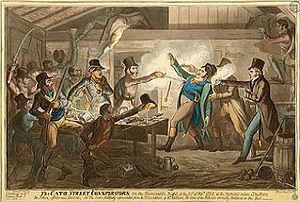
Thistlewood and his comrades began a midnight purge of their organization, discovering both Edwards and George Ruthven to be spies for the British Home Office. Ruthven confessed his plan to meet with a dozen Bow Street Runners (the newly formed police force) and apprehend the Spenceans at the loft they had rented on Cato Street. Holding the spies prisoner, Thistlewood announced that plans should go forward immediately as soon as the cabinet members could be found. While there was no dinner at Harrowby’s home, the other cabinet members were found at their own homes and massacred in coordinated attacks infamous for their use of grenades. Harrowby himself was hunted by a team who left London in pursuit that afternoon. True to his boasts, coffee shopkeeper John Ings decapitated two men and placed their heads to Westminster Bridge, where he was apprehended by shocked Coldstream Guards.
Thistlewood and the conspirators who had not been killed barricaded Mansion House and declared themselves a Committee of Public Safety to oversee the transition to a new representative government. Their fliers depicted revolution akin to that seen in France thirty years before. Within days, Britain was “set alight” by revolutionaries marching while loyalists defended the remaining government.
The idea of a revolution mirroring that of France, however, proved overall unappetizing. While most were ready for reform, few wanted the horrors of the guillotine, the Terror, and, perhaps ultimately, a British Napoleon. The loyalist soldiers of Britain rallied behind the Duke of Wellington, who had seen the fires of London from his home of Apsley House on the outskirts. Taking up arms, he marched on Mansion House, capturing and later executing the conspirators following military trial. Much of England fell under martial law, and instigators of violence were rooted out. Wellington was granted unprecedented powers as a new Prime Minister, and, though he was able to provide for Catholic Emancipation, he continued Britain as a rigidly censored place. Revolutionary ideals were mistrusted, as was seen for decades after in the arrest and exile of communist Karl Marx in 1850.
--
In reality, Thistlewood did not suspect Edwards, who turned over the conspiracy to the Home Office. The men were arrested in a brawl, and conspirators Robert Adams and John Monument testified against the others under the promise of dropped charges. Five men, including Arthur Thistlewood, William Davidson, and John Ings, were hanged at Newcastle prison, though original sentences added drawing and quartering, which were commuted. Five others were sent to penal colonies, a show of reform which was gradually coming to Post-Napoleonic Europe.
Mass public gatherings continued, and the British government under Prime Minister Lord Liverpool decided to take action. On August 16, 1819, the cavalry charged a group of over 60,000 protestors at St. Peter’s Field in Manchester who were marching for representation reform as only males owning land valued at forty shillings were allowed to vote. More than a dozen were killed and hundreds injured, spurring shock across Britain as newspapers covered what came to be known as the “Peterloo Massacre.” In response, the government increased its suppression in the next months with the Six Acts, which banned unlawful training, gave magistrates the right to seizing arms and require permission for rallies, and reduced free press.
Thistlewood and his cohorts were infuriated by Parliament. Following the death of George III on January 29, 1820, Thistlewood’s second-in-command George Edwards suggested that they act: kill the Prime Minister and his cabinet and seize the government in the lull between kings. They determined their plan on February 22 and roused up twenty-seven men ready to act. Jamaican William Davidson, who had once served the Earl of Harrowby, Lord President of the Council and host of the dinner they planned to attack, stopped by for details and discovered Harrowby was not at home. When he mentioned this to Thistlewood, the latter recalled the agent provocateur at the Spa Fields riots and that Edwards had been eager about the sudden idea of an attack.
Thistlewood and his comrades began a midnight purge of their organization, discovering both Edwards and George Ruthven to be spies for the British Home Office. Ruthven confessed his plan to meet with a dozen Bow Street Runners (the newly formed police force) and apprehend the Spenceans at the loft they had rented on Cato Street. Holding the spies prisoner, Thistlewood announced that plans should go forward immediately as soon as the cabinet members could be found. While there was no dinner at Harrowby’s home, the other cabinet members were found at their own homes and massacred in coordinated attacks infamous for their use of grenades. Harrowby himself was hunted by a team who left London in pursuit that afternoon. True to his boasts, coffee shopkeeper John Ings decapitated two men and placed their heads to Westminster Bridge, where he was apprehended by shocked Coldstream Guards.
Thistlewood and the conspirators who had not been killed barricaded Mansion House and declared themselves a Committee of Public Safety to oversee the transition to a new representative government. Their fliers depicted revolution akin to that seen in France thirty years before. Within days, Britain was “set alight” by revolutionaries marching while loyalists defended the remaining government.
The idea of a revolution mirroring that of France, however, proved overall unappetizing. While most were ready for reform, few wanted the horrors of the guillotine, the Terror, and, perhaps ultimately, a British Napoleon. The loyalist soldiers of Britain rallied behind the Duke of Wellington, who had seen the fires of London from his home of Apsley House on the outskirts. Taking up arms, he marched on Mansion House, capturing and later executing the conspirators following military trial. Much of England fell under martial law, and instigators of violence were rooted out. Wellington was granted unprecedented powers as a new Prime Minister, and, though he was able to provide for Catholic Emancipation, he continued Britain as a rigidly censored place. Revolutionary ideals were mistrusted, as was seen for decades after in the arrest and exile of communist Karl Marx in 1850.
--
In reality, Thistlewood did not suspect Edwards, who turned over the conspiracy to the Home Office. The men were arrested in a brawl, and conspirators Robert Adams and John Monument testified against the others under the promise of dropped charges. Five men, including Arthur Thistlewood, William Davidson, and John Ings, were hanged at Newcastle prison, though original sentences added drawing and quartering, which were commuted. Five others were sent to penal colonies, a show of reform which was gradually coming to Post-Napoleonic Europe.
Subscribe to:
Posts (Atom)
