Thursday, June 7, 2012

June 7, 1893 – Young Gandhi Jailed in South Africa

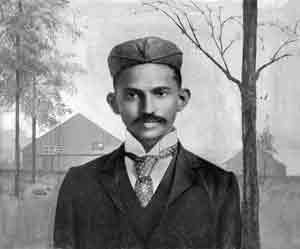
 In an influential episode of Indian leader Mohandas Karamchandand Gandhi’s young life, he was removed from the first-class carriage of a train in Pietermaritzburg, South Africa, and jailed after he struck the conductor.  Gandhi was able to plead self-defense after citing roughness on the part of the conductor and stated that he took his rights as a citizen of the British Empire seriously.  He was allowed onto a train the next day, and it was ingrained in his mind that “might makes right,” a lesson he had learned while studying law in London and a far cry from his Jainist upbringing.

Gandhi had been born October 2, 1869, in Porbandar, Bombay Presidency.  His mother, a devout Jain, died in childbirth, as had his father’s three previous wives and was common in the era before modern medicine.  His father, who largely influenced him, was a diwan in Porbandar, holding a high office with little duty, as had Mohandas’s grandfather before him.  After his arranged marriage at age 13, Gandhi was encouraged to study law so that he might one day take over his father’s position, and he traveled to University College London in 1888.  There, he found a very different world from his vegetarian, non-alcoholic upbringing.  He attempted to hold to vegetarianism, but his landlady’s bland food drove him to find dining at pubs.  As he grew accustomed to English culture, such as taking dancing lessons, Gandhi discovered a wealth of advantages being part of the British system.  Upon his return to India, he struggled to establish a barrister practice due to his shyness in court and instead worked more preparing documents.  In 1893, he agreed to a contract with Dada Abdulla & Co. at Colony of Natal in South Africa.

The Indians of wealth in South Africa were largely Muslim, while the Hindus were primarily poor indentured servants.  Gandhi, who had never cared much for religion, saw little difference, especially as both faced terrible discrimination under rule by whites.  On his journeys in South Africa, the incident on the train was one of many points where he determined he could only make “right” by finding enough “might.”  He was struck by a stagecoach driver for not making room for a white passenger; Gandhi recorded the event and later sued the driver and the company, making a name for himself.  Hotels that refused him were added to a list for boycott, later published as he helped found the Natal Indian Congress in 1894 as a body actively protecting Indian rights.  When he was attacked by a mob in 1897, Gandhi individually sued each known attacker, many of them later being placed in jail.  Officials were unnerved by his dedication to the law and to the Empire, using many of their own social weapons against him in addition to acts of non-cooperation.  When Britain declared war on the Zulu in 1906, Gandhi led a volunteer Indian ambulance corps, giving Indians credence into the regular British Army.

In 1915, Gandhi returned to India and brought his reputation with him.  He joined the Indian National Congress and quickly became a leader.  Toward the end of WWI, Gandhi was invited to recruit Indians for the war effort.  Gandhi enthusiastically agreed and wrote in “Appeal for Enlistment,” "To bring about such a state of things we should have the ability to defend ourselves, that is, the ability to bear arms and to use them...If we want to learn the use of arms with the greatest possible despatch, it is our duty to enlist ourselves in the army."  Though the war ended soon afterward, it gave ground for a long term project of working Indian soldiers into becoming a key part of British security.

Gandhi continued working with non-violence when it was obvious that the greater “might” was held by the British whites.  In the Champaran agitation, Gandhi arrived with a team of lawyers that broke down the system of landowners forcing tenant farmers to grow indigo for a fixed price in a weakening market.  He joined the Muslim Khilafat movement in 1919 to protect Islamic religious sites and gained great following as a unified leader of Indians.  At the Jallianwala Bagh massacre in 1919, protests erupted the Rowlatt Act that extended emergency wartime powers and British and were put down violently by Brigadier-General Dyer.  Gandhi, who had been leading the hartal (protest through suspension of business) in Delhi, determined that the time had come to act.  He challenged the colonial government to spread its martial law, which it did, only worsening the unrest.  Weapons smuggled by Indian soldiers, part of which had started the reactionary massacre, were spread, and all India seemed set aflame.

The Indian Revolt raged until 1922, when India was granted dominion status at Gandhi’s urging, similarly to Ireland.  In a new political climate, Gandhi began work to transform India by erasing culture he opposed, such as child marriage, untouchability, and oppression of women.  The renewed liberalism without the drive for independence as had been seen before splintered the Indian movement.  Sectionalism returned, and violence between Muslims, Hindu, and Sikhs rose as Britain stepped out of Indian government.  Following Gandhi’s assassination in 1934, voices began anew for independence, which was granted in 1947.  Civil war broke out as lines were redrawn, the first of four wars among India, Pakistan, Bangladesh, and Punjabi.

Gandhi’s goals of lifting up an oppressed people were accomplished despite bloodshed, which would be seen again with the assassinations and bombings on both sides in the Civil Rights Movement in the United States in the 1950s and ‘60s and in South Africa in the 1980s and ‘90s.


--

In reality, Gandhi’s mother survived childbirth and raised him strongly in the Jain faith.  When he went to London, he promised her to hold onto Jain principles.  Vegetarianism proved difficult, but he was eventually inspired by author Henry Stephens Salt to join the Vegetarian Society, which put him in touch with the Theosophical Society.  Upon Gandhi’s return to India, he would join the Indian National Congress, which had been founded by Theosophical Society members in 1885.  Gandhi continued his work with non-violence and civil disobedience (even canceling protests that turned violent, such as those against the Rowlatt Act), gradually winning over a united population of Muslim and Hindu Indians and beginning the Quit India movement in 1943 that won India’s independence after World War II.  Jawaharlal Nehru referred to Mahatma (“Great Soul” in Sanskrit) Gandhi as “the father of the nation” and “the light… of our lives” in a speech following Gandhi’s assassination on January 30, 1948, by a Hindu extremist.  Gandhi served as an inspiration to many nonviolent resistance leaders such as Martin Luther King, Jr., and Nelson Mandela.

Wednesday, June 6, 2012

June 6, 1942 and 1944 – A Cursed Day for the Allies


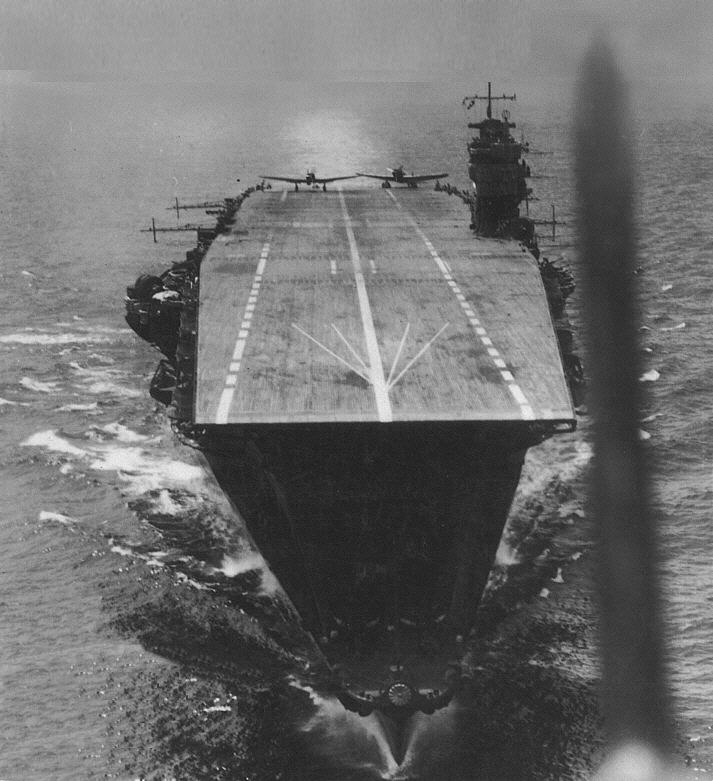
On two occasions two years apart during the Second World War, the sixth of June proved to be a day of disaster.  The first was in the Pacific Theater as the Imperial Japanese Navy looked to take Midway Island and push American control 1,200 miles backward.  Since the war in the Pacific had begun for the Americans with the Japanese raid on Pearl Harbor on December 7, 1941, it had been mostly a calculated retreat.  FDR ordered General Douglas MacArthur to relocate from the Philippines to Australia in February, 1942, prompting the famous “I shall return” speech.  The Japanese swept through the Dutch East Indies until finally being stopped at the Battle of Coral Sea.  While the Allies took heavier losses, they hindered the Japanese enough to stop their invasion of southern New Guinea.

In the next weeks, Yamamoto collected a massive fleet to make an attack on Midway Island, America’s most forward holding in the northern Pacific.  The attack had been expected by command since the 1930s, but there seemed no way to beat Japanese numbers with victory at Coral Sea being granted by superb American flight crews since ships did not even sea one another.  Code-breakers attempted to trick the code for Midway out of the Japanese naval code JN-25 by falsely broadcasting in May that the Midway water distillation plant had broken and requesting supplies.  While Japanese radio-operators were preparing to pass along word that “AF” (Midway) was short of water, command stopped them, having been suspicious over the American carriers seeming to appear exactly in the right place and time at Coral Sea.  Yamamoto, who had spread his fleet widely to avoid detection, decided Americans were already suspicious and reordered his ships into a tighter pack that struck Midway and the few American reinforcements there.  Most of the American Pacific fleet was in Hawaii, with the U.S.S. Lexington carrier under extensive repair.

After the fall of Midway, the Japanese and Americans fought endlessly between Midway and Hawaii, with the Americans finally pushing the Japanese back in November of 1942.  They had allowed the Japanese to dig in at places such as the Eastern Solomons and Guadalcanal, but the full industrial might of America finally outpaced early Japanese advantages.  With the loss of nearly 1000 pilots over the month-long Battle of Hawaii, the Japanese were unable to replace their crews, and the navy became impotent, relying on the army to hold the islands conquered early in the war.  The Second Battle of Midway in 1944 restored it to American hands at the cost of thousands of Marines’ lives.  By December 1945, the Americans had overtaken outlying Japanese bases at Okinawa and Iwo Jima, making routine firebombing of the mainland possible.

June 6 was also the day of the disastrous attempt at an amphibious landing on the north coast of France.  Weather had delayed the attack from June 5, but the Allies made an eager assault at Normandy on the morning of June 6, 1944, without full air support.  While many of the German High Command were absent (Hitler was reported to have slept late that day) or more fearful of attack at Calais, communications broken up by Allied paratroopers ironically inspired reserve commanders to act on their own initiative.  The Allies held the beach for a time, but Panzers under Rommel drove the troops back into the sea by afternoon (thanks to winning out before Hitler in an argument with Field Marshal Gerd von Rundstedt about mobile defense).

Eisenhower and the Allies retreated to prepare for another amphibious invasion, but the “worst channel storm in 40 years” delayed them through June.  Instead, the Allies determined to feint at Calais and made an assault Marseille in the South, for which Churchill had long campaigned.  Italy had been occupied by the Germans after capitulating, slowing advance up the Italian peninsula into a stalemate.  Operation Dragoon created a fresh front through southern France, causing the Germans to move their attention southward.  Shortly afterward, the Allies struck at Brittany, finally establishing a lasting beachhead at Brest.  Meanwhile, on the Eastern Front, Stalin began ferocious counterattacks, pushing westward and catching whole German armies in pincer movements.  By May of 1945, Russians had marched into Bavaria, taking as much ground as possible as the Western forces attempted to catch up for the Battle of Berlin a month later.

The war in Europe ended on May 28 with the Soviets controlling almost the whole of Germany.  Issues immediately began to arise with occupation zones as French demanded an area of Germany.  At Potsdam that July, the quickly fracturing Allies determined that the Soviets could control Germany as long as it followed the Potsdam Agreement and Russia would declare war on Japan to end the Pacific theater.  President Truman’s use of the atomic bomb and the Soviet invasion of Manchuria led to VJ Day on January 14/15.  Again, the Soviets made great leaps in occupation, taking Korea and the northern islands of Japan while the beleaguered American forces worked to disarm southern islands still held by imperial forces.

With so much Soviet influence in the East, Stalin refused to give up Manchuria to the Chinese as a result of the ongoing Chinese Civil War, explaining they needed secure railways to support the occupational forces in Korea.  Both Nationalist and Communist Chinese balked at the invasion and called another truce as they had during Japanese invasion, although each was willing to injure the other whenever possible.  The occupation of Manchuria began the Sino-Soviet War, which dragged on as Western powers watched.  With the development of Russian atomic weapons in 1949, the West finally acted with a NATO ultimatum banning the use of atomic weapons.

NATO-Soviet relations continued to crumble until the death of Stalin in 1956 ignited revolutions beginning in Hungary and spreading throughout Europe.  Already stretched thin with fighting in China and occupation in Central Asia, the stress was enough to break the Soviet Bloc and bring the experiment of Russian Communism crashing down.  War in China continued until NATO influence finally brought Kai-shek’s Nationalists into power, spreading capitalism into other former Soviet nations such as Korea and Xinjiang.


--

In reality, the US had broken the Japanese naval code and was able to appear at Midway with reinforcements, including the Yorktown, which had been repaired round-the-clock in Hawaii over 72 hours at Nimitz’s urging.  German High Command, however, was not as able and delayed counterattacks on D-Day until much too late to reverse Allied advances into Normandy.

Tuesday, June 5, 2012

June 5, 1832 – June Revolution Ousts July Monarchy

Political turmoil that had begun with the French Revolution over forty years before continued as France once again rebelled against a ruler, King Louis Philippe.  After experimenting with Republicanism and suffering the Reign of Terror, France had finally become unified behind the Emperor Napoleon.  Napoleon proved too ambitious, however, and the congress of Europe finally defeated him in 1816.  France was restored to a monarchy under Louis XVIII, pushing for a return to absolute rule and even dispatching the expeditionary force known as the “Hundred Thousand Sons of Saint Louis” to put down liberal government in revolutionary Spain in 1823.  The growing bourgeoisie struggled against the return of an unquestionable king, finally leading to the overthrow of Charles X with the July Revolution of 1830 after years of economic trouble in France.  Louis-Philippe, Duke of Orléans and cousin to the king, was instated as a constitutional monarch determined by popular sovereignty.

Not everyone was pleased with the balance of power, however.  Conservatives known as “Legitimists” wanted a return to the House of Bourbon, and they began their own schemes at overthrowing Louis-Philippe, whom they saw as illegitimate to the throne.  An attempt at kidnapping the royal family out of Paris failed, as did a rebellion led by Princess Caroline of Naples and Sicily to install her son and would-be heir to Charles X, Henry V, as king in Marseilles.  The insurrection was put down, and the Legitimists determined not to fight again, rather to argue their side through the press.

Meanwhile, the bourgeoisie had grown to great stature in France, much of which was at the cost of the petit bourgeoisie, “small businessmen” such as shop keepers, restaurateurs, and craftsmen.  In Lyon, the second-largest city in France, there was an uprising of the canut (silk workers) in 1831.  They called for a fixed price on silk goods to stop the drop in wages by those employed by large silk manufacturers and earnings among those who owned their own loom workshops.  Manufacturers determined a fixed price would undermine free enterprise and reminded the local prefect of laws banning guilds and strikes.  Outraged by the dismissal of their demands, the workers rose up in an enforced strike, barricaded the town, and defeated the national guard, many of whom were affiliated with the canut anyway and eagerly joined the cause.  The king and his government, particularly Casimir Perier, President of the Council of Ministers, responded by dispatching a 20,000 man army to put down the insurrection.  The soldiers arrived without bloodshed, and the uprising ended with only a few arrests, all of whom were acquitted.

Republicans in Paris saw the near-success of the workers and determined a sense of camaraderie with them, setting up linked secret societies.  The workers had already been in touch with Catholic royalists, but the republicans had their own network known as The Rights of Man Society.  Since it was illegal to have meetings larger than twenty people, the society was organized into a militaristic system of 20-man groups headed by a president, who met with the next level of twenty, who had their own leaders up a chain of command.  A cholera epidemic with rumors of poisoning by the wealthy spread unrest, and leaders determined to begin an uprising at the funeral of respected General Jean Maximilien Lamarque, who was a benefactor to the poor (hated Casimir Perier had died a month before, also victim to the plague).  A new republic was declared, and rebels quickly seized the city, setting up barricades and arming themselves.  Five thousand national guard backed by twenty-five thousand soldiers marched into Paris to end them.

However, the republicans had learned about the key to the canut’s temporary success: winning over the guard.  Using their societies, the leftists had gotten into contact with likeminded thinkers among the army who supported Lamarque’s philosophy.  As the soldiers entered the city, many of them disbanded and joined the barricades, turning the battle into a stalemate.  The show of weakness from Louis-Philippe inspired cities all over France to join the rebellion, particularly Lyon, whose model for societies based on skilled laborers acted as conduit for revolution.  Without enough soldiers to put out all the fires, Louis-Philippe abdicated, and many of the bourgeoisie found their industrial empires broken up.

The next few years in France proved happy as crops at last gave good harvests and the economy rebounded.  Fixed prices and firm laws on how far businesses could expand forced the benefit to be shared by the widest number of hands.  France seemed to become a model for republican revolutionaries, who began a wave of uprisings demanding economic as well as civil constitutions.  Eventually, however, economies turned downward again in the late 1840s.  Fixed prices meant that many luxury items simply were not purchased rather than being purchased at a lower rate, and shop owners and manufacturers found themselves with warehouses of useless goods.  Black markets and bartering surged across Europe, calling into question the worth of economic intervention.  While laws in royal countries were overturned quickly, France’s republican government debated endlessly.  Finally, in 1848, Henry V was made regent of France by Legitimists working alongside Orleanists, who eagerly awaited the coming-of-age of Louis-Philippe’s ten-year-old grandson, Philippe I, who would rule until 1894 as an outspoken democrat, often chaffing his longtime prime minister, Louis-Napoléon Bonaparte.


--

In reality, the French National Guard and Army surrounded the June Rebellion, crushing it at the Battle of Cloître Saint-Mercy.  The rebellion was witnessed firsthand by a hapless Victor Hugo, who would use it as a basis for his famed novel Les Misérables, idealizing the revolution.

Sunday, June 3, 2012

June 3, 1540 – De Soto Discovers Gold North of Florida


Conquistador Hernando de Soto had been born to a poverty-stricken area of Spain and left to seek his fortune, which he did in the New World.  He sailed to Panama in 1514 and accompanied Pizarro on the expedition to conquer the Inca in 1532.  De Soto, who had proven himself as an able, cunning, and ruthless commander, returned to Spain in 1534 with vast wealth from his share of the plunder.  He married and petitioned the king to return to the New World as governor of Guatemala so he could explore further into the Pacific Ocean, but Charles V awarded him Cuba instead with an order to colonize Florida to the north.  Ponce de Leon had discovered the vast lands to the north in 1521, but attempts colonize up the coast over the next decade had all failed due to disease, lack of supplies, and hostile natives.

In 1539, de Soto put together a 600-man expedition with ample provisions and livestock for an ongoing expedition to discover gold.  He studied the stories of Cabeza de Vaca, one of the four survivors of the ill-fated Narváez expedition into North America in 1527, which suffered endless attacks from natives, shipwreck, enslavement, and finally fame among natives for healing techniques.  Upon their arrival in Florida, the de Soto expedition came upon Juan Ortiz, who had been dispatched years before to find the lost Narváez and was captured by locals.  De Soto took on Ortiz as a guide and friend to local Indians, which served the expedition much more smoothly than the natives Narváez had captured and forced to be guides, resulting in them leading his men in circles through the roughest territories possible with ample ground for ambushes. 

After months of exploring up the Florida peninsula, the expedition wintered in Anhaica, the greatest city of the Apalachee people, whom Narváez had been falsely told were wealthy with gold.  Rumors now said there was gold “toward the sun’s rising.”  They traveled inland through the spring, northeasterly across a number of rivers and through several realms of native peoples.  Finally among the Cofitachequi, they met “The Lady of the Cofitachequi”, their queen.  She treated the well armed men kindly with gifts of pearls, food, and, at last, gold.  Rather than being native gold, however, the men recognized the items as Spanish, most likely abandoned from the nearby failed settlement by Lucas Vázquez de Ayllón that lasted only three months in 1526.  Disturbed by the bad luck with gold, the expedition departed, bringing the Lady with them as an involuntary escort as they came through the lands of the Joara, what she considered her western province.  There they found the “Chelaque”, who were described in the later annuals translated by Londoner Richard Hakluyt, as eating “roots and herbs, which they seek in the fields, and upon wild beasts, which they kill with their bows and arrows, and are a very gentle people. All of them go naked and are very lean.”  The civilization was rudimentary at best, "the poorest country of maize that was seen in Florida."  De Soto wanted to go further into the mountains and rest his horses there, but he determined to rest first using supplies ransomed for the Lady.  During the month-lost rest, many of his soldiers searched ahead for gold, while at least one stayed and taught agricultural techniques to the locals.

During a plowing session using a horse, which the natives had never seen before, they struck a large yellow rock.  The natives worked to free it and throw it away, but the conquistador recognized it as a 17-pound gold nugget.  De Soto was shocked by the find, as were the natives, who had never considered the inedible metal worth anything.  He immediately built a fort and dispatched men back to Cuba for reinforcements.  Meanwhile, de Soto and the bulk of his force captured the Lady of the Cofitachequi again and seized her kingdom.  The Spanish built a settlement at the mouth of the Santee River called Port Carlos (for Charles V) as well as another farther inland, where mining of the placer deposits of gold began.  Other deposits of gold were discovered in the region, spurring a gold rush to the area.  A short-lived war broke out with King Tuscaloosa in the west, but the area was quickly depopulated of natives due to disease from the Columbian Exchange.

De Soto’s gold fields proved to be shallower than he hoped, but the Spanish presence in Florida was affirmed.  Plantations grew up as planters experimented with what grew best, eventually settling on tobacco as a cash crop.  With the seventeenth century, the English began to block the spread of Spanish influence with colonies in Virginia and Plymouth, eventually assigning a border along the James River.  The French challenged Spanish control over the Mississippi River and dominated much of Canada until the Seven Years’ War caused Britain to annex Canada and force France to give the Louisiana to the Spanish, dividing North America between the Spanish and British Empires.

Due to heavy taxation following the war, Enlightenment ideals caused many in the American Colonies to call for resistance and even independence.  However, with a strong Spanish bastion just to the south, the outcry never spread beyond the Boston Insurrection.  Instead, the American Union would gain marginal self-rule, which would be successfully tested with the Slavery Abolition Act of 1833.  The expansive state of Florida, meanwhile, would undergo a bloody fifteen year war of independence from Spain.


--

In reality, de Soto passed over the gold fields of what would be North Carolina and Georgia.  The gold was not discovered in North Carolina until 1799 and Georgia until 1828.  Both discoveries caused gold rushes, pushing the native Cherokee, believed to be decedents of the Chelaque, westward.

Site Meter