Showing posts with label india. Show all posts

Sunday, June 7, 2020

458 - Biological Warfare Counters the Huna


The expansive Gupta Empire ruled for hundreds of years over northern India, stretching from the mouth of the Ganges River in the Bay of Bengal to the Indus River pouring into the Arabian Sea. Successive generations of rulers such as Chandragupta and Samudragupta added substantial territory to their influence as well as securing important trade routes that funded the flourishing empire. In the middle fifth century, however, invasion from the north seemed it would break apart imperial rule.

Skandagupta, who came to the throne as the lesser son of Kumaragupta after a forceful seizure of power in about 455, sought to defend his lands from the Huna, also known as Alchon Huns or White Huns, whose migratory conquests marched south from Central Asia. The Huna had gained political recognition by the Sassanid Empire to the west, guarding each other’s flanks while the Sassanids fought Byzantines in the Middle East and the Huna sought to expand. Skandagupta used the heavy cavalry, supported by war elephants and infantry, that had brought together the Gupta Empire to drive away the Huna incursion. It was obvious, however, that Skandagupta’s victory would only be temporary as the Huna were a quickly growing power.

Pondering the issue, Skandagupta looked out over his empire, which was often presented as the most advanced in the world. Analytical texts such as Kama Sutra had studied aspects of the human experience that many considered beyond understanding, Jainist mathematicians had defined principles of infinity, and creators had synthesized the logic of warfare into the game that the world would come to know as chess. No problem should be beyond their collective minds, so Skandagupta put out an edict that whoever discovered the best solution would be given a great reward. Numerous designs for innovative weapons and techniques flooded the palace at Pataliputra. Skandagupta’s choice was one that had been a part of human strategy for centuries: biological warfare.

The strength of the Huna rested in their herds, particularly their warhorses. Gathering sick horses from outbreaks in corners of the empire of diseases such as equine influenza and glanders, the imperial guard smuggled them into the northwest to be sold, allowed to be stolen, or simply let go to blend in with the Huna’s own. One strategy even had horses the guise of an Ashvamedha sacrifice in which soldiers would protect a horse as it wandered freely through the empire for one year, proving the stability of the imperial rule. Proving to be much less expensive than keeping up a large army to deter Huna invasion, Skandagupta and his descendants repeatedly introduced waves of plagues among the horsemen, devastating their herds and base of their economy.

In generations to come, however, the Guptas felt the consequences of the plagues as they often spread back into the empire from the west. Horse populations dropped, and the empire found itself with a dire shortage of beasts of burden. Attempts were made to expand the use of elephants and even camels, but elephants took a long time to propagate and camels did not do well in more humid climates. In about 500, Skandagupta’s great-grandson Budhagupta followed his ancestor’s example to appeal for ideas to resolve the burden issue.

By then, the Gupta Empire had grown by leaps in its science. Aryabhata had summarized Indian knowledge of mathematics and astronomy into one great work and clarified the place-value system that implied the existence of a “zero.” While he supported a geocentric model of the universe, he did show the Earth was round and rotated on an axis with the moon using reflected sunlight. Art and architecture had thrived with the imperial households increasingly supporting Buddhism with new temples. Numerous scholars focused their attention on contagions to better understand how to protect local horse herds. After reviewing complex schemes for mass canal systems and improved designs for carts, Budhagupta approved an engine that mimicked the power of a horse by steam from a boiler. Steadily steam engines came into use with iron soon replacing early brass models.

While the first steam engines were used to pull carts, soon the devices were being used in stationary form at mills. Religious objection to using forests for fuel were met with increased mining of the empire’s extensive coal resources. Demand for iron drove Gupta conquests southward into the kingdoms of the Vakatakas, beginning a new era of expansion for the empire. As the economic middle classes grew throughout the caste system, the newly rich patronized engineers and scholars, especially when their discoveries in chemistry or physics could make money. Varahamihira furthered geometry and trigonometry and define reflection and refraction in optics, leading to the development of lenses that soon allowed for telescopy, microscopy, and photography.

The Gupta Empire lasted approximately three hundred years before its satellite provinces in Southeast Asia broke into smaller states and revolution changed the imperial structure for more representation. By then, the technology and culture of India had spread widely, and, even in a different political form, northern India remained the scientific and economic center of the world. Indian steamships circumnavigated Africa to Europe and reached as far as Japan and New Zealand, establishing colonies for trade all along their paths. Buddhism, the imperially supported religion above others, spread along with the economic wealth, creating a complex mixture of versions of related religions throughout the world. Buddhism grew further under the Indian-influenced Song dynasty in China, where scholar-bureaucrats continued the Guptan practice of encouraging technological development and launched expeditions to map the western hemisphere.


--

In reality, the Huna continued generational invasions of northern India going as far as Eran midway through the subcontinent. Conquerors such as Toramana and Mihirakula were seen as bitterly cruel, especially as Mihirakula’s beliefs in Shiva drove him to destroy temples and any recorded knowledge. Eventually the Guptas and their allies defeated the Huna, but by then the trade routes had been wrecked and the empire had been worn down.

Thursday, May 23, 2013

April 7, 1541 - Francis Xavier Vows an Eternal Portuguese Empire


On April 7, 1506, Francisco de Jasso y Azpilicueta was born in the Kingdom of Navarre at the Castle of Xavier, from which he would later take his surname.  He was the youngest son of Juan de Jasso, an adviser to the king, and wealthy heiress Doña Maria de Azpilcueta y Aznárez.  When Francis was six, Spain invaded Navarre.  After his father’s death, Francis's older brothers worked alongside French conspirators hoping to repel the Spanish invaders.  When the plot failed, the family was stripped of its land holdings and their castle was reduced to a residence with all of its battlements destroyed.

With civil war raging around the impoverished family, his mother determined to save Francis by sending him to live with her relative Martin de Azpilcueta in 1518.  Rather than growing up in a city under the thumb of Spanish rule in a country that would eventually be cut in half with the southern end ceded to the invaders, Francis joined a world of academics.  Martin completed his doctorate in canon law at Toulouse and brought Francis with him to the University of Salamanca.  There, Martin contributed to the revolutionary doctrines of the School of Salamanca, where Francisco de Vitoria and others who reinvented natural law, argued for human rights even among aborigines, and promoted free will alongside liberty.  Martin himself, earning the nickname “Doctor Navarrus,” determined the time value of money, introducing the first notions of finance theory and principles of investment.

The ideas were formative to young Francis's thinking, and he was considered a promising genius when he began studies at the Collège Sainte-Barbe in Paris.  There he met men such as Ignatius of Loyola and Pierre Favre who would later found the Society of Jesus (Jesuit) monastic order.  While Francis agreed with much of the men's thinking, they eventually parted ways as Francis considered himself more of a humanist, replying to Ignatius of Loyola's Biblical rhetorical question, "What will it profit a man to gain the whole world, and lose his own soul?" with "The world, for a time," treating it as a cost-benefit analysis.

Francis could not be satisfied with the theories of academia and wished for action.  He left his teaching position at Beauvais college to apply himself to the growing field of economics and banking.  He caught the attention of Martim Afonso de Sousa, an adventurer who began the colonization of Brazil and furthered Portuguese expansion in India.  When de Sousa was to be dispatched to India in 1541 as the new viceroy, he brought Francis along with him.  Their ship, the Santiago, also carried Jesuits whom King John III had asked to help restore the characters of Portuguese men stationed in the east as they had fallen toward the pagan ways.  Francis and the Jesuits again compared philosophies, and again Francis sought to build up the world’s condition rather than attempt to alleviate it.

Arriving in India, Francis was appalled alongside the Jesuits of the imperialists' treatment of locals.  He argued for the Indians' natural rights and gained favor from both sides with the encouragement of economic investment to improve the region.  While Jesuits aided the poor and spread the Word, Francis worked to build banks and fair courts in addition to the factories and fortresses set up by de Sousa.  Portuguese soldiers and administrators there were fraught with ambition, which Francis fostered, as well as corruption, against which Francis worked with the establishment of stiff penalties and economic blacklisting.  He refused to allow slavery and instead argued for fair wages to Indians and Portuguese alike.

The formula worked well.  The local economy flourished, and soon the native populace was eager to attend the Jesuits’ schools to learn Portuguese.  As soon as Francis built up a bank in one port, he used the excess funds to expand banking to the next.  India came under Portuguese rule with military power linked to economic success: any rebellion or invasion by other European power would cripple the wealth and was thus opposed by locals.

By 1545, Francis began expansion of his planned trading empire eastward to what were known as the Spice Islands.  Again using the Jesuits as a method to inspire confidence among the locals, he was able to communicate his economic principles and investment strategies.  In 1548 he met with a Christian Japanese man, Anjiro, later called Paulo de Santa Fe, who had fled to the Jesuits seeking a better life.  He gave lengthy details of his homeland, which inspired Francis to travel there.  The Japanese proved unfriendly with no port agreeing to take in his ship until he met with the daimyo of Satsuma.  The Japanese aristocracy resisted Jesuits who had come with Francis and outlawed Christianity.  Rather than give up his business, Francis changed his formula and worked almost exclusively with the merchant class, boosting imports, encouraging factories, and gradually making the culturally outcast profession into a noble one.

In 1552, Francis set sail for a new market, arguably the greatest yet:  China.  While waiting during an attempt to get cheaper passage and entry into China, he died of a fever on the island of Shangchuan.  Although his economic principles did not reach China during his lifetime, they had established an enormous stronghold for Portuguese power in the East.  Later colonizers would battle over China with the English eventually wresting control of the empire away from the French.

With such a monopoly, the Portuguese attracted eager allies as well as enemies among the rest of Europe.  Portuguese became the international language of banking, and Portugal state banks were found even in colonies of other nations.  Naval warfare through the eighteenth century weakened Portugal’s hold, and eventually their colonies would gain political independence.  Even today, however, Lisbon rivals London and Zurich as a banking hub and international markets are centered on Portuguese-based trading in economic capitals like Goa, Malacca, and Nagasaki.


--

In reality, Francis Xavier grew up close to his family in worn-torn Navarre.  Arguably due to his experience in suffering, he left the world of academia to join Ignatius of Loyola and the Jesuits.  He worked tirelessly to bring Christianity to the Orient and has become a patron saint of missionaries alongside the biblical Saint Paul.

Wednesday, January 23, 2013

March 23, 1801 - Conspiracy to Murder the Tsar Stopped


Paul, the son of Catherine the Great, was born in 1754, when Catherine was still Grand Duchess during Elizabeth's reign.  Elizabeth immediately took Paul as her own, attempting to indoctrinate him with her own tutors.  Her care was minimal at best; stories were told of the infant Paul falling out of his crib and sleeping on the floor through the night until morning when his lackluster caregivers noticed.  As he grew, Paul proved to be quite intelligent and made up for his uncaring home-life by immersing himself in stories of chivalry and fantasy.

Upon the death of Peter III after only a few months of rule, Catherine became autocrat of Russia.  Paul disagreed with many of her mother's stances, particularly her wars of expansion into the Middle East and Central Asia.  He followed his Peter in appreciation of the new Prussian style, focusing on reform and defensive war.  Although he attended Catherine's council meetings early on, he later spent most of his time on his estates drilling soldiers along the model of Frederick the Great.  Paul wrote a work of military reform, Reflections, which proved to be a criticism of his mother's policies.  Catherine ended much of her attention to Paul.

The distance between mother and son was finalized when Paul's son Alexander was born.  Catherine took Alexander from Paul as he had been taken from her and trained him with her own tutors.  It became clear that Catherine wished to pass over Paul, even contacting his mother Maria for confirmation, but all parties seemed to agree that traditional succession meant Paul would have his time to rule.  When Catherine suffered a stroke in 1796, Paul became Tsar of All Russias.

Even before his rule, Paul was known as an eccentric.  He was fascinated by chivalry and immediately began laws reforming the ruling class.  Paul repealed his mother's legalization of corporal punishment for nobles (a popular move) but also enacted new policies attempting to forge a new age of noble knights, dispensing generous gifts on those who agreed and banishing those who opposed him.  He reformed the army, dismissing many generals and recreating the uniforms to emulate the stylish, if ineffectual, Prussians.  Paul also welcomed the Knights Hospitaller, who had fled their home in Malta from General Napoleon, and they elected him Grand Master, a title in which he reveled.

While his domestic policy caused turmoil, Paul struggled with foreign affairs.  He first recalled his mother's final expedition of 13,000 troops who were prepared to march on Iran, ending expansionism.  Paul also had inherited an alliance with Austria and Britain against Republican France, whom he despised as an illegitimate uprising against nobility.  While first enthusiastic about battling to return order to Europe, Paul was soon betrayed.  It became clear that Austria was attempting territorial gain in Italy.  The Austro-Russian campaign in Switzerland proved fruitless, and the Austrians retreated, leaving the Russians to fight as rearguard with heavy losses.  Meanwhile, an Anglo-Russian invasion of the Netherlands also turned to a retreat, and Paul was disappointed with the efforts of allied troops.  When Britain seized a Danish frigate in violation of Scandinavian neutrality and refused to return Malta to the Knights Hospitaller, Paul ended his alliance with Britain as he had Austria.

Meanwhile, foreign relations with France improved dramatically.  Napoleon had overthrown the republic's Directory and installed himself as First Consul, which matched Paul's worldview of noble rule much more closely.  After Napoleon generously returned 7,000 Russian prisoners despite Britain's failure to pay promised ransom, Paul began secret communications for an anti-British alliance.  The two concocted a scheme to march overland through Persia to harass India, Britain's valued market.  In January of 1801, Paul ordered Ataman Orlov and 20,000 Cossack cavalry to begin the preliminary march to India to map an invasion route.

Two months later, a contingent of drunken dismissed officers burst into Paul's rooms in the newly constructed St. Michael's Castle.  Paul hid behind the curtains but was found, and the officers attempted to force him to sign an abdication.  Paul refused and, during the scuffle, managed to escape his room.  He called for guards, finally finding those loyal enough to defend him.  His attackers were executed and an investigation found, tracing some funding from British agents reacting to Paul's seizure of British ships and factories in Russia.

Anti-British fervor swept the country, coinciding with the arrival of British Admiral Horatio Nelson's fleet in Reval that May.  He was fresh from Copenhagen, where the ships had bombarded the city and forced the Danes to comply in Britain's destruction of the Armed Neutrality Coaltion between the Scandinavian countries.  Russia attempted to fight off the fleet, but the British ships overcame them at the Battle of Reval and sailed for St. Petersburg.  Paul remained in the city despite suggestions to flee and organized the use of small fire ships piloted toward Nelson's fleet, emulating the battle against the Spanish Armada.  Nelson refused to be defeated by Russians, going down with his flagship as the sabotaged ships eventually retreated.

Paul and Napoleon dispatched their invasion in August of 1801 in Astrabad on the Caspian Sea.  Napoleon contributed scientists and artists, much as he had done with his Egyptian expedition, while Paul dispatched brightly colored cloth for sale and fireworks for displays.  They passed into Persia, where Fath Ali Shah had signed an Anglo-Persian treaty earlier that year, stating, "Should it ever happen that an army of the French nation attempts to settle on any of the islands or shores of Persia, a conjunct force shall be appointed by the two high contracted parties, to act in cooperation, to destroy it."  A British force marched out from India, but the Persians, upon recognizing that neither France nor Russia intended conquest thanks to Paul's rejection of expansionistic warfare, capitulated and signed a new alliance with France and Russia.  The British were defeated at the Battle of Kandahar, and the Russo-French force marched into India.

Britain began to panic and struggled to create a new coalition.  Scandinavia refused and again ousted British authority with a coalition of neutrality.  Austro-Hungary joined with Britain as Napoleon expanded again into Italy; Prussia joined later as the war spread to Germany.  At the indecisive Battle of Trafalgar, Britain attempted to destroy the combined French-Spanish navy but merely wounded it before returning to protect the Channel.  Meanwhile, at Paul's encouragement, Napoleon dispatched the fleets to harass Britain's colonies where they would be most vulnerable.  As colony after colony fell or became disrupted, Britain's economy crashed.  Finally in 1812, the world came to peace with a final armistice requested by Britain.

Through the nineteenth century, Europe recuperated and began a new wave of colonization began in Africa and Asia.  Paul, however, worked to continue his reforms inside Russia, welcoming French technological improvements while solidifying his chivalric order.  After the death of his son Alexander due to typhus in 1825, Paul began to groom his grandson Alexander II for rule, but the tsar died the next year.  Eight-year-old Alexander II was made tsar, advised by a council whose powers were expanded during the wave of revolutions following the death of Napoleon II in 1848.  Russia came late into the race to colonize, taking only a few areas in Central Asia while France dominated the Middle East and Britain took hold of much of China, paring it with Prussia and Batavia as they had in Africa.  Paul's legacy of reform improved much in the lives of the average Russians, but finally his aged chivalric order was overthrown in 1919 by revolts calling for a greater share of wealth  for the populace.


--

In reality, Paul was assassinated.  He refused to sign the abdication and was stabbed with a sword.  His son Alexander was told by one of the assassins, General Zubov, "Time to grow up! Go and rule!"  Alexander became determined to defeat Napoleon and overturned his father's pro-French plans.  After Napoleon's defeat at sea by Nelson in 1805 and on land in Russia by Alexander in 1812, the French Empire finally crumbled.

Thursday, June 7, 2012

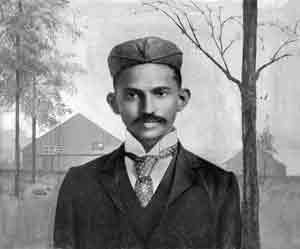
June 7, 1893 – Young Gandhi Jailed in South Africa

 In an influential episode of Indian leader Mohandas Karamchandand Gandhi’s young life, he was removed from the first-class carriage of a train in Pietermaritzburg, South Africa, and jailed after he struck the conductor.  Gandhi was able to plead self-defense after citing roughness on the part of the conductor and stated that he took his rights as a citizen of the British Empire seriously.  He was allowed onto a train the next day, and it was ingrained in his mind that “might makes right,” a lesson he had learned while studying law in London and a far cry from his Jainist upbringing.

Gandhi had been born October 2, 1869, in Porbandar, Bombay Presidency.  His mother, a devout Jain, died in childbirth, as had his father’s three previous wives and was common in the era before modern medicine.  His father, who largely influenced him, was a diwan in Porbandar, holding a high office with little duty, as had Mohandas’s grandfather before him.  After his arranged marriage at age 13, Gandhi was encouraged to study law so that he might one day take over his father’s position, and he traveled to University College London in 1888.  There, he found a very different world from his vegetarian, non-alcoholic upbringing.  He attempted to hold to vegetarianism, but his landlady’s bland food drove him to find dining at pubs.  As he grew accustomed to English culture, such as taking dancing lessons, Gandhi discovered a wealth of advantages being part of the British system.  Upon his return to India, he struggled to establish a barrister practice due to his shyness in court and instead worked more preparing documents.  In 1893, he agreed to a contract with Dada Abdulla & Co. at Colony of Natal in South Africa.

The Indians of wealth in South Africa were largely Muslim, while the Hindus were primarily poor indentured servants.  Gandhi, who had never cared much for religion, saw little difference, especially as both faced terrible discrimination under rule by whites.  On his journeys in South Africa, the incident on the train was one of many points where he determined he could only make “right” by finding enough “might.”  He was struck by a stagecoach driver for not making room for a white passenger; Gandhi recorded the event and later sued the driver and the company, making a name for himself.  Hotels that refused him were added to a list for boycott, later published as he helped found the Natal Indian Congress in 1894 as a body actively protecting Indian rights.  When he was attacked by a mob in 1897, Gandhi individually sued each known attacker, many of them later being placed in jail.  Officials were unnerved by his dedication to the law and to the Empire, using many of their own social weapons against him in addition to acts of non-cooperation.  When Britain declared war on the Zulu in 1906, Gandhi led a volunteer Indian ambulance corps, giving Indians credence into the regular British Army.

In 1915, Gandhi returned to India and brought his reputation with him.  He joined the Indian National Congress and quickly became a leader.  Toward the end of WWI, Gandhi was invited to recruit Indians for the war effort.  Gandhi enthusiastically agreed and wrote in “Appeal for Enlistment,” "To bring about such a state of things we should have the ability to defend ourselves, that is, the ability to bear arms and to use them...If we want to learn the use of arms with the greatest possible despatch, it is our duty to enlist ourselves in the army."  Though the war ended soon afterward, it gave ground for a long term project of working Indian soldiers into becoming a key part of British security.

Gandhi continued working with non-violence when it was obvious that the greater “might” was held by the British whites.  In the Champaran agitation, Gandhi arrived with a team of lawyers that broke down the system of landowners forcing tenant farmers to grow indigo for a fixed price in a weakening market.  He joined the Muslim Khilafat movement in 1919 to protect Islamic religious sites and gained great following as a unified leader of Indians.  At the Jallianwala Bagh massacre in 1919, protests erupted the Rowlatt Act that extended emergency wartime powers and British and were put down violently by Brigadier-General Dyer.  Gandhi, who had been leading the hartal (protest through suspension of business) in Delhi, determined that the time had come to act.  He challenged the colonial government to spread its martial law, which it did, only worsening the unrest.  Weapons smuggled by Indian soldiers, part of which had started the reactionary massacre, were spread, and all India seemed set aflame.

The Indian Revolt raged until 1922, when India was granted dominion status at Gandhi’s urging, similarly to Ireland.  In a new political climate, Gandhi began work to transform India by erasing culture he opposed, such as child marriage, untouchability, and oppression of women.  The renewed liberalism without the drive for independence as had been seen before splintered the Indian movement.  Sectionalism returned, and violence between Muslims, Hindu, and Sikhs rose as Britain stepped out of Indian government.  Following Gandhi’s assassination in 1934, voices began anew for independence, which was granted in 1947.  Civil war broke out as lines were redrawn, the first of four wars among India, Pakistan, Bangladesh, and Punjabi.

Gandhi’s goals of lifting up an oppressed people were accomplished despite bloodshed, which would be seen again with the assassinations and bombings on both sides in the Civil Rights Movement in the United States in the 1950s and ‘60s and in South Africa in the 1980s and ‘90s.


--

In reality, Gandhi’s mother survived childbirth and raised him strongly in the Jain faith.  When he went to London, he promised her to hold onto Jain principles.  Vegetarianism proved difficult, but he was eventually inspired by author Henry Stephens Salt to join the Vegetarian Society, which put him in touch with the Theosophical Society.  Upon Gandhi’s return to India, he would join the Indian National Congress, which had been founded by Theosophical Society members in 1885.  Gandhi continued his work with non-violence and civil disobedience (even canceling protests that turned violent, such as those against the Rowlatt Act), gradually winning over a united population of Muslim and Hindu Indians and beginning the Quit India movement in 1943 that won India’s independence after World War II.  Jawaharlal Nehru referred to Mahatma (“Great Soul” in Sanskrit) Gandhi as “the father of the nation” and “the light… of our lives” in a speech following Gandhi’s assassination on January 30, 1948, by a Hindu extremist.  Gandhi served as an inspiration to many nonviolent resistance leaders such as Martin Luther King, Jr., and Nelson Mandela.

Site Meter