Showing posts with label persia. Show all posts

Wednesday, January 23, 2013

March 23, 1801 - Conspiracy to Murder the Tsar Stopped


Paul, the son of Catherine the Great, was born in 1754, when Catherine was still Grand Duchess during Elizabeth's reign.  Elizabeth immediately took Paul as her own, attempting to indoctrinate him with her own tutors.  Her care was minimal at best; stories were told of the infant Paul falling out of his crib and sleeping on the floor through the night until morning when his lackluster caregivers noticed.  As he grew, Paul proved to be quite intelligent and made up for his uncaring home-life by immersing himself in stories of chivalry and fantasy.

Upon the death of Peter III after only a few months of rule, Catherine became autocrat of Russia.  Paul disagreed with many of her mother's stances, particularly her wars of expansion into the Middle East and Central Asia.  He followed his Peter in appreciation of the new Prussian style, focusing on reform and defensive war.  Although he attended Catherine's council meetings early on, he later spent most of his time on his estates drilling soldiers along the model of Frederick the Great.  Paul wrote a work of military reform, Reflections, which proved to be a criticism of his mother's policies.  Catherine ended much of her attention to Paul.

The distance between mother and son was finalized when Paul's son Alexander was born.  Catherine took Alexander from Paul as he had been taken from her and trained him with her own tutors.  It became clear that Catherine wished to pass over Paul, even contacting his mother Maria for confirmation, but all parties seemed to agree that traditional succession meant Paul would have his time to rule.  When Catherine suffered a stroke in 1796, Paul became Tsar of All Russias.

Even before his rule, Paul was known as an eccentric.  He was fascinated by chivalry and immediately began laws reforming the ruling class.  Paul repealed his mother's legalization of corporal punishment for nobles (a popular move) but also enacted new policies attempting to forge a new age of noble knights, dispensing generous gifts on those who agreed and banishing those who opposed him.  He reformed the army, dismissing many generals and recreating the uniforms to emulate the stylish, if ineffectual, Prussians.  Paul also welcomed the Knights Hospitaller, who had fled their home in Malta from General Napoleon, and they elected him Grand Master, a title in which he reveled.

While his domestic policy caused turmoil, Paul struggled with foreign affairs.  He first recalled his mother's final expedition of 13,000 troops who were prepared to march on Iran, ending expansionism.  Paul also had inherited an alliance with Austria and Britain against Republican France, whom he despised as an illegitimate uprising against nobility.  While first enthusiastic about battling to return order to Europe, Paul was soon betrayed.  It became clear that Austria was attempting territorial gain in Italy.  The Austro-Russian campaign in Switzerland proved fruitless, and the Austrians retreated, leaving the Russians to fight as rearguard with heavy losses.  Meanwhile, an Anglo-Russian invasion of the Netherlands also turned to a retreat, and Paul was disappointed with the efforts of allied troops.  When Britain seized a Danish frigate in violation of Scandinavian neutrality and refused to return Malta to the Knights Hospitaller, Paul ended his alliance with Britain as he had Austria.

Meanwhile, foreign relations with France improved dramatically.  Napoleon had overthrown the republic's Directory and installed himself as First Consul, which matched Paul's worldview of noble rule much more closely.  After Napoleon generously returned 7,000 Russian prisoners despite Britain's failure to pay promised ransom, Paul began secret communications for an anti-British alliance.  The two concocted a scheme to march overland through Persia to harass India, Britain's valued market.  In January of 1801, Paul ordered Ataman Orlov and 20,000 Cossack cavalry to begin the preliminary march to India to map an invasion route.

Two months later, a contingent of drunken dismissed officers burst into Paul's rooms in the newly constructed St. Michael's Castle.  Paul hid behind the curtains but was found, and the officers attempted to force him to sign an abdication.  Paul refused and, during the scuffle, managed to escape his room.  He called for guards, finally finding those loyal enough to defend him.  His attackers were executed and an investigation found, tracing some funding from British agents reacting to Paul's seizure of British ships and factories in Russia.

Anti-British fervor swept the country, coinciding with the arrival of British Admiral Horatio Nelson's fleet in Reval that May.  He was fresh from Copenhagen, where the ships had bombarded the city and forced the Danes to comply in Britain's destruction of the Armed Neutrality Coaltion between the Scandinavian countries.  Russia attempted to fight off the fleet, but the British ships overcame them at the Battle of Reval and sailed for St. Petersburg.  Paul remained in the city despite suggestions to flee and organized the use of small fire ships piloted toward Nelson's fleet, emulating the battle against the Spanish Armada.  Nelson refused to be defeated by Russians, going down with his flagship as the sabotaged ships eventually retreated.

Paul and Napoleon dispatched their invasion in August of 1801 in Astrabad on the Caspian Sea.  Napoleon contributed scientists and artists, much as he had done with his Egyptian expedition, while Paul dispatched brightly colored cloth for sale and fireworks for displays.  They passed into Persia, where Fath Ali Shah had signed an Anglo-Persian treaty earlier that year, stating, "Should it ever happen that an army of the French nation attempts to settle on any of the islands or shores of Persia, a conjunct force shall be appointed by the two high contracted parties, to act in cooperation, to destroy it."  A British force marched out from India, but the Persians, upon recognizing that neither France nor Russia intended conquest thanks to Paul's rejection of expansionistic warfare, capitulated and signed a new alliance with France and Russia.  The British were defeated at the Battle of Kandahar, and the Russo-French force marched into India.

Britain began to panic and struggled to create a new coalition.  Scandinavia refused and again ousted British authority with a coalition of neutrality.  Austro-Hungary joined with Britain as Napoleon expanded again into Italy; Prussia joined later as the war spread to Germany.  At the indecisive Battle of Trafalgar, Britain attempted to destroy the combined French-Spanish navy but merely wounded it before returning to protect the Channel.  Meanwhile, at Paul's encouragement, Napoleon dispatched the fleets to harass Britain's colonies where they would be most vulnerable.  As colony after colony fell or became disrupted, Britain's economy crashed.  Finally in 1812, the world came to peace with a final armistice requested by Britain.

Through the nineteenth century, Europe recuperated and began a new wave of colonization began in Africa and Asia.  Paul, however, worked to continue his reforms inside Russia, welcoming French technological improvements while solidifying his chivalric order.  After the death of his son Alexander due to typhus in 1825, Paul began to groom his grandson Alexander II for rule, but the tsar died the next year.  Eight-year-old Alexander II was made tsar, advised by a council whose powers were expanded during the wave of revolutions following the death of Napoleon II in 1848.  Russia came late into the race to colonize, taking only a few areas in Central Asia while France dominated the Middle East and Britain took hold of much of China, paring it with Prussia and Batavia as they had in Africa.  Paul's legacy of reform improved much in the lives of the average Russians, but finally his aged chivalric order was overthrown in 1919 by revolts calling for a greater share of wealth  for the populace.


--

In reality, Paul was assassinated.  He refused to sign the abdication and was stabbed with a sword.  His son Alexander was told by one of the assassins, General Zubov, "Time to grow up! Go and rule!"  Alexander became determined to defeat Napoleon and overturned his father's pro-French plans.  After Napoleon's defeat at sea by Nelson in 1805 and on land in Russia by Alexander in 1812, the French Empire finally crumbled.

Saturday, January 19, 2013

March 22, 1739 – Nader Shah Assassinated in Delhi


After centuries of stable rule, the Safavid dynasty of Persia began to decline, and chaos swallowed up the empire.  Sultan Husayn was seen as weak, and the powerful Ghilzai Afghans of Kandahar rebelled against his rule.  He dispatched a new governor to quell the uprising, but the Afghans killed him and began expanding their rebellion.  Husayn marched out against the rebels with a force of three times their size, but his army was defeated, and the Afghans drove him back to the capital Isfahan, where they forced him to abdicate in 1722.  Meanwhile, the Ottoman and Russian empires, seeing an opportunity to advance, seized great swaths of Persian land at their frontiers.

As Husayn's son Tahmasp II attempted to restore order, he called for aid from many of the local chieftains, including Nader of the Afshar.  Nader had been born a shepherd's son.  His father died when Nader was young, and then the boy and his mother were captured as slaves by raiders.  Nader escaped slavery and later fell in with brigands.  There, his tactical mind and ruthless spirit shown, and he rose to become their leader.  He became admired by the Afshar chiefs, who welcomed him and gave him daughters to be his wives.  When the Afghans came to his city Mashhad, he submitted but then escaped to build up a private army.  His might grew until he was recognized and called upon by Tahmasp.

Nader discovered that Tahmasp's general Fath Ali Khan was a traitor and turned him over to the shah for execution.  As a reward, Tahmasp granted Nader the title Servant of Tahmasp and gave him command of the army.  Over the next three years, Nader created a powerful force that routinely defeated the Afghans in battle.  In 1729, the Afghans fled, and Tahmasp returned to Isfahan.  Nader plundered the city to reward his army and was granted governorship over the eastern part of Persia as well as Tahmasp's sister as another wife. 

While war continued with the Afghans, Nader also campaigned against the Ottomans, chasing them out of the lands stolen during the uprising.  His campaign was interrupted when the Afghans besieged his home at Mashhad, and he rushed east to rescue his family.  Tahmasp took over the campaign and squandered Nader's victories, eventually signing a piteous treaty.  Nader was infuriated and determined to overthrow the sultan.  He managed to get Tahmasp drunk and displayed him to the court, showing that the sultan was unfit to rule.  They forced him to abdicate, giving the throne to the baby Abbas III while Nader served as regent.  He campaigned against the Ottomans for the next three years, finally winning back the lost provinces and creating an alliance with the Russians.

With the wars settled in 1736, Nader emulated his heroes Genghis Khan and Timur by calling a massive meeting of the leaders throughout the empire.  Nader recommended himself as shah rather than the young Abbas, and the recommendation was accepted unanimously.  He then carried on the war against the remaining Afghan strongholds, finally defeating them utterly in 1738.  Still hungry for conquest, he pressed on into the Mughul Empire of India, claiming they had harbored Afghan enemies.  At the Battle of Karnal in 1739, his army of some 55,000 destroyed a force twice its size.  Nader captured the emperor Mohammad Shah and carried him to his own capital, Delhi.

There, as the triumphant army entered, Nader found himself stabbed by an assassin posing as a prince with a gift.  The city turned to pandemonium.  Indians excited by the news of Nader's death attacked Persian soldiers.  The soldiers counterattacked and looted what they could, but eventually the Persian army fled India in disarray.

Meanwhile, Nader's son Reza Qoli Mirza had been ruling Persia while his father was away campaigning.  Upon news of his father's death, Reza had the remaining Safavids, including former sultans Tahmasp and Abbas, executed.  Tahmasp's sister, Nader's wife, committed suicide, and no one stood against Reza as he took the throne.  While his father had been a military genius, Reza preferred the imperial life to campaigning.  He enjoyed luxuries, and the British East India Company proved able to supply them.  Reza traded infatuations with Europe, who took him to be the son of the "Second Alexander", as legends grew about Nader.  Envoys from Europe showered Reza with gifts, and the new sultan gave glamorous contracts for trading posts.  Many Persians distrusted the foreigners, and a threat arose to Reza's power when Kurds rebelled in 1747.  Rather than leading the army himself, Reza brought in European mercenaries.  After the rebellion was put down, the mercenaries stayed.  Reza began massive modernization projects, primarily canals, which brought the attention of French and British bankers to the nation.

Upon Reza's death in 1766, the British orchestrated a take-over of Persia, installing a puppet ruler much as they had done with principalities in India as the Mughul Empire collapsed.  Gradually over the next century, the lands would be split up between Britain in the south and Russia, who seized much of the north.  When the world entered its post-war phase of relinquishing colonies, former British Iran and the Soviet satellites of Azerbaijan and Khurasan became prime grounds for Cold War activity, especially along the western Iranian oilfields.


--

In reality, the assassination was only a rumor.  Nader Shah punished the city by allowing his army to plunder it and only stopped when Mohammad Shah granted his entire treasure, including the fabled Peacock Throne, which was enough to cancel taxes in all of Persia for three years.  Nader continued campaigning, but his health gradually faded as his cruelty increased.  He was finally assassinated in 1747 by his officers who decided they should "breakfast off him ere he should sup off them."  The nation fell into civil war, and the chaos largely kept out Western European influence and modernization until the Qajar Dynasty of the nineteenth century.

Thursday, August 2, 2012

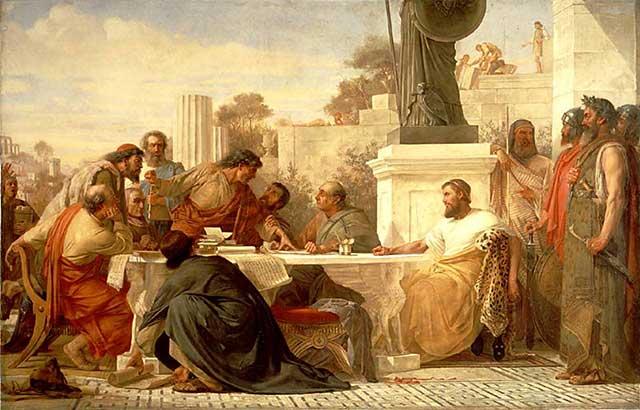
June 26, 363 – Emperor Julian defeats Sharpur II


After a divine vision foretold Constantine’s victory over Maxentius at Milvian Bridge in 312, he determined to reverse the persecution of Christians in the Roman Empire.  In 313, Constantine issued the Edict of Milan, returning confiscated property to churches and affirming freedom of religion granted by Galerius in 311.  His mother, Helena, led expeditions to sites important to Christianity such as the birthplace of Christ in Bethlehem, and Constantine used his resources to build cathedrals after cathedral upon them, such as the Church of the Nativity.  In 325, Constantine commanded bickering bishops to meet at the Council of Nicaea, which clarified doctrine, hamstrung Arianism, and made Christianity far more political.

After Constantine’s death, his three sons inherited the empire, which soon fell into civil war again.  Constantius II, the second son, eventually gained control and reorganized his command structure with those who had proven loyal.  Among them was his bookish cousin Julian, who had spent much of his life in exile at studies of philosophy and religion.  Julian had become a lector in the Church, but Constantius ordered him to become the representative Caesar in Gaul to keep further rebellions from arising.  There, Julian learned the art of war while defeating Franks and Germans and winning utter loyalty of his soldiers.  He also abandoned Christianity, instead seeing religion in the Neoplatonic perspective as metaphor for ideals, a metaphor better viewed, he believed, through pagan myth and ritual.

Renewed war with the Sassanids in Persia prompted Constantius to recall half of Julian’s forces in 360.  Julian, who had become even more popular by seizing civilian rule and preventing tax increases toward corrupt local government, refused.  His soldiers dubbed him “Augustus”, and Julian marched to war against his cousin in 361.  Constantius fell deathly ill and, to stave off civil war, pronounced Julian the rightful ruler of Rome.  Julian arrived in Constantinople and began abolishing the autocratic practices established by Constantine, whom he blamed for corruption throughout the empire.  He also blamed the weakness of Roman values, which he attributed to the spread of Christianity.  While encouraging his peers to take up pagan ritual again, Julian stripped the Church of privileges and required that all public educators had to be approved by him, ending the careers of numerous Christian tutors.  To spread his popularity and speed the demise of Christianity, which had become integral as the empire’s system of charity, he began to create state philanthropy and universal ethical codes for priests regardless of religion.

While Julian worked to push his reforms through, issues arose in the East as the Sassanids continued their harassment of Roman fortifications and its ally, Armenia.  He settled in Antioch (known for its wealth of temples to Apollo) for a time and solved a food shortage by forcing land-holders to sell.  From there, he built up a massive expeditionary force of nearly 100,000 and marched into Persia.  His armies moved enigmatically, feigning invasions northeastward to draw out King Shapur II and his army, while Julian’s main force worked its way down the Euphrates to attack the Sassanian capital at Ctesiphon across the Tigris.  The defenders determined to attack him in the field, but Julian won a staggering victory where 2,500 Sassanids died versus seventy Romans.  Julian met with his commanders to determine action as the Romans did not have the equipment for a siege and Shapur’s larger army was returning quickly while 30,000 Romans who had been a distraction in the north.  The general consensus was a retreat to regroup, but Julian refused and dubbed himself the avatar of Alexander the Great.

Julian ordered a siege of Ctesiphon, which proved to be yet another feint.  When Shapur arrived, he withdrew the sieging troops to the marshlands that had been flooded by locals breaking dykes as defense against Julian’s arrival.  Shapur attacked, but the wet ground made his heavy cavalry and war elephants useless.  The light Romans, however, held high ground and were able to defeat the soldiers sent against them.  When Shapur’s army began to retreat, Julian signaled the counterattack, which drove the Sassanids to flee.  Shapur was captured, and Julian became the conqueror of Persia.

Julian stayed in Persia for years to maintain control and began adapting to the eastern cultures.  His religious philosophy proved to welcome new cults such as Mithras and Isis, which he exported all over Rome.  Money from the conquests went to projects to support other religions, such as Judaism, for whom Julian rebuilt the Temple in Jerusalem despite fires caused by an earthquake in Galilee that had driven away workers during the first attempt in 363.  Christianity dwindled into one of a multitude of religions, all represented in Rome, whose Pantheon served as the capitol of all belief toward the platonic ideal.  Political rule, which governed and promoted religious action, was maintained in Constantinople.

The Persian frontier proved difficult to hold as Huns attacked, but it served well as a buffer for Rome.  Germans were welcomed into the empire fluidly due to Julian’s universalist appeals, as were the later Huns upon their settlement of eastern Europe.  Eventually the Roman Empire fell due to myriad reasons, particularly civil war as particular cults rose up against corrupt leaders.  The tradition of religious egalitarianism continues with periodic new cults coming to the forefront while others faded.  Christianity continues as a general belief held by many largely as a social philosophy of “love thy neighbor” and held stringently only by a few ascetic monks.


--

In reality, Julian retreated while the Sassanids harassed the army.  At the Battle of Samarra, Julian himself aided in the defense of the rear, driving away attackers but being speared in the fray.  While there are theories of assassination by a Christian soldier, his personal physician Oribasius of Pergamum determined the wound was from a Persian spear.  According to legend, Saint Mercurius (224-250) appeared to the imprisoned Saint Basil in 363, who had been praying for aid, which Mercurius had delivered by spearing Julian himself.

Site Meter