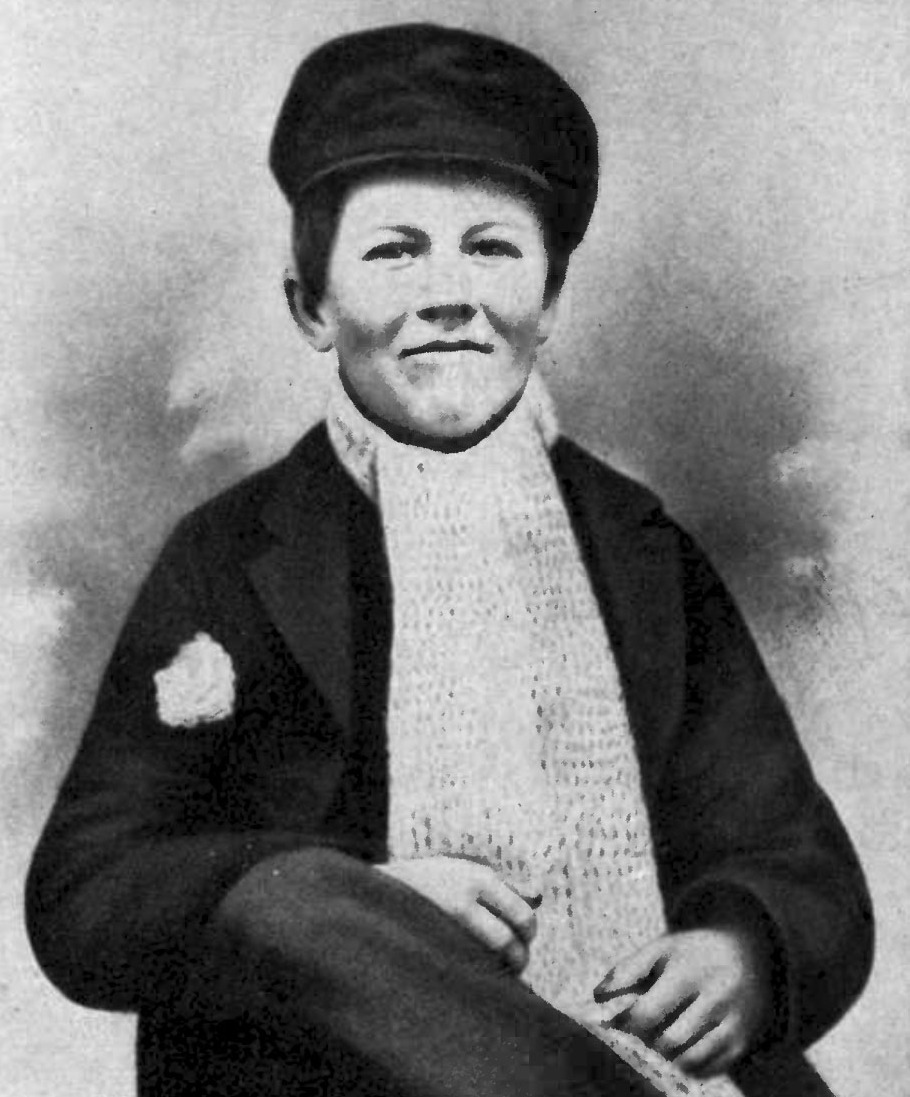
One week after his own death, Thomas Edison proved himself
once more to be an incredible inventor. Using a device he had worked on in
secret for a decade, his assistants were able to contact Edison beyond the
grave. An astounded crowd of press and socialites heard the first public words
sent via Spirit Phone, fittingly those of its own creator, “It is very
beautiful over here!”

Edison had managed a legendary career as an inventor and
businessman. After being fired from his telegraph job for an electric battery
experiment gone awry that destroyed his boss’s desk, Edison pursued his
passions in creating new devices, including the quadraplex telegraph (1874), a
phonograph (1877), an incandescent lightbulb (1879). Through the years, Edison
would collect over one thousand patents, many focusing on improving technology
and creating a new way of life for millions of people around the globe.
Toward the end of his own life, Edison became more
philosophical. He wrote a commentary entitled “Spiritualism,” analyzing facets
of the paranormal movement that had once more seized the public interest. While
skeptics like Harry Houdini worked to disprove frauds, Edison stated that he
did believe that “our personality hereafter will be able to affect matter.”
Echoing the laws of conservation of matter and energy, Edison held that “life
is undestructable.” He described a constant amount of “life units” on the
planet, which would be broken apart upon death and reshuffled as “swarms” that
made up aspects of every plant, animal, thought, and memory in the world.
Although Edison’s perceived seat of human personality in the
Broca’s Area of the brain proved to be questionable, the Spirit Phone did show
that souls lived on. Those who had recently passed away were contacted easily
enough for final farewells. Those who had died long ago, however, seemed to
have already been shuffled into absence. Teams of curious historians brought
the Spirit Phone to reportedly haunted castles and churches, competing to find
the oldest entity still able to communicate. Firsthand accounts from events
centuries before soon became readily available.
The Spirit Phone proved instrumental to police, who were
able to solve numerous murders simply by dialing up the victim for a statement.
Soon each major police station had its own Spirit Phone and trained operator to
summon potential witnesses. Prosecutors had more difficulty gaining convictions
in court as recordings were often questioned or thrown out altogether. Further
court matters arose when spirits sought to amend their wills and yet were
legally dead, thus not having property rights.
Religious figures denounced the Spirit Phone despite its
success in having past relatives use passwords or citing memories no one else
could know about. Counterarguments suggested that the phone was being tampered
with by demonic forces. Others held the phone as an ever more elaborate hoax. Edison
himself had been called an atheist for years, although he routinely described
his beliefs in the Supreme Intelligence.
In 1933, the newly deceased Fourteenth Dalai Lama of Tibet gave
a limited address via Spirit Phone to discourage its use. He stated that the
device prompted entities to remain tied to the mortal realm rather than passing
on to become one with eternity, which would tip the delicate balance of life
and death. Following the development of ghost-driven machines due to the need
for manpower in World War II, many living people began to agree with him,
although few would readily give up the Spirit Phone outright.
--
In reality, the invention is largely said to be myth,
especially by the Edison Estate, who claim to have not seen any evidence of
designs or prototypes in any of Edison’s work despite an interview in the
October 1920 issue of Forbes magazine
that he was working on such a device. Edison himself told the New York Times in 1926, “I really had
nothing to tell him, but I hated to disappoint him, so I thought up this story
about communicating with spirits, but it was all a joke.” Through the years,
many other electronic devices often nicknamed “ghost boxes” have claimed to be able
to communicate with the spirit realm. Skeptics remain unconvinced while
believers feel that the human spirit can indeed affect electromagnetic fields
and thus speak from beyond the grave.